A time of growing cruelty

In a recent post on her blog, Alice Walker writes about how the FBI has called Assata Shakur a terrorist. At one point in the post, Walker, being a poet, diverges from commentary on current events into a meditation on the prevalence of cruelty in the United States today:

“What is most distressing about the times we live in, in my view, is our ever accelerating tolerance for cruelty. Prisoners held indefinitely in orange suits, hooded, chained and on their knees. Like the hunger strikers of Guantanamo, I would certainly prefer death to this. People shot and bombed from planes they never see until it is too late to get up from the table or place the baby under the bed. Poor people terrorized daily, driven insane really, from fear. People on the streets with no food and no place to sleep. People under bridges everywhere you go, holding out their desperate signs: a recent one held by a very young man, perhaps a veteran, under my local bridge: I Want To Live….”

In recent months, I’ve been trying to understand why I feel there is something morally unsound in our society recently — and yes, I know that every era thinks their time is morally unsound. But every era does have its own particular moral unsoundness, and I think Walker is on to something: our time is a time when we are increasingly tolerant of cruelty, even amused by cruelty.

Why we still need OWL, part II

The school newspaper controversy in nearby Mountain View, which I reported on in this post, got picked up today by the San Jose Mercury News in an article written by Sharon Noguchi: “Mountain View High School newspaper’s sex stories raise parents’ ire”.

The Merc tries to remain objective, but they’re obviously on the side of the student journalists who dared to report on some of the realities of teen life today. In her news article, Noguchi writes: “But the debate also illustrates the gap between adult and teen conversation and mores.” As a columnist, Scott Herhold was able to state his opinion boldly: “A group of parents crawled from their caves to protest that the student journalists had taken things too far — that the stories promoted unprotected sex and imperiled futures. In truth, the articles in the Oracle, the student newspaper, were fairly tame….”

Herhold goes on to point out the heroes of the story, the people who protected the rights of student journalists, and who stood up for what was right instead of caving to intolerant parents and religious views: “The heroes were the administrators and educators who stood up for the paper, led by Superintendent Barry Groves. At the meeting, Groves praised the journalism department and said, ‘There’s nothing I would have taken down.'”

Residents of Los Altos and Mountain View might want to take a moment and write a note of support to Barry Groves. You can find his email address on the school district Web site.

Further reading: You can read the Oracle online here. The Los Altos Town Crier published my letter to the editor on this topic, under the title “Minister supports sex education for teens” (“Look, Mildred, those crazy Unitarians are at it again”), and for the sake of the record I’ll include the full text below the fold.

Continue reading “Why we still need OWL, part II”

UU kid on Obama’s Facebook page

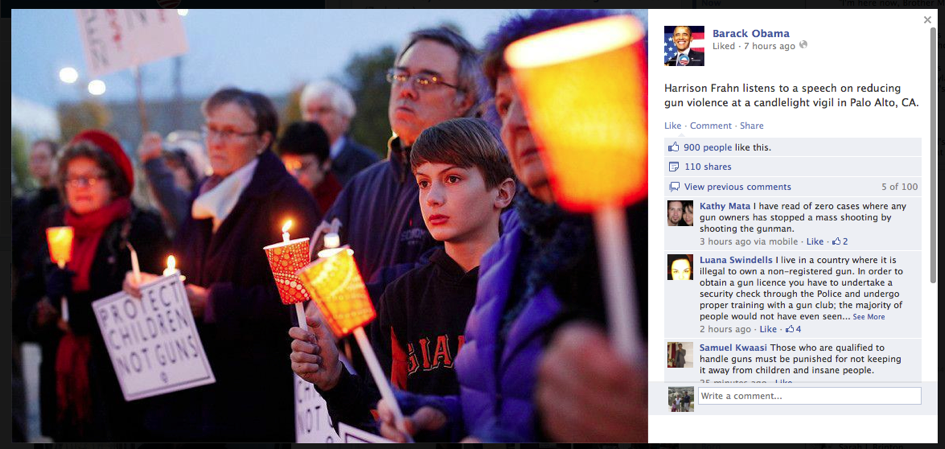
One of the middle schoolers from our congregation went to a gun control rally, and a photo with him in it appeared on Barack Obama’s Facebook page. How cool is that?

Obama's Facebook page

Click on the image above to see the caption inserted by Obama’s social media staff: “Harrison Frahn listens to a speech on reducing gun violence at a candlelight vigil in Palo Alto, CA.” I’m sure Obama never even saw this post; I’m sure Obama has forgotten the year or two he spent in a Unitarian Universalist Sunday school; I’m sure that Obama’s social media team merely posted this because it’s a good photo to further their political goals. Nevertheless, it’s really fun to see a UU kid recognized in this way — recognized for taking a public stand on something he cares about.

Quote of the month

From the article “Flea market capitalists: disaffected and disenchanted,” by Arthur E. Farnsely II:

“Disaffection is not going to be repaired by politicians, business leaders, or pastors trying harder. Over the decades the modern West has built a consumer society in which people get more personal choices and lifestyle freedom in exchange for a loss of community, tradition, and stability. We are still interdependent, of course, but the connections are complex, malleable, idiosyncratic.

“Some people still live in tight-kint communities; others are lucky enough to have the education and money needed to pursue their “lifestyles choices.” But the people at the bottom have limited choices, and some choose to be left alone. Flea market dealers are an extreme example of this segment, but poor and lower working class people all across America have tenuous relationships to the institutions of family, school, business, and government.

“A recent Pew study confirms the rising number of people who claim ‘no religious affiliation.’ People are also increasingly choosing ‘no political affiliation.’ (Many people who say they are politically independent reliably vote conservative or liberal, but this only proves the point — they have opinions but resist membership commitments.)”

— in Christian Century, 23 January 2013, p. 25.

If you want to adequately explain why people are choosing to have no religious affiliation, you have to take into account the effects of consumer capitalism on the way we perceive and live in the world. We expect to have choices these days, and institutions of any kind limit the kinds of choices we have come to expect as consumers.

The year in review, pt. 1

It has not been a great year in liberal religion.

In one ongoing negative trend, most Unitarian Universalists continue to act as though we are part the ruling elite in this country. Mind you, as recently as the 1950s, Unitarian Universalists actually could claim to be part of the ruling elite. Back then, Unitarians and Universalists were considered mainline Protestants, and the United States was run by mainline Protestants, for mainline Protestants. And while the Universalists were marginal at best by the mid-twentieth century, the Unitarians could claim to have some real influence. Most notably, A. Powell Davies preached to a congregation containing a number of high-level functionaries in the federal government, as well as a few elected officials; and the Washington newspapers supposedly held their Monday morning editions until they could get the text of his Sunday sermons. Also worth noting: Adlai Stevenson II, Democratic presidential nominee in 1952 and 1956, was a Unitarian, as were a number of other politically influential people.

Today, however, the mainline Protestant coalition that long dominated the United States is crumbling, and Unitarian Universalists have moved themselves out of, and been pushed out of, mainline Protestantism. As a result, politicians either don’t care about us, or they can dismiss us since we represent such a tiny minority (about half a percent of the total U.S. population). As a religion, we have no real power or influence.

Yet we continue to act as if we do have political influence. The most blatant example of that was the “Justice General Assembly” in June of this year. A few thousand Unitarian Universalists from across the country went down to Phoenix, Arizona, and protested unjust and discriminatory state law. Sheriff Joe Arapaho of Maricopa County used our presence to bolster his carefully cultivated image with his voters — here come these out-of-state leftist hippies, telling me what to do, but I’m standing up to them! — and I’m sure our interactions with him did nothing to weaken his political position; indeed, our presence in Phoenix probably strengthened his political position. As far as our influence on state politics, I could find no evidence that we were even noticed — OK, we made it into the local newspapers, but honestly who cares about newspapers any more? In short, we’re doing social justice as if it’s 1955. Justice GA made us feel good, but had little positive impact beyond that.

On the other hand, there are some Unitarian Universalists who have moved beyond social justice c. 1955. For example, I continue to be impressed with the organizing efforts of groups like the Unitarian Universalist Legislative Ministry of California (UULMC). But UULMC represents a quite different approach to influencing politics — UULMC is a separate nonprofit organization that employs ministers who are not serving a local congregation, as well as other staffers, to do organizing around specific legislative issues. UULMC can not only build coalitions with other advocacy groups, it can use the skills and abilities of ordained ministers to influence legislators, without those ministers having their time and attention divided between politics and a congregation.

This approach to influencing public policy is significantly different from the 1950s approach in which Unitarians assumed they were part of the ruling elite and deserved special access; it’s also very different from the 1960s model of protest politics, where the grounding assumption was to disrupt the ruling elite. Justice GA remained mired in the 1950s and 1960s — you have to pay attention to us because we’re important! and — we’re going to be angry protestors just like in the 1960s! UULMC have moved forward into the very different realities of the 2010s.

Tomorrow: The year in review continues, with thoughts on why UU ministry to children and youth sucks

Supreme Court will hear Prop 8 appeal

The Supreme Court has announced that it will hear the appeal regarding the lower court decision to strike down Proposition 8, which repealed same-sex marriage in California.

So there will be no free weddings at the Unitarian Universalist Church of Palo Alto — at least not until June, 2013, assuming the Supreme Court upholds the lower court’s ruling.

Free weddings in Palo Alto, if Prop 8 goes down!

If the Supreme Court declines to hear the appeal on the lower court’s ruling overturning Proposition 8, same-sex marriage will be legal again in California. And if that happens, the Unitarian Universalist Church of Palo Alto (www.uucpa.org) will offer free weddings for one day about a week after the Supreme Court announcement — we’re saying about a week afterwards, because it’s unclear how long it will take Santa Clara County clerks to issue marriage licenses. The deal goes for opposite-sex couples, too.

We can’t set a firm date yet, for obvious reasons. In the mean time, please help spread the word — if Prop 8 goes down, we’ll do free weddings for a day!

Election day

A beautiful sunny morning, with damp warm air. I walked the half a dozen blocks to the Congregational Church of San Mateo, noticing little shoots of green poking up everywhere, prompted to grow by the light rains a couple of weeks ago. A big sign outside the church said “VOTE HERE,” and there were smaller signs in Spanish and Chinese, presumably saying the same thing.

At the table for Precinct 2628, two people looked up my name and each of them carefully crossed my name out on their lists of registered voters. The next person at the table had me sign my name in a book, and then she gave me a receipt with an access code on it.

I walked over to the voting booths, and found an open booth between two occupied booths. I cast my votes for U.S. president, U.S. representative, state senator, member of the state assembly, member of the county board of supervisors, member of the county board of education, three members of the board of commissioners of the San Mateo County Harbor District. I also cast my vote for eleven state ballot initiatives and three county ballot initiatives. The only way I got through all those votes without my eyes glazing over was that I brought a sample ballot with me on which I had marked all my preferences. (Years ago, I would do all my research for voting in newspapers, and usually you couldn’t get much information about local candidates; now I can do all my research for local candidates online.) When I finished voting, the same people were still in the voting booths on either side of me, still working their way through all the votes they had to cast. Continue reading “Election day”

Indirect economic attrition

In his short story “The Upside Down Evolution” (c.1985 in Polish, 1986 in English), science fiction writer Stanislaw Lem claims to have read a military history of the world written in the twenty-first century, and used what he learned in his novels:

In 1967, I wrote a science fiction novel entitled His Master’s Voice (published in English in 1983 by Harcourt Brace Jovanovich). On page 125 of that edition, third line from the top, are the words “the ruling doctrine was … ‘indirect economic attrition’,” and then the doctrine is expressed in the aphorism, “The thin starve before the fat lose weight.”

The doctrine expressed publicly in the United States in 1980 — thirteen years after the original [Polish] version of His Master’s Voice — was put a little differently. (In the West German press they used the slogan “den Gegner totrüsten” — “arm the enemy to death.”)

The policy of indirect economic attrition has changed significantly with the fall of the Communist Bloc; nevertheless, it remains an effective foreign policy, one which will, no doubt, be followed by either major presidential candidate.

Kavita Ramdas on women’s rights and social entrepreneurship

Kavita Ramdas spoke beautifully and eloquently on the topic of women’s rights and social entrepreneurship. I meant to take comprehensive notes, but didn’t. Instead of comprehensive notes, here are some highlights of her talk:

— Kavita likes to broaden the definition of “social entrepreneur.” Typically, a “social entrepreneur” is someone who works in the social sector; that is, a risk-taking innovative social entrepreneur is more concerned with changing and improving culture and society than with making a profit. But she would like to broaden the definition to include social activists. To make her point, she pointed out that an activist like Gandhi was a risk-taking innovator who worked to change broader culture and society.

— She said that in the United States, we have made great progress in women’s rights. Even though we never managed to put the Equal Rights Amendment into the U.S. Constitution, women’s rights are enshrined in law. Compared to her home country, India, the U.S. has made great progress in women’s rights. However, there is another aspect to feminism, and that is allowing persons to have both feminine and masculine characteristics, and in this respect she feels India has done better than the U.S. Continue reading “Kavita Ramdas on women’s rights and social entrepreneurship”