REA: Religious literacy, bullying, and RE teaching

In the second breakout session of the Religious Education Association 2014 conference, I attended a combined colloquium. Wing Yu Alice Chan, a doctoral student at McGill University, presented work in progress under the title of “Can Religious Literacy Deter Religious Bullying?” Andrea Haith of Canterbury Christ Church University presented her work in progress under the title of “An Exploration of Religious Education Teachers’ Understandings of Religiously Inspired Violence and the Worldviews of Children in the Classroom.”

Chan presented a definition of religious literacy based on a definition by Diane Moore (2007), the ability to discuss and analyze the intersections o religion with society.

She next defined religious bullying as bullying on the basis of religious difference, including physical and psychological bullying, online bullying, etc. In a review of literature on religious bullying, she found research that indicates that religious bullying gets transmitted across generations. Furthermore, she found research that the aftereffects of religious bullying can lead to religious extremism.

At the moment, her research is focusing on two North American religious literacy programs in public schools: Quebec’s “Ethics and Religious Culture” program, and the “World Geography and World Religions” programs in modesto, California. These are the only two mandatory courses in religious literacy that she found in North America. In her research so far what is most prominent is the role of dialogue.

Her research methodology is outlined in her online prospectus here.

Andrea Haith is a teacher of religious education in the United Kingdom (U.K.). She began by saying that teaching religious education is extremely challenging, as the young people taking the courses “don’t see the point.” It is also challenging because “any discussion of Islam does evoke stereotypes.”

Haith said that the U.K. has complex legislation that implements religious education in the public schools. The challenge then is how to discuss religiously inspired violence within this framework. Her research focuses on the teaching of religiously inspired violence as it relates to religious education teaching more generally.

Her hypothesis is that religious education has become “sanitized,” in part because examination-focused learning outcomes may serve to distort the subject matter of religious education. Her research questions include:

— What is the nature of RE teacher’s understandings of religiously inspired violence?
— How are these understandings translated into teaching practice in the classrooms?
— Is there a relationship between teachers concepts of religiously inspired violence and their pedagogy?

Haith’s research project is outlined online here.

At the end of the two presentations, a questioner pointed out that a key issue is how we train teachers. Haith and Chan both agreed.

Another questioner pointed out that it is problematic to consider religious literacy out of any other context, and that religious literacy must be placed in a values-based context. Haith and Chan seemed less interested in this idea.

I asked a somewhat inarticulate question about the importance of students recognizing their own religious identity. Interestingly, in a later colloquium, I learned about the “worldview framework approach” in Mualla Selçuk and John Valk’s presentation “Journeying into Islam” (more on their research here); Selçuk and Valk’s worldview framework explicitly names religious identity as important.

I would say that I found both Haith and Chan’s research to be of great interest and importance. Chan’s research into the relationship between religious literacy and religious bullying could be especially valuable.

The day after election day

Yesterday, before I voted, I spent at least an hour doing some final research into the various candidates and ballot initiatives. The San Jose Mercury news and the San Francisco Chronicle had offered a reasonable amount of coverage of California ballot initiatives, and of the more prominent statewide elections. I already had most of the information I needed to cast my vote. Nevertheless, I went to the League of Women Voters (LWV) Web site to review information about those initiatives and candidates.

News media had offered very little coverage of county elections, like the contentious San Mateo Harbor District Commission elections, and very little coverage of minor state elections, like the elections for Board of Equalization Members. Again, the LWV Web site was invaluable — e.g., it pointed me to an online video of a LWV forum with most of the Harbor District Commission candidates.

In the end, I was able to make what I felt were reasonably informed decisions on most of the candidates and initiatives. But I also realized that I had not spent enough time really learning about the issues and candidates. I should have attended candidate forums for local elections. I should have spent more time learning about statewide elections. Democracy takes time, and I did not put in enough time. And these days, I think political advertisements are so full of lies and innuendo that each time you see or hear one should count as negative time spent on learning the issues — which means spending even more time actually learning about issues and candidates.

Today, I was reading Hannah Arendt’s On Revolution, and came across this quotation from Thomas Jefferson: “If once [our people] become inattentive to the public affairs, you and I, and Congress and Assemblies, Judges and Governors, shall all become wolves.”

Is that howling I hear in the distance?

BlogNov0514

P. G. Wodehouse on individualism

P. G. Wodehouse, a novelist of ideas? How absurd!

And it is true that most of his dozens of novels are bits of fluff, with no more intellectual content than the brain of Bertie Wooster, one of his most famous characters. But in some of his earlier novels, Wodehouse occasionally gets philosophical — as in this passage from the 1918 novel Picadilly Jim, where Jimmy, the wealthy twenty-something protagonist, comes to the sudden and unpleasant realization that he has been pretty self-centered for much of his adult life:

“…Life had suddenly taken on a less simple aspect. Dimly, for he was not accustomed to thinking along these lines, he perceived the numbing truth that we human beings are merely as many pieces in a jig-saw puzzle, and that our every movement affects the fortunes of some other piece. Just so, faintly at first and taking shape by degrees, must the germ of a civic spirit have come to prehistoric man. We are all individualists till we wake up.” [chapter 6]

Of course, Wodehouse was writing nearly a century ago. We have progressed further in the development of civic spirit since then: the jig-saw puzzles of the wealthy and the rest of the world are no longer connected to one another. If he were alive today, Jimmy could enjoy his wealth without having ever to wake up.

The other May Day

Around the world, except in the United States, May Day is International Workers Day. This is odd, because May Day commemorates something that happened in the United States.

On May 1, 1886, some 350,000 workers went out on strike across the U.S., although the strike was centered in Chicago, where 80,000 workers marched along Michigan Avenue. This May Day strike was the culmination of a movement to obtain an eight-hour day for workers. All the railroads that went into Chicago, the major rail center in the country, stopped running. Many industries through the U.S. were paralyzed.

Generally speaking, the May 1 strike was peaceful. But on May 3, there was violence at the McCormick Harvester plant in Chicago. The workers there had been shut out of the plant, and scabs brought in. The workers were holding a rally outside the plant when police charged them, shooting into the crowd and killing six.

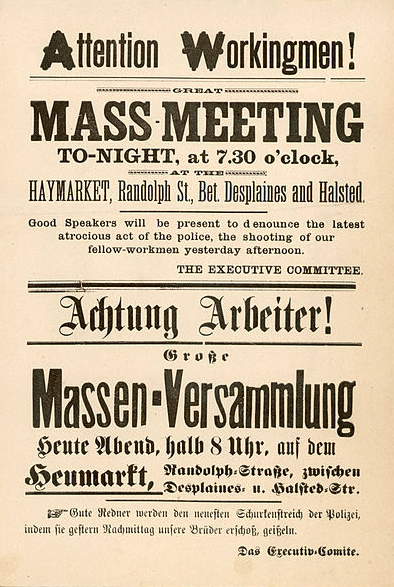
Bilingual 1886 May Day posterThe violence escalated the next day, May 4, at rally in Haymarket Square in Chicago, that was called to protest the violence at the McCormick plant. The mayor of Chicago attended the rally, and there were hours of peaceful speeches by labor leaders. Late in the evening, the police decided to march into Haymarket Square and order the crowd to peaceably disperse. The leaders of the rally pointed out that were already peaceful. At this point, someone threw a bomb. Later, the newspapers and the city government, all of whom had an anti-labor bias, claimed that the rally’s organizers must must be held responsible for the bombing, though there was no evidence linking them to it.

Eight organizers of the labor rally, although seven of them weren’t even present at the time of the riot, were arrested on charges of murder. Civic leaders and the newspapers whipped up public sentiment against the eight organizers. Since many of the workers involved were immigrants, much of the media’s ire was directed at “foreigners.” No one seems to have mentioned the fact that the police marched on a peaceful political assembly, something that is supposedly protected by the First Amendment of the U.S. Constitution.

All eight organizers of the rally were convicted, and seven of them were condemned to death. One of these last committed suicide in his cell, and three more were hanged. Almost a decade later, then-governor of Illinois John Peter Altgeld issued pardons for the four dead organizers and the three still living, saying “The proceedings lost all semblance of a fair trial.”

In the years after the 1886 events, May Day came to be celebrated internationally as a day to celebrate workers’ rights. We still don’t celebrate International Worker’s Day in the United States, but as you dance around the Maypole dances, or sing your Beltane carols, or as you attend the occasional May 1st rally for immigrants’ rights — it’s worth remembering the other May Day.

(N.B.: In the image of the poster announcing the rally in Haymarket Square, notice that it is bilingual, in German and English, reflecting the fact that many workers were immigrants.)

A possible case for teaching intelligent design

The philosopher Thomas Nagel, who declares himself an atheist, argued in a 2008 article in Philosophy and Public Affairs that intelligent design (ID) can not be dismissed as easily as young earth creationism. Yes, ID is very problematic, as Nagel knows:

“I understand the attitude that ID is just the latest manifestation of the fundamentalist threat, and that you have to stand and fight them here or you will end up having to fight for the right to teach evolution at all.” [Thomas Nagel, “Public Education and Intelligent Design,” Philosophy and Public Affairs, v. 36, no. 2, p. 203.]

However, Nagel says, both ID and scientific naturalism are grounded in worldviews that originate outside science. He then asks, Why is it OK to disallow one of these world views in public education, while allowing the other worldview? Speaking as an atheist, he says:

“I do not regard divine intervention as a possibility, even though I have no other candidates. Yet I recognize that this is because of an aspect of my overall worldview that does not rest on empirical grounds or any other kind of rational grounds. I do not think the existence of God can be disproved. So someone who can offer serious scientific reasons to doubt the adequacy of the theory of evolution, and who believes in God, in the same immediate way that I believe there is no god, can quite reasonably conclude that the hypothesis of design should be taken seriously.” [pp. 202-203]

Many political liberals will reject this notion out of hand, but Nagel makes a convincing argument that they should think more carefully about their rejection. It is worth reading the entire article, in order to follow Nagel’s careful and nuanced line of thought; the article is online here.

Oh, that explains it

I’ve been reading about the meltdown of the Mt. Gox bitcoin exchange in the mainstream media. It all sounds so Serious and Mysterious — Was it outside thieves or insider embezzlement? — What will this do to online finances? — And, whither the future of bitcoin and similar currencies?

It’s not serious or mysterious, it’s actually stupidity. Charlie Stross, science fiction author and former computer programmer, points out that “MtGox” stands for “Magic: the Gathering Online Exchange.” Then he goes on to add:

“C’mon, folks. Mt. Gox was a trading card swap mart set up by an amateur coder and implemented in PHP! And you expected NSA-levels of trusted computing security, so you trusted your money to it?”

Now that I know all this, the whole story just seems Sad and Sordid. A few Magic card freaks move into amateur banking. A bunch of credulous people trust way too much money to the Magic card freaks. As happens all too often in human affairs, stupidity bred disaster.

I think there’s theology in here somewhere: Something about the essential fallibility of humans. And (more importantly) something about the way humans need to pretend that stupid human mistakes are actually Serious and Mysterious.

The “New Mutualism”

Sara Horowitz, founder of the Freelancer’s Union (my union) and a winner of a MacArthur “genius grant” in 1999, defines the “New Mutualism” on her blog:

“Do It Ourselves — The people (the builders, the makers, the consumers) have to be in control. That could mean a worker-owned cooperative or maybe a membership organization. It’s not about venture capitalists funding the next fancy app and receiving all the profits. New Mutualism is about working together and a community reaping the benefit.

“Driven By a Social Mission — New Mutualist organizations are driven by a social good and serve a true need in their community. Their income makes them sustainable but isn’t their sole priority. They care about the greater good instead of fixating on profiteering.

“Do Together What You Can’t Do Alone — New mutualist groups draw their power from the strength of community and a feeling of solidarity, those spiritual and economic connections that make a group more powerful than any individual. A single freelancer might not be able to afford their own office space, but fifty freelancers working together can have a fantastic office that’s all the more powerful because of the like-minded individuals who built it.”

— The values behind Horowitz’s New Mutualism are not all that different from the values behind our liberal congregations: we, too, do it ourselves; we are driven by social mission; and we do together things that we could not do alone. Seems to me there are some striking similarities between our liberal congregations and the New Mutualism.

New Mutualism

REA 2013 conference: teaching religion and good citizenship

“We need to cross borders and join forces for a more humane world,” said Seibren Miedema in his President’s Address during the final plenary session of the 2013 Religious Education Association (REA) annual conference. Miedema is professor emeritus at Vrije Universiteit (Free University), Amersterdam, Netherlands, and president of the REA.

“Learning to work, to live, to play together should be possible,” he said, “and should start in early childhood.”

When Miedema was goring up in the Netherlands in the 1950s, the society was “pillarized”; that is, everyone living in a given Dutch town tended to belong to the same church. I happened to sit next to him during the pre-conference session, and he said then that he didn’t really encounter anyone from a different denomination (let alone a completely different faith tradition) until he was in his teens. In his President’s Address, he said that pillarization began to break down in the 1960s, as society changed rapidly and people of different faiths began engaging in, e.g., social justice work together.

Coming from that Dutch background, Miedema now believes that state-sponsored schools can and should play a crucial role in fostering inter-religious dialogue. He spoke about “the impact of the schools’ contribution, in terms of the selected subject matter and of the arrangement of pedagogical relations and situations by the professionals, on the personal identity formation of students.”

Miedema said he agrees with the position that the “binding role” of religion in society is of “utmost importance” and “should not be neglected.” This position is opposed to the official position in, e.g., France. Miedema reminded us that John Dewey, one of the intellectual founders of the REA, believed that schools should cultivate the religious side of children. Continue reading “REA 2013 conference: teaching religion and good citizenship”

REA 2013 conference: Walter Feinberg

Walter Feinberg spoke at the third plenary session of the 2013 Religious Education Association (REA) annual conference. Feinberg is interested in education for democratic citizenship, and has recently done research on the teaching of religion in public schools with Richard Layton. Feinberg and Layton have a new book out, For the Civic Good: The Liberal Case for Teaching Religion in the Public Schools, and Feinberg’s talk was based in part on this book.

Feinberg began by pointing out that it is constitutional to teach about religion in U.S. public schools. He cited Abington v. Schempp, a 1963 Supreme Court ruling which declared devotional reading from the Bible to be unconstitutional; but in its ruling the Court also stated: “One’s education is not complete without the study of comparative religion or the history of religion and its relationship to the advancement of civilization.”

Feinberg said that he advocates teaching about religion in the public schools because it is “preparation for the development of a civic public.” A “civic public” is “a group of strangers in communication with one another about a shared destiny.” Another way of putting this is that learning about religion, including other people’s religious traditions, is good preparation for citizenship. This is the only reason Feinberg accepts, and he rejected other reasons for teaching religion in the public schools, e.g., he rejected Stephen Prothero’s religious literacy argument, asking what makes religious literacy more special than musical illiteracy or economic illiteracy.

Emphasizing the need for excellent teachers if you’re going to teach about religion in the public schools, Feinberg added: “You have to watch out for charismatic, really bad teachers, they’re the worst kind.” Good teachers respect the individual beliefs of the students; and they are inclusive (i.e., they would never refer to the Hebrew Bible as the “Old Testament,” which is a Christian label that Jews don’t accept). A third minimum pedagogic requirement is that teachers “should not discourage reasonable student inquiry,” and ideally would encourage it.

He mentioned two specific kinds of courses he likes to see in the public schools. He likes courses that teach the Bible as literature, where the Bible is read as “one of our canonical texts.” He also likes courses about world religions, courses which can “make the strange familiar, and by so doing, make the familiar strange.”

And a good goal for public school courses about religion is to help students “learn to hold more than one interpretation in their head at a time, be aware of other interpretations.” Feinberg does not want to change students’ beliefs, but he does want them to learn to acknowledge their perspective may be different from other people’s perspectives. He gave the example of a Christian fundamentalist student who would learn that they should not say, “If you don’t believe in Christ, you’ll go to hell,” and instead learn to be able to say, “Based on my faith, the way you get in to heaven is to accept Christ.”

REA 2013 conference: video on religious diversity

Hannah Markus, a doctoral candidate based at the Protestant Theological Univeristy in Amsterdam, and the Driestar Educatief in Gouda, Netherlands, was moderator for the showing of a four-part Dutch documentary that touches on the topics of pluralism and religion. Markus showed us the first two in the series, and I was particularly interested in the second one:

Living in the cultural and economic behemoth that is the United States, it can be difficult to find non-U.S. perspectives. For that reason, I found it very useful to see a Dutch perspective on globalization and diversity; it gives me some new insight into these trans-national issues.