One of the sessions in the Our Whole Lives comprehensive sexuality education curriculum for grades 7-9 involves inviting a couple with a baby to visit the class. The couple tell the teens what it’s like to have a baby in the house. Topics that usually come up include parent sleep deprivation, the sense of tremendous responsibility, and of course how much work it takes.
With that in mind, here’s a poem by William King (1663-1712).
The Beggar Woman
A gentleman in hunting rode astray, More out of choice, than that he lost his way, He let his company the Hare pursue, For he himself had other game in view. A Beggar by her trade; yet not so mean, But that her cheeks were fresh, and linen clean. “Mistress,” quoth he, “and what if we two shou’d “Retire a little way into the wood?” She needed not much courtship to be kind, He ambles on before, she trots behind; For little Bobby, to her shoulders bound, Hinders the gentle dame from ridding ground. He often ask’d her to expose; but she Still fear’d the coming of his Company. Says she, “I know an unfrequented place, “To the left hand, where we our time may pass, “And the mean while your horse may find some grass.” Thither they come, and both the horse secure; Then thinks the Squire, I have the matter sure. She’s ask’d to sits: but then excuse is made, “Sitting,” says she, “’s not usual in my trade “Should you be rude, and then should throw me down, “I might perhaps break more backs than my own.” He smiling cries, “Come, I’ll the knot untie, And, if you mean the Child’s, we’ll lay it by.” Says she, “That can’t be done, for then ’twill cry. “I’d not have us, but chiefly for your sake, “Discover’d by the hideous noise ’twould make. “Use is another nature, and ’twould lack “More than the breast, its custom to the back.” “Then,” says the Gentleman, “I should be loth “To come so far and disoblige you both: “Were the child tied to me, d’ye think ’twould do?” “Mighty well, Sir! Oh, Lord! if tied to you!” With speed incredible to work she goes, And from her shoulders soon the burthen throws; Then mounts the infant with a gentle toss Upon her generous friend, and, like a cross, The sheet she with a dextrous motion winds, Till a firm knot the wandering fabrick binds. The Gentleman had scarce got time to know What she was doing; she about to go, Cries, “Sir, good b’ye; ben’t angry that we part, “I trust the child to you with all my heart: “But, ere you get another, ’ten’t amiss “To try a year or two how you’ll keep this.”
Now you can see why this poem reminded me of a sex ed lesson. The beggar woman just taught the gentleman that there’s more to sex than he knew.
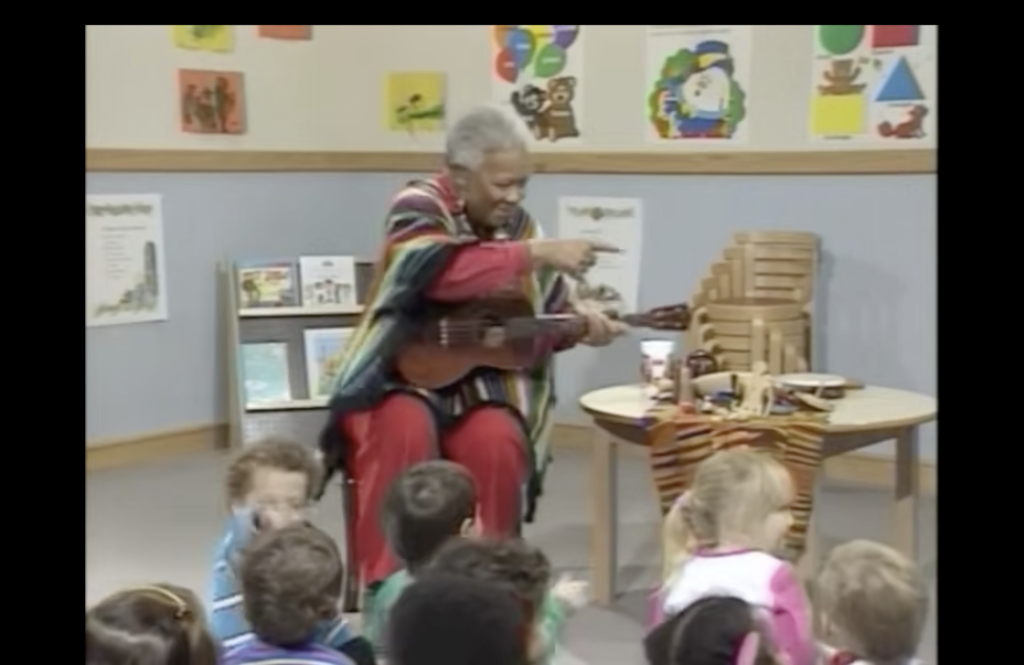
Today I got to listening to Ella Jenkins songs on Youtube. I was mostly curious how she used her ‘ukulele when she was singing with children.
But as I watched the few videos there are of her actually singing with kids, I began to appreciate how good she is working with children. She was especially good with preschoolers and early elementary grades. There’s a great photo on her website showing her sitting on the floor in the middle of a circle of young children leading a song. Of the 18 children visible in the photo, every single one appears engaged with the music — even the ones who are looking away are clapping along with the song.
Her music is also just right for young children. Her singing is understandable and straightforward, and she’s brilliant at using call-and-response techniques to get kids singing. Her skillful ukulele accompaniment is understated, so that it supports but never overwhelms the singing. Both the songs she has written, and the folks songs she has found, are prefect for singing along. Pretty much everything she does seems designed to get kids to sing along with her.
You can watch her in action in a video where she sings “Who Fed the Chickens” with another group of preschoolers. This is a call-and-response song with hand motions. Ella sings, “Who fed the chickens?” and the children respond with “I did,” or “she did,” or “they did,” or “we did,” while pointing at the appropriate person or group of people. Ella makes it all fun, and the children respond. It’s also worth noting that the video was recorded in 2012, when Ella was 88.
Ella Jenkins is pretty fabulous. Makes me want to play the baritone ukulele.
The Religious Education Association is holding an online talk this evening. One of the presenters will be on ecological board games:
“Paul H. Van Straten, Memorial University of Newfoundland: ‘Anticipating the Opportunities and Challenges of Using Commercial-off-the-Shelf Games to Educate People on Environmental Sustainability in a Christian Context.’ Some studies show that digital games and board games can be used to facilitate religious learning in Christian post-secondary settings. Would game-based learning be a viable option for educating Christians on environmental sustainability in a congregational church environment? This paper analyzes several commercially-available ecological digital games and board games to explore potential learning opportunities and challenges for integrating such games in a Christian small-group study environment.”
Although the paper will tell about games in Christian communities, I imagine the findings will be applicable to Unitarian Universalist communities as well (perhaps with some tweaking and language changes).
This is actually a topic that I’ve been working for some years now. I’ve used various ecological games in Unitarian Universalist religious education for children and teens since at least 2006. Recently, I’ve been working on ecology games for adults. To this end, I recently attended an online talk by Thomas Maiorana, professor of design at U.C. Davis, where he introduced a board game he’s developing that’s intended to promote wildfire resiliency in local communities. (You can watch a recording of the talk here.)
Local congregations and faith communities should be ideal settings for ecology board games. So I’m looking forward to tonight’s presentation, in hopes that I’ll learn about some new games, and more importantly learn about implementation strategies.
For the record, some of the ecology board games I’ve used in UU settings include:
Wildcraft: A Cooperative Herbal Adventure Game teaches players about some common wild herbs. It plays well with mixed age groups, and in my experience kids up through middle school have fun with it. At approx. $50, it’s expensive.
NOAA’s Carbon Cycle Game shows how burning fossil fuels affects the carbon cycle. You can play this as a tabletop game, or as a run-around game.
Family Pastimes publishes several board games with ecological themes. I’ve played three of their games — A Beautiful Place, Earthquake, and Dragonfly with young children, and all three were fun and well-designed. Better yet, they were inexpensive, just $12-15 each. (But these aren’t adult-friendly games.)
Promoting Wildfire Resilience. Thomas Maiorana hasn’t yet made the board game publicly available, but will do so soon on this website.
In addition, the following are run-around games, not board games, but worth playing:
Lynxes, Hares, and Leaves is an active run-around game I got from environmental educator Steve van Matre’s book Acclimatizing. I’ve played this successfully with mixed age groups including adults and kids. Here’s an old version of my adaptation of this game. Someday I’ll get around to posting my updated rules.
The Food Chain Game is another run-around game that I’ve played successfully with mixed age groups. This is my heavily adapted version of a game from the old Project WILD curriculum. Again, one of these days I’ll post my rules.
Other games I’m intrigued by, but haven’t yet played, include the following:
Carol and I are getting ready to cast our vote in the upcoming election. Early voting starts today at Cohasset Town Hall, and we wanted to be ready. So we sat in the kitchen and did some research on the candidates and the ballot questions.
We no longer have a real newspaper in Cohasset. There’s the Coastal Mariner, but it’s a typical Gannet local paper, with very little actual local news. There’s the online Cohasset Anchor, which has some good lifestyle stories but it’s not a place I’d look for hard news on local elections. As for the regional newspapers, the Quincy Patriot-Ledger used to be an OK source for local news, but it’s yet another Gannet paper where staff has been cut to the point where there’s not much local coverage any more. As for the Boston Globe, they pretty much ignore southeastern Massachusetts.
So we turned to the League of Women Voters for information about state and local elections. We went to https://www.vote411.org/ and entered our address. Up popped a list of every candidate for every race. We looked at the Massachusetts Information for Voters booklet, which is mailed to everyone in Massachusetts and contains comprehensive information about the five ballot measures we vote on this year.
In this post, while I’ll offer some opinions about the election, more importantly I’m going to reflect on democracy and the democratic process. And my first reflection is this — we hear a great deal about the presidential election, both in the news, on social media, and in face-to-face interactions. This emphasis on the presidential election makes it seem like we’re voting for emperor or king. But U.S. democracy encompasses far more than Harris vs. Trump (and before you complain, I listed those two candidates in alphabetical order). In fact, the overemphasis on the presidential election is harming our democracy. So let’s talk about all those other elections.
After I wrote this post, I walked over to Town Hall to cast my ballot…and got my sticker.
We started by looking at the candidates for the U.S. Senate. The League of Women Voters sends out these standard questions for all Senate candidates to answer:
Although I’m not a philosopher, I was trained in philosophy. So when I hear arguments, I tend to want to ask some questions about any given argument. What’s the origin of this argument — is it a perennial argument, or did it begin at some point in time? What’s the purpose of this argument? Since most arguments do not reduce to Boolean logic, what are some of the diverse positions taken in this argument?
Currently, there are arguments in pop culture about sex and gender. Pop culture usually reduces these arguments to a simple binary: traditionalists vs. progressives. But even a cursory examination shows that the so-called “progressive” camp includes a diversity of opinions.
Especially useful are the tidbits of intellectual history scattered through this essay. Take, for example, the origin of the current distinction between sex and gender, which dates only to the 1960s:
“…Psychologists writing on transsexuality were the first to employ gender terminology in this sense. Until the 1960s, ‘gender’ was often used to refer to masculine and feminine words, like le and la in French. However, in order to explain why some people felt that they were ‘trapped in the wrong bodies’, the psychologist Robert Stoller (1968) began using the terms ‘sex’ to pick out biological traits and ‘gender’ to pick out the amount of femininity and masculinity a person exhibited. Although (by and large) a person’s sex and gender complemented each other, separating out these terms seemed to make theoretical sense allowing Stoller to explain the phenomenon of transsexuality: transsexuals’ sex and gender simply don’t match. Along with psychologists like Stoller, feminists found it useful to distinguish sex and gender. This enabled them to argue that many differences between women and men were socially produced and, therefore, changeable….” [Section 1.2]
So “gender” is a relatively recent concept. But our concept of “sex” is also fairly recent:
“…Our concept of sex is said to be a product of social forces in the sense that what counts as sex is shaped by social meanings. Standardly [sic], those with XX-chromosomes, ovaries that produce large egg cells, female genitalia, a relatively high proportion of ‘female’ hormones, and other secondary sex characteristics (relatively small body size, less body hair) count as biologically female. Those with XY-chromosomes, testes that produce small sperm cells, male genitalia, a relatively high proportion of ‘male’ hormones and other secondary sex traits (relatively large body size, significant amounts of body hair) count as male. This understanding is fairly recent. The prevalent scientific view from Ancient Greeks until the late 18th century, did not consider female and male sexes to be distinct categories with specific traits; instead, a ‘one-sex model’ held that males and females were members of the same sex category. Females’ genitals were thought to be the same as males’ but simply directed inside the body; ovaries and testes (for instance) were referred to by the same term and whether the term referred to the former or the latter was made clear by the context…. It was not until the late 1700s that scientists began to think of female and male anatomies as radically different moving away from the ‘one-sex model’ of a single sex spectrum to the (nowadays prevalent) ‘two-sex model’ of sexual dimorphism.” [Section 3.2; emphasis is mine]
Thus, our current understanding of “biological sex” is not an ageless, universal concept. To use Theodore Parker’s terminology, “sex” and “gender,” then, are transient concepts rather than permanent concepts. All this is useful to know when someone tells you, with great sincerity, that a certain definition of “sex” or “gender” is the one true and correct definition. That may be true at this moment, but it was not necessarily true in the past, and it won’t necessarily be true in the future.
None of this should distract us from the very real injustices that stem from widely-held concepts of “sex” and “gender.” But this may helps explain why we humans seem to take such a long time to achieve justice. Remember what Parker said about justice:
“I do not pretend to understand the moral universe, the arc is a long one, my eye reaches but little ways. I cannot calculate the curve and complete the figure by the experience of sight; I can divine it by conscience. But from what I see I am sure it bends towards justice.”
Indeed, our eye reaches but a little ways along the arc of the moral universe. And nor can we yet “calculate the curve.”
Still recovering from a mild concussion. As the brain fog clears, I’ve been reading Dashiell Hammett, one of the great philosophical novelists of the early twentieth century. In an introduction to a collection of Hammett’s stories, Steven Marcus discusses the famous “Flitcraft parable,” contained in The Maltese Falcon, in which a man named Flitcraft is almost killed by a falling beam. His narrow escape from death causes Flitcraft to completely abandon his old life, but within five years he has settled down to almost exactly the same life, just in another city with another wife. Marcus writes:
“[The parable] is about among other things is the ethical irrationality of existence, the ethical unintelligibility of the world. For Flitcraft the falling beam ‘had taken the lid off life and let him look at the works.’ The works are that life is inscrutable, opaque, irresponsible, and arbitrary — that human existence does not correspond in its actuality to the way we live it. For most of us live as if existence itself were ordered, ethical, and rational. As a direct result of his realization in experience that it is not, Flitcraft leaves his wife4 and children and goes off. He acts irrationally and at random, in accordance with the nature of existence. When after a couple of years of wandering aimlessly about he decides to establish a new life, he simply reproduces the old one he had supposedly repudiated and abandoned; that is, he behaves again as if life were orderly, meaningful, and rational, and ‘adjusts’ to it…. Here we come upon the unfathomable and most mysteriously irrational part of it all — how despite everything we have learned and everything we know, [humans] will persist in behaving and trying to behave sanely, rationally, sensibly, and responsibly. And we will continue to persist even when we know that there is no logical or metaphysical, no discoverable or demonstrable reason for doing so…. The contradiction is not ethical alone; it is metaphysical as well….”
So, what’s the meaning of life according to Hammett? There isn’t any, except what you make.
Recently, I’ve had a number of conversations bemoaning the long slow decline of UU World magazine, the denominational magazine of the Unitarian Universalist Association. Ongoing budget cuts at the UUA have cut many departments, and UU World is no exception. In the past two decades, staff has been cut, print publication has dropped from six times a year to twice a year, and online publication is less frequent.
UU World may have hit its peak as a glossy publication in the 2000s. Chris Walton, one of the sharpest commentators on the UU scene, was on the editorial staff (Chris later became editor of the publication), while the editor-in-chief was Tom Stites, a long-time journalist who had been part of two Pulitzer Prize-winning teams. Chris started his own design business. But what happened to Tom Stites?
I happened to run across Tom Stites when I was researching an upcoming series of sermons on challenges to democracy. It turns out that Stites is now the president of the Banyan Project, a nonprofit organization working to create community new outlets based on a coop-ownership model. It’s an ambitious project — they’ve even designed a new software platform for community news outlets based on a coop model.
This is a super interesting project. The demise of local newspapers remains one of the biggest challenges to democracy in the United States today — just as the echo chambers of social media remain one of the biggest threats to democracy today. If you live in a local news desert, it’s very hard to learn what’s going on in local government, and very hard to make informed decisions as a voter and as a citizen. A coop model may not work for every news desert, but at this point we need as many options as possible — anything that can help to eradicate news deserts is A Good Thing.
Definitely worth taking a look at the Banyan Project website.
(Still recovering from a mild concussion…slowly emerging from brain fog….)
Twenty years ago, sociologist Mark Chaves demonstrated that one of the things that congregations are really good at is exposing people to the arts, especially music (Congregations in America, Harvard Univ. Press, 2004). In the course of studying everything that congregations are really good at, Chaves came to a rather surprising conclusion:
“If we ask what congregations mainly do, the answer is, in the first place, gather people for worship and religious education. But another answer is that, in their pursuit of worship and religious education, congregations generate as a by-product more artistic activity than either social services or political activity. Although many may wish it were otherwise, congregations facilitate art… more commonly and more intensively than they pursue either charity or justice.” [p. 201; emphasis mine]
I believe this remains true today. In fact, in my limited experience I’d say participating in music-making (as opposed to consuming music, or as opposed to other art forms) is what really hooks people in the UU congregations I’ve been part of. If you want to grow your congregation, and you have the choice between asking staff to spend more time on public acts of social justice, or asking staff to spend more time on nurturing the choir — go with nurturing the choir, every time.
Recently, though, I had a conversation with a UU who pointed out that many people feel intimidated by choir participation. This comment came from someone who is a fairly skilled amateur musician; they were not talking about themselves, they were making what I feel is an astute observation. And it tallies with my own observations. I remember leading some songs with a group of UU children a dozen years ago, and realizing that several of the children had never sung in a group before — we are a society that either consumes music, or performs music, but rarely makes music together.
“The amateur ukulele club scene is a kind of musical revival of participative music making, reminiscent of the sixties folk music and eighties rock band, with the ukulele as a self-accompanying instrument for singers and non-singers alike. The explosive growth of ukulele clubs and sales raises the question: how does the combination of a simple song sheet with no music symbol or notation and a small, lightweight four-stringed acoustic instrument provide sufficient material for group music making by performers who are not trained to read music or at all in music?….”
Ku documents how ‘ukulele clubs are evolving new ways of making music together, while drawing from a widely-known repertoire of popular music, and using online learning tools such as Youtube videos and lyrics websites.
So then of course I started searching for UU ukulele groups. I found them in: Ithaca, N.Y.; Eugene, Ore.; Salt Lake City; Dubuque, Iowa; Boca Raton, Fla.; Newark, Del.; and Raleigh, N.C.. No doubt there are others out there, but I was too lazy to continue my web search.
I’m not saying that your UU congregation should start a ‘ukulele group. But if we want to reverse the decline of Unitarian Universalism, I suspect we should all start thinking more about expanding the kinds of participative music making we nurture.
I took a sick day today (for a truly boring reason not worth going into). My main need was plenty of rest, so I did as little as possible. Since I’ve been getting increasingly serious about playing ‘ukulele, I decided to listen to a bunch of ukulele virtuosi. What follows are my notes to myself about what I’ve been listening to.
Jake Shimabukuro is perhaps the preeminent ‘ukulele virtuoso today. I’m in awe of his technical proficiency. However, his music doesn’t do much for me. I have to say the same thing about James Hill, who occupies the number two spot amongst ‘ukulele virtuosi — amazing skills, but I’m not much moved by his music. Taimane, who I think now edges Hill out for the number two spot, also dazzles me with her technical brilliance but once again her music just doesn’t do it for me.
Now on to some lesser-known ‘ukulele players who do move me with their music.
I first discovered Corey Fujimoto from his 2015 video of the Presto movement of Bach’s Sonata No. 1 in G minor (BWV 1001). His technical skills have only increased since then. He doesn’t appear to be recording much these days, butt he’s a regular on the Hawaii Music Supply ‘ukulele podcast, where he usually plays with Kalei Gamaio, another ukulele virtuoso. Here’s one of their recent recordings. In my opinion, Fujimoto is not only technically brilliant, but his musical sensibility is worth spending time with. His deep knowledge of classical, pop, rock, jazz, and traditional Hawai’ian musics comes together in something uniquely beautiful. He has a deeply humane musical sensibility.
Kalei Gamaio’s solo work is also well worth listening to. I think I first ran into his playing from this video of him jamming on Pachelbel’s Canon in D with Brittni Paiva and Sungha Jung (they really get going about a minute and a half in). Gamaio is probably best known for his own composition “The Unknown,” which has been covered by hundreds of aspiring ‘ukulele players. But I like him best when he plays jazz, as in this recording of “Autumn Leaves” with Neal Chin — or this recording of “Spain” with Chin and Andrew Molina. What I especially like about Gamaio is how well he listens to other players, and complements what they’re doing without overwhelming; he never shows off, but always uses his technical abilities in service of the music. For me, this kind of humility and sensitivity raises him above many other players.
Turning back to jazz and pop, Brittni Paiva is, in my opinion, underrated as a ‘ukulele player. Women are often ignored in the ukulele world, and of the women uke players Taimane Gardner seems to get the most attention. Paiva isn’t as flashy a player as Gardner, but her technique is so good she doesn’t need to be flashy. You see, Paiva doesn’t need to play a lot of notes because every note she plays is perfect, every note has a purpose, as in this recording. She’s also a multi-instrumentalist, and has issued albums where she played every instrument, and produced the album as well. Listen to her version of Dave Brubeck’s “Take Five.”
Fujimoto, Gamaio, and Paiva all come from Hawai’i, the home of the ‘ukulele. The other major hotspot for ‘ukulele players is Japan. I’m just beginning to learn about Japanese players — if you don’t speak Japanese (like me), it’s hard to find out about them. Fortunately, I just discovered the ‘Ukulele Japan website, an English-language site with links to a dozen of the top Japanese players. I’m still exploring this site, and learning about players like Kiyoshi Kobayashi, Iwao, and Tomoko Suzuki. Check out Suzuki’s version of Benny Goodman’s “Sing Sing,” which includes an amazing percussion break — sheer unadulterated fun
George Formby singing “When I’m Cleaning Windows”
Speaking of unadulterated fun, that brings me to the ‘ukulele player who inspired George Harrison, and indeed all the Beatles. That would be none other than George Formby. It’s easy to dismiss Formby’s humorous songs as dated, but there’s more than than you’d think. Maybe he’s not an impressive ‘ukulele soloist like Paiva, but his syncopated right-hand technique is world-class — as in this film performance of “When I’m Cleaning Windows.” And while his songs are goofy, there’s a kind of innocence and simplicity to them. He’s an Everyman ukulele virtuoso.
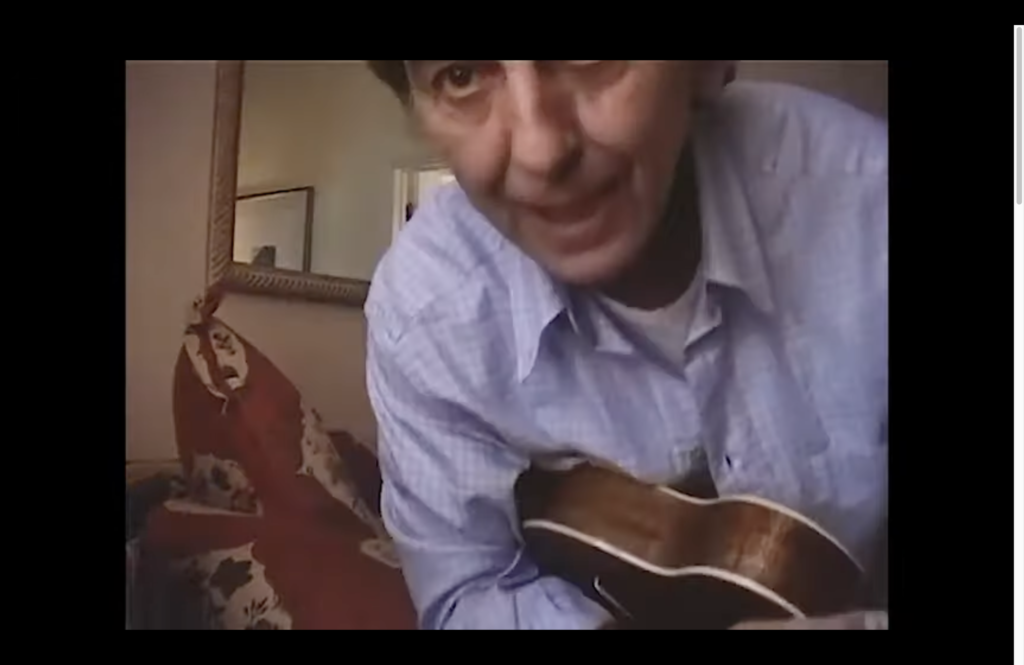
Which brings me to one final ‘ukulele virtusoso, George Harrison himself: here he is playing the ukulele not long before he died. Simple stuff, but so well done. It’s just about perfect. (And I do think I hear a little bit of Formby in Harrison’s playing.)
So what do I look for in a ‘ukulele player? Dazzling technique is ultimately empty, unless there’s some deep meaning behind it. The best music has to have — for want of a better word — humaneness.
And that’s what I did on my sick day: I listened for the humanity in the music.
Also, I left out Aunty Genoa Keawe, but that’s mostly because I couldn’t find good free videos of her online (she died in 2008). I love the way she accompanied her singing with her uke.
Our congregation’s Ecojustice Camp, a week-long summer camp, just finished its overnight. We left no trash ourselves, but we scoured our campsite for trash that might have been left by others. The campers carefully arranged the trash on a picnic table. Here’s a photo of all the trash we found: