Best new song of the season

OK, this song came out on Jennifer Cutting’s 2011 album “Song of Solstice,” so it’s not exactly new. But it’s new to me this year, and I think it’s the best new Yuletide song I’ve heard in a few years.

The song is called “Light the Winter’s Dark,” and below you can find my take on the lyrics, from the singing of Coope, Boyes, and Simpson, the English a capella trio who usually sing traditional tunes. Yeah, the lyrics are a little preachy, but most sacred song is a little preachy. I can’t find the song on Youtube, but you can hear a brief preview of the tune on the CD Universe Web site here; or there’s a longer preview at the iTunes store.

Get the choir in your Unitarian Universalist congregation to sing this song next year…

Continue reading “Best new song of the season”

Moral law

Wayne LaPierre, chief executive officer of the National Rifle Association, offered an interesting statement yesterday in response to the mass murders at the Sandy Hook Elementary School in Newtown, Connecticut, a statement that reveals a coherent moral outlook. According to a report in the New York Times, LaPierre said, “The only thing that stops a bad guy with a gun is a good guy with a gun.” He therefore proposed providing armed security guards in every school in the United States. The report goes on to quote LaPierre as saying

Now I can imagine the headlines — the shocking headlines you’ll print tomorrow…. More guns, you’ll claim, are the NRA’s answer to everything. Your implication will be that guns are evil and have no place in society, much less in our schools. But since when did the gun automatically become a bad word?

This is only a partial exposition of this particular moral outlook. Zane Grey, popular author of Western novels, gave a somewhat more complete exposition of this morla outlook in his 1912 novel Riders of the Purple Sage. Towards the end of the chapter titled “Faith and Unfaith,” the gunman Lassiter is explaining to the heroine Jane Withersteen why he must keep his guns:

“Blind — yes, an’ let me make it clear an’ simple to you,” Lassiter went on, his voice losing its tone of anger. “Take, for instance, that idea of yours last night when you wanted my guns. It was good an’ beautiful, an’ showed your heart — but — why, Jane, it was crazy. Mind I’m assumin’ that life to me is as sweet as to any other man. An’ to preserve that life is each man’s first an’ closest thought. Where would any man be on this border without guns? Where, especially, would Lassiter be? Well, I’d be under the sage with thousands of other men now livin’ an’ sure better men than me. Gun-packin’ in the West since the Civil War has growed into a kind of moral law. An’ out here on this border it’s the difference between a man an’ somethin’ not a man. Look what your takin’ Venters’s guns from him all but made him! Why, your churchmen carry guns. Tull has killed a man an’ drawed on others. Your Bishop has shot a half dozen men, an’ it wasn’t through prayers of his that they recovered. An’ to-day he’d have shot me if he’d been quick enough on the draw. Could I walk or ride down into Cottonwoods without my guns? This is a wild time, Jane Withersteen, this year of our Lord eighteen seventy- one.”

For the character Lassiter, to be a man (not “to be human,” but to be a man) means being able to protect yourself, and implicitly to be able to protect women and children. According to Lassiter’s character, the Civil War caused a kind of moral vacuum — the Civil War meant the destruction of a way of life, the triumph of Northern industrial might over the South’s emphasis on honor and duty. Even “churchmen” carry guns, and kill people, denying that Christianity can offer an alternative moral outlook that effectively competes with the moral outlook that requires a man to carry guns.

Packing a gun continues to be a “kind of moral law” in the United States today. I find it hard to name another moral law in U.S. society today that is as compelling to as many people as packing a gun. LaPierre knows that he isn’t going to convince those of us who hold to a different moral law; but he also knows that his moral law of packing a gun attracts more adherents than any other single moral law.

This clash between moral outlooks, between moral laws, is not going to be over in the near future. And at the moment, the moral law of packing a gun remains stronger than any other alternative.

Five words on what you like about this season

Wynne, chair of the board, asked us each to introduce ourselves by giving our names, our roles, and then by saying “five words about what you like about this season.”

Being Unitarian Universalists who like to talk, none of us kept to the five word limit. Except Louis, who said:

“After apocalypse, days get longer.”

Xmas jokes

I always need clean Christmas jokes, the kind of thing you can tell to a fifth grader. Philip came through for me in a big way this year. Below are some of the jokes he passed along to me. As the reindeer comedian said, These will sleigh you!

What do elves learn in school?
The elfabet.

How many letters in the elfabet?
Only twenty-five, because of Noel.

What do you get when you cross a snowman with a vampire?
Frostbite.

What do psychiatrists call someone who is afraid of Santa?
Claustrophobic.

Little boy: “Mom, can I have a dog for Christmas?”
Mother: “No, you’ll have turkey like everyone else in the family.”

Mother: “What’s the best thing to put into a Christmas cake?”
Little girl: “Your teeth.”

Little boy: “Teacher, what do you call Santa’s helpers?”
Teacher: “Subordinate Clauses.”

OK, that’s the last joke. You can stop groaning now.

Jingle Bells

So James Pierpont, the guy who wrote “Jingle Bells,” was a Unitarian, and worked as the music director at the Unitarian church in Savannah, Georgia, before the Civil War — and before that church has to close down because it leaned strongly Abolitionist. But “Jingle Bells” is not in any Unitarian Universalist hymnal. If you want to sing it during a Sunday service, here’s an arrangement laid out on a half-letter-size sheet, that you can stick into the typical order of service:

Jingle Bells (PDF)

(This arrangement is from an early edition of Pierpont’s sheet music, available online at the Library of Congress.)

Supreme Court will hear Prop 8 appeal

The Supreme Court has announced that it will hear the appeal regarding the lower court decision to strike down Proposition 8, which repealed same-sex marriage in California.

So there will be no free weddings at the Unitarian Universalist Church of Palo Alto — at least not until June, 2013, assuming the Supreme Court upholds the lower court’s ruling.

73 DE W1CUA

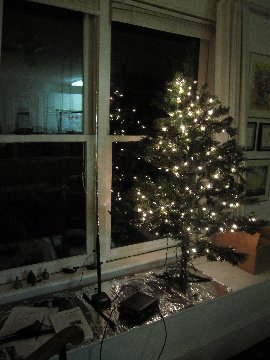
Here’s Dad’s Christmas tree:

This requires a bit of explanation. The aluminum foil under the tree is a nice Christmas-y touch, looking a little like ice and/or snow. But it’s also the ground plane for the vertical antenna for Dad’s 2 meter rig 40 meter rig — you can see the antenna sparkling in the lights just to the left of the tree.

This is about as cool as Christmas decorations can get.

Free weddings in Palo Alto, if Prop 8 goes down!

If the Supreme Court declines to hear the appeal on the lower court’s ruling overturning Proposition 8, same-sex marriage will be legal again in California. And if that happens, the Unitarian Universalist Church of Palo Alto (www.uucpa.org) will offer free weddings for one day about a week after the Supreme Court announcement — we’re saying about a week afterwards, because it’s unclear how long it will take Santa Clara County clerks to issue marriage licenses. The deal goes for opposite-sex couples, too.

We can’t set a firm date yet, for obvious reasons. In the mean time, please help spread the word — if Prop 8 goes down, we’ll do free weddings for a day!

Making labels

Yesterday, my friend Lewis came over to our apartment. Lewis is a luthier who makes (among other things) Celtic bouzoukis, and he wanted me to make some labels for them.

He brought a bouzouki to show me where the labels would go. I talked to him about light-fast pigments and archival papers, while for his part he told me about the instruments he makes:— His Celtic bouzoukis are beautiful instruments, and each one differs slightly in small details from the others — a slightly different bracing pattern, an inlaid piece of ebony inside the sound box with the number of the instrument. When you look at one of his bouzoukis, he wants you to know that it was made by hand, not by a machine. And he wanted each label to look hand-made, beautiful but with small imperfections.

So we sat at the kitchen table, eating home-made soup Lewis brought, and we made labels. I had some 100% rag vellum which I cut into 1-1/2 by 2-1/2 inch rectangles. Lewis signed each one using a magic marker with light-fat archival ink. I carefully wrote the serial number and “CELTIC BOUZOUKI / Oak. CA” under his signature, and then put a band of red watercolor paint along the top edge of the label. I don’t make many things like this any more; most of the things I make are text or photos or videos meant to go on Web sites, things you cannot touch. Real papers have different textures; they feel good under your fingers and hands, the pen moves over them in different ways, the ink soaks in or adheres to the surface differently. Paints are incredibly sensuous: the pigments finely ground into some luscious medium — linseed oil, gum arabic, casein, beeswax, whatever — and you dip a brush or knife into that vivid blob of color, and as you spread it the color changes as it interacts with whatever you’re painting, and you can smell it, and feel it when you use your fingers to smooth or blend.

The tools you use to make things have their own sensuality. To put the paint on the labels, I used a red sable watercolor brush, a gorgeous tiny little cluster of perfect animal hairs at the end of a delightfully balanced wooden handle. I remember one painting teacher, years ago, who used to insist a good watercolor brush should be as firm as a partially tumescent penis (yes, he was a man). The subject of art is always love or sex or death, but making things is all about sex, all about the act of creation. Creating things to be viewed on a screen is very satisfying — I love the way the completed image or text glows with that faintly blue light that comes out of your screen — but you can’t touch it or smell it while you’re making it. If making things is like sex, then making things for the screen is like reading about sex; it all happens in your mind and eyes, not in your body.

But the metaphor has overwhelmed the subject, because all I was doing was making labels. What amazes me is that the labels I made yesterday — cutting out a rectangle of paper, adding some lettering and a spot of color — will wind up inside musical instruments which are works of art and which may well outlive me. Far fewer people will see the labels I made than will see this blog post, but making the labels was far more satisfying.