Ho Hsien-ku

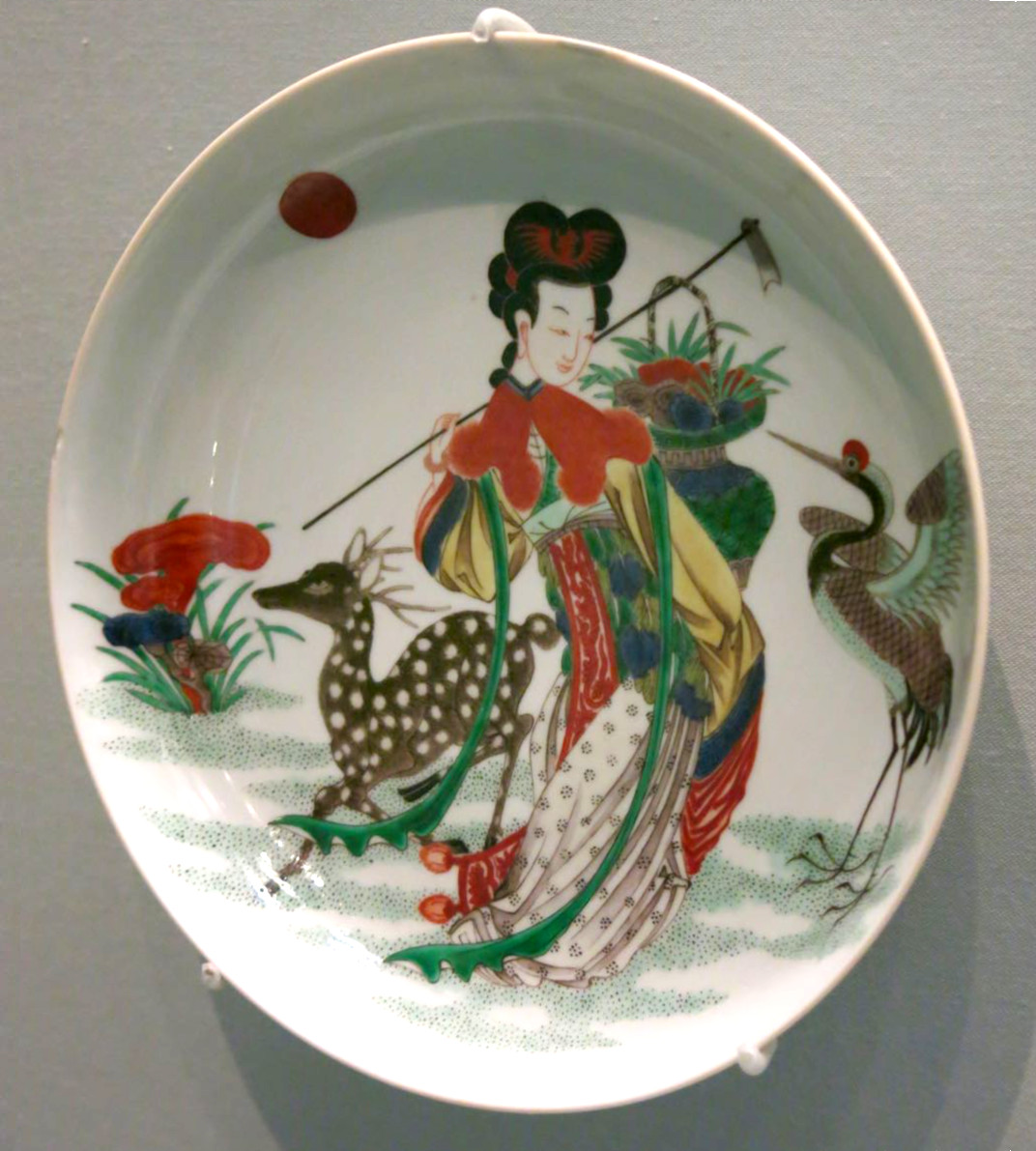
Ho Hsien-ku [Pinyin: He Xian’gu] is one of the Eight Taoist Immortals (Pa-hsien, Pinyin Baxian), and the only one who is unambiguously female. Six of the other Eight Immortals are definitely male, though at least one source (W. Perceval Yetts, “Eight Immortals,” p. 805) notes that Lan Ts’ai-ho may be depicted by artists as gender-ambiguous.

These Immortals began as humans, and transcended their humanity to become more than human. They could not be classed as either God or saint in the senses of those words used in the dominant Western religious traditions; but given their immortality and their powers, I would class them as deities. “The Eight Immortals are a group of seven men and one woman who are said to have attained immortality inspired by each other, and who continue to serve humanity by appearing in seances and inspirations” (Livia Kohn, Daoism and Chinese Culture, [Cambridge, Mass.: Three Pines Press, 2004], p. 164).

Below the photograph, I’ll append a brief biographical account of Ho Hsien-ku by W. Perceval Yetts, from “The Eight Immortals,” The Journal of the Royal Asiatic Society of Great Britain and Ireland, (London: 1916), pp. 781-783 (endotes are Yetts’ own notes).
Ho Hsien-ku

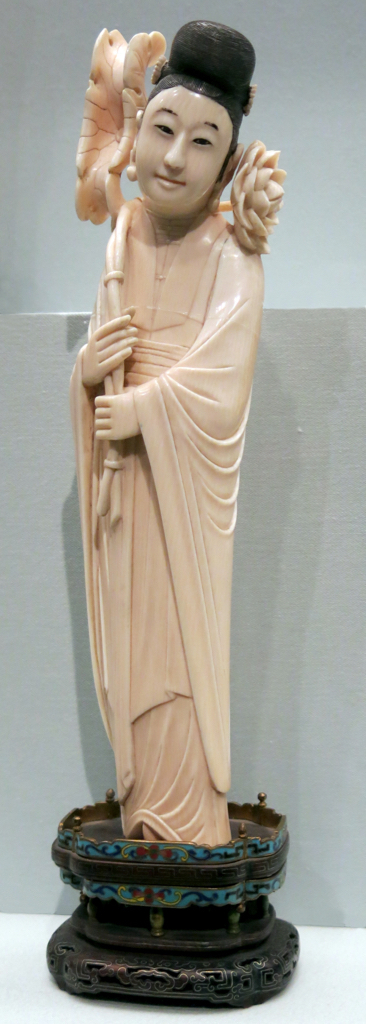
Above: Ho Hsien-ku with a lotus, an ivory sculpture made between 1850 and 1911 (Ch’ing Dynasty) at the Asian Art Museum (accession no. R2005.71.47).


“Ho Hsien-ku,” from “The Eight Immortals by Perceval Yetts:

Ho Hsien-ku is shown as a comely girl sometimes dressed in elaborate robes, but more often wearing over a simple garment the leafy cape and skirt affected by the hsien [English: enlightened one, immortal]. A large ladle is her recognized emblem. Its bowl, made of bamboo basketwork, is often filled with several objects associated with Taoist immortality, e.g., the magic fungus (1) and peach; (2) sprigs of bamboo and of pine; (3) and flowers of the narcissus. (4) The place of the ladle may be taken by the more picturesque long-stalked lotus bloom; and sometimes she holds just a fly-whisk or the basket of wild fruit and herbs gathered for her mother.

Biography from Lieh hsien chuan [Collected Biographies of Immortals by Lieh-hsien chuan], ii, 32, 33:

Ho Hsien-ku was the daughter of Ho T‘ai, of the town of Tsêng-ch‘êng, in the prefecture of Canton. At birth she had six long hairs on the crown of her head. When she was about 14 or 15 a divine personage appeared to her in a dream and instructed her to eat powdered mica, (5) in order that her body might become etherealized and immune from death. So she swallowed it, and also vowed to remain a virgin.

Up hill and down dale she used to flit just like a creature with wings. Every day at dawn she sallied forth, to return at dusk, bringing back mountain fruits she had gathered for her mother. Later on by slow degrees she gave up taking ordinary food. (6)

The Empress Wu (7) dispatched a messenger to summon her to attend at the palace, but on the way thither she [Ho Hsien-ku] disappeared. (8)

In the ching lung period (about A.D. 707) she ascended on high in broad daylight, (9) and became a hsien. In the ninth year of the t‘ien pao period (A.D. 750) Ho Hsien-ku reappeared, standing amidst rainbow clouds over a shrine dedicated to Ma Ku. Again, in the to li period (about A.D. 772) she appeared in the flesh on the Hsiao-shih Tower at Canton.

NOTES

[These are W. Perceval Yetts’s own notes.]

(1) This, the most ubiquitous object in Chinese art, has received various botanical names. (See Bretschneider, “Botanicum Sinicum,” Journal of the Chinese British Royal Asiatic Society, vol. xxv, p. 40, and vol. xxix, p. 418.) Its branches expand into flattened umbilicated extremities with scalloped edges. It is probably largely because of the resistance its wood-like substance offers to decay that it has been adopted as the emblem par excellence of immortality. There are records of its supernatural qualities having been recognized as early as the third century B.C. (see Chavannes, Les Mémoires historiques de Se-ma Ts’ien, vol. ii, p. 176 seq.), and to the present day it is sold by native apothecaries as a drug capable of prolonging life.

(2) Any representation of the magic peach is a covert allusion to that enigmatical figure, Hsi Wang Mu, the Queen of Taoist Fairyland. Among the wonders of her mountain domain was the tree that bore but once in 3,000 years peaches the taste of which gave immortality.

(3) Bamboo and pine, being evergreen, are emblems of longevity.

(4) The name the narcissus bears is sufficient reason why it should be included in this category.

(5) For the meaning of [what is here translated as “mica”]: see note by Dr. Laufer in T‘oung Pao, vol. xvi, p. 192. Perhaps a parallel may be found here between the alchemy of China and the West. Talc, a mineral often confused with mica, figures prominently in the writings of mediaeval alchemists, and as late as 1670 it was advocated as a mysterious preservative of youth and beauty by the Apothecary in Ordinary to the English Royal Honsehold, N. le Febure by name, in his Compleat Body of Chymistry, pt. ii, p. 106 seq.

(6) One of the first steps on the road to hsien-ship. Taoists are often said to have given up the ordinary diet of cereals. Some gradually reduce their food till they die of starvation. So emaciated is their condition that their bodies after death become mummified, and thus they do actually attain a kind of corporeal immortality. Particulars of this aspect of Chinese eschatology are to be found in an article by the writer in The Journal of the Royal Asiatic Society for July, 1911.

(7) The notorious woman who, through the possession of an extraordinary personality and a genius for intrigue, rose from obscurity to become the supreme ruler of China during the latter part of the seventh century. See Mayers, Chinese Reader’s Manual, pt. i, No. 862; and Giles, Biographical Dictionary, No. 2331.

(8) I.e., Ho Hsien-ku eluded the envoy. Chinese legend abounds in instances of summonses to Court being sent to hermit sages and others who had cut themselves off from worldly affairs. The recipients have almost invariably shown a consistent contempt for mundane honors by refusing to comply, and imperial curiosity as to their reputed wisdom or powers of magic has remained unsatisfied.

(9) The actual period of the day or night when emancipation from earthly ties takes place and the final stage in becoming a hsien is completed is considered in Taoist lore to have a determining influence upon the subsequent career of the hsien. See, for example, the following passage from the Chi hsien lu: “When (after death) the body remains like that of a living man, the condition is that of release from the flesh, shih chieh; when the legs do not become discolored nor the skin wrinkled — that is shih chieh; when the eyes remain bright and unsunken, in no respect differing from those of a living man — that is shih chieh; when resuscitation follows death — that is shih chieh; when the corpse vanishes before it is encoffined, and when the hair falls off before the mortal body soars (to heaven) — both of these are shih chieh. Most perfect is the release that takes place in broad daylight, but less complete is the release that occurs at midnight. When it takes place at dawn or at dusk, then the persons concerned are relegated to a terrestrial abode” (i.e. they will not reach the celestial paradise, but remain in haunts of the hsien on earth, such as the K’un-lun Mountains, the Isles of the Blest, and the Five Sacred Hills).
HeXiangu2

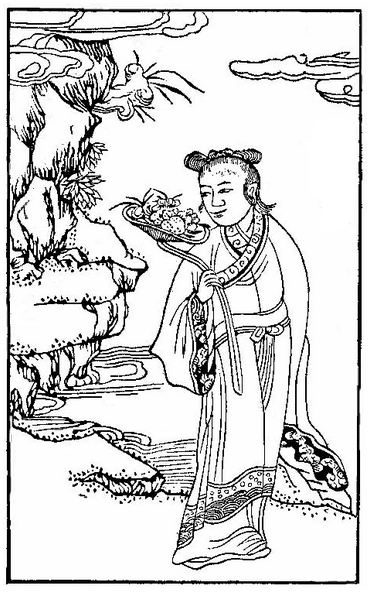
Above: Drawing of Ho Hsien-ku in Yetts, p. 781 (public domain image).

Going from “Oops” to “Yay!”

My denomination recently did an excellent redesign of their Web site, making it completely responsive and easy to view on tablets and smartphones.

My denomination then updated the denominational bylaws so they are now only available as a PDF. Which means the bylaws are now neither responsive nor easy to view on tablets or smartphones.

Improve a Web site. Yay!

Then break it. Oops.

This is why it is essential to have processes in place to continually monitor a Web site’s usability. Because it is way too easy to do something stupid that breaks the functionality of even a modestly complex Web site (he says, speaking from personal experience). And because when you go from “Yay!” to Oops,” you need to be able to get back to “Yay!” as quickly as possible.

Ahura Mazda

BlogOct3015

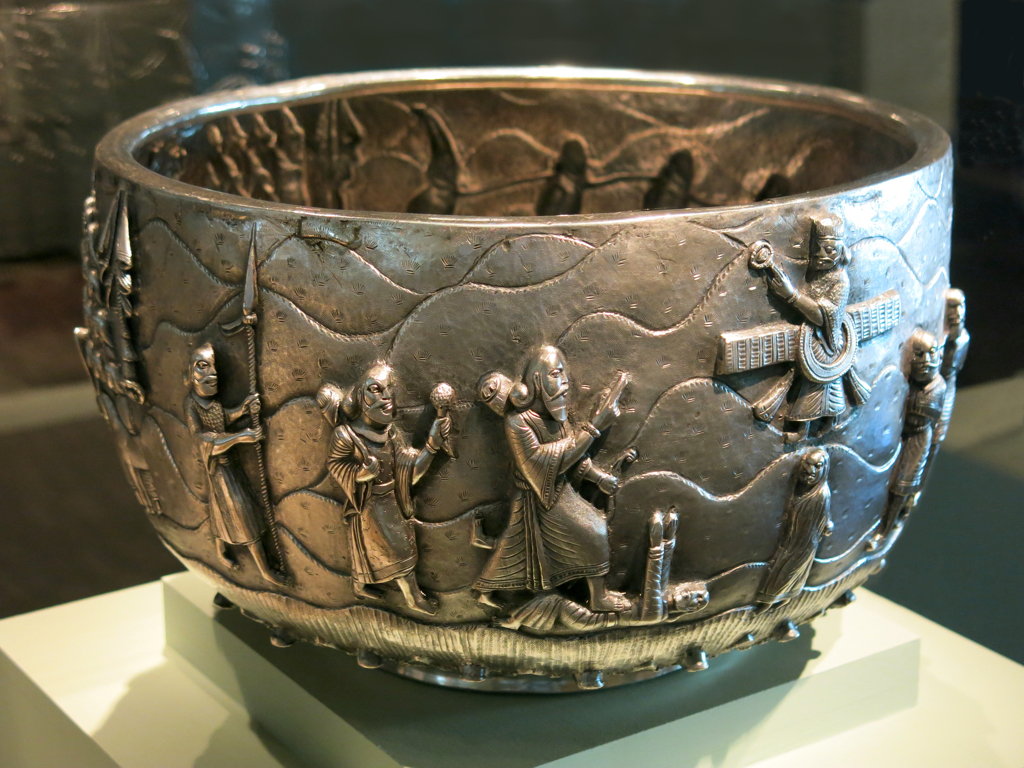
The supreme deity of the Zoroastrian faith, known as Ahura Mazda, is represented on this ceremonial bowl as a winged disk, at upper right in the photo. The bowl depicts the victory of the Zoroastrian Emperor Darius (550-486 BCE), with Ahura Mazda appearing as a presence near and above the emperor. The bowl was made in Burma in the last quarter of the nineteenth century, and is now at the Asian Art Museum in San Francisco (accession no. 2009.25).

Zoroastrianism is the oldest extant monotheistic religion. According to the Pluralism Project: “The one supreme and infinite God — Ahura Mazda — cannot be fully understood by humanity, [but] six attributes of Ahura Mazda were revealed to Zarathushtra. Known as the Amesha Spentas, they include Vohu Mana, the Good Mind; Asha, the divine law of righteousness, justice, and truth; Kshathra, the majesty and power of good dominion; Armaity, Ahura Mazda’s love and benevolent devotion; Haurvatat, well-being and perfection; and Ameratat, immortality. Humans must strive, both through reason and action, to emulate these attributes of God to live a good life.”

Christmas and Hallowe’en with P.D.Q Bach

It is a rare song that’s appropriate at both Christmas and Hallowe’en season, but the much-beloved “Good King Kong Looked Out” (from A Consort of Christmas Carols by P.D.Q. Bach [1807-1742]) is one such carol. The thought of good King K. squinching through the snow made me want to illustrate this traditional carol, using much-modified public domain images….

Good King Kong Looked Out

William R. Jones writing retreat

Hassahan Batts writes: “Practitioners Research and Scholarship Institute (www.prasi.org) is having another writing retreat where we are bringing together students of Dr. Jones in Allentown, Pennsylvania. If interested please email justequality@yahoo.com .”

No date given, so if you’re interested I’d suggest writing to the above email address right away.

A what?

When we were kids, we often heard my father talk about the diamond supported helix. We had no idea what a diamond supported helix was, except that it was something that went into a traveling wave tube, which is a type of microwave power tube. Of course we also had no idea what a traveling wave tube was, or what a microwave power tube was.

Since then, I learned that Dad did some of the pioneering research in diamond supported helices, and I’ve had enough coursework in physics to understand that this is something to do with electron optics. But I never knew what a diamond supported helix looked like. Today, my younger sister and I were looking through Dad’s files, and we actually found a photograph of a diamond supported helix. It was nothing like I imagined it. But it is actually quite a beautiful piece of technology:

Detail of a diamond supported helix

Look at all that copper, presumably to suck heat out. Guess I have to bring that photo along when we go visit Dad tomorrow; he’ll get a kick out of seeing it.

Personal computer, c. 1983

My sister and I are doing some organizing in our father’s condo. Dad’s a retired electrical engineer who saved almost everything, and he has several decades worth of electrical gear. Including this:

Sharp PC-1500 Pocket Computer

It’s a Sharp PC-1500 Pocket Computer, which apparently ran the same operating system as the famous Radio Shack TRS-80 computer. What you’re seeing above is the computer nested in its docking station, which has a little printer built into it. For memory, you hitched up a cassette player, and at top left there’s a special computer memory cassette. There are several boxes of software — not sure how that worked — plus a keyboard overlay (on the ground in front of the computer) which goes with one of the software packages.

Abby remembers this computer well, because Dad had a biorhythms program that fascinated her.

Religion in the public square

In the United States, all too often the phrase “religion in the public square” means someone accosting you and telling you that you should join their religion; so the meaning of the phrase becomes, “our religion is right and yours is wrong.” Or that same phrase can be used pejoratively to imply that all religious practice shouldb e kept out of public view; so the meaning of the phrase becomes, “all religion is wrong.” Either way, someone is imposing their own views on the rest of a democratic society.

But if ours is a truly multicultural democracy, we should allow space in the public square for a variety of worldviews, without letting any one worldview dominance over the others. This becomes a delicate balancing act. Literal or metaphorical shouting matches between religious worldviews don’t promote tolerance; mind you, sometimes you have to get into shouting matches to preserve the openness of the public square, as when we have to fight to limit Christmas displays on public property, but no one imagines that these shouting matches increase tolerance. So given that public religious expression is a delicate balancing act, what does it look like when you have an appropriate expression of a religious worldview in the public square?

Sukkah at the JLISF, Columbus and Lombard, San Francisco

Today I saw such an expression of a religious worldview in the public square, and it looked like a rented flatbed trailer with a sukkah built on top of it. The trailer was parked in front of the Jewish Learning Institute of San Francisco (JLISF), on Lombard Ave. right off busy Columbus Ave in the North Beach neighborhood. Carol and I walked by just as some people from JLISF were cleaning up from lunch. They were polite and friendly, and ready to explain that they were celebrating Sukkot, and what a sukkah was, and so on.

This is a good display of religion in the public square: present, but not intrusive; with friendly people who are ready to explain, but not berate.

Sukkah through a bus window

(Posted the next day, and backdated.)

Go to a bookstore

It’s the last day of Banned Books Week 2015. Local bookstores are often on the front lines of fighting local book bans. (And while I rely on the big behemoth booksellers, face-to-face bookstores can be centers of cultural resistance in a way that chain bookstores and online booksellers will never be.) With that in mind, I dug up some bookmarks from some of my favorite local bookstores:

Bookmarks

Kuan yin

Kuan yin (in Pinyin, Guanyin) is a deity with multiple identities, including multiple gender identities. According to the Lotus Sutra, the Buddha said, “If living beings in this land must be saved by means of someone in the body of a Buddha, Guanshiyin Bodhisattva will manifest in the body of a Buddha and speak Dharma for them.” And if someone needs to be saved by this boddhisattva, Guanshiyin, who is also known as Guanyin or Avalokiteshvara, will manifest him/herself in whatever form works best:

“If they must be saved by someone in the body of the wife of an Elder, a layman, a minister of state, or a Brahman, he [sic] will manifest in a wife’s body and speak Dharma for them. If they must be saved by someone in the body of a pure youth or pure maiden, he will manifest in the body of a pure youth or pure maiden and speak Dharma for them. If they must be saved by someone in the body of a heavenly dragon, yaksha, gandharva, asura, garuda, kinnara, mahoraga, human or non-human, and so forth, he will manifest in such a body and speak Dharma for them.” [trans. from City of Ten Thousand Buddhas Web site

Guanyin2

Above: “The Boddhisattva Avalokiteshvara (Chinese: Guanyin), 1300-1400 CE,” Asian Art Museum, catalog no. B61S37+

Guanyin also became a Daoist deity, a female immortal; one can chant a spell to the Daoist Guanyin “whereby one will accomplish unimaginable virtues, and give evidence to the penetration of the absolute.” (Guanyin mizhou tu)

Guanyin

Above: A Daoist Guanyin, adapted from Henrik Sorenson’s article “Looting the Pantheon.”

“The increasing Daoist appropriation and transformation of the Avalokiteshvara cult and the associated teachings which took place during the later imperial period, is also reflected in the mid-Qing work, the Guanyin xin jing bijue (‘Secret Explanation on the Heart Scripture of Avalokiteshvara’). This text, which to all appearances and purposes appears to be a Buddhist commentary on the Prajnaparamitahrdaya sutra, one of the most important and popular Buddhist scriptures in China, on closer examination turns out to be a Daoist commentary on the Buddhist sutra. In addition to its full-scale doctrinal modification, it casts Avalokiteshvara in the role as a female immortal (nuxian) from the Zhou dynasty (1122–255 BCE). … the level of appropriation [of Buddhist deities by Daoism] could, and often did, go well beyond superficial borrowing, ending with something akin to full-scale integration.”

— Henrik H. Sørensen, “Looting the Pantheon: On the Daoist Appropriation of Buddhist Divinities and Saints,” The electronic Journal of East and Central Asian Religions, vol. 1 (Edinburgh: Asian Studies at the University of Edinburgh, 2013), p. 62.