Naomi Klein: The Democrats done it

In an opinion piece in The Guardian, Naomi Klein gives her analysus of why Trump won the presidential election: Kalein puts the blame squarely on the Democratic party, who embraced neo-liberalism:

“Under neoliberal policies of deregulation, privatisation, austerity and corporate trade, their living standards have declined precipitously. They have lost jobs. They have lost pensions. They have lost much of the safety net that used to make these losses less frightening. They see a future for their kids even worse than their precarious present.

“At the same time, they have witnessed the rise of the Davos class, a hyper-connected network of banking and tech billionaires, elected leaders who are awfully cosy with those interests, and Hollywood celebrities who make the whole thing seem unbearably glamorous. Success is a party to which they were not invited, and they know in their hearts that this rising wealth and power is somehow directly connected to their growing debts and powerlessness.”

I think Klein is on to something here. When you realize that a moderate like Bernie Sanders looks like a socialist to most Americans, you realize just how far to the right the Democratic Party has gone. Klein notes that the neo-liberalism embraced by the Democrats has not provided much in the way of benefits to a lot of people.

And Klein offers a way forward:

“People have a right to be angry, and a powerful, intersectional left agenda can direct that anger where it belongs, while fighting for holistic solutions that will bring a frayed society together. Such a coalition is possible. In Canada, we have begun to cobble it together under the banner of a people’s agenda called The Leap Manifesto, endorsed by more than 220 organisations from Greenpeace Canada to Black Lives Matter Toronto, and some of our largest trade unions.”

So I looked up The Leap Manifesto referenced by Klein. It’s not perfect, it’s obviously targeted at Canadians — but it’s pretty good.

Something like the Leap Manifesto written by and for progressive U.S. residents would be a great place for us to start rebuilding democracy here in the U.S.

“All you, to whom adversity has dealt a final blow”

As we think about the the necessity of rebuilding a foundering democracy, a democracy currently dominated by rancor and hate, I can’t help thinking about one of my favorite songs for activists.

Back on December 24, 2008, I wrote about how this song literally saved someone’s life; and how it is a song that could serve as a non-theistic anthem. But I recently found a Youtube video of Liam Clancy singing this song — Clancy was best known for his rendition of the anti-war song “And the Band Played Waltzing Matilda” — and perhaps what he says is the best possible introduction to the song:

“I think it was Bertolt Brecht [says Clancy] who said one time, ‘With a man’s dying breath, he should be prepared to make a fresh start.’ That’s what this next song is about, although it’s supposedly about a ship that went down in the sixties, a ship called the ‘Mary Ellen Carter.’ There’s a lovely last verse to it which is the moral of the whole thing. And it’s a verse that I will tell you because, like myself, you may get solace from it on occasions of tragedy… It says:

“‘All you, to whom adversity has dealt a final blow,
With smiling bastards lying to you, everywhere you go,
Turn to, and put out all your strength of arm and heart and brain,
And like the Mary Ellen Carter, rise again.

“‘Rise again, rise again,
Though your heart may be broken and your life about to end,
No matter what you’ve lost, be it a home, a love, a friend,
Like the Mary Ellen Carter, rise again.'”

And in a later post, I’ll write about some of the ways we can make democracy rise again.


Video still of Liam Clancy speaking

Above: Liam Clancy saying, “Rise again”; video still from “The Mary Ellen Carter” as sung by Clancy (click on the photo for Clancy’s rendition of the song).

Or to hear a video that first tells how the song saved Robert Cusik’s life, and then to hear Stan Rogers himself singing the song (Rogers starts singing at 1:35), click here.

Hooray for the rule of law

Speaking as a religious leftist, here’s a brief word to my liberal friends about the rule of law.

We just had an emotionally and politically divisive election. Yet the rule of law has held out: we will all quibble about the details, but while the election may not have lived up to many people’s ideals for a fair election, for the most part the election was fair. And then I think back to Massachusetts politics, where for many years the president of the state senate had close ties to organized crime, and where politics was very dirty and very personal (see: Dick Lehr and Gerard O’Neill, Black Mass: Whitey Bulger, The FBI, and a Devil’s Deal, New York: Public Affiars, 2000) — and Rhode Island politics, where it was rumored that half the state legislature had Mob ties, and where the governor was convicted of blatantly illegal activities. By those standards, the recent presidential election looked like a Sunday school outing.

Actually, having supervised some pretty unpleasant Sunday school outings, maybe I should change that analogy.

Bad analogy aside, the point is that for the most part the existing laws and court opinions held sway. You may have preferred it if there were different laws on the books, and different court opinions (I certainly would prefer that), but for the most part, the rule of law has held.

So this is not an apocalyptic scenario. Carol and I read to each other at night, and right now we’re reading “A War in 1935” by Evelyn Waugh, from When the Going Was Good (Penguin Books, 1946/1976), in which he describes the Italian invasion of what was then Abyssinia; that situation represented a breakdown of the rule of law, and was mildly apocalyptic. I’m also reading (on my own), the Letters of Pliny the Younger, in which he describes some of the truly horrible events during the reign of the emperor Domitian, a reign during which people could be put to death on mere suspicion of an unpleasant thought about the emperor. And then, look at the coverage from Syria: that really is an apocalyptic scenario, in which the rule of law has completely broken down.

I don’t like the results of the recent presidential election, but at this point I prefer it over the 1972 presidential election, when, under the direct leadership of Richard Nixon, the rule of law did break down. Or consider the Teapot Dome scandal during Warren Harding’s presidential administration. Or Franklin Roosevelt’s attempt to pack the Supreme Court in order to get the rulings he preferred. Or, for that matter, the breakdown of the rule of law detailed by Michelle Alexander in The New Jim Crow.

So far, the rule of law is holding out pretty well. I would prefer that some of the current laws on the books were different, but in my case that mostly means that I need to get off my ass and stop working too many hours at my job and do my duty as a citizen of a democracy and get involved in elections and legislation. Nor do I have any illusions that the rule of law can be taken for granted; this again means, in my case, that I need to get off my ass and do my duty as a citizen of a democracy by attending city and county meetings, getting involved in voluntary organizations that amplify my solo voice (this, by the way, includes involvement in a local UU congregation).

If I don’t like the results of an election, then I need to stop spending time in the echo chamber of social media, stop anesthetizing myself by watching too many Youtube videos, and actually go out and do something.

That’s my two cent’s worth. Your mileage may vary.

No lines, plenty of angst

Carol and I just voted. No lines, no waiting. No anxiety — at least, no anxiety in the voting process itself.

Photo of my "I Voted" sticker

Today’s Daily Journal, our local freebie newspaper, reports that the Good Shepherd Episcopal Church in Belmont, Calif., is hosting a “stress-free zone” this evening — a place where you can go and not talk about politics, and not look at media. Rev. Michael Arase-Barhau of the church suggests people bring knitting, a book to read, adult coloring books, whatever.

Carol and I have a different destination in mind: we’ll be going to sing Sacred Harp music at Inder’s house in Oakland. And last night, we went to our congregation for a song circle organized by VJ, in the spirit of election eve song circles (the difference was that ours allowed any gender to participate). I don’t do adult coloring books (maybe I should), but singing works for me as a way to reduce anxiety.

It’s not just the presidential election. Here in Silicon Valley, we have a number of local ballot initiatives for rent stabilization measures. These initiatives are proving to be divisive. In our congregation, we have people on both sides of the rent stabilization issue, and while there isn’t any visible rancor, there are definitely some people who know not to talk local politics with each other.

Maybe this is the biggest problem. Here in the U.S., we lack skills in talking about disagreement. You either agree with someone, or you refuse to talk with them. You don’t like Hillary Clinton? then you won’t talk to a Clinton supporter. You don’t believe in God? then you’ll refuse to talk to Christians. We Americans believe in competition rather than collaboration; in market-based decisions rather than wisdom-based decisions; in individual rights rather than communal good.

No wonder we’re anxious.

Election research in California

We have 17 statewide ballot initiatives/referenda to vote on this year, some of which are confusing as hell.

Fortunately, the UU Justice Ministry of California (formerly the UU legislative Ministry, a less-politically-correct but more accurate name) has come up with an excellent one-page summary of 2016 ballot recommendations.

blognov0616

The best thing about this is that it summarizes the ballot recommendations of 15 different advocacy groups, including the League of Women Voters, the Sierra Club, Jewish and Christian faith-based legislative groups, and other groups. I found this very helpful as I try to make my way through the confusion of ballot initiatives.

Methinks Uber doth protest too much

A London Employment Tribunal has ruled that Uber is in the transportation business, not the software business; and that Uber is an employer, not a service that connects independent contractors to customers.

If you like reading legal documents, this decision is worth reading: the Tribunal is both witty and brutally critical of Uber. Here’s one quote from the decision, Case nos. 2202550/2015, paragraph 87 (the entire decision is online here:

“In the first place, we have been struck by the remarkable lengths to which Uber has gone in order to compel agreement with its (perhaps we should say its lawyers’) description of itself and with its analysis of the legal relationships between the two companies [i.e., between Uber B.V., and its subsidiary Uber London Ltd.], the drivers and the passengers. Any organisation (a) running an enterprise at the heart of which is the function of carrying people in motor cars from where they are to where they want to be and (b) operating in part through a company discharging the regulated responsibilities of a PHV [Private Hire Vehicle] operator, but (c) requiring drivers and passengers to agree, as a matter of contract, that it does not provide transportation services (through UBV or ULL), and (d) resorting in its documentation to fictions,36 twisted language37 and even brand new terminology,38 merits, we think, a degree of scepticism. Reflecting on the Respondents’ general case, and on the grimly loyal evidence of Ms Bertram [lawyer for Uber] in particular, we cannot help being reminded of Queen Gertrude’s most celebrated line: ‘The lady doth protest too much, methinks.’ 39

“36 Eg the passenger’s ‘invoice’ which is not an invoice and is not sent to the passenger
“37 Eg calling the driver (“an independent company in the business of providing Transportation Services”) ‘Customer’ (in the New Terms [of service]). This choice of terminology has the embarrassing consequence of forcing Uber to argue that, if it is a party to any contract for the provision by the driver of driving services, it is one under which it is a lient or customer of “Customer’.
“38 Eg ‘onboarding’ for recruitment and/or induction and ‘deactivation’ for dismissal
“39 Hamlet, Act III, sc 2″

The Tribunal doesn’t come right out and say that Uber is lying. But the Tribunal does state, for example (para. 89), that “Uber is in business as a supplier of transportation services,” not as a technology company. The Tribunal quotes with approval the following paragraph from a North California District Court judgment: “Uber does not simply sell software; it sells rides. Uber is no more a ‘technology company’ than Yellow Cab is a ‘technology company’ because it uses CB radios to dispatch taxi cabs.”

And the Tribunal later states (para. 93) that Uber “is precluded from relying upon its carefully crafted documentation because, we find, it bears no relation to reality.”

And further, the Tribunal calls Uber’s legal arguments (para. 96) illustrative the phenomenon of “‘armies of lawyers’ contriving documents in their clients’ interests which simply misrepresents the true rights and obligations on both sides.” So while the Tribunal does not say that Uber is lying, the Tribunal makes it very clear that Uber is not telling the truth.

As you’d expect, Frances O’Grady, General Secretary of the British Trades Union Congress, speaks more harshly of Uber. Calling Uber and its ilk purveyors of “sham self-employment,” O’Grady said, “For many workers the gig economy is a rigged economy, where bosses can get out of paying the minimum wage and providing basics like paid holidays and rest breaks.”

This is pretty much what the Tribunal said in its decision, except more politely.

All this reveals a dark side of Silicon Valley: a significant part of the Valley’s vaunted “innovation” actually relies on armies of unscrupulous lawyers contriving documents to avoid legal requirements designed to protect workers and consumers. So thank goodness for the scrupulous lawyers who help expose the facts when Silicon Valley does not tell the truth.

BBC News offers more on this story here.

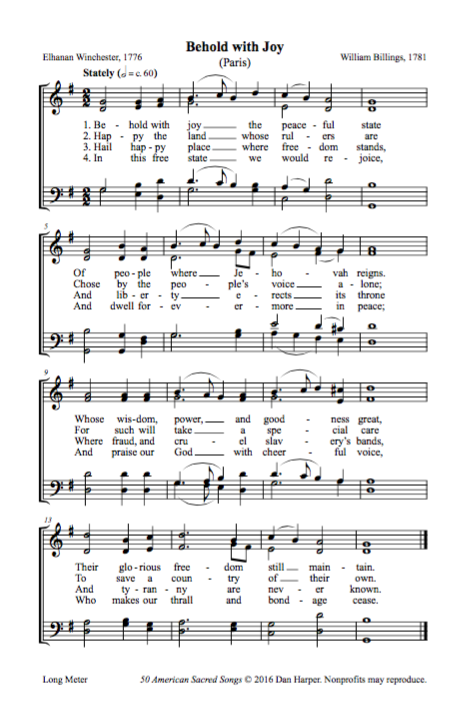
“Babylon Is Fallen”

“Babylon Is Fallen” is not your stereotypical Shaker hymn. The text, by Richard McNemar and first published in 1813 in the Shaker hymnal Millennial Praises, is all about the fall of Empire; the words to the refrain, “Babylon is fallen, is fallen!” come from that great anti-Imperial text, the book of Revelation (18:2): “Fallen, fallen is Babylon the great!”

I remember singing this song with a group of shape-note singers at the time of Occupy Oakland’s shutdown of the Port of Oakland, and it seemed eerily appropriate: “All her merchants cry with wonder / ‘What is this that’s come to pass?’ / Murmuring like the distant thunder, / Crying out, “Alas! Alas!” Obviously, the text predates consumer capitalism; yet insofar as consumer capitalism takes on the role of Empire, this text is worth singing in the early twenty-first century.

In any case, here’s the song:

Babylon Is Fallen thumbnail 1

Babylon Is Fallen thumbnail 2

Babylon Is Fallen PDF

This setting of the text comes from The Sacred Harp, a shape note tunebook that has maintained a living tradition in the South since the 1850s. Traditional Southern singers don’t hold back on this song, as you can hear in this Youtube video. So this is not a polite church hymn to be sung in a breathy voice. It was likely written as a camp-meeting song (come to think of it, it would have sounded good at the Port of Oakland shutdown), and it should be sung full-throated and with vigor.

Click here for permissions and more about the 50 American Sacred Songs project.

“We Still Live Here”

Deneva has been researching Thanksgiving curriculum materials for our congregation, and she sent me a link to an online video titled “We Still Live Here: Black Indians of Wampanoag and African Heritage”:

Still from "We Still Live Here" video

This video poses a nice challenge to neat and tidy racial categories: if you look black, and grew up in a Wampanoag family, and speak Wampanoag, and identify more with your Wampanoag heritage than your African heritage, what are you? Obviously, from the point of view of the U.S. criminal justice system, you’d be non-white. But in terms of your racial and ethnic identity, surely you are a Wampanoag Indian. Such a conclusion challenges typical racial categories in the U.S., where there is a popular myth that both White and Indian are recessive genetic traits, swamped by even the slightest amount of non-white DNA — which implies that even the slightest bit of African heritage means you’re of African descent. And many of us in the U.S. cling to that old myth, even if we’ve taken a high school biology class and have basic knowledge of genetics. This reveals the power of myth over rationality.

But the best part about the video for me was listening to the regional accent. I miss speaking Eastern New England dialect.

Non-traditional holiday traditions

This afternoon, after the Sunday services, we had a panel discussion about non-traditional traditions for Unitarian Universalist families celebrating the holidays. As I listened to the other panelists tell about their family holiday traditions, it became clear that your ethnic background has a big influence on how you celebrate holidays. With that in mind, here is my contribution to the panel discussion:

I grew up a New England Yankee, and a Unitarian Universalist. My Uncle Dick claimed that my mother’s family were Unitarians since Unitarianism began in North America, though Uncle Dick was notoriously unreliable on such things. My father’s side was Pennsylvania Dutch, and they were definitely Christian, members of the Evangelical United Brethren (EUB), a German language Methodist group. When my father announced that he was going to marry a Unitarian, that sent his mother into a dither. She was the daughter of a EUB minister, and her husband, my father’s father, served as an EUB minister for two years before he became a newspaperman. So my grandmother was in a dither, and she went to her minister with the news that her eldest son was going to marry a Unitarian. “Don’t worry, Mrs. Harper,” he said, “the Unitarians are weak on doctrine, but they are good people.” This reveals the most important thing about Unitarian Universalists and traditions: we are good people who don’t pay much attention to doctrine.

When I was a child, my family’s traditions were mostly dictated by my New England mother. Dad didn’t stand much of a chance, since we lived quite close to my mother’s twin sister, and my mother’s mother, and they were the ones who came over for holidays; whereas Dad’s family lived way down in New York City and southeastern Pennsylvania, and didn’t drive up for holidays. So many of our family traditions derived from New England Yankee culture.

Thanksgiving provides a good example of how we did family traditions. As New England Yankees, we knew we were descended from the Puritans, which we confused with the Pilgrims, so we felt a direct connection with the Thanksgiving story. As it turns out, there wasn’t much of a connection; our ancestors were indeed religious dissidents, they just didn’t happen to be Pilgrims. The important point is that we thought we were connected to the Pilgrims. Because of this supposed Pilgrim influence, I think we took it for granted that we could do what we wanted with Thanksgiving; nothing was sacred, except what we decided was sacred.

Or maybe that was the Unitarian Universalist influence. We didn’t always say grace before Thanksgiving dinner, and I don’t remember God being mentioned very often. When I was quite young, my Unitarian mother made sure I knew that public prayer was not very nice, and that Jesus himself had told his followers that if they went out and prayed on the street corners, they were hypocrites. By the same token, Mom also taught me that Unitarians don’t have to bow their heads when they pray; in fact, bowing one’s head might be making too much of a public demonstration of one’s supposed piety. We might hold hands while saying grace, but we didn’t have to bow our heads, and the few graces I remember were short and to the point.

Then my eldest cousin started attending youth group meetings at her Unitarian Universalist church, and she brought back a grace from her youth group. She had us hold hands, then she said, “Rub-a-dub-dub, thanks for the grub, yay, God!” So God was mentioned at least once at our Unitarian Universalist Thanksgiving dinner. And humor was allowed and even encouraged. Another time, one of the cousins suggested we go around the table and each say something we were thankful for. This non-traditional grace stuck for a few years, then disappeared. Our family traditions continually changed and evolved.

As we and our cousins got older, several of us experimented with vegetarianism. My mother and her twin sister did the cooking, and I’m sure they rolled their eyes at the fervor with which some of us expressed our vegetarian convictions. I can’t remember any special vegetarian dishes; what got cooked was what got cooked, and you ate it or you didn’t. Besides, we vegetarians knew that if we asked for a vegetarian dish, we might well be told to cook it ourselves; this was more Unitarian influence, straight from Ralph Waldo Emerson’s essay on “Self Reliance.” Another result of the Unitarian influence was that we were committed to social justice, and since we had all read France Moore Lappe’s book Diet for a Small Planet, there was more than one lecture from the vegetarians on the ethics of eating meat: it takes 16 pounds of grain to make one pound of beef! This was another result of our combined New England Yankee and Unitarian heritages: there was always plenty of guilt to go around.

Christmas for our Unitarian Universalist family was interesting, if somewhat confusing to a young child. When I was young, our Christmases had little mention of God; Jesus was referred to as Jesus, which made some of the familiar Christmas carols sound odd; and I was a little unclear on the Christmas story. We always went to our Unitarian Universalist church for the Christmas eve candlelight service, a service with great music, lots of carol singing, an opportunity to light candles, and a brief sermon which always seemed to focus on social justice rather than a re-telling of the Christmas story.

Back at home, we followed the long-standing New England tradition of lighting a bayberry candle on Christmas Eve, just before you go to bed. Mom said, “A bayberry candle, Burned to the socket, Brings health to the house, And money to the pocket.” One year I asked what this had to do with Christmas. My mother gave a confusing answer to the effect that the candle helped light the way for Jesus and his family on their way to the inn. I’m not sure if she made that story up on the spot, or if that was something her Unitarian mother had once told her. Yet another principle of Unitarian Universalist holidays is that you get to make things up on the spot.

Christmas got more interesting as we children got older. One year I studied the Frankfurt School of Marxism at college, and realized that much of Christmas is a product of consumer capitalism. This Marxist analysis annoyed my family less than you might expect; as Unitarian Universalists, we were used to questioning everything; my sisters and cousins all challenged some aspect of just about every holiday or tradition we had. I guess we were lucky that we were all Unitarian Universalists; I think it must be very annoying for non-Unitarian Universalists when they have to put up with our incessant critiques and challenges. Although for me, such challenges are half the fun of holidays and traditions.

One last thing I should mention: The combination of Unitarian Universalist values and New England Yankee culture has made me very doubtful about all holidays. Those old Puritans thought the only holiday should be Sunday, the weekly day of rest. To celebrate anything else was to be idolatrous; idolatry consists of placing an undue importance on something which is not all that important. As I get older, I am surprised at how strong that feeling is in me. My partner and I do not exchange gifts on Christmas, and the main way we celebrate is we go out for Chinese food. Thanksgiving is a good excuse to have a meal with family. The important part of holidays for me is to maintain connections with family and friends, and to keep alive cultural traditions; engaging in a supernatural or metaphysical interpretation of holidays is placing an undue importance on something that is not important.

To sum up, then, here’s what I know about Unitarian Universalist holiday traditions:
1. we are weak on doctrine, and as a corollary we can make things up on the spot;
2. we are influenced by regional cultures;
3. we challenge everything and are critical of everything;
4. a sense of humor is required.