Years are coming — speed them onward! When the sword shall gather rust, And the helmet, lance, and falchion, Sleep at last in silent dust!
This hymn has mostly been reprinted in Universalist and Unitarian Universalist hymnals, and it is usually attributed to the Universalist minister Adin Ballou, who founded the utopian Hopedale community in Milford, Massachusetts, in 1842. Ballou and the members of the Hopedale community were believers in women’s rights and abolition and temperance and education and pacifism. Recently, while I was researching family history, I discovered that my mother’s great-grandparents Nathan Chapman and Hepzibah Whipple left the utopian Rogerenes of Ledyard, Conn., to join the nearby utopian Hopedale community in Massachusetts; and their daughter Jeannette was married in Hopedale to her husband Richard Congdon by none other than Rev. Adin Ballou; and though by the time of this marriage the Hopedale community had gone bankrupt, the spirit of the community lived on in the Hopedale Unitarian church of which Ballou was the minister.
Not only did this family history help explain why I’m a feminist, pacifist, educator, and utopian dreamer, but I decided it must explain why I like this hymn so much.
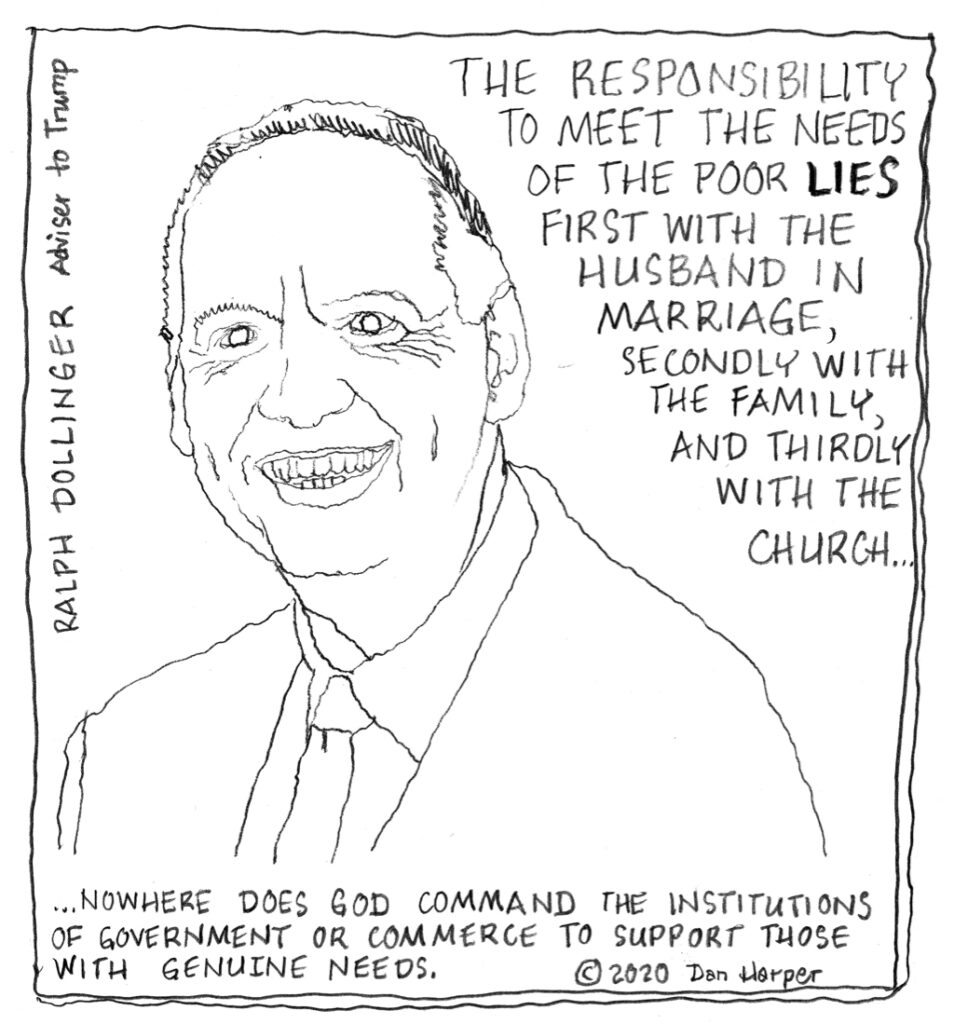
Ralph Drollinger, former professional basketball player and now the leader of Capitol Ministries in Washington, D.C., leads Bible studies for old white guys in power. He can boast that 11 of the 15 members of Trump’s cabinet attend his Bible study. According to the journalist Katherine Stewart, Drollinger should be identified more with politics than religion; specifically, with a political movement Stewart calls “Christian nationalism.” In a recent interview, Stewart quoted Drollinger on the subject of responsibility to the poor:
“The responsibility to meet the needs of the poor lies first with the husband in marriage, secondly with the family, and thirdly with the church. Nowhere does God command government or commerce to support those with genuine needs.”
This sounds to me as though Drollinger is telling rich men that if they will only support their wives and family and maybe give something to their church — beyond that, Drollinger is giving them permission to ignore the poor. Which reminds me of a story in the book of Mark about someone very like Ralph Drollinger who went to Jesus to ask a question:
“As Jesus was setting out on a journey, a man ran up and knelt before him, and asked him, ‘Good Teacher, what must I do to inherit eternal life?’ Jesus said to him, ‘Why do you call me good? No one is good but God alone. You know the commandments: “You shall not murder; You shall not commit adultery; You shall not steal; You shall not bear false witness; You shall not defraud; Honor your father and mother.”‘ He said to him, ‘Teacher, I have kept all these since my youth.’ Jesus, looking at him, loved him and said, ‘You lack one thing; go, sell what you own, and give the money to the poor, and you will have treasure in heaven; then come, follow me.’ When he heard this, he was shocked and went away grieving, for he had many possessions.”
If Ralph Drollinger will go and sell everything he owns, and give the money to the poor, then I’ll be willing to listen to his thoughts about supporting poor people. Until then, I’m going to ignore his cold-blooded and heartless words, and I’m going to continue in the tradition of my New England forebears who believed that one of the key roles of government was, in fact, to support those in need.
In an interview on the Religious Studies Podcast, journalist Katherine Stewart points out that it’s wrong to identify all Christian evangelicals with the Trump White House. Stewart’s research shows that the Trump White House uses religion to mobilize voters to support them — specifically, mobilizing voters around abortion and opposition to same sex marriage and LGBTQ+ rights. She calls this a political movement, which she names “Christian nationalism.”
When pressed by the interviewer, David McConeghy, Stewart elaborates on why Christian nationalism is fundamentally about politics, not about religion. Speaking of one of the leaders of the movement, Ralph Drollinger, Stewart says:
“The policies he’s promoting are: deregulation; sort of a compliant workforce; a lack of basic workers’ rights; I think he’s called the flat tax something like ‘God’s form of taxation.’ And you know, this is all music to the ears of the funders of the movement. Many of the funders are these members of plutocratic families … the DeVos and Prince families, the Green family. And these very hyper-wealthy families rely on minimal workers’ rights, and economic and environmental deregulation to maintain and increase their profits. So the movement is promoted to the rank-and-file as being about these culture war issues. But when movement leaders are talking amongst themselves, or to political leaders, the message is much more expansive.”
Stewart also believes, based on her research, that Christian nationalism as a political philosophy is basically opposed to representative democracy; yet the Christian nationalists are also very sophisticated at manipulating the electorate to get their supporters into positions of leadership and power.
For these and other reasons, Stewart asserts that this is a political movement, one that uses religion for its own ends. I think this is a helpful way of looking at electoral politics in this election year: rather than being distracted by the red herring of Christian evangelicals getting involved in politics, we would do better to pay attention to the manipulation of the electorate by the political force of Christian nationalism.
With the shelter-in-place order, any socializing we do is on camera. Plus many of us have to use videoconferencing for work. As long as we’re going to be spending lots of time on camera, we might as well look our best. So here are some tips for making yourself look good on your laptop’s (or your phone’s) crappy little web camera.
First of all, and perhaps most importantly, have your laptop or phone sitting on something stable. Ideally, you want to move the camera as little as possible, for two reasons. First, if you’re in a videoconference, you want to focus attention on your face, and if you move the camera around that’s going to be a distraction. Second, unless you have a really fast internet connection you probably want to save bandwidth; if you have a stable backdrop, that will be less information you’re sending out, and so you’re less likely to have degraded audio or video.
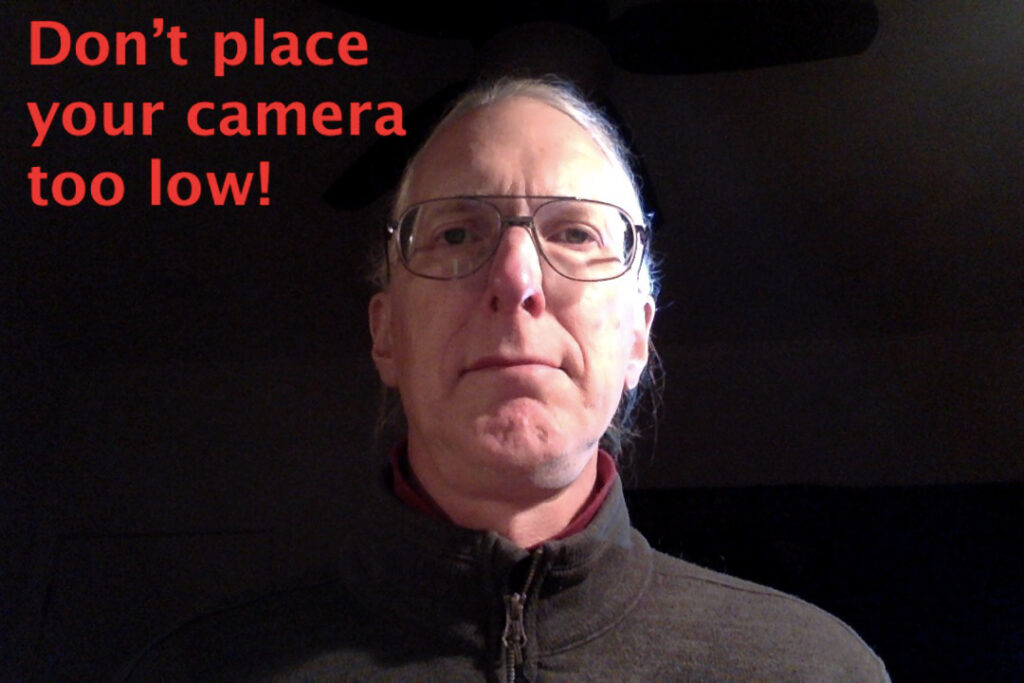
Second of all, don’t place your camera too low. If your camera is too far below your face, people will be looking up your nose, and if you’re middle-aged they can see all those incipient jowls that you’ve been trying to hide. In other words, don’t do this:
Camera placed too low, and only one source of lighting
Boy, do I look ugly in the photo above! Don’t make yourself look ugly. Place your computer or phone so that the camera is about at the level of your chin. However, don’t place your camera too high; there’s a psychological disadvantage to giving your viewers the impression that they are higher or taller than you.
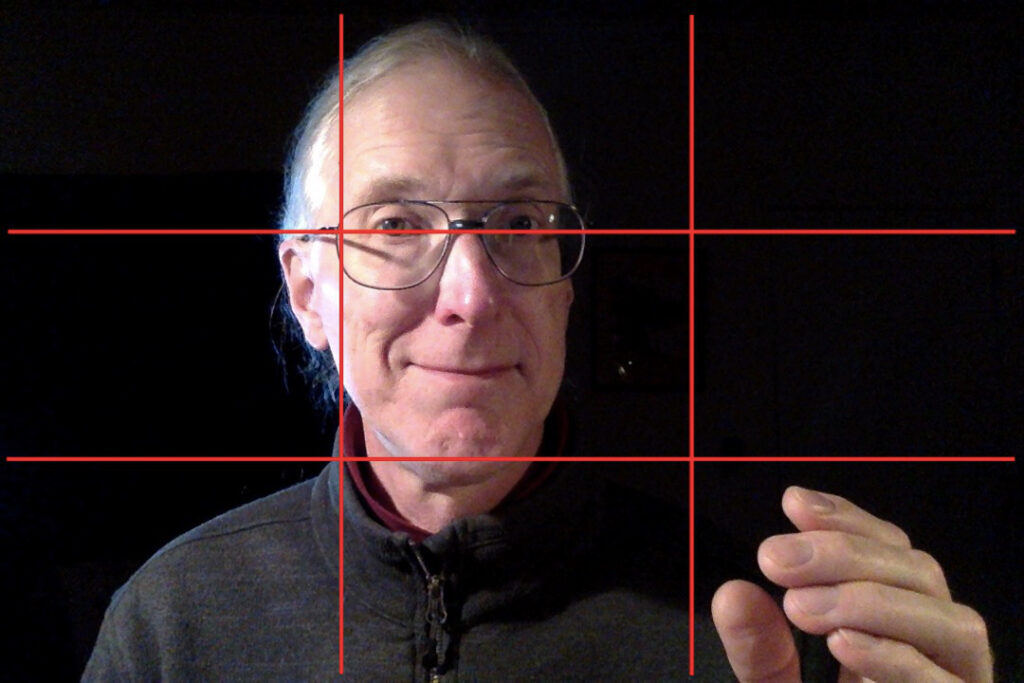
In addition, learn about the Rule of Thirds. Imagine that your screen is divided in thirds both horizontally and vertically, sort of like a tic-tac-toe board. Have your eyes placed so that they’re about a third of the way from the top of the screen. Move so that your head is NOT in the center of the frame, but about a third of the way to one side (I like to move to my left, so that my right hand, my dominant hand, can make gestures in the space to my right). Setting up your camera using the Rule of Thirds will make you look more professional, because that’s what we’re used to seeing in movies and on television.
Use the Rule of Thirds to place yourself in the frame of the camera
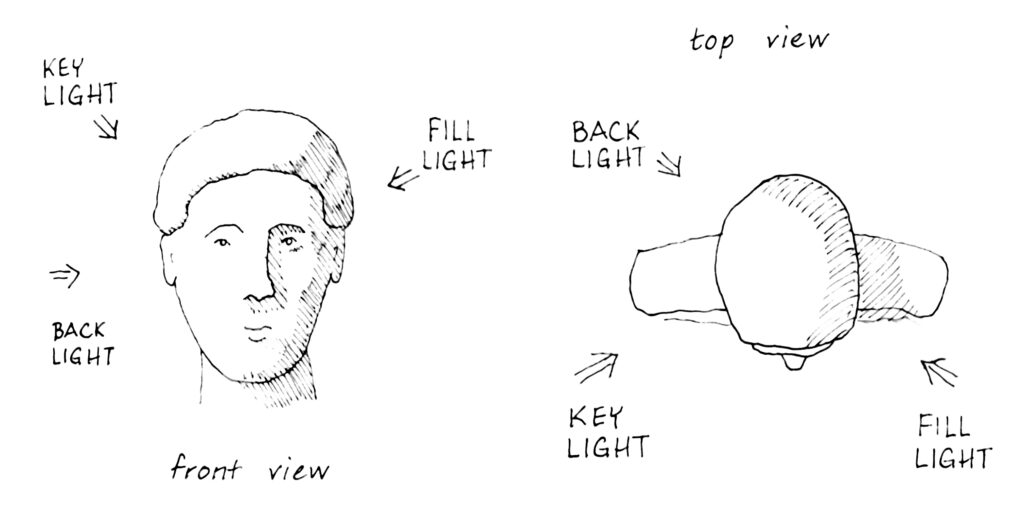
Now let’s take a look at lighting. In movies and television, they use what’s called “three point lighting.” That just means that they use three light sources to light someone’s head. First, you set up the “key light,” which is the most important light. If you’re at home and on a videoconference during the day, your key light is most likely determined by the nearest window — in that case, try to sit so that the light from the nearest window is coming towards you at about a 30 degree angle — and you want diffuse daylight, so make sure there’s a curtain or something to give diffuse light. At night, sit so that the strongest light in the room becomes your key light.
With only the key light, your head will look a little one dimensional or washed out; and if you have any wrinkles or blemishes, they will tend to stand out. Therefore, you need to set up another light, called the “fill light,” which will fill in the stark shadows cast by the key light. The fill light should be less bright than the key light. The drawing below shows where the key light and the fill light come from:
Diagram of three point lighting
Then if you want really professional lighting, you’ll add what’s called a “back light.” This comes from the same side as the key light, and it lights up the back edge of your head. By lighting up that back edge of your head, it makes you look that much more three dimensional. However, it’s super time consuming to set up a back light, so I don’t bother when I’m on a videoconference.
Now here are some examples of what I look like with these different lights. Here I am with just the key light — it’s adequate, but pretty stark:
The shelter-in-place order has made livestreaming our church’s worship services a little more complex. We just had a tech rehearsal with worship leaders and tech support people each in their own locations, using Zoom as our basic platform. We have learned a lot since we livestreamed last week! Here’s a summary of what is currently working for us:
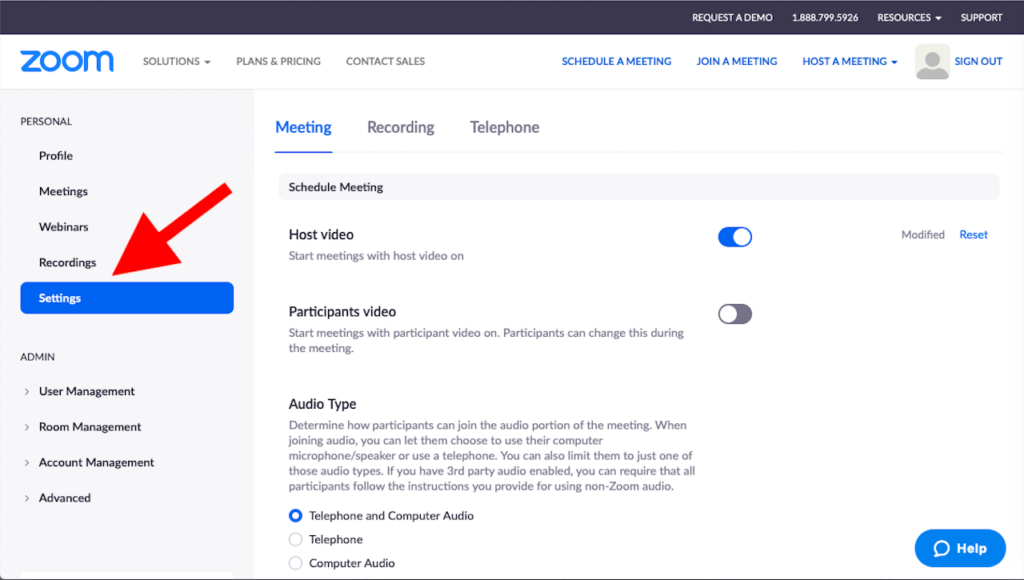
(1) Before the rehearsal, whoever owns the Zoom account needs to log in to their Zoom account and go over the settings carefully (see the screenshot below to see where to find “Settings” when logged in to Zoom). The critical settings you need to be aware of are as follows: (a) Do not allow “Join before host.” This is to prevent someone from hijacking the feed with inappropriate screensharing before you take control. (b) UNtick “Participant video: Start meetings with participant video on.” You want participant videos off, partly to prevent distraction, but also to prevent trolls from putting inappropriate content on their video feed. (Zoom will allow participants to start their video feed again, so you’ll also need someone to monitor participant videos during the service; see below.) (c) Tick “Mute participants upon entry.” (d) Tick “Allow co-hosts,” for two reasons: First, you’re going to need 2-3 people to manage the video feeds; second, make all worship leaders co-hosts because that puts them at the top of the participant list so you can more easily find them when switching back and forth between worship leaders and musicians. (e) Tick “Allow host to put attendee on hold.” Just in case. (f) Under “Screen sharing,” make sure you select the option where only allow host(s) can share screens. This prevents so-called “Zoombombing,” where trolls put up inappropriate images on your Zoom feed. (g) Tick “Disable desktop/screen for users.” (e) Tick “Allow users to select original sound in their client settings.” This improves the audio quality of musicians enormously.
(2) Well before the service starts, make sure you have email addresses for all co-hosts and worship leaders. Cell phone numbers would be a good idea too. If something fails, it’s nice to have a backup communication method besides private chat within Zoom.
(3) Start the Zoom call at least 15 minutes before the stated start time for the worship service, and make sure your co-host(s) who are managing participants also log in early. You want to have at least two hosts managing participants before the stated start time, when you’ll have your big influx of participants log in. Have your worship leaders log in early as well, and assign them co-host status so they appear at the top of the participants list.
(4) During the worship service, you’ll want people in the following tech roles: (a) One host to “Spotlight video” of whichever worship leader or musician is on. (b) One or two hosts to manage the participants. If you have a really small service (say, 30 or fewer participants logged in), you might be able to combine this role with the previous role. (c) One or two people to work on audience engagement; these people will be monitoring the chat. Specific tasks might include monitoring chat for joys and sorrows (we’re going to allow joys and sorrows in chat); pasting hymn/song lyrics into chat at the appropriate moment; watching for newcomers to the service and perhaps greeting them privately in chat; generally monitoring behavior. (d) Optional: we’ll also have a few knowledgable people monitoring audio and video quality, and providing feedback and/or advice as needed.
(5) Send out a script ahead of time. Our script, which was the basic order of service, proved to be inadequate. The primary worship leader (the senior minister in our case) is going to send out a full script, and our music director is going to insert cues for the host who’s in charge of switching the video feeds.
(6) We did a brief postmortem to talk about what worked and what didn’t work, and of course we’re doing email follow-up as well.
One final point: While putting on a worship service is always a team effort, it becomes even more of a team effort when you’re livestreaming (especially when everyone has to watch from home), because the tech crew becomes an integral part of the worship team. I consider this a major benefit of livestreaming services: in these times, when we’re all feeling a little isolated and scared, being a part of a team effort can be quite comforting.
For me, the biggest stumbling block for livestreaming worship services has always been copyright issues.
Especially troublesome are hymns.
Many of the most popular hymn tunes are protected by copyright. Even if a tune is in the public domain, the arrangement may be copyrighted (and it can be difficult to find out if the arrangement is, in fact, copyrighted). Even if the arrangement is copyrighted, some people will claim copyright for their typesetting of the hymn. If a hymn is protected in any way under copyright, you’re not supposed to photocopy or project or electronically disseminate the printed version of the hymn; if any part of the music is protected under copyright, you’re not supposed to broadcast audio of it. No, not even if you own hymnals with the hymn: owning a hymnal just allows you to use the hymn in an in-person event such as an in-person worship service.
The solution to this problem: copyright free hymns.
For the past few years, I’ve been collecting copyright free hymns and spiritual songs. I have huge disorganized files (both electronic and hard copy) of public domain tunes and texts and arrangements. I’ve pulled many songs from the great early African American collections, including Slave Songs of the U.S. (1868), the Fisk Jubilee Singers songbook (1873), and Cabin and Plantation Songs, assembled by the Hampton Institute (1901). Although most of the hymns I’ve found are Christian, I’ve also found some good hymns and songs with Buddhist, Jewish, Neo-Pagan, Ethical Culture, or secular content. All the hymns I’ve found would be suitable for use in a Unitarian Universalist worship service; indeed, many of them are public domain versions of hymns in our current hymnal that are protected by copyright in some way.
I’ve just put 24 of these copyright free hymns and spiritual songs in a Google Drive folder here.
I’ll put a list of the songs currently in the folder below. And I’ll be adding more copyright free hymns and spiritual songs as I find time to produce fair copies of the versions I have.
Update, 1/18/2022: I’ve more than doubled the number of hymns and spiritual songs in the Google Drive folder. List of the songs has been moved to a new blog post titled “More copyright-free hymns.”
We got the shelter-in-place order from the San Mateo County Board of Health:
“Effective midnight tonight, the Health Officer of San Mateo County is requiring people to stay home except for essential needs. The intent of this order is to ensure the maximum number of people self-isolate in their places of residence to the maximum extent feasible. … This order is in effect until April 7. It may be extended depending on recommendations from public health officials.”
We’re allowed to go to the grocery store or the pharmacy, and we can go for walks outdoors if we stay away from other people, but that’s about it.
So Carol and I went up to the local grocery store at 5 p.m. We usually go shopping every day, but now we’d rather minimize our trips to the store, so we thought we’d pick up a few things. The store showed all the signs of panic buying — I call it panic buying because while there were no bags of rice on the shelves, there was plenty of bulk rice available. I also noticed that the only canned beans left on the shelf were good old B&M Baked Beans; Californians don’t really like New England style baked beans, not even when they’re panic-buying. In any case, we found plenty of food for our needs.
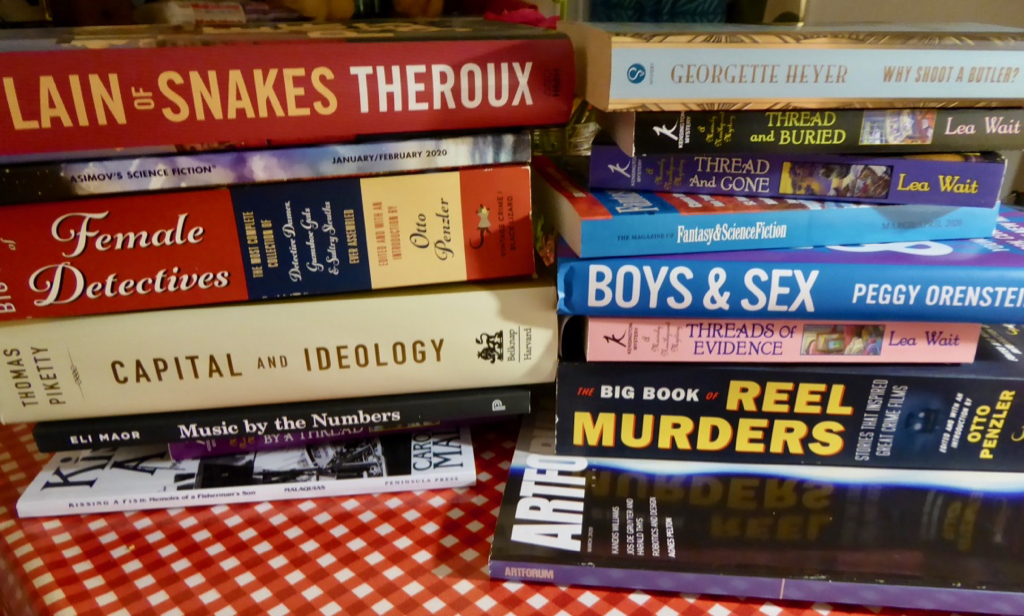
Then we went off so I could do my own panic buying. You see, the libraries closed a couple of days ago, and I’ve already finished the books I had taken out. I hate ebooks because they make my eyes tired. I hate Amazon. And if I don’t feed my reading addiction, things get ugly. So we went to our local Barnes and Noble, and I bought some books:
Yes, most of the books I got are junk — pulp fiction and cozy mysteries and science fiction magazines — but I got some serious books too. The book by Thomas Piketty should be dense enough to last me a while.
But … I don’t know … this may not be enough books … maybe I better rush down and buy more books before the bookstore closes….
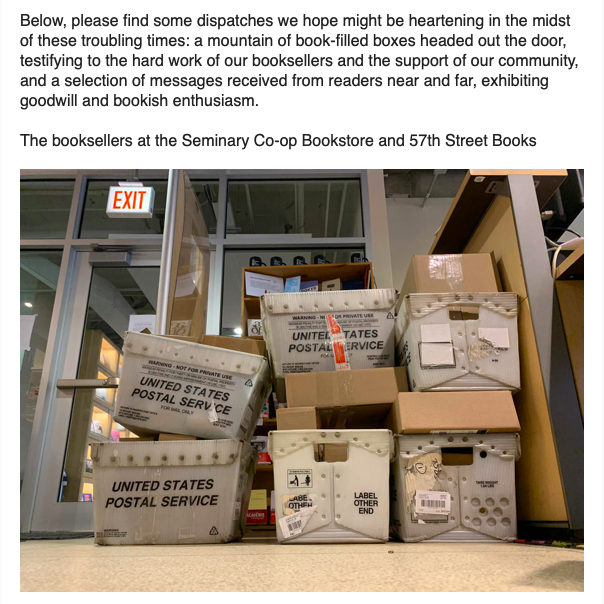
Update, Friday, March 20: The Seminary Coop Bookstore in Chicago is offering free shipping to its book-deprived customers. Amazon doesn’t need your business right now! Feed your book addiction, and help keep one of the last independent coop bookstores in the U.S. alive. I just place an order with them, why don’t you? Below is an excerpt from the email they sent out:
For the past two or three decades, there have been scholars who have argued (fairly persuaively, in my view) that “religion” is not a particularly useful category. I’m currently working my way through Tim Fitzgerald’s book The Ideology of Religious Studies (Oxford Univ. Press, 2000), and Fitzgerald offers some compelling arguments why “religion” is not a useful category for academic study. For example:
“Claims … that religion is a phenomenon, or humans are religious beings, or all societies have religion(s), or religion is an aspect of society, or society is an aspect of religion imply a further proposition that ‘religion’ indicates some reality that is not already covered by ‘society’ and ‘culture,’ that religion is something over and above and additional to society and culture. Outside of a specific theological claim, this implication is, I believe, a fallacy. This is because there are virtually no situations now in the scholarly literature produced by religious studies writers where religion has any useful work to do as an analytical category pointing us to some distinctive aspect of human reality. The word ‘religion’ is now used to refer to so many different things that it has become virtually synonymous with ‘culture’ and ‘society’ in the broadest senses….” (p. 222)
I find a great deal to agree with in this statement. Having had some training the fine arts, I’m more inclined to think of ‘religion’ as part of one specific aspect of culture, the arts: a religious building combines architecture and installation art; religious services are performance art with music, or maybe they’re drama, improv, theatre games; ritual is conceptual art (or is conceptual art ritual? they’re hard to tell apart).
One of the differences between what we call “religion” and what we call “art” in our culture is that “art” is made by experts and bought and sold by rich people, whereas “religion” is co-created by a few experts and lots more non-experts, and it is (in many cases) self-funded and not consumed but participatory. If that’s the case, then when I look at the continuum from art (created by experts, consumed by rich people) to religion (co-created by non-experts, participatory-not-consumed), I want to be on the far left of the “religion” end of the continuum.
Any blogger worth their salt now has to write a post about the novel COVID-19 virus, popularly known as coronavirus. I want to talk about the recommendations for handwashing issued by the Center for Disease Control (CDC).
Now, the CDC is recommending that we wash our hands frequently to avoid spreading infection from COVID-19 and other infectious diseases like the flu. I’m fine with that. According to the CDC, proper handwashing technique involves five steps.* I’m fine with that, too. But in Step 3, the CDC instructs us to sing the “Happy Birthday” song twice so we make sure we wash for a full 20 seconds. [* Update: 14 March 2025: Charlie pointed out that’s now a dead link; the CDC info has moved here.]
Ugh. I hate the “Happy Birthday” song. I don’t want to sing it once, let alone twice, let alone every time I wash my hands.
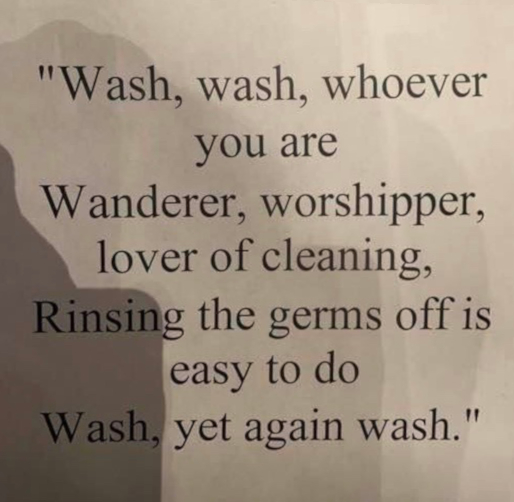
Fortunately, I have an alternative. Ginger, a UU religious educator in the Bay Area, found this, which was posted in a bathroom of a UU congregation:
“Wash, wash, whoever you are, Wanderer, worshipper, lover of cleaning, Rinsing the germs off is easy to do Wash, yet again, wash.” (with presumed apologies to Rumi and Coleman Barks)
If you sing “Wash, wash, whoever you are…” to Lynn Ungar’s tune in the UU hymnal Singing the Living Tradition (no. 188), at a reasonably quick tempo (about 144 bpm), it takes about 16-17 seconds to sing. Then you can repeat “Wash, yet again, wash” to make a full 20 seconds. Much better than the “Happy Birthday” song.
And there are still more songs you (and/or your children) can use to time your handwashing.
More than a decade ago, Dr. Robert Piper, retired professor of political science at UMass Dartmouth, demonstrated how you can sing the ABC song to time your handwashing. Since I trust retired professors of political science, that’s what I’ve been doing ever since.
Or, if you want to be religious, there’s a passage from sacred scripture that neatly fits the tune of the ABC Song (which is, by the way, a lovely folk tune immortalized by Mozart in K. 265) — I’m referring of course to the Mad Hatter’s poem in the holy writ of Alice’s Adventures in Wonderland:
“Twinkle, twinkle, little bat! How I wonder where you’re at! Up above the world you fly, Like a tea tray in the sky. Twinkle, twinkle, little bat! How I wonder where you’re at!
So you see, if you too hate the “Happy Birthday” song, you (and/or your children) now have 3 other options to time handwashing: “Wash, wash, whoever you are”; the ABC song; and “Twinkle, twinkle, little bat.”
Update: (1:12 p.m.) Ginger found yet another UU handwashing song online, which also lasts about 20 seconds:
“Come wash your hands with me Come wash your hands with me Come wash your hands with me, So we can know peace of mind. And I’ll bring you soap, When soap is hard to find, And I’ll wash my hands with you So we can help humankind.”
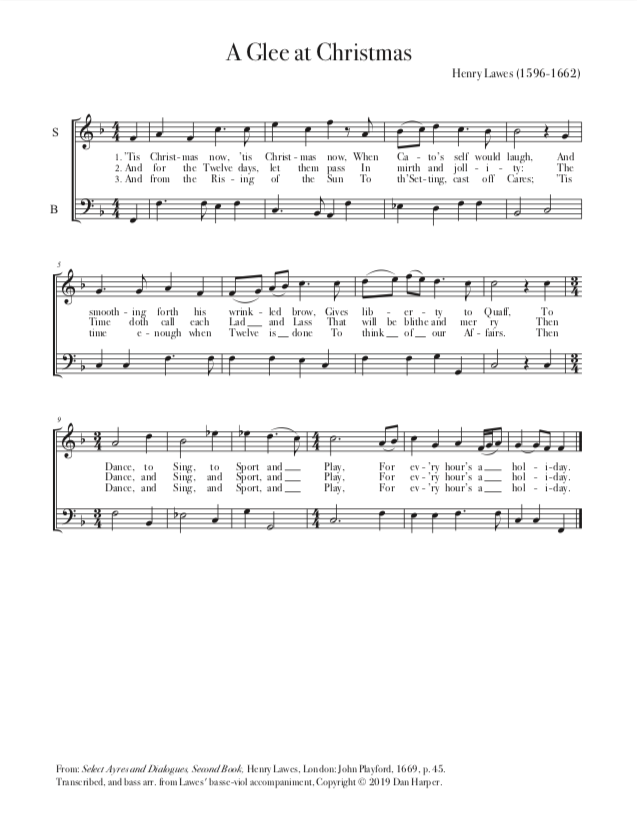
A little-known song for Christmas by Henry Lawes. This song, published in 1669, is a Christmas party song, with absolutely no religious content except the word “Christmas.”
’Tis Christmas now, ’tis Christmas now, When Cato’s self would laugh, And smoothing forth his wrinkled brow, Gives liberty to Quaff, To Dance, to Sing, to Sport and Play, For ev’ry hour’s a holiday.
And for the Twelve days, let them pass In mirth and jollity: The Time doth call each Lad and Lass That will be blithe and merry Then Dance, and Sing, and Sport, and Play, For ev’ry hour’s a holiday.
And from the Rising of the Sun To th’Setting, cast off Cares; ’Tis time enough when Twelve is done To think of our Affairs. Then Dance, and Sing, and Sport, and Play, For ev’ry hour’s a holiday.
Click on the image below for a PDF of sheet music for this song. The melody in the sheet music is Lawes’ melody; Lawes outlined a bass line to be played on theorbo or bass-viol, and I changed the rhythms of this slightly to fit the lyrics so bass voices could sing this part.