The Unitarian Universalist Association (UUA) posted a notice today recommending that Unitarian Universalist congregations should consider NOT opening in-person meetings before May, 2021. You can read the recommendations here.
I’m glad the UUA has issued these recommendations. I had already come to most of the conclusions outlined in their recommendations. I’ve been trying to figure out how to gently break it to lay leaders and congregants who are already feeling weary of being stuck at home, already getting tired of Zoom meetings, that we really won’t be able to meet in person until there’s an effective vaccine and/or an almost universally effective treatment with incredibly robust contact tracing in place. Which means most likely no in-person meetings for at least another year — maybe longer in some areas.
The only thing I’d quibble about in the UUA recommendations is this statement: “It is the UUA’s strong recommendation that congregations plan for ongoing virtual gathering and operations through May 2021.” I would have added the phrase “at least” before “through May, 2021.” I don’t think there’s any guarantee that we will be able to resume in-person meetings by the end of May 2021; human beings are really good at false hope, and I wouldn’t want to encourage that human tendency.
That minor quibble aside, the recommendations are quite well done, especially in how they recognize that different congregations in different locales will face different sets of problems.
Best of all, now I don’t have to go through the trouble of summarizing all the research I’ve been doing. All I have to do is point to the UUA recommendations, and say, “This generally agrees with the research I’ve been doing.”
And then we can all say together, “OK, let’s plan for a year of online programming. How can we unleash our creativity, serve the needs of our members and friends, and make Unitarian Universalism in Silicon Valley serve the goodness of humanity?”
Former president Barack Obama has called the current presidential administration’s response to the coronavirus situation “an absolute chaotic disaster.” (Full quote here.)
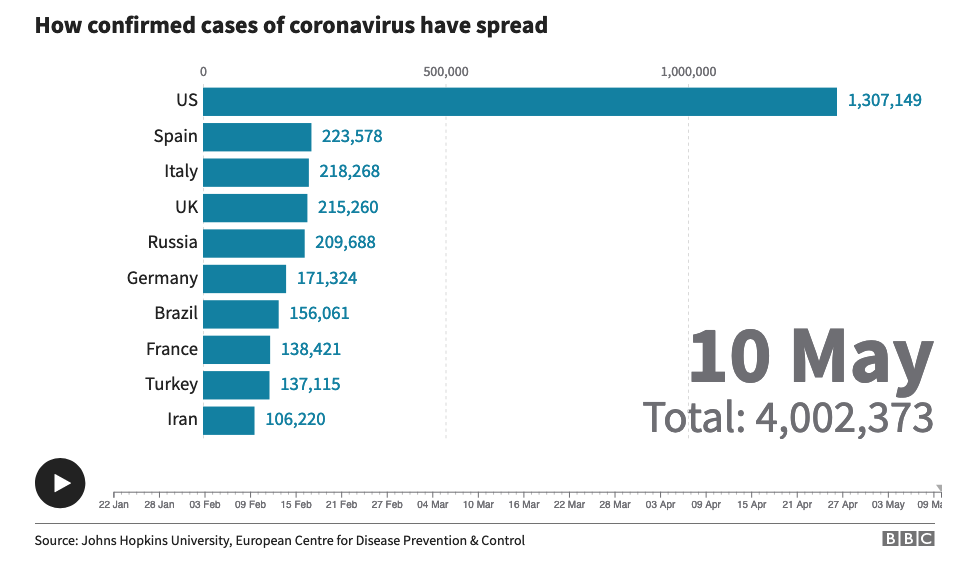
Even accounting for some measure of political calculation, hoping to help his own party’s chances in the November election, there’s a lot of truth in what Obama said. For example, look at this bar graph showing the number of cases per country:
And to quote the BBC: “More than 77,000 people have now died and the US has 1.2m confirmed cases — both by far the highest in the world.”
I’m still trying to figure out how best to deliver kid-friendly and parent-friendly religious education during the age of shelter-in-place.
Videoconference Sunday school, using Zoom, works well for some families. For younger kids, the format that works best centers around a story, followed by some kind of activity to go with the story. Middle schoolers tend to want more peer interaction.
But with any age, kids (and parents) who have had enough videoconferencing through school won’t attend. How to reach them? I got feedback from some parents that online videos might be useful, IF they didn’t require parental supervision.
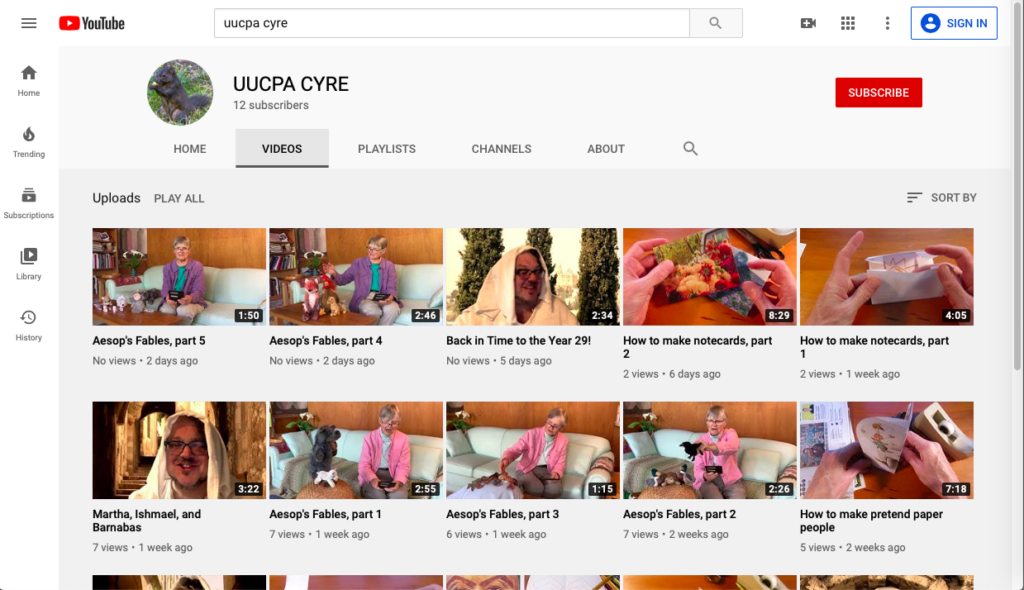
So I’ve slowly been building up a library of on-demand videos that, while not explicitly religious in nature, at some level promote UU values. Here’s some of what I’ve collected on the UUCPA CYRE Youtube channel:
A series of “How To Make” videos, that mostly require easily obtainable materials like scrap paper, scissors, a pencil, and maybe crayons and sticky tape. These videos show how to make things that promote imaginative play and give children a sense of active engagement and agency. With these, my goal as an educator is to move kids away from being passive consumers of online content, towards actively creating their own imaginative lives.
But this is very much a work in progress. I’m still trying to figure out how to provide the best content for kids that promotes UU educational values. If you have ideas for content I could create, I’d love to hear them! Or if you know videos created by UUs that I should consider adding to curated lists, let me know:
On Monday, Zoom released a major update to the Zoom client. If your church is using Zoom for religious education and services, note that the 5.0 version will be required for all users by May 30, so start reaching out to your congregation now — after May 30, they won’t be able to log in to one of your meetings without upgrading.
If you run kids’ programs on Zoom, you will want to upgrade now. Zoom has plugged some obvious holes that could be exploited by trolls — or by mischievous kids wanting to disrupt a class. Most important, the host “can disable the ability for participants to show their profile picture or change it in a meeting.” Other critically important security upgrades for those of us who do Zoom meetings with legal minors include the ability to embed an audio watermark in recordings (you really don’t want anyone recording minors without parental permission). And there are a few other enhancements to security that will also be helpful to teachers.
As of April 2, the San Mateo County Board of Health recommends that everyone wear a mask when they’re in public places.
I’ve been doubtful about the efficacy of masks, since my understanding is that wearing a mask won’t do much to protect you from being infected by others. But I’ve come to understand that masks might protect others from being infected by you, if you happen to have COVID-19 but are still asymptomatic.
So today I decided to be a good citizen and sew a couple of masks, one for Carol and one for me. I am very slow at sewing, partly because I don’t know how to use a sewing machine, and partly because I don’t know what I’m doing. But I found a good online video showing how to make one of the 2-layer pleated masks that are supposed to be the most effective handmade masks. I didn’t have the elastic bands called for in the video, but I had some 1/4 inch polyester cord to use for the ties. Carol has a big bolt of unbleached cotton muslin, and I sacrificed an old t-shirt. Sewing the pleats by hand was kind of a pain at first, but I quickly figured it out.
After two or three hours, I had a mask for Carol and a mask for me. We went to the grocery store, and three quarters of the people there were also wearing masks. Mask wearing peer pressure has begun.
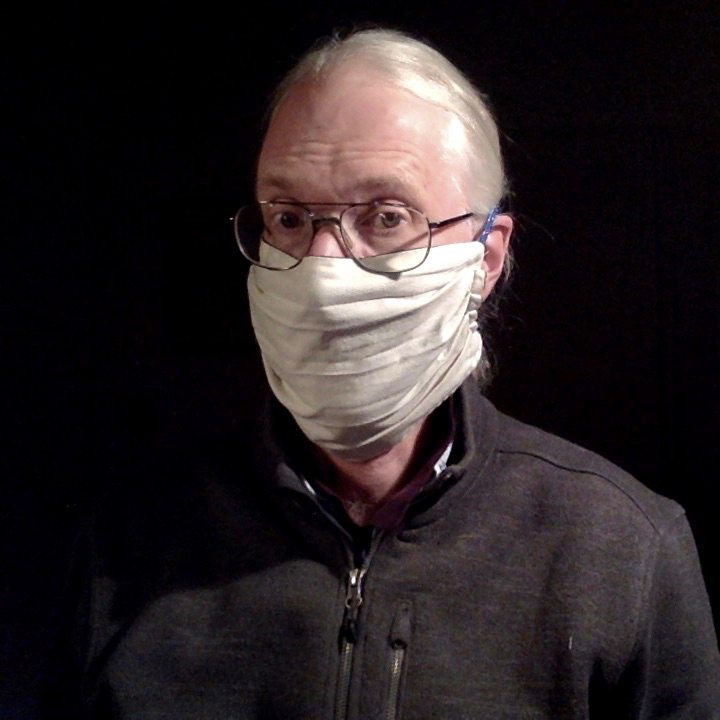
Me wearing my mask
As soon as we got home, I washed both masks in hot water, as you’re supposed to do.
Next step: make another mask for Carol using a high fashion fabric for the outer layer….
If you’re one of those using Zoom to carry out online programs and ministries for our congregations, you’ll want to update to the latest version of the Zoom app (a.k.a. the Zoom client). The latest version is 4.6.10, and I got notification about it an hour ago.
This update has one absolutely critical security feature that you must have: you can prevent participants from changing their screen name. The previous version gave participants the ability to change their screen name to anything, including something obscene, and the host couldn’t do anything except boot that person off the call.
There are other security enhancements, too. Update now.
I like several things about Abby’s videos. First, they’re a great supplement to Zoom calls — some of us are getting Zoom burnout, and it’s nice to be able to watch a video when YOU want to watch it. Second, they’re Goldilocks videos — not too long, not too short, but just the right length. Third, they don’t put a big burden on parents — the crafts project can be done by kids on their own without parental supervision, kids can watch the installments of Alice on their own, and the story time for young children has them doing what they’re going to be doing anyway which is sitting in a parental lap.
So I repurposed this Youtube channel, where I already had some religious education videos. I added a video we used in last Sunday’s service. I created a couple of playlists, one for crafts (Abby’s craft video is included there), and another for story time (Abby’s Alice stories are going there, because Alice in Wonderland is a sacred text). I’ve got a children’s librarian from our congregation half convinced to do a story time, I’m planning a story time (I think I’ll read aloud from an old edition of the Jataka Tales), there will be more crafts projects.
Blog readers, if you know of some videos that you think would be appropriate to share on this Youtube channel, please send me the links. I can’t promise to put everything up, but I’d really like to see your suggestions — send them to danharper then the little “at” sign then uucpa then a dot then org.
This Sunday, during our congregation’s online service, we’re going to go back in time…
…using the congregation’s time machine…
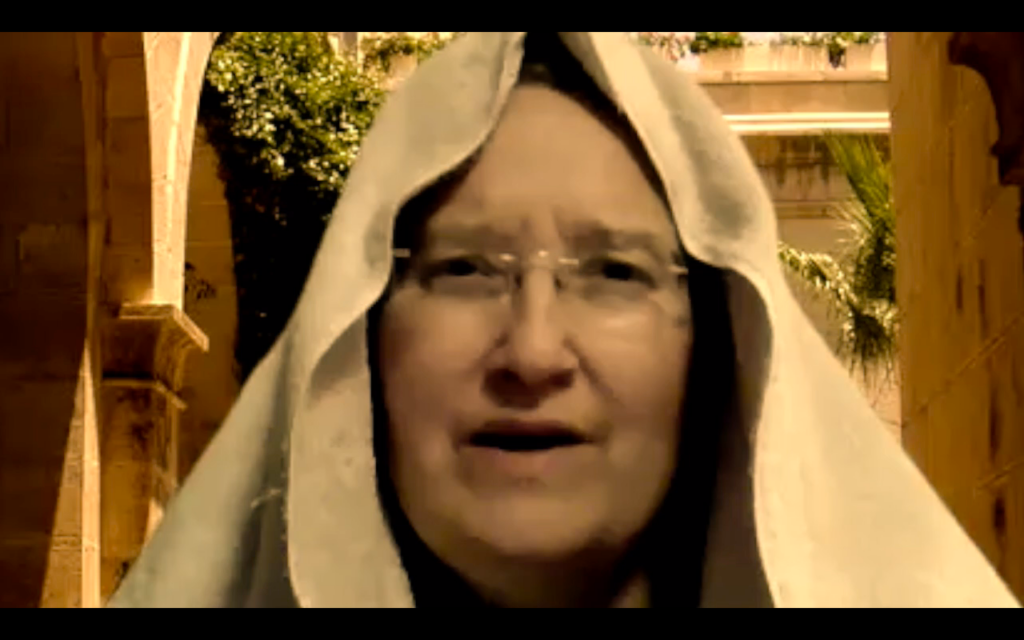
…to the year 29 C.E., to a small town in the land of Judea. There we will meet a fellow named Ishmael, who’s the kind of person who loves to spread rumors.
“They say,” says Ishmael, “that….”
If Ishamael lived today, he’d be the kind of fellow who emails you the latest internet conspiracy theory. But since he lives in the year 29 in Judea, he spreads his rumors face-to-face in the town’s marketplace. He meets up with a woman named Martha. When he learns that Martha’s brother Peter has joined the entourage of the famous rabbi Jesus of Nazareth, not surprisingly he has a few conspiracy-theory-type rumors to tell Martha. This causes Martha to wonder if her brother is going to be OK….
“Now you’ve got me wondering,” says Martha….
Our trip to the past will take less than three minutes, allowing us plenty of time for the usual singing, music, preaching, etc. The whole thing will be livestreamed on the Facebook page of the Unitarian Universalist Church of Palo Alto, this Sunday at 9:30 and 11.
While we have to shelter in place, I thought I’d have time to turn to serious reading. There’s a pile of books on the floor next to my desk with titles like How Judaism Became a Religion: An Introduction to Modern Jewish Thought, and Early Greek Science: Thales to Aristotle, and Capital and Ideology.
And what have I actually been reading? Very little in the way of serious books, I can assure you. It turns out that I’m actually the teensiest bit stressed out, between the COVID-19 pandemic, and working way too many hours to get our congregation’s programs and services online, and having my usual routine completely disrupted. Without diminishing the importance of the first two, I suspect this last may have had the biggest effect on me: I thought I wasn’t much of a creature of habit, but like all humans I’m very much a creature of habit, and when my daily habits are so completely changed it’s unsettling. So I’ve been reading fluff, junk, pulp fiction — in short, guilty pleasures.
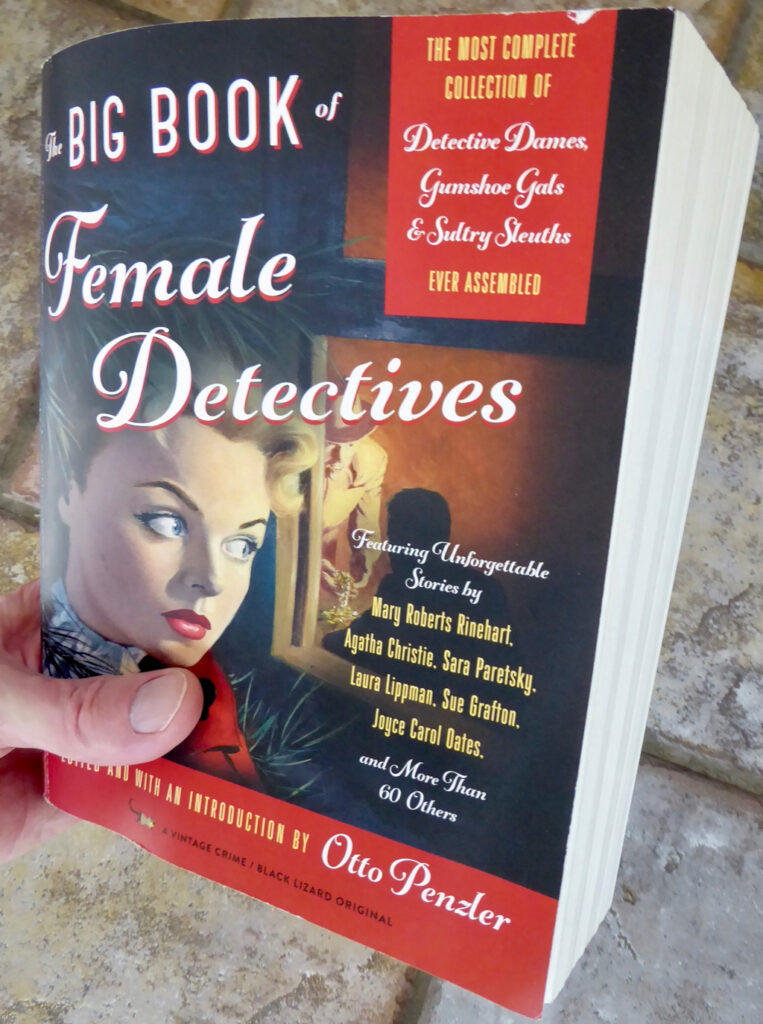
I’ve been reading The Big Book of Female Detectives, ed. Otto Penzler (Vintage Crime, 2018). It’s 1,111 pages of guilty pleasures, stories with no intellectual value at all. All right, I admit that there is one piece of serious literature in the book, a very short story (four pages) by Joyce Carol Oates, which I skipped over because every paragraph began with the word “because” and that required a little too much thought on my part. So subtract four pages, and make that 1,107 pages of pure unadulterated thoughtless fun.
The first dozen stories are British and American stories from before the First World War; many of the plots creak alarmingly under the weight of suspended disbelief. One of my favorites from this section of the book is “An Intangible Clew” by Anna Katharine Green, featuring Violet Strange, a very wealthy young woman who is secretly a brilliant detective. Here is how she arrives at the scene of the crime in this story:
“When the superb limousine of Peter Strange [Violet’s brother] stopped before the little house in Seventeenth Street, it cause a veritable sensation…. Though dressed in her plainest suit, Violet Strange looked much too fashionable and far too young and thoughtless to be observed, without emotion, entering a scene of hideous and brutal crime…. Her entrance was a coup du theatre. She had lifted her veil in crossing the sidewalk and her interesting features and general air of timidity were very fetching….”
Many of the early stories in the book — the stories are arranged in chronological order — feature female detectives who hide their brilliance under an appearance of brainlessness. Thus when you finally get to Agatha Christie’s novel The Secret Adversary, featuring Tuppence Cowley as detective, with her sidekick Tommy Beresford, you realize how innovative Christie was. Tuppence Cowley is smart, funny, and brave. She doesn’t pretend to be stupid when she’s not (indeed, it’s Tommy who isn’t very bright, and admits it), and she comes across as a real person, a three-dimensional character. The plot of The Secret Adversary whizzes along at a breakneck pace, so fast that the unbelievable parts of the plot (of which there are a great many) have gone by before you realize how unbelievable they are. And who cares about the plot anyway? — you read this book to enjoy Tuppence’s personality.
Worthy of note is a mid-twentieth century story by Mary Roberts Rinehart, once a best-selling author and now mostly forgotten. Rinehart’s “Locked Doors,” which has appeared in other anthologies, is less a mystery story than a story of suspense; but there’s a surprise ending to the story that makes perfect sense of all the outre plot elements, and while it’s not entirely believable, the ending is believable enough to make it satisfying.
The next high point in the book is a story by Sue Grafton, featuring her famous detective Kinsey Milhone. It’s easy to forget how revolutionary Sue Grafton was: not only are her stories reasonably well-written, but Kinsey Milhone is as smart, funny, and brave as is Tuppence Cowley, but Kinsey doesn’t need a man to make her complete — she doesn’t need to get married (Tuppence agrees to marry Tommy at the end of The Secret Adversary), she doesn’t need a male boss (Tuppence reports to the powerful and mysterious Mr. Carter), she’s independent and alone and likes it that way. If Kinsey Millhone is a result of the feminist revolution of the 1970s, then thank God for the feminist revolution of the 1970s.
Most of the other stories in the book have no redeeming value, but they’re so much fun to read — even if you forget them moments after you’ve finished them. These stories would make perfect beach reading, but since we’re not allowed to travel to the beach they also make perfect shelter-in-place reading, requiring no intellectual effort while keeping your mind off of current events.
They’re trying to support schools which are doing online learning, and trying to support everyone who has been shut out of their local library.
Their collection consists of mostly 20th century materials, mostly still in copyright, that are out of print and not easily accessible as ebooks. I’ve used some of their books in the past, when you had to “check out” books for a specific period of time (and if the book was in use, you had to wait for it). It’s a small but excellent collection. Best of all, their online reader is excellent — their reader makes Google Books look absolutely sick in comparison.
So if you’ve been suffering from book deprivation, access the National Emergency Library here.