What doesn’t kill you….

Sometimes when I’m talking to someone who has just been through a major life disaster, they will say, “Well, ‘what doesn’t kill you makes you stronger,’ right?” They find it comforting to think that life will turn out all right in the end.

When I’m doing pastoral counseling, my job is mostly to listen, and maybe to help people find at least a little hope in their lives. If the phrase “What doesn’t kill you makes you stronger”gives them hope, then of course I agree with them.

But I can’t help thinking about all the people who have suffered through one of life’s disasters, and come out of the other end weaker, rather than stronger. And I think to myself: “What doesn’t kill you, doesn’t kill you.” That can still be an expression of hope, just maybe a little more true to more people’s actual experiences.

So I was pleased to read about Kate Bowler’s new book, No Cure for Being Human (and Other Truths I Needed To Hear). Bowler’s earlier book, Everything Happens for a Reason (and Other Lies I’ve Loved) gently showed up the mistakes of the Prosperity Gospel, that strange vaguely Christian theology which interprets any misfortune as some kind of personal failing that has invoked God’s disfavor.

Bowler’s new book continues in the same vein. Religion News Service says the book “is a broadside against a culture obsessed with the power of positive thinking.” Bowler is a professor at Duke University who has written academic studies of the Prosperity Gospel. And she survived stage 4 colon cancer while in her thirties, and “her health is fragile and will likely remain so.” So she is someone who can see just how damaging the prosperity gospel can be. And she’s out to provide a popular, friendly, optimistic alternative.

And boy, do we need an alternative to the Prosperity Gospel. Because it’s not just Christians who believe in the Prosperity Gospel. I have atheist friends who think this is the best of all possible worlds, that you can improve your life by making more money and “taking care of yourself,” that if anything goes wrong in your life it’s your own fault. I have Buddhist friends who believe that you wouldn’t suffer if you’d just meditate more, so if you feel bad it’s your own fault. And I have Pagan friends who are convinced that it’s negative thinking that causes life’s problems, meaning if you have any problems, it’s your own fault.

But of course it isn’t your fault. When bad things happen to you, more often than not it just means that bad things have happened to you. (Of course, if you do something foolish like storming the Capitol building and you find yourself in jail, then yes it actually is your fault.) I’m glad there are people like Kate Bowler who are willing to point out that the Prosperity Gospel in any form — Christian, atheist, Buddhist, Pagan — is wrong. There’s a better way: learn to live with life as it is, and instead of manufacturing fake hope, find real hope instead.

Step by Step

I got curious about the song “Step by Step,” a song that Waldemar Hille and Pete Seeger put together — it’s hymn number 157 in the Unitarian Universalist hymnal. Hille found a poem in the “Constitution and Laws for the Government and Guidance of the American Miners’ Association” (1864), and he and Seeger made a song out of it. But Seeger said they changed some of the words, so I got curious about the original wording. I found a digitized copy of the poem online, and it reads like this:

Step by step, the longest march
Can be won, can be won,
Single stones will form an arch
One by one, one by one,
And by union, what we will
Can be all accomplished still.
Drops of water turn a mill—
Singly none, singly none.

I decided I liked the original words better than Hille and Seeger’s rewrite — the original second stanza feels more positive to me. Then I realized I’ve always disliked Hille and Seeger’s tune; it sounds like a dirge, better suited to a funeral than to a union marching song.

Worst of all, Hille and Seeger slapped a copyright on their song. Maybe while they were alive they would have given permission to use it freely, but they’re both dead now. Besides, who wants to have to write for permission to sing the song?

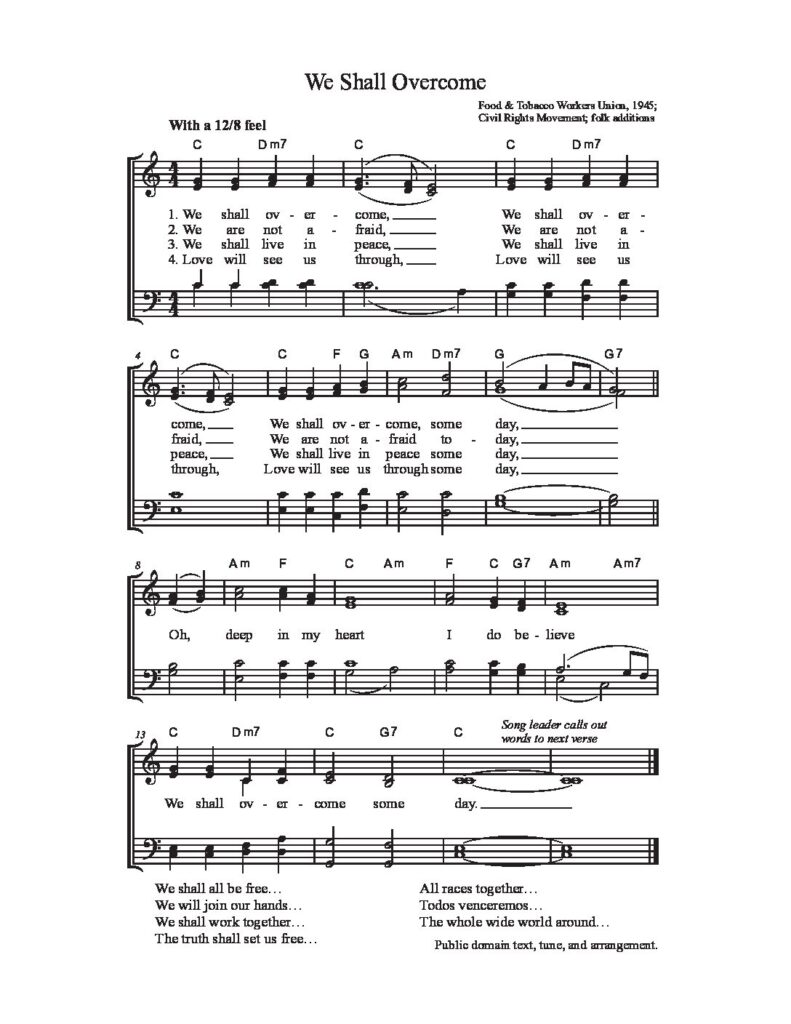
So here’s my version of this grand old union song. It has the original public domain words, paired with a tune licensed under the Creative Commons Attribution-ShareAlike 4.0 International License:

Click on the image above for a PDF.

Solving the Silicon Valley housing crisis four people at a time

The title of a recent San Francisco Chronicle article says it all:

He wanted to let homeless neighbors sleep in cars outside his church. It launched a two-year battle.

The “he” in the title is my new UU hero, Chris Kan. Chris grew up in San Francisco, and after a stint teaching at UC Santa Cruz, moved to Silicon Valley to do cancer research. He also joined the Unitarian Universalist Church of Palo Alto (UUCPA), where he got involved in an effort to allow car dwellers to park safely in the church parking lot. I’m proud to say that UUCPA is my congregation, too, and I’m proud that many of us supported Chris in this two year battle — showing up at City Council meetings, working behind the scenes with community stakeholders, coordinating with Move Mountain View, a local nonprofit, to provide support services, arranging to have a Porta-Potty on site, making sure we could provide free wifi to car dwellers, and on and on — but Chris was the one who provided clear and steady leadership through this agonizing two-year process.

Sadly, we all knew that UUCPA’s permit application would take forever to get through the city of Palo Alto. The city is notorious for its torturous permitting process. And during the application process we suspected we’d hear comments like, “We don’t want those people living near us.” Those are the things you have to expect when you propose any solution to Silicon Valley’s housing crisis: the city government will take forever to approve the project, and some city residents will talk about “those people.”

Admittedly, we were a little surprised when Stevenson House, the subsidized elderly housing project next door to our church, filed a last minute appeal to block our permit this summer. But it all turned out all right in the end. You can read about the appeal in this news article — the reporter quotes Grace Mah, president of the Stevenson House Board, as saying the Board wanted background checks. True, some safe parking programs do require background checks, but our local county opposes background checks because they raise another barrier to housing. Fortunately, the Stevenson House Board quickly changed its mind, and the next time they met they voted to drop the appeal. (That installment of the story is reported here.) I’m a big supporter of Stevenson House’s mission, and I appreciate the fact that their board, after doing their due diligence, ultimately supported our safe parking program. We’re grateful to have a good neighbor like Stevenson House, a group that’s also committed to solving the Silicon Valley housing crisis.

The big problem is how badly local city governments are handling any proposed solution to the Silicon Valley housing crisis. As Chris Kan told the Chronicle reporter: “They basically treated [the safe parking program] the same way you would if I was building a condo building…. [but] it’s literally a parking lot with a trash can.” I suppose you could do some incisive social analysis of why local city governments throw up barriers to any solution to the Silicon Valley housing crisis. However, I’ve given up on incisive social analysis, preferring to pour my energy into supporting people like Chris Kan, who are actually out there solving the problem. As I said, Chris is my new UU hero.

Update: NBC Bay Area covers this story here. Here’s an excerpt from their story — I particularly like Amber Stine’s comment at the end:

“A board member at the senior living facility next door [i.e., Grace Mah of Stevenson House] asked for a review…. She eventually dropped the request after Kan and other church members explained the program…. ‘The pushback is fine. Some of it is necessary. It creates conversation. I think it’s the outcome that matters more than anything,’ said Amber Stime, executive director of Move Mountain View.”

Conspiracy theories and religion

In the latest podcast at the Religious Studies Project, Carmen Celestini, a postdoctoral fellow at the Centre on Hate, Bias, and Extremism, talks about her research into conspiracy theories. She begins by offering one of the best definitions I’ve ever heard of what a conspiracy theory actually is:

“A conspiracy theory is usually some articulation of fear and trying to find an answer to what’s causing the fear or causing sustained sense of disaster. It’s an explanation when some of the things that you would normally turn to aren’t providing the answers you’re looking for.”

Then she offers a fascinating overview of conspiracy theories in North America, from the Know-Nothings in the 19th century, to the John Birch Society in the 20th century, to QAnon in the 21st century. She covers a bunch of topics that I’m currently fascinated with, including the resurgence of the John Birch Society in recent years, “Blue Beam,” “White Lives Matter,” the Council for National Policy, and the role of religion among people who refuse to get vaccinated.

She concludes by saying that it’s not helpful to merely dismiss conspiracy theories, because they’re not going to simply disappear:

“Possibly when people get back to work and the pandemic is over and people start engaging with social groups again, [the prevalence of conspiracy theories] might lessen a little bit, but those ideas of distrust are not going to simply go away. Those ideas of distressing the media or government are not going to go away. And it is something that the government and media and all of us have to articulate. We have to be out there in our public intellectualism talking about these things and not dismissing people but engaging and trying to understand.”

This is useful advice for religious liberals who may be inclined to dismiss conspiracy theories, and the religious impulses associated with them. Instead of dismissing them, we’d be better off using our skills in interfaith and cross-cultural understanding. The distrust underlying conspiracy theories is real, and it behooves us to try to understand.

Teaching resource

I’ve been looking — for quite a while now — for a teaching resource of some kind that shows how some Christians and some Christian groups do in fact support persons of non-binary gender.

The anti-LGBTQ+ Christians are loud and vocal, and they dominate both media and the popular imagination. But I know there are plenty of progressive Christians who feel their religion is fully compatible with being LGBTQIA+. Unfortunately, as is so often the case in our society, most people think it’s a zero-sum game, so the loudest group gets to take charge of the discourse. In addition, as is so often the case in our religiously illiterate society, everyone seems to assume that all religions are monolithic; everyone assumes that one Christian group gets to represent all Christian groups everywhere, ignoring the fact that Christianity has tremendous internal diversity.

As a religious educator, I’ve long tried to teach people both about Christianity’s internal diversity, and about how some Christians are fully supportive of LGBTQIA people. But in a the context of our zero-sum-game, religiously-illiterate society, I haven’t had much success. I kept thinking: If only I had some great teaching resource that showed how some Christians do not have a binary understanding of gender.

So I was pleased to discover this video, which profiles several interesting non-binary Christians. The interviewer, Grace Selmer Baldridge, happen to be a non-binary Christian, which I think makes this video especially powerful. I could wish that Grace Baldridge had been able to interview some non-white non-binary Christians, but aside from that weakness, the interviewees are diverse in their gender identity, in their age, in their expression of their Christianity.

This video may not work well as a teaching resource for those Unitarian Universalists who suffer from anti-Christian bias. Nevertheless, I’m thinking this video could be a great teaching tool for showing both the internal diversity of Christianity, and showing how some Christians believe their religion calls them to a non-binary understanding of gender.

To watch the video on Youtube, click on the image above.

To whet your appetite, here are some quotes from the video:

“We just have to be honest that using the pronoun ‘he’ for God is a habit, but it has no theological justification.” — Dr. Lizzie Berne DeGear, independent scholar

“When I imagine a trans child coming to understand, ‘I might be a girl in this boy body,’ I’m like, ‘Thank you, God, the child is becoming aware of who they really are.’…. God creates out of love. God creates love out of love. We who are in the image of God are all awesome. So when I’m talking to you, I’m learning a little more about God. Because you’re in God’s image. And when you’re talking to me, the same is true.” — Rev. Dr. Jacqueline J. Lewis, senior minister, Middle Collegiate Church

“As a church, we said: We’re publicly going to affirm the LGBTQIA community. We don’t have to be uniform in that belief right away, we can question it, we can disagree, but this is the stance our church is going to take from here on out.… We lost lots of people. We lost thousands of dollars. And it was such a good move. We can sit here and be comfortable, and say OK, the money’s still rolling in and there’s a lot of people coming through my doors, and we can feel good about that. But when there’s literally people out there who are told that they’re not loved, people whose families are disowning them for this, we need to step up and become safe spaces.” — Jonathan Williams, former lead pastor, Forefront Church, Brooklyn, and son of a trans woman

“We really feel that the only way we can combat that negativity [about LGBTQIA people] is with people of faith standing up and saying: No, this is actually not in alignment with how we understand our faith, that you can be Christian and trans, and you can be Christian and gay, and that they’re not mutually exclusive.” — Jamie Brusesehof, mother of a trans child

COVID’s impact on health care providers

The Wild Hunt, a pagan news blog, has a good post on how health care providers are dealing with the current COVID surge: “Pagan health providers respond to the Delta variant surge.” The author, Stacy Psaros, interviews several nurses who say things like, “You have healthcare workers being driven out of the industry due to burnout, physical and emotional stress of the situation.” Psaros also includes a few facts about how the current surge is different, including that in the week ending August 19, 22.4% of the weekly reported COVID cases were children, according to the American Pediatric Association.

Towards the end of the article, Psaros spends too much time quoting a nurse who doesn’t believe in vaccine mandates for health care providers and doesn’t think the experts are to be trusted — so much so that the editors of The Wild Hunt had to insert a disclaimer refuting some of this interviewee’s more ridiculous assertions. Sadly, it sounds like Psaros agrees with this interviewee, while not really understanding how this kind of libertarianism actually contributes to the health care provider burnout she’s reporting on. Nevertheless, despite this serious flaw, the article is worth reading so you can hear from some health care providers about what they’re experiencing.

Transgracial

“Transgracial” — that’s not a typographical error. Rebecca Tuvel, professor of philosophy at Rhodes College in Memphis, explores the implications of a “transgracial,” or combined transgender and transracial identity, in a post to the American Philosophy Association (APA) “Black Issues in Philosophy” blog. In this post, Tuvel argues that transracial identity is analogous to transgender identity, where “analogous to” doesn’t mean “identical to.” When she first published these ideas in 2017, apparently some people were outraged. But I think Tuvel’s proposed analogy is less interesting than an essay she refers to written by Ronnie Gladden, who presents as a black man but who identifies as a white woman.

This essay, published in 2015 in Queer Cats Journal of LGBTQ Studies is titled “TRANSgressive Talk: An Introduction to the Meaning of Transgracial Identity.” The author, at that time a doctoral student in education at Northern Kentucky University, identifies their names as both Ronnie Gladden and Rachael Greenberg, so I’ll refer to them as Gladden/Greenberg. (For reference, it appears in 2021 that they identify simply as Ronnie Gladden.) In 2015, Gladden/Greenberg began their essay by saying:

“My confrontation with my internalized racial unrest, along with a growing awareness of my authentic gender identity, has been prompted, in part, by two socio-political shifts: 1) the escalating tensions belying the ‘Black Lives Matter’ movement, and 2) the increased visibility of transgender individuals in a myriad of public spaces. Increasingly, I feel an urgency to be forthcoming about my true identity in an era where transparency is not just encouraged; it is demanded. In spite of presenting as outwardly black and male — by and large I view myself as white and female….”

Gladden/Greenberg writes about an intersectional identity that I hadn’t thought about before. They describe tensions in their life that I wouldn’t have thought about. At the same time, claiming a transracial identity in the U.S. today may not seem possible, given the way we understand race in our society. But a 2014 article in Georgetown Law Journal by Camille Gear Rich, Gould School of Law at USC, titled “Elective Race: Recognizing Race Discrimination in the Era of Racial Self-Identification”, referred to in Tuvel’s blog post, may help to think further about the question of transracial identities. In this article, Rich writes:

“[W]e are in a key moment of discursive and ideological transition, an era in which the model of elective race is ascending, poised to become one of the dominant frameworks for understanding race in the United States. Because we are in a period of transition, many Americans still are wedded to fairly traditional attitudes about race. For these Americans, race is still an objective, easily ascertainable fact determined by the process of involuntary racial ascription — how one’s physical traits are racially categorized by third parties. The elective-race framework will challenge these Americans to recognize other ways in which people experience race, including acts of voluntary affiliation as well as selective and conditional affiliations.”

Rich acknowledges that this new elective model of race poses distinct challenges: “The elective-race framework rejects claims about the obdurate, all-encompassing nature of white privilege and the need for racial passing” (p. 1506). Rich isn’t denying that white privilege is real, but at the same time different individuals may navigate white privilege in different ways. Rich also points out that “neither lay understandings nor institutional understandings of elective race are fully developed”; I’m finding Rich’s article to be an excellent resource as I develop my own understanding of elective race.

Given that a significant number of people — let’s say, a growing number of people — accept the evolving concept of elective race, it should be no surprise to find people who identify as living at the intersection of transracial and transgender identities. I imagine that will be a difficult intersection at which to live. I wonder how Unitarian Universalism (and other religions, for that matter) will respond to the persons living at that intersection.

The problem with Diffen

Someone in our congregation pointed me to diffen.com, which says it will et you “Compare anything.” Want to compare the first generation Apple TV remote with the second generation version? Diffen has got you covered. My informant said that Diffen also has a religion category, so of course I had to check it out.

Diffen’s comparisons of religion would have gone well back in the 1960s, when we were beginning to understand that there was a great big world out there but we still unquestioningly accepted a world view centered on Europe and the United States. (A less polite way of saying this is that Diffen is about fifty years behind the current state of religious studies scholarship.) Yet Diffen’s understanding of religion is probably similar to that of the majority of Americans and Europeans. In other words, Diffen probably represents an accurate picture of pop culture notions of religion.

Let’s take one of their comparisons between two religions and pick it apart. Let’s click on Cao Dai vs. Confucianism.

“Place of origin” seems pretty straightforward, right? Clearly, Cao Dai originated in Vietnam, and Confucianism originated in China. Well, sort of. It might be more accurate to say that Cao Dai began in French Indochina; yes, that’s Vietnam, but Cao Dai emerged partly in response to colonial oppression. As for Confucianism arising in China, there was no nation known as “China” when Confucianism began, and indeed the teachings of Kongzi (“Master Kong,” i.e. Confucius) were often a direct response to the political situation of the Spring and Autumn period of the Eastern Zhou empire. Imperial China arose several hundred years after Kongzi lived, during the Qin dynasty.

Emphasizing the historical nature of religion is not mere nitpicking. One of the key goals of religious literacy, according to the American Academy of Religion, is helping people understand that religions change over time. With its simplistic category of “Place of origin,” Diffen removes historical nuance and may even lull you into thinking that religion is some timeless thing outside of history.

Later we come to “Use of statues and pictures.” Maybe Diffen thinks its intended audience isn’t smart enough to understand a term like “material culture.” But to me this feels like another instance of Western bias. We Westerners are still concerned with the split between Protestants and Catholics. We still think it’s important to know if a religion uses a lot of statues and pictures, because we want to know if that religion is more like Catholicism or Protestantism. But a more fruitful, and more nuanced, line of inquiry is to ask about the material culture of a religion. What physical objects are important to the religion? How are physical objects used by the religion?

You see attempts at nuance as you go down the list of comparisons between Cao Dai and Confucianism. There’s an item asking for a comparison of “Concept of Deity,” and under Confucianism it says, “Most [adherents] believe in One God, but this is not necessary since Confucianism is not a religion but a belief system about social ordering.” Whoever wrote this at least understands that Confucianism doesn’t fit well into the Western category of religion; whoever wrote this also understands that there’s at least some internal diversity within Confucianism. But once again Confucianism is reduced to some kind of simplistic East Asian Christianity. The underlying problem here is Diffen assuming that the way you must compare religions is to compare the “Concept of Deity” — given their Western bias, they obviously assume that all religions must have a concept of a deity. And indeed, a little further down the list, Diffen asks for a comparison of “Concept of God.” Because if it’s a religion, it must have a God (capitalized and singular).

I’m trying to be kind to Diffen. But — wow, I thought Wikipedia’s articles on religion have problems, but Diffen is unbelievably bad.

I don’t think the problem lies in Diffen, though. I think the problem lies in the religious illiteracy of Western culture. Most college graduates haven’t reached the basic, low-level standards for religious literacy established by the American Academy of Religion (more about those standards here). Many Americans are actually proud of being religiously illiterate: many American Christians think all they have to know is their Bible, and many American atheists and nones think religion should be ignored. Americans have a sense of cultural superiority and insularity that allow them to ignore the rest of the world. If you’re a white American, you can say: Why should I bother with Black culture, I’m not Black. If you’re a Christian, you can say: Why should I bother about Jewish culture, I’m not Jewish. If you’re an atheist or a none, you can say: Why should I bother about religious culture, I’m not religious.

Unfortunately, when it comes to religion, Diffen plays right into this sense of cultural superiority and insularity. Diffen might be great for comparing two different Apple TV remotes, but it’s not up to the task of comparing religious traditions.

Another attribution problem

We’ve been singing “Follow the Drinking Gourd” with campers at our ecojustce day camp. But Tobi just pointed out that we may want to drop it next year. Why? Well, first of all there’s serious doubt whether it’s a traditional African American song. The most familiar form of the song (including the version found in the Unitarian Universalist hymnal) derives from the version recorded by the Weavers. This version is an arrangement by Lee Hays, first published in 1947 in “People’s Songs Bulletin”; let’s call this the Hays version. Compare the Hays version to the first published version, collected by amateur folklorist H. B. Parks between 1912 and 1918, which first appeared in print in 1928 in Publications of the Texas Folklore Society, Number VII:

The 1928 Parks version, with 11 measures and four fermata, does not conform to the conventional structure of Anglo-American folk music. The 1947 Hays version, on the other hand, has 8 measures with no fermata and a more elaborate melody in measures 5-6. You can imagine Lee Hays regularizing and developing the melody so that it better conformed to the standards of an eight-bar chorus of the Folk Revival. The Parks version, with its “irregular” structure, feels more like something that could have been collected in the field from a singer who had no training in conventional Western music theory. (And I admit my personal preference: I like its lonesome sound much better than what I consider to be the sanitized sound of the Hays version.)

But what about Parks’s version? How authentic is it?

Continue reading “Another attribution problem”

Many conservative Christians are appalled by anti-vaxxers

Steve Hassen, a conservative Christian, has written a blog post that explains why conservative Christians should get vaccinated. The blog post is based on a podcast interview with Professor Warren Throckmorton, a psychologist. Here’s an excerpt from the blog post:

“I asked Throckmorton for his view on the COVID-19 pandemic and what he thinks about vaccination? He and his family are vaccinated. When I asked him about Christianity and science, he told me Biblical sources provide believers guidance. He pointed out that Timothy, a disciple of St. Paul, had a stomach ailment. He was not advised to pray or just have faith but to take a little wine (that is, treat the ailment). Luke, who wrote one of the Gospels, was himself a physician. God gave us incredible gifts: our minds, intelligence, and curiosity. Certainly, we are meant to use our minds and think and not allow irrational fears to cause harm and death.”

Hassen covers a lot of ground in his blog post. He takes on Trump: “How can anyone [who’s] religious think God is using Donald Trump?” He explains how science and conservative Christian faith are compatible. He critiques Christian nationalism and dominionism, two of the biggest threats to U.S. democracy today. And he touches on the problem of narcissism in the pastors of mega-churches (some of what he says there reminds me of one or two people who used to be ministers of some of our largest UU congregations).

Hassen reminds me of the conservative Christians I used to know back in the day: people whose intelligence, morals, and ethics I held in great respect, even while disagreeing with them on some theological points. Unitarian Universalists who like to demonize white evangelical conservative Christians might want to read this post, and expand their horizons a little bit. If we’re going to stop the threat to democracy represented by QAnon and Trumpism, we need all the allies we can get.