Nine more copyright free hymns

Nine more copyright-free hymns. Yes, you can use these hymns online without having copyright trolls harass you. They’re in this Google Drive folder, along with 91 others — making a total of 100 copyright-free hymns in that folder.

Of interest in this batch of copyright-free hymns:

There are 3 hymn tunes by Thomas Commuck, the first Native American composer to publish his music. In two cases, I found texts in a current UU hymnal with copyright-protected music, and substituted one of Commucks’ tunes instead. In the third case, I found a lovely text by Frances Ellen Watkins Harper, the African American Unitarian poet from the mid-19th century, and paired it with a Commuck tune. These three hymns will be of interest if you’d like to include an Indigenous composer in your worship music.

For “Hush, Somebody’s Calling My Name,” I found a 1923 arrangement by J. B. Herbert, based on melodies provided by Rev. Turner Henderson Wiseman (1881-1939). T. H. Wiseman was a charismatic African American minister of the early twentieth century. On Feb. 7, 1914, the Kansas City (Mo.) Sun called him “a brilliant young minister,” adding: “Perhaps there is no young man in the ministry of the African Methodist Episcopal Church who has made such an enviable reputation as Rev. T. H. Wiseman…. Rev. Wiseman is not only a pleasing and intellectual preacher of the Gospel, but is one of the most accomplished and sweetest singers of the race.” He made a number of recordings in the 1920s, many of which you can find online. His quartet’s recording of “Hush” is online at the Internet Archive, and is well worth listening to. In the notes to this hymn (see below), I discuss what Wiseman’s contribution to this song might have been.

(Researching these nine hymns was painful. My brain hurts. I need to take a break from this copyright-free hymn project.)

Notes to all nine new hymns below the fold.

Continue reading “Nine more copyright free hymns”

Still more copyright-free hymns

Five more copyright-free hymns added to this Google Drive folder. Full info about these newly added hymns below the fold. There are now 91 copyright-free hymns in the Google Drive folder.

66 of these are copyright-free versions (tune, text, and arrangement) of hymns from one of the two current Unitarian Universalist hymnals.

For the hymns not in the hymnals, I’ve tried to increase racial and gender diversity: 8 are from the African American tradition; 4 by women authors; 1 by a woman composer; and there’s 1 South African freedom song. I’ve also tried to add a little theological diversity: 1 Buddhist hymn; 1 Jewish hymn; 1 Neo-Pagan chant.

In the future, I’m planning to add tunes by Native composer Thomas Commuck, who was the first Native American to publish composed music. I’m also planning to add another 34 copyright-free versions of hymns from the current UU hymnals, bringing the total to 100 (plus the 25 hymns not from the current hymnals). Eventually, all these hymns will be gathered together on a static webpage. (But I don’t know when I’ll finish all these tasks, since we’re moving in a few weeks.)

Info for the newly-added hymns is below the fold.

Continue reading “Still more copyright-free hymns”

More ambiguous copyright status

Here’s yet another example of a hymn in a current UU hymnal, with an ambiguous copyright status.

The lyrics to “This Old World Is Full of Sorrow” — no. 315 in Singing the Living Tradition — apparently first appeared in print in 1983 in New American Songster, ed. Charles W. Darling (Univ. Press, 1983). Darling provides the following source for the lyrics:

“Howie Mitchell learned the words to ‘This Old World’ from Bernie Lourie while attending Cornell University. Its message is universal. Test: Golden Ring, Folk-Legacy FSJ-16 (used by permission of Folk-Legacy Records, Sharon, CT).”

The album Golden Ring was first released in 1964, and is still available from the Smithsonian Institute (which bought out Folkways Records). You can still purchase the individual track for “This Old World” on the Folkways website. I can’t find any earlier publication.

My guess is that these lyrics are a product of one or more anonymous authors during the Folk Revival of the 1950s and early 1960s. Given the spirit of sharing during the Folk Revival, and given that they resemble other folk lyrics, the authors/redactors of the texts doubtless considered them to be in the public domain. From a legal standpoint, Folkways Records slapped a copyright on the recording, although they really didn’t have the right to do so. During the Folk Revival, this was standard practice: companies slapped copyright notices on public domain tunes and lyrics, often to prevent other companies from claiming copyright on public domain material. However it would be difficult to enforce any copyright claim, and it’s unlikely the Smithsonian Institute, current holder of the putative copyright, would even try.

Regardless, the attribution in Singing the Living Tradition should be changed. Instead of “Words: American folk tune, adapt.” (which doesn’t even make sense), a better attribution would be “Words: probably U.S. Folk Revival, 1945-1964.”

Here are the words as they appear in New American Songster:

This old world is full of sorrow,
Full of sickness, weak and sore.
If you love your neighbor truly,
Love will come to you the more.

We’re all children of one Father,
We’re all brothers and sisters too.
If you cherish one another
Love and pity will come to you.

This old world is full of sorrow,
Full of sickness, weak and sore.
If you love your neighbor truly,
Love will come to you the more.

So what about the other two verses printed in Singing the Living Tradition? It’s a good bet they were written by the compilers of the hymnal. (They certainly don’t sound like folk lyrics, or even composed lyrics from the Folk Revival.) So Unitarian Universalist congregations can safely use the last two verses in Singing the Living Tradition. But if you use them for any other purpose, assume they’re copyright-protected.

As for the music provide from hymn no. 315, it’s adapted from The Southern Harmony. There are enough changes in the arrangement that it may be protected by copyright. Again, it’s probably fine for Unitarian Universalist congregations to use, but for any other purpose assume that there’s a copyright.

Phone privacy and abortions

Now that Roe v. Wade is likely to fall, we all have to think carefully about electronic privacy and abortion. Big Tech is already tracking everything you do. The data they steal from you can easily be used to find out whether you (for biological females) or your partner (for biological males) is pregnant.

The Digital Defense Fund (DDF) has created a “Guide to Abortion Privacy” showing how to maintain your reproductive privacy. The DDF guide is focused on phone privacy, but similar principles apply to computer privacy; make sure your laptop is as secure as your phone.

DDF also provides a poster and an infographic about abortion privacy. DDF appears to give permission to repost these graphics freely, so I’ll include the infographic below. (Image alt text can be found here.)

Digital Defense Fund infographic “How your phone documents your abortion experience”

Actually, anyone wanting to maintain online privacy should study these guides. We live in a world where increasingly individual behavior is subject to outside control. Big Tech wants to control your behavior as a consumer. The Religious Right want to control your religion, gender, sexual orientation, and pregnancy. Big Business wants to control your ability to organize for better working conditions. And so on…. If you want to retain some small amount of control over your life, you need to do whatever you can to maintain your online privacy.

Out of the mouths of Scots

Sometimes another blogger says what you want to say, but better, and more concisely. Earlier today, Scottish blogger and science fiction author Charles Stross wrote about how the Supreme Court of the United States intends to overturn Roe v. Wade, saying in part:

“It is unwise to underestimate the degree to which extreme white supremacism in the USA is enmeshed with a panic about ‘white’ people being ‘out-bred’ by other races. This also meshes in with extreme authoritarian patriarchal values, the weird folk religion that names itself “Christianity” and takes pride in its guns and hatred of others, homophobia, transphobia, an unhealthy obsession with eugenics (and a low-key desire to eliminate the disabled which plays into COVID19 denialism, anti-vaxx, and anti-mask sentiment), misogyny, incel culture, QAnon, classic anti-semitic Blood Libel, and Christian Dominionism (which latter holds that the USA is a Christian nation—and by Christian they mean that aforementioned weird folk religion derived from protestantism I mentioned earlier—and their religious beliefs must be enshrined in law).”

That just about covers it, doesn’t it.

Next, let us discuss how Margaret Atwood’s A Handmaid’s Tale is about to jump genres, from science fiction into historical fiction….

Post-pandemic singing

Dr. Anthony Fauci has declared that we are now “out of the full-blown explosive pandemic phase” of COVID. This doesn’t mean that COVID is gone. It just means that “we’ve now decelerated and transitioned into more of a controlled phase,” according to Fauci.

This tallies with my own observations. COVID is still a threat, but not as dire a threat as it was a few months ago. So over the weekend, I decided to go to a group singing event that would require proof of vaccination for entry.

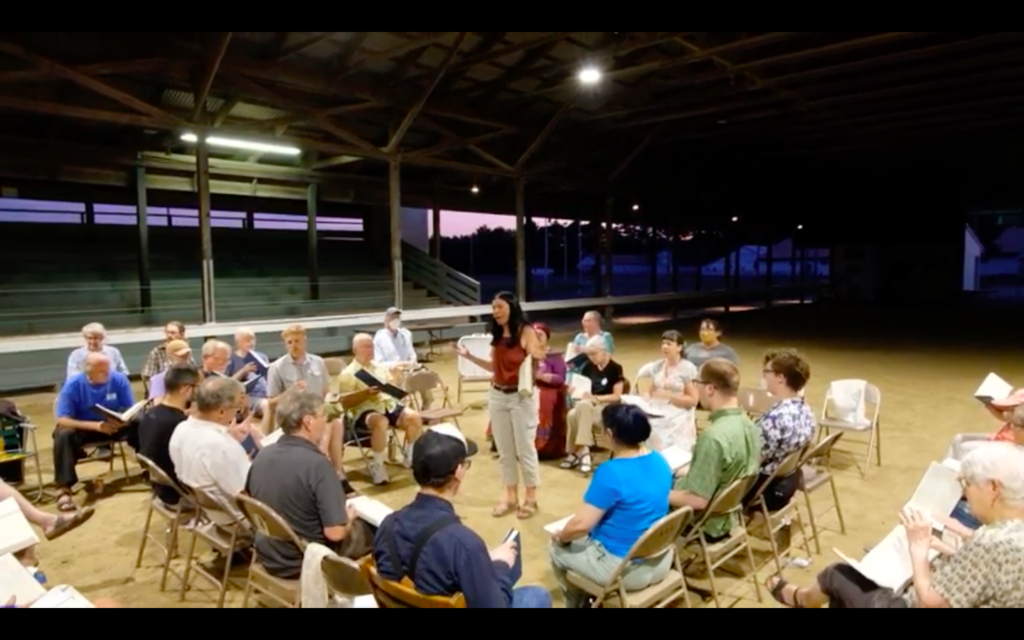
There were perhaps forty people at this Sacred Harp singing. I found it a little bit scary to be with so many people. (Though I was far more scared walking through airports when we flew to visit Carol’s father back in March — there were many more people in the airports, and anyone who was eating or drinking had their masks off.)

While I did find it to be a little bit scary, I also found it to be exhilarating. I’ve been too isolated during the pandemic. And I’ve done almost no in-person singing — no singing in choirs, no folk music jam sessions, no singing with a quartet, very little Sacred Harp singing. I’m not a particularly good singer, but before the pandemic, singing was my primary social outlet. Saturday’s singing event was definitely good for my mental health.

In this phase of the pandemic — this “more controlled phase,” to use Fauci’s words — we’re going to be balancing the threats from COVID against the threat that isolation poses to our mental health. It’s going to be a difficult balance to strike.

I’ll put a photo of the singing below the fold. But if you get triggered by seeing a bunch of people singing indoors at this point in the pandemic, don’t click through.

Continue reading “Post-pandemic singing”

Behind the scenes

Since 2020, I’ve been filming stories-for-all-ages in a puppet studio I put together in the nursery at the Palo Alto church. We’re about to resume infant and toddler care, so it’s only a matter of time before I have to remove the puppet studio from the nursery. But I managed to take some behind-the-scenes photos of puppets and puppeteers in action while filming a few last videos.

When we’re filming, the puppeteers mostly watch the action on the computer screen. Sometimes looking at the screen is disorienting and we have to look up at the puppets. We tape the script to the back of the puppet stage at our eye level. Puppets who are not in the current scene lie on the table next to us (you can see Possum in the lower left corner of the photo.)

Puppeteer view

This is what the camera sees when the zoom is set to the widest angle:

Camera view

A wider view, from behind the camera. We sometimes have up to seven lights aimed at the stage. Props are laid out on the table to the left of the puppet stage. When not needed in the current scene, the puppets stay in cloth bags, and you can see Rolf’s head poking out of the dark blue bag in the lower right corner of the photo.

View from behind the camera

I’ll miss the puppeteer studio when it’s gone. But I won’t miss sweating in that small room on hot days, with the doors closed to keep outside sound out. I won’t miss having to reshoot a scene because a helicopter went overhead, or someone started talking on their phone right outside the door, or the cello class started up unexpectedly, ruining the sound. I won’t miss having a carefully-constructed set suddenly decide to fall over in the middle of filming. I won’t miss spending fifteen minutes trying to level the camera, only to find that somehow, mysteriously, the stage has gone out of level. I won’t miss shooting video on a tight deadline with little margin for error. But… I will miss bringing Sharpie and Possum and the other characters to life.

Webpage with links to all videos, plus “Meet the Stuffies”

Toxic masculinity

Actor Will Smith slapped comedian Chris Rock during the Oscar awards ceremony. Now we learn that he was asked to leave but refused. I’ve been asking myself some questions about this incident….

— Why didn’t security remove Will Smith? Had he slapped a woman, of course he would have been hustled out of there. But a man hitting another man is somehow considered normal.

— Why a slap, and not a punch? Because a man defends his honor by slapping the other man. It’s a challenge to a subsequent duel. This continues to be a behavioral norm for men in Euro-American culture.

— If Chris Rock’s joke was aimed at Jada Pinkett Smith, Will Smith’s wife, why didn’t she slap him? Because this really wasn’t about Will Smith defending Jada Pinkett Smith. It was really about Will Smith defending his own honor.

— Why didn’t Will Smith stop to think about the example he was setting for all the teens and young men who idolize him (and he had plenty of time to think on that walk up to the stage)? Because he was passing along what he learned from previous generations of American men: Defend your honor with violence.

This incident is a classic example of toxic masculinity. The norms of toxic masculinity are deeply ingrained in our social structure. Men are trained from birth to defend our honor. We are socialized from birth to use violence.

I’d like to think that I would never do what Will Smith did. But if I’m honest with myself, in the right circumstances, I might. Yes, I’m a pacifist. I’m a feminist. I’ve taken on a non-standard gender role by working in the helping professions. But any American man could do what Will Smith did, given the right circumstances. Yes, even me. Even you….

Of course Will Smith should be held accountable for his bad behavior. But those of us who are men might also want to think about what this incident says about all of us. We men still have work to do to change what it means to be a man. Let’s use this incident to remind ourselves how important that work is.

Update: In response to a thoughtful email — (1) I’m not trying to excuse Chris Rock’s insensitive joke. (2) Most men do not consider it acceptable to slap another man. (3) One of the horrible things about toxic masculinity is that it damages all men (to say nothing of other genders).

Family memories

For a long time, I didn’t watch films or video. I used to tell people that online videos had spoiled me, so much so that I was no longer able to watch anything that lasted longer than 3 minutes. But what really happened was that I got sick of movies and television. It is true that I got caught up in the burst of creativity that marked the early days of online video, starting in about 2005. Remember some of those creative, interesting web series hosted on blip.tv? Then online video morphed into memes, cat videos, and brazen efforts to monetize monetize monetize. So I stopped watching film and video, again.

But recently I’ve found short films by some really good creative filmmakers on Vimeo.com. There’s also a lot of crap on Vimeo, as you’d expect. Here are some films worth watching, all relating to the topic of family memories:

Signe Barvild Staehr “The Nannies”

Devon Blackwell “Friends Who Remember”

Carole Nguyen “No Crying at the Dinner Table”

Carol encounters Bike life

Carol is a local bike activist, and she’s been working with MoveSanMateo to promote bike lanes in North Central, our old neighborhood in San Mateo (which we got priced out of when our landlord sold the building we lived in).

So when she heard that bo2focused was organizing a bike ride in North Central, the neighborhood where he grew up, she got other MoveSanMateo bicyclists to go and join their ride.

It wasn’t just a bike ride, it was Bike life. What is Bike life? It’s a subculture. It’s a bunch of young bike riders popping wheelies on city streets. Bike life sometimes puts together big rides, not unlike Critical Mass or Bike Party put together big rides. Just like Critical Mass, Bike life sometimes annoys motorists by filling up the public right of way with so many bicycles that cars and trucks have to slow down.

bo2focused posted some videos of Saturday’s ride, and Carol appears at the beginning of one of the videos, talking to one of the vendors who showed up.

Carol’s brief appearance in a Bike life Instagram video

Carol says she was probably the only bicyclist there who was over 40. She was also one of the few women, and one of the few white people. The Bike life people drifted in over next next couple of hours, and at last they started riding through North Central. Wheelies that last five or ten minutes, and bicyclists weaving around one another, are characteristic of Bike life. Carol decided to drop to the back of the pack, and then at a traffic light she lost the Bike life group. So she rode over to Wursthaus, where some of her MoveSanMateo bicyclist friends were hanging out and eating lunch to celebrate City Council approving the North Central bike lanes.

Bike life is not known for being cautious. After Carol left the ride, Bike life kind of took over the intersection at Delaware and Fourth. The police were called out, including a motorcycle cop who attempted to follow one of the bicyclists….

Click on the screen grab above to see the video on Instagram

Embarrassingly for the police officer, his motorcycle fell down. The Bike life group rode off down Delaware.

Continue reading “Carol encounters Bike life”