Thre are links to some stalwarts of the older generation of poets, including well-known figures like Maxine Hong Kingston. Among the older poets, I was pleased to see a link to some of Lawson Fusao Inada’s poetry. I used to have a book of his poetry which I quite liked but it must have disappeared in the last cross-country move. Reading his poetry again makes me want to get another of his books.
I enjoyed seeing a link to Indran Amirthanagayam’s poems. He’s almost exactly my age (an old guy), and I first saw him maybe forty years ago when he was the lyricist and lead singer of a punk rock band. Now he’s older, respectable, a U.S. diplomat — but his poems still have some of that punk rock energy.
I was also pleased to see links to younger poets like Chen Chen and Ocean Vuong. To my shame, I haven’t kept up with younger poets. It looks like this will be a good way to get introduced to some of the newer poets.
It’s Asian American Pacific Islander Native Hawaiian heritage month, and to celebrate I’ve been reading poetry — mostly by Americans of East Asian and South Asian descent (I had to narrow things down a bit, so left off West Asia and all the Pacific Islands). I’ve also been dipping into some Asian poetry. Here are some comments on two books I’ve been looking into:
They Rise Like a Wave: An Anthology of Asian American Poets
ed. Christine Kitano and Alycia Pirmohamed (Blue Oak Press, 2022) — I’m really enjoying this collection. No, I haven’t liked all the poems. But I have felt that even the ones I didn’t care for were worth reading. And there are some real gems in this book, like Mai Nguyen Do’s poem “Ca Dao,” which begins:
The rice field is the oldest concert hall. I’ve sung for four thousand years here: in my mother, my grandmother, the mother goddess, God. I’m already dead when I’m singing….
Do gives the feel of folk poetry, as you’d expect from the title (“ca dao” is a term for Vietnamese folk poetry). Yet the poem itself is very contemporary. The combination makes for a haunting and memorable poem.
I also liked Mary-Kim Arnold’s poem “Forgotten War” very much. At first, it might sound a little didactic in places, but the total effect is not at all didactic. Arnold takes us from scenes of the Korean War to a scene in a U.S. bar, and a few other places along the way. In the powerful last stanza, she says:
You can stay up all night counting corpses and still not know who you are. You can open your mouth to speak but still not know your own name.
Overall, it’s a high quality collection with a wide range of contemporary poets, from a wide range of Asian backgrounds — West Asia, South Asia, East Asia, Pacific Islands. Highly recommended.
Your Emergency Contact Has Experienced an Emergency
Chen Chen (BOA Editions, 2022) — I liked Chen Chen’s first book of poems, and had high hopes for this new book. There some good poetry here, but the collection doesn’t have the energy and humor which marked the first book. And lines like this one made me lose interest: “I mean, is ‘shit,’ is ‘scat’ more or less literary than ‘poop’?” — that kind of line in the midst of a love poem just sounds academic and self-indulgent. Yet as I say, there’s some good poetry here. For example, I like the first stanza of “The School of Australia”:
Your emergency contact has called to quit. Your back-up plan has backed away. Your boyfriend has joined a boy band named All Your Former Boyfriends….
The rest of the poem doesn’t live up to the promise of that first stanza. But it’s worth reading through this book to find little gems like that. And there’s no doubt that Chen Chen is a poetic talent worth watching. Worth reading.
Focused as I am on my favorite obscure corners of popular culture, I usually miss the really big worldwide trends. So I was completely unaware of The Wiggles until I read about them on a science fiction fandom blog.
If you too have remained blissfully unaware of The Wiggles, they’re an Australian band that released their first album in 1991. The Wiggles write and perform songs for preschoolers (and their parents); three of the four of original members of the band had degrees in early childhood education.
I did a deep dive into Wiggles subculture today. I listened to a bunch of their music. I read about how children would come to live shows dressed as Emma, the Yellow Wiggle, complete with yellow dress and yellow bow in their hair. More importantly, while watching their videos, I saw how they create developmentally appropriate live performances and videos. Yes they’re primarily entertainers (not educators), yes there are problems with what they do, but on the whole I’m impressed with the way they treat young children with respect.
As one small example of what I mean about treating young children with respect: When they begin a live performance, they do not say, “Hello, boys and girls” — a vaguely condescending formula that leaves out parents — they say “Hello, everyone.” That’s really thoughtful.
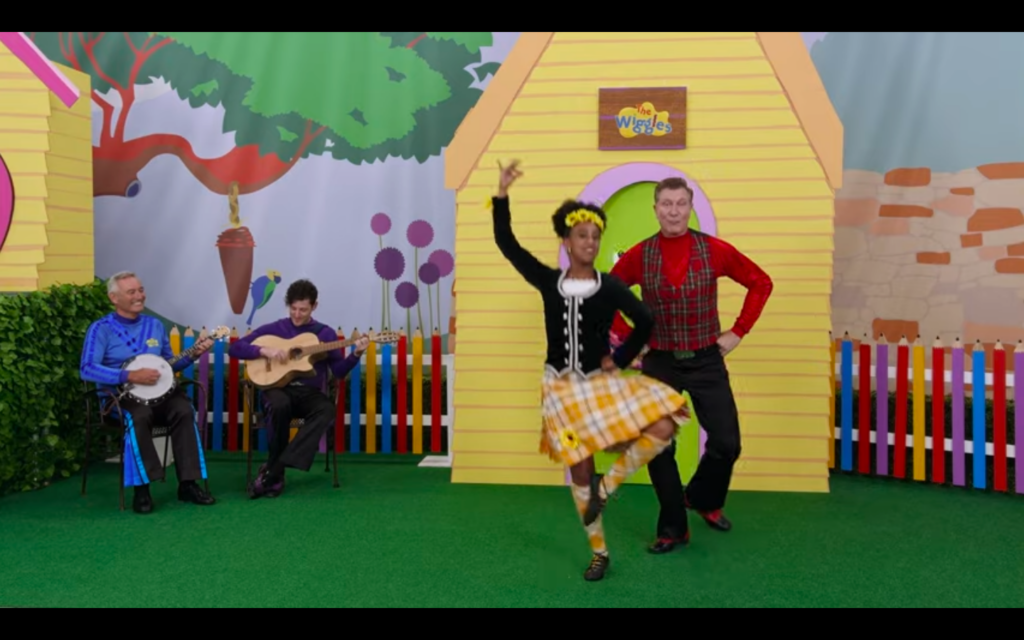
I’m also impressed with the way they’re changing with the rapidly chaning culture around them. Take, for example, their video “Di Dicki Do Dum” released last August. In the dance routine, Tsehay Hawkins, the yellow Wiggle, and Simon Price, the Red Wiggle, combine Euro-folk dance with urban dance moves. This kind of cultural mash-up is A Big Thing in the obscure world of folk dance. The venerable Cecil Sharp House in England, center of the universe for many who do Anglo-American Euro-folk-dance, now mixes all kinds of folk dance traditions:
“‘Hip-hop is the folk dance of today,’ said Natasha Khamjani…. They’re both social dances created for crowd participation, both also existing on the fringes of the mainstream, she added. Khamjani was taking a quick break during a rehearsal of a high-energy performance blending Bollywood moves and English country dancing with the unmistakable bounce of hip-hop moves.” [As reported by the BBC]
The Wiggles also make pretty darned good music. Both the singing and the accompaniment in the “Di Dicki Do Dum” video are really well done. The music has to be good. Preschoolers are going to listen to recordings of the sings over and over and over and over again. If the music sucks, parents are going to tear their hair out, and never buy any more Wiggles music or go to any more Wiggles shows.
Looking at The Wiggles videos makes me think about what we do in our Unitarian Universalist religious education programs and in our worship services. Unlike The Wiggles, we’re not in the entertainment business. But if we really want to welcome families with young children, I realized I can learn a lot from them: awareness of developmental appropriateness, respect for audiences, use of dance and movement, respectful cultural mash-ups, and so on.
Having said that, I’m now done with The Wiggles. And trying desperately to forget their songs.
As David Pierce points out in his article, the ActivityPub protocol has the potential for making social media more like email (in a good way). Email is an open protocol. If social media ran like that, you could post on Facebook and your friends on Twitter, Youtube, Instagram, and TikTok could all see your posts; they could also react to your posts and respond to them.
This could change the way websites work, including this website/blog.
Especially now that WordPress is working on implementing the ActivityPub protocol. Since something like a third of all websites are based on WordPress, that’s a big portion of the web that could wind up being compatible with the ActivityPub protocol. WordPress is also looking at a few other, similar open protocols such as Nostr and the AT protocol, so it seems likely that they will implement some kind of open social media protocol.
This makes me think seriously about installing the ActivityPub plugin on this blog. If I do, you’ll be able to follow this blog from Mastodon, and also from Medium, Tumblr, and Flipboard, all of which are integrating with ActivityPub protocol in various ways.
So… when I can find the time… I’ll install ActivityPub on this blog and see how it goes….
From the novel Second Sister by Chan Ho-Kei, a native Hong Konger. The novel is set in Hong Kong in the year 2014, and follows the adventures of Au Nga-Yee as she tries to find out why her sister Siu-Man committed suicide by jumping from the window of their apartment. Without spoiling things for you, I can safely tell you that the plot involves social media, the Dark Web, and the tech industry. Nga-Ye has to hire N, a hacker and a most unusual detective, to figure out what really happened to Siu-Man.
Late in the book, N, the detective, reflect on his motivations for continuing to work as a detective:
“The word he hated most in the world was ‘justice.’ Which wasn’t to say he didn’t know the difference between good and evil — but he understood that rather than simplistic morality, most conflict in the world arose from differences of opinion, with both sides raising the flag of justice and claiming to be on the side of reason. This allowed them to justify the most underhanded means as ‘a necessary evil’ to defeat the other side — the law of the jungle, essentially. N had a deep understanding of this. He had money, status, power, and talent, so he could do pretty much whatever he wanted and other people would see him as an avatar of ‘justice’ — but he knew that keeping others down in the name of justice is another form of bullying.” (Chan Ho-Kei, trans. Jeremy Tiang, Second Sister [2017; trans. Grove Atlantic, 2020])
While this passage merely represents one character in a murder mystery talking to himself, there is some truth in what this character says. It is all too easy to misuse the word “justice.”
I’ve long been skeptical of the philosophical concept of the “social contract.” It always sounded anachronistic to me. The social contract is supposed to go back to prehistory, but the whole notion of a “contract” is actually a modern Western notion.
But I never thought about who gets to participate in the social contract. Back in 1997, Charles W. Mills published “The Racial Contract” in which he takes on philosophers like Rousseau, Hobbes, and Kant. Apparently, in that book he argues that the people who get to participate in the social contract are white people. And if white people are the only people who get to participate in the social contract, then people of other skins colors… well, maybe they aren’t really people, but sub-people.
Today is National Library Workers Day. I managed to thank three librarians. I got the official name of the day wrong (I kept calling it “National Library Staff Appreciation Day”; I have no idea where I got that from). But I got the sentiment right.
If it seems kind of corny to thank a librarian or a library worker — it’s not. Library workers were on the front lines during the COVID lockdown, arranging for pickup of library books, getting coughed on by thoughtless library patrons who came to pick up books, putting together online resources to keep library patrons sane, and more. Then in the last two years, librarians have been on the front lines of the culture wars; the American Library Association recently reported that “for a second year in a row the number of books targeted for censorship nearly doubled from the previous year.”
One of the purposes of National Library Workers Day, by the way, is to “advocate for better compensation for all library workers.” Librarians are often woefully under-compensated; I think this is partly because library work is often viewed as “women’s work,” which to many people means it’s worth less. But librarians are actually critically important because they help promote the free and unfettered flow of information upon which a healthy democracy is founded.
Finally, Thursday is National Take Action for Libraries Day. That’s the day when you are encouraged to write to your elected representatives and tell them how important it is to support libraries. The theme this year is “Tell Congress: Stand Against Censorship.”
I can’t figure out if this is anti-intellectualism or something stranger. But a website calling itself the “Washington Free Beacon,” which is funded by conservative billionaire Paul Singer, recently ran a hatchet-job piece about Lucas Kunce, a Democrat in Missouri who plans to run for U.S. Senator in 2024. Of course a conservative website is going to oppose any Democratic candidate in this polarized world. But one of the reasons they gave for opposing Kunce was not his political policies, but the fact that he plays Magic: The Gathering:
“…In a free and just society, playing Magic: The Gathering with a journalist would disqualify someone from seeking public office. To paraphrase one of America’s most formidable intellectual prognosticators: ‘We don’t want nerds elected in Missouri….'”
(They link that phrase “formidable intellectual prognosticator” to a low-quality Youtube video of Donald Trump saying, “We don’t want perverts.”)
I’m not going to provide a link to the Washington Free Beacon hatchet-job, because as an ad hominem attack, it doesn’t deserve any incoming links. (I also won’t link to leftist websites that indulge in ad hominem attacks.) But you can read more about the Lucas Kunze story at File 770, a nerd website that I read regularly.
Anyway. I guess the Washington Free Beacon is saying that no one can be a political conservative who plays Magic (35 million people do so) — nor by extension can any other nerds, including people who read science fiction, watch Star Trek, are good at math, think science is cool, etc. This is political polarization run amok.
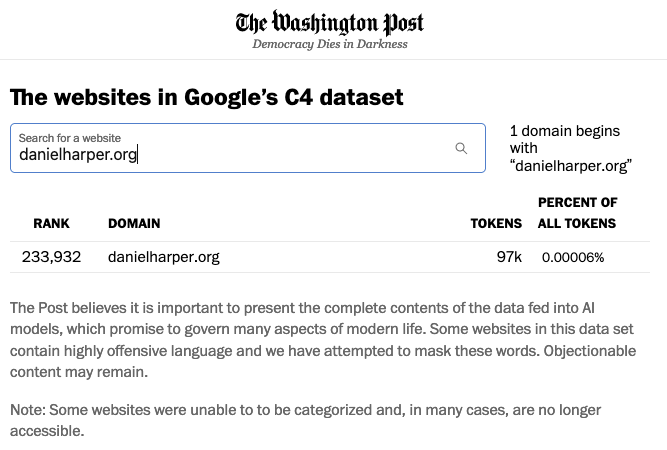
The Washington Post investigated which websites got scraped to build up the database for Google’s chatbot. The Post has an online tool where you can check to see if your website was one of the ones that got scraped. And this online tool shows that danielharper.org was one of the websites that got scraped.
True, there were 233,931 websites that contributed more content than this one did. Nevertheless, I’m sure that Google will compensate me for the use of my copyright-protected material. So what if they used my material without my permission. Soon, a rep from Google will reach out to me, explaining why their scraping of my website is unlike those sleazy fly-by-night operations that steal copyright-protected material from the web to profit themselves without offering the least bit of compensation to the author. Not only will they pay me for the use of my material — they will also issue a written apology, and additional compensation because they forgot to ask permission before stealing, I mean using, my written work.
I heart Big Tech. They’re just so honest and ethical.