You have to enter your name, address, and email to access the free downloads; I haven’t yet taken the time to do that. But I’ve seen one of their arrangements, “Love Call Me Home” by Peggy Seeger, and it looks pretty good. My musician friend recommends everything they produce.
Yet another news article about a religious group taking a public stand that homosexuality is sinful: the Christian Reformed Church in North America did so in its national meeting last month. Because of this stance, several open and affirming Christian Reformed Churches have to decide what to do. Do they disaffiliate, or kick out their openly LGTQ+ members and staff? The news article offers this insight:
“‘I think it’s because of the culture wars in the United States that the [Christian Reformed Church] synod has decided that they’re going to push this issue,’ said Henry DeMoor, a professor emeritus of church polity at Calvin Seminary who has watched the unfolding clash and belongs to another Christian Reformed Church in Grand Rapids. ‘It seems like we have divided the church, the way the Republicans and the Democrats divide politically.'”
Politics has long influenced US religious history. Back in the mid-nineteenth century, Protestant denominations split over the issue of slavery. Baptists, Methodists, Presbyterians, and other Protestant groups split because of differing views on slavery and anti-Black racism.
Religion does not belong to some Platonic Realm of Truth which is somehow separate from daily life. Religion is thoroughly enmeshed in the ordinary concerns of day-to-day living. And right now, US society is deeply divided over how to address ongoing racism, and how to understand human sexuality. These deep divisions are going permeate every aspect of human society, including religious organizations.
Religion is of this world. For someone like me, this is a good thing because it means that religion is actually of use in dealing with day-to-day problems. But that also means religion is not going to be some idyllic oasis where you can escape from reality — religion may help you deal with reality, but it is not going to separate you from reality.
“On June 17, 1976, on the fourth anniversary of the Watergate break-in, seven students at Concord-Carlisle Regional High School re-enacted the operation by bungling a break-in at the principal’s office. I was one of them….”
You can read JB’s piece to find out what happened to us when the vice-principal caught us.
Now, JB contends that in many ways, times were more innocent in the 1970s. There’s some truth in that contention. For example, while many of today’s high schools have armed cops patrolling the hallways, all we had was a couple of unarmed undercover narcotics agents. On the other hand, there was that race riot at our high school in our senior year (an event I want to write about some day, when I can find the time to research it more fully). Or if you were gay, as one of my close friends was, that high school could get ugly.
But more to the point, it may be that time has blurred our memories of the utter venality of Richard Nixon and his henchmen. Yes, the Watergate break-in was less violent than the armed insurrection at the Capitol building on Jan. 6. But if you really think about it, the extent of Nixon’s criminality, and his naked desire for raw power, still have the capacity to astonish us.
Seen in the blogosphere: “…internet search is broken these days….”
I’m so glad others have noticed this.
Internet search is broken in many ways. Like this: Sometimes I don’t want searches that only apply to the U.S., or another smaller geographical region. And I don’t want any search to point me to websites obviously pirated from other sources and rewritten by crap “AI” tools. And if I put something in quote marks, I don’t want search results that don’t include that exact search string. And if I search for a given search string and add “site:.sampledomain.com” I don’t want to see search results from other domains. And so on….
The whole nonbinary gender thing is new and different, right? I mean, that’s why old people are so worked up about transgender and nonbinary, because it’s so new. Right?
Well, no. Now that I’m officially past the age of sixty, I qualify as old people (you can’t call me middle-aged, that’s for sure). And to me, non-binary gender seems normal. It doesn’t feel new at all. So how come an old guy like me feels that way?
Russell Arben Fox has been doing a series on pop music from 1983 at his blog In Media Res. I’ve been following his series in a desultory fashion, and I finally tumbled to one of his main point — that a lot of pop music from the early 1980s bent or broke gender norms. David Bowie was especially well-known for androgyny. I remember a friend, someone we’d now call nonbinary gender, commenting on how great it was that Bowie was so publicly gender non-conforming. Prince came along a bit after Bowie, became far more famous, and was just as androgynous. Among less well known musicians, Annie Lenox, the lead singer of Eurythmics, frequently wore androgynous clothing. In the New Wave band The Human league, singers Philip Oakey, Susan Ann Sulley, and Joanne Catherall, wore the same makeup. The list goes on….
Catherall (l) and Oakey (r) of The Human League, from the video “(Keep Feeling) Fascination”
You can find a lot of androgyny in early 1980s pop music. It was the logical extension of cultural trends that began in the 1960s — guys with long hair and big Afros, the feminist revolution challenging gender roles, and so on. By the early 1980s, Poly Styrene of X-Ray Spex felt no need to play the role of a sexy girlie lead singer — she could just be herself without being forced into someone else’s (mis)conception of what it meant to be female. Nor was it just the musicians — that’s what people going to clubs, or just listening to the music, were doing, too.
That historic moment didn’t last long. The Reagan revolution rolled back progress in gender. The Clinton years cemented the regression. In this century, everyone seems to have forgotten that nonbinary gender was a thing, before it was even called nonbinary gender. I’d forgotten about it until I started looking at those old music videos from that era. But it did happen. For a few years, when I was in my late teens and early twenties, androgyny was socially acceptable (in the big cities, anyway). As a product of that era, no wonder I’m much more comfortable with nonbinary gender than with the strict gender roles and gender norms that came later.
Personally, I’m glad nonbinary gender is back. I feel it’s much easier than everyone being crammed into the same tiny little gender boxes. Sigh. Too bad Ron DeSantis and the Florida state legislature don’t feel the same way.
One of the reasons some people give for leaving organized religion is that they’re disgusted by the hypocrisy of organized religions in allowing sexual abuse to go on. But from what I can see, all of our human institutions are open to abuse. Schools, politics, the for-profit world, entertainment, sports — all of these human institutions are capable of harboring and hiding abusers.
I’ve come to believe that the next big abuse scandal is going to erupt in school sports. We’ve seen the beginnings of this in girls’ gymnastics, but I think it’s going to get much bigger than that. School sports often require very little supervision of coaches and other adult leaders, and many coaches and adult leaders don’t get much oversight from any authority that can really hold them accountable. We’ve all heard of those schools where the school principal would lose their job if they dared to criticize a winning football coach. But this lack of accountability and oversight is the perfect environment for sexual predators — which means that there’s a high probability that sexual predators have sought out positions in schools sports in order to have access to victims.
With that in mind, it’s enlightening to read Dan Kennedy’s blog post on how school sports are avoiding scrutiny for racist and homophobic harassment. The Massachusetts Interscholastic Athletic Association (MIAA) has been stonewalling journalists who are trying to report on school sports harassment. This is classic behavior in situations where legal minors are being abused, where the watchdog is guarding the perpetrators rather than guarding the victims.
Journalists are reporting that the MIAA receives around one new complaint a week. Yet the MIAA is defying state public records law by refusing to make those complaints public. Ironically (or maybe not), the lead journalist working on this story is with the Boston Globe, the newspaper that uncovered the Catholic sexual abuse scandal nearly two decades ago.
Again, speaking from my experience of nearly three decades of youth work, the current situation in school sports may provide the perfect cover for adults who want to abuse kids, whether that abuse involves sexual abuse, humiliation, or some other sick power trip. The solution to the problem is the same as with the church abuse crisis: open and transparent supervision of all adults leading school sports; watchdog groups that don’t engage in cover-ups; expulsion of abusive adults regardless of how charismatic or talented they may be. But at the moment, the school sports juggernaut appears to be even more resistant to reform than the Catholic church hierarchy was twenty years ago.
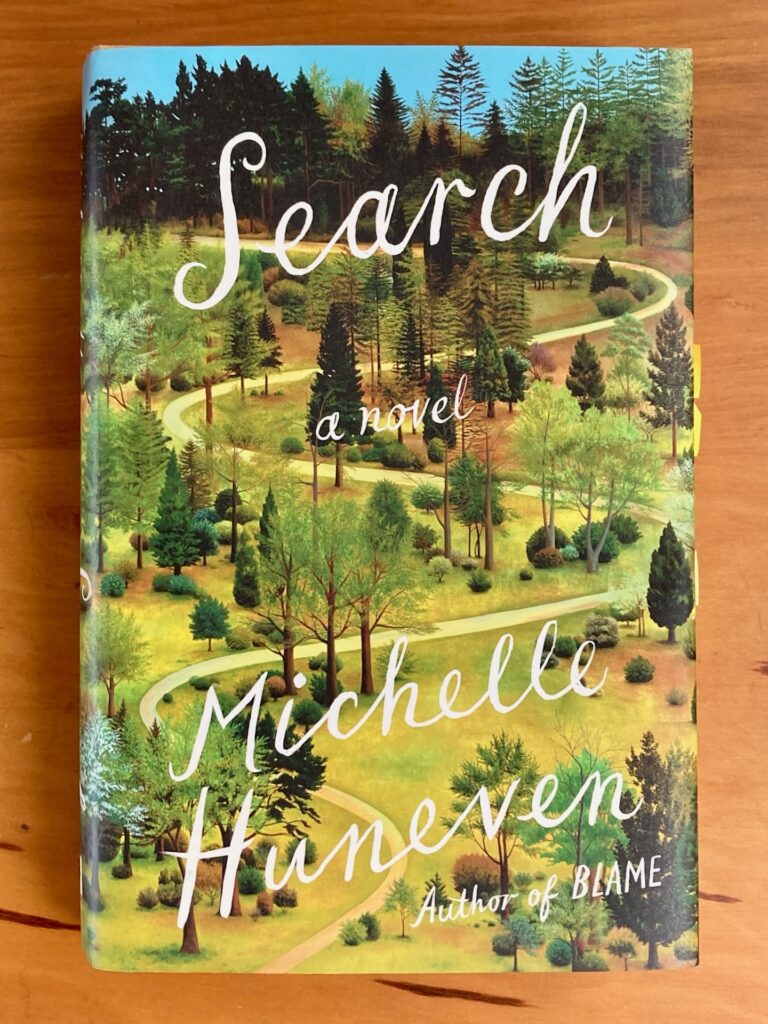
Bev loaned me the book Search: A Novel (Penguin, 2022), by Michelle Huneven. Search is the story of a ministerial search committee in a Unitarian Universalist congregation in southern California during their year-long process to find someone to replace their retiring minister. Michelle Huneven actually served on a ministerial search committee, and the book is a fictionalized account of her experiences. Bev, who loaned me the book, is a long-time lay leader who has lived through six different ministerial searches in the past quarter century. She told me that I really need to read this book. So I did.
(Spoiler alert: I’m going to reveal key elements of the book’s plot. Continue at your own risk.)
I was talking with someone about how we were both feeling a bit out of sorts — little things like getting appointments slightly wrong, nothing really serious but constantly annoying. We both had good reasons for feeling a bit out of sorts (for my part, I moved, started a new job, my partner’s father died). But I’ve heard quite a few other people say they feel the same way. So I said to this other person, The pandemic emergency officially ended a couple of months ago, but I feel like it’s still lingering on; I mean, this time last year, we were still in partial lockdown. This other person said, It’s like we all have PTSD. I said, I’m not a clinician, I’m not qualified to diagnose PTSD, but I think you might be right.
Recently, I read an article quoting a Juneteenth activist saying something like: The time between Juneteenth and July 4 should be a sixteen day celebration of American freedom. Opal Lee, who championed the holiday for many years before it became a reality, said: “Juneteenth will be the bridge that we can all go over. We should celebrate from June 19th to the 4th of July!” As someone who grew up celebrating Patriot’s Day — April 19, or the commemoration of the Shot Heard Round the World — I agree that we need more days to celebrate the American dream of freedom. So I’m grateful that my employer decided Juneteenth is a paid holiday for staff at our congregation, and I’m using the day to celebrate American freedom.
Although maybe I’m celebrating U.S. freedom in an unusual way. For me, an important result of freedom in the U.S. is the freedom we have for artistic expression. And with that in mind, this Juneteenth I’m celebrating by listening to music by Anthony Braxton. National Public Radio has said of him:
“Anthony Braxton has always done things his own way. He’s famous for creating his own musical syntax and strategies, in work that straddles jazz and classical traditions but conforms to no established pattern. He is a true American original — and by his own account, a perpetual work in progress.”
Isn’t that perfect for a celebration of American freedom?… combining cultural influences… conforming to no established pattern… creating your own way… a perpetual work in progress.
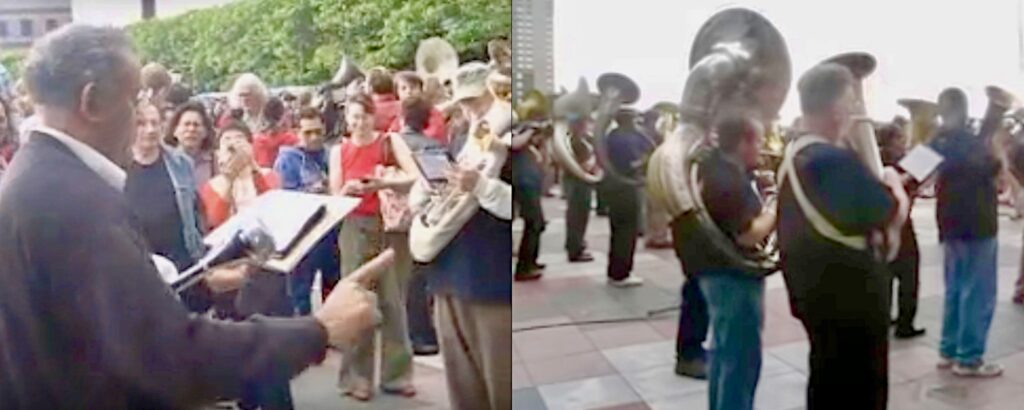
With that in mind, today I’m listening to one of my favorite works by Braxton: “Composition No. 19 (For 100 Tubas).” A recording is available from Braxton via Bandcamp. You can also see two short video clips of an outdoor public performance here and here. While I suspect Braxton would resist any easy interpretation of this composition, I can’t help but hear this as being in small part a musical commentary on John Philip Sousa’s patriotic marches, but in a musical idiom that is much more powerful and much more nuanced.
Composite of two screen grabs from the “100 Tubas” videos. Braxton is shown at far left.
Update, 6/19:Here’s a video of another performance. Definitely worth watching, since there’s a whole visual aspect of this composition, too. Update, 6/20: Added Opal Lee quote.