“Alt tet”Alt text” is text that you add to images on your website, so that people who are blind or have impaired vision can use their screen reader to tell them what the image is. I’ve been very bad about adding alt text to images on this blog, partly because I was unsure how much detail I should go into.
Well, someone on Mastodon pointed out this guide to writing alt text on the UX Collective website: “How to write an image description.” The author, Alex Chen, suggests a model format he calls “object-action-context.”
Then Chen provides examples of alt text using his object-action-context model. He goes into details like how long alt text descriptions should be (it varies depending on the image). He also points out that any image description is better than none at all.
Chen has inspired me to add alt text to all images on my websites, and (more importantly) on our congregation’s website.
When I arrived at First Parish in Cohasset in August, I started watching for newcomers. Of course, I didn’t know most of the people, but each Sunday I would ask the long-time members if there were any newcomers.
We had no newcomers in August. One in September. None in October. Then two so far in November.
As a former salesperson, when I see so few newcomers I immediately assume that there’s no marketing going on. That’s what marketing does — it reaches people who are new to your business (and a small nonprofit organization like a congregation is a business). The primary form of marketing for most Unitarian Universalist congregations is a website. So I decided to take a look at the First Parish website. I found that since the COVID pandemic had started, there had been very little new material added to the website (no surprise there, people were busy doing other things). The administrator and I started adding content to the website at least weekly, beginning in October. Sure enough, we got a couple of newcomers stopping by in November.
I’d like to believe the tiny uptick in newcomers is a result of our markting efforts. Of course I know this is the worst kind of evidence — it’s all anecdotal, there’s no way of proving a causal relationship, etc., etc. I know that I could simply be deluded by confirmation bias here — I see something that confirms what I already believe, and continue to believe what I believe.
But I still think marketing works. If your website is your only form of marketing, then paying attention to your website should yield dividends.
“I think what is important is that we move away from thinking of allyship as something we are, but instead think of it as something we do,each time we do something. Each time we want to contribute to a particular struggle for justice, we must decide what must be done in the moment, irrespective of what we have done before or what type of person we think we are.”
I came away from this blog post thinking that if I hear someone saying they are an ally, this may not mean much. I’m going to watch what they do instead of listen to what they say they are.
Jew or Judean?
Marginalia hosts a scholarly debate on how to translate ioudaioi in texts from the last centuries BCE and the first few centuries CE. Does it mean Jew or Judean? While this may seem like a big argument over a trivial detail, the scholars involved claim the stakes are higher than you’d think.
For example, if you translate ioudaioi in the Gospel of John as “Jew,” then that could reinforce one of the foundations of Christian anti-Semitism. The ioudaioi, the Jews, killed Jesus. Whereas if you translate ioudaioi as “Judean,” someone from the land of Judea, maybe you can undermine that foundation of anti-Semitism.
But other scholars argue that in some texts, ioudaioi is better translated into modern English as “Jew,” sometimes as “Judean.” It all depends on the context. And we don’t want to inject anachronisms into translations.
Another point comes up: Is it anachronistic to talk about Judaism as a religion in this era? Was Judaism more of an ethnic identity than a religion? (In a related story, Haaretz reports on archaelogist Yonatan Adler’s new book that advances the claim that the archaelogical record does not show evidence for Jusdaism as a religion before the 2nd century BCE.)
Dare You Fight?
Editor Neal caren is creating an online collection of W. E. B. DuBois’s articles for The Crisis. These articles were written between 1914 and 1934, and many have not been collected previously.
DuBois’s essays are fascinating to read. His articles for The Crisis sounds radical even by today’s standards.
“It’s not entirely the Twitter people’s fault. They’ve been taught to behave in certain ways. To chase likes and retweets/boosts. To promote themselves. To perform. All of that sort of thing is anathema to most of the people who were on Mastodon a week ago…. To the Mastodon locals it feels like a busload of Kontiki tourists just arrived, blundering around yelling at each other and complaining that they don’t know how to order room service.”
Although I’m most emphatically not a Twitter user (I left Twitter in 2014, not in 2022), I am a new Mastodon user. I hope the Mastodon users don’t see me as behaving badly….
I’ve been looking for a better social media outlet for a while now. I stopped using Twitter years ago because it got too nasty. I’ve stayed on Facebook mostly because I have a lot of friends from Sacred Harp singing there — but Facebook is mostly an ugly place, and I don’t like the way they steal all our data. Several years ago, I tried Diaspora, an open source decentralized social media project, and while I liked the software architecture, there wasn’t enough content to interest me.
Over the past few months, I’ve been hearing about Mastodon, another open source de-centralized social media project. I checked it out, but it felt like too much work, so I let it drop. Then yesterday I logged onto Facebook to check on a Sacred Harp singing, and the Facebook algorithm placed some unpleasant content where I had to see it. Time to take another look at Mastodon.
And yesterday, it turned out, was the day when there was a huge migration of academics and others from Twitter to Mastodon.
Screen grab from Mastodon showing graph of uptick of people joining Mastodon yesterday
Many local Mastodon servers (known as “instances”) were overwhelmed, and stopped accepting new accounts. But I finally found an instance I liked, which was open, and set up an account.
Wow.
So. Much. Better. Than. FB or Twitter.
Mastodon does not have some creepy opaque algorithm controlling what you get to see. If you want to see every post (called “toots” on Mastodon), you see them in chronological order. If you want to see every toot on your local instance, same thing. If you want to read just the toots from the people you’re following, you get to see them all, in chronological order.
There are lots of interesting people on Mastodon. I found quite a few academics. A robust community of amateur radio operators. Lots of science fiction fans. Tons of political junkies. Most major news outlets are now doing something on Mastodon.
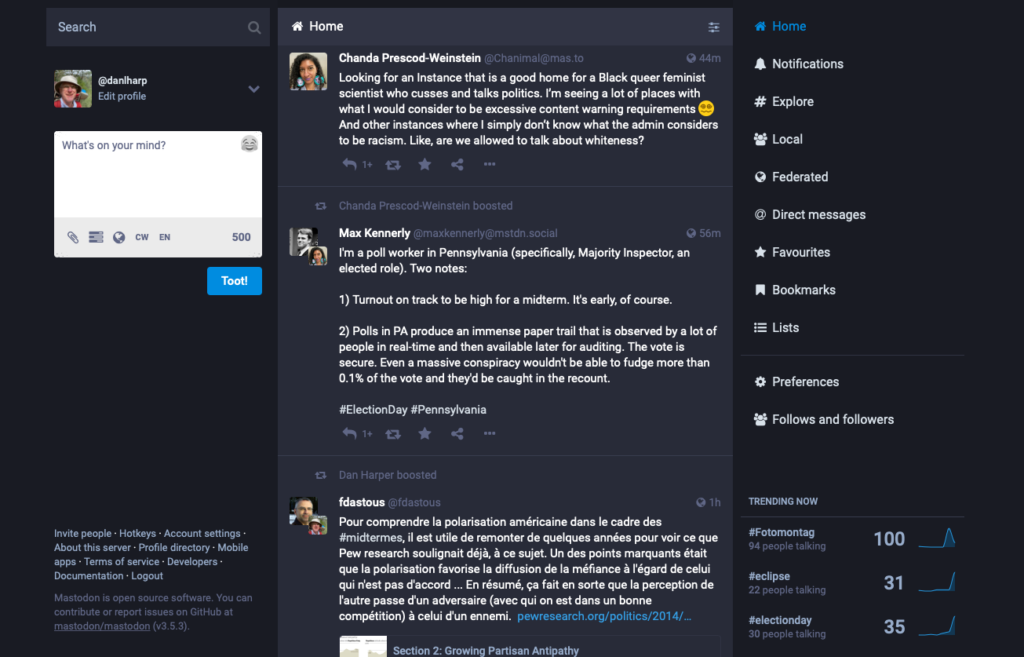
Screen grab of my Mastodon home page, today at about 10:30 a.m.
It would be nice to see more Unitarian Universalists on Mastodon. I think it could be a better match for our values than the big commercial social media companies. If you set up an account, Mastodon relies heavily on hashtags, and the Unitarian Universalist hashtag appears to be #UU — include that in your profile so the rest of us can find you.
Admittedly, Mastodon is not for everyone. While it’s relatively easy to use, there is definitely more of a learning curve than with the commercial social media outlets. Nor is it a replacement for Twitter or Facebook — it is different from both. But for me (so far), it’s much better than the cesspools of Facebook or Twitter.
A decade ago, a small software company called XtraNormal allowed you to make free animated videos online. You’d choose a character, input some text, pick a few gestures, and the software would do the rest, posting the final video on Youtube.
I thought this was a great idea. I started out with a video of a robot telling the story from the Gospel of Thomas, ch. 97, the parable of the empty jar. Then I did a video of a robot telling the story of the rich young man from the Gospel of Mark, ch. 10. By the time I thought about it again, XtraNormal had stopped giving away their services, and had converted everything to Windows-only software. I wouldn’t have minded buying their software, but I’d be damned if I’d buy a Windows machine just to run their software. So I only made those two videos.
I never posted the second video on my blog, so here it is, ten years late:
(Note that I moved this video, and the first video, from Youtube to Vimeo. During the move, I improved the audio a little, and tightened up the editing a bit.)
Since 2020, I’ve been filming stories-for-all-ages in a puppet studio I put together in the nursery at the Palo Alto church. We’re about to resume infant and toddler care, so it’s only a matter of time before I have to remove the puppet studio from the nursery. But I managed to take some behind-the-scenes photos of puppets and puppeteers in action while filming a few last videos.
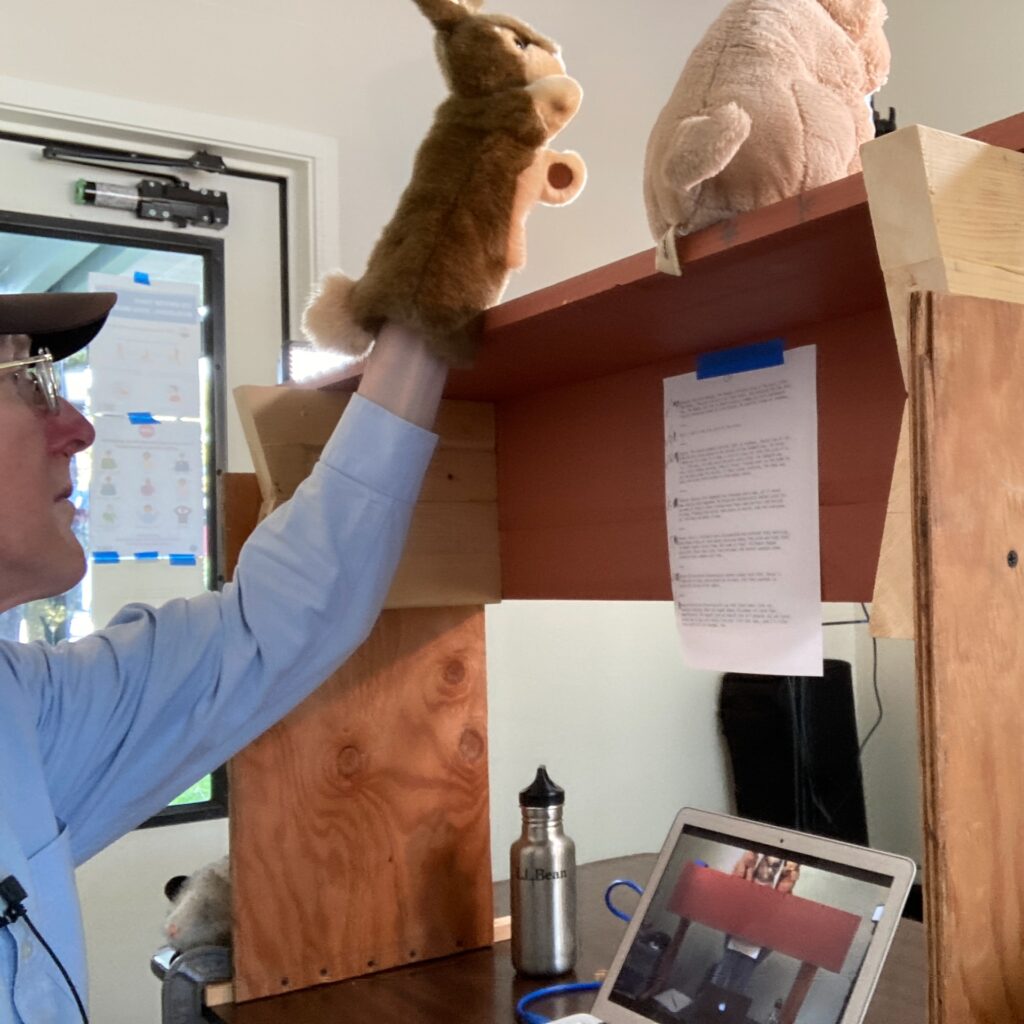
When we’re filming, the puppeteers mostly watch the action on the computer screen. Sometimes looking at the screen is disorienting and we have to look up at the puppets. We tape the script to the back of the puppet stage at our eye level. Puppets who are not in the current scene lie on the table next to us (you can see Possum in the lower left corner of the photo.)
Puppeteer view
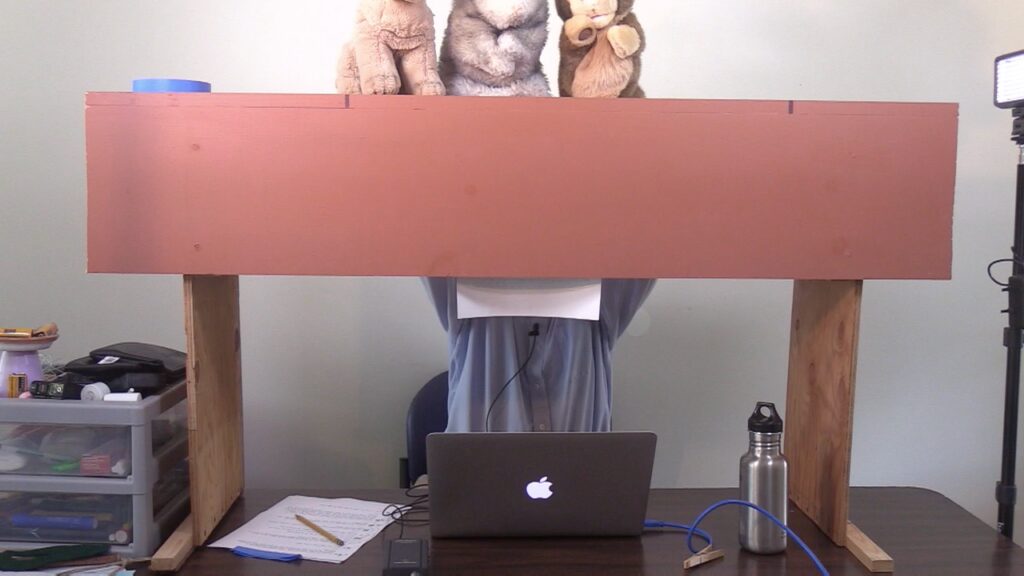
This is what the camera sees when the zoom is set to the widest angle:
Camera view
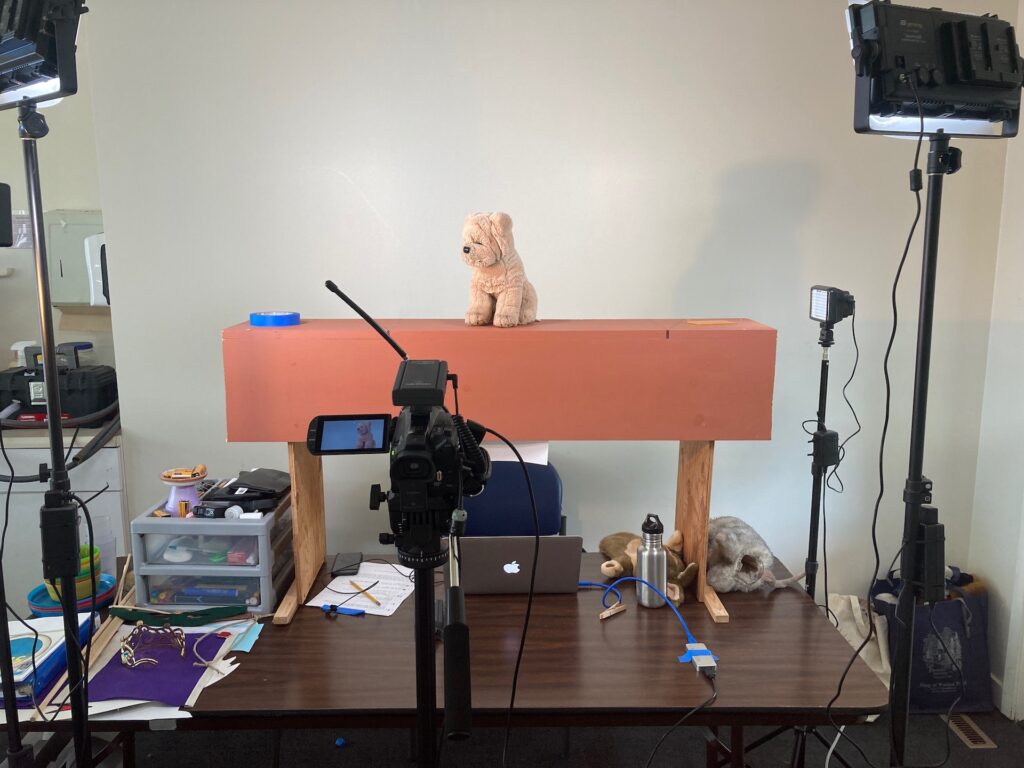
A wider view, from behind the camera. We sometimes have up to seven lights aimed at the stage. Props are laid out on the table to the left of the puppet stage. When not needed in the current scene, the puppets stay in cloth bags, and you can see Rolf’s head poking out of the dark blue bag in the lower right corner of the photo.
View from behind the camera
I’ll miss the puppeteer studio when it’s gone. But I won’t miss sweating in that small room on hot days, with the doors closed to keep outside sound out. I won’t miss having to reshoot a scene because a helicopter went overhead, or someone started talking on their phone right outside the door, or the cello class started up unexpectedly, ruining the sound. I won’t miss having a carefully-constructed set suddenly decide to fall over in the middle of filming. I won’t miss spending fifteen minutes trying to level the camera, only to find that somehow, mysteriously, the stage has gone out of level. I won’t miss shooting video on a tight deadline with little margin for error. But… I will miss bringing Sharpie and Possum and the other characters to life.
I’ve been looking — for quite a while now — for a teaching resource of some kind that shows how some Christians and some Christian groups do in fact support persons of non-binary gender.
The anti-LGBTQ+ Christians are loud and vocal, and they dominate both media and the popular imagination. But I know there are plenty of progressive Christians who feel their religion is fully compatible with being LGBTQIA+. Unfortunately, as is so often the case in our society, most people think it’s a zero-sum game, so the loudest group gets to take charge of the discourse. In addition, as is so often the case in our religiously illiterate society, everyone seems to assume that all religions are monolithic; everyone assumes that one Christian group gets to represent all Christian groups everywhere, ignoring the fact that Christianity has tremendous internal diversity.
As a religious educator, I’ve long tried to teach people both about Christianity’s internal diversity, and about how some Christians are fully supportive of LGBTQIA people. But in a the context of our zero-sum-game, religiously-illiterate society, I haven’t had much success. I kept thinking: If only I had some great teaching resource that showed how some Christians do not have a binary understanding of gender.
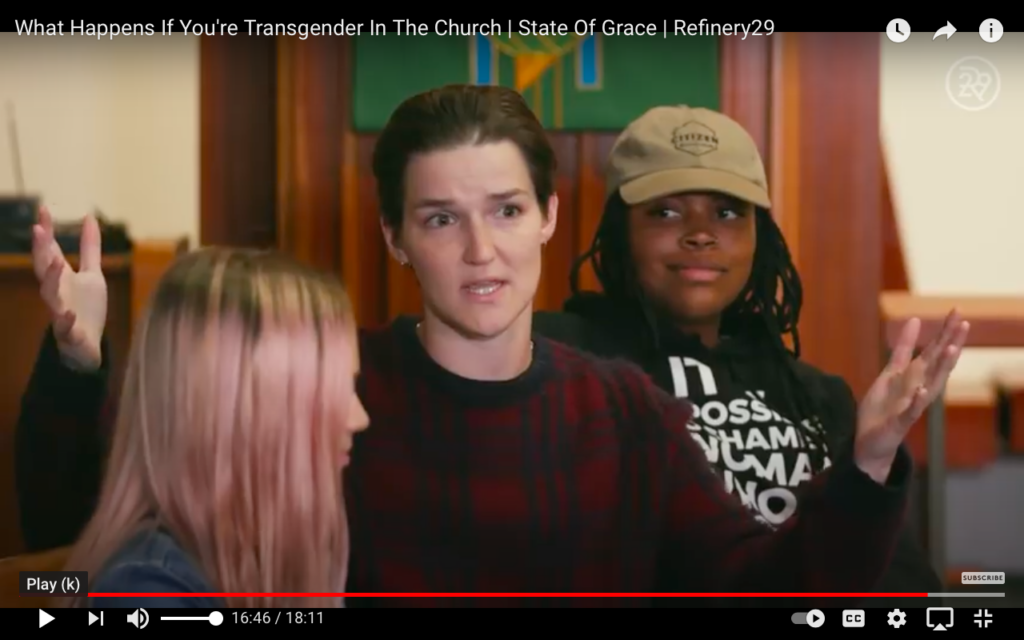
So I was pleased to discover this video, which profiles several interesting non-binary Christians. The interviewer, Grace Selmer Baldridge, happen to be a non-binary Christian, which I think makes this video especially powerful. I could wish that Grace Baldridge had been able to interview some non-white non-binary Christians, but aside from that weakness, the interviewees are diverse in their gender identity, in their age, in their expression of their Christianity.
This video may not work well as a teaching resource for those Unitarian Universalists who suffer from anti-Christian bias. Nevertheless, I’m thinking this video could be a great teaching tool for showing both the internal diversity of Christianity, and showing how some Christians believe their religion calls them to a non-binary understanding of gender.
To watch the video on Youtube, click on the image above.
To whet your appetite, here are some quotes from the video:
“We just have to be honest that using the pronoun ‘he’ for God is a habit, but it has no theological justification.” — Dr. Lizzie Berne DeGear, independent scholar
“When I imagine a trans child coming to understand, ‘I might be a girl in this boy body,’ I’m like, ‘Thank you, God, the child is becoming aware of who they really are.’…. God creates out of love. God creates love out of love. We who are in the image of God are all awesome. So when I’m talking to you, I’m learning a little more about God. Because you’re in God’s image. And when you’re talking to me, the same is true.” — Rev. Dr. Jacqueline J. Lewis, senior minister, Middle Collegiate Church
“As a church, we said: We’re publicly going to affirm the LGBTQIA community. We don’t have to be uniform in that belief right away, we can question it, we can disagree, but this is the stance our church is going to take from here on out.… We lost lots of people. We lost thousands of dollars. And it was such a good move. We can sit here and be comfortable, and say OK, the money’s still rolling in and there’s a lot of people coming through my doors, and we can feel good about that. But when there’s literally people out there who are told that they’re not loved, people whose families are disowning them for this, we need to step up and become safe spaces.” — Jonathan Williams, former lead pastor, Forefront Church, Brooklyn, and son of a trans woman
“We really feel that the only way we can combat that negativity [about LGBTQIA people] is with people of faith standing up and saying: No, this is actually not in alignment with how we understand our faith, that you can be Christian and trans, and you can be Christian and gay, and that they’re not mutually exclusive.” — Jamie Brusesehof, mother of a trans child
Someone in our congregation pointed me to diffen.com, which says it will et you “Compare anything.” Want to compare the first generation Apple TV remote with the second generation version? Diffen has got you covered. My informant said that Diffen also has a religion category, so of course I had to check it out.
Diffen’s comparisons of religion would have gone well back in the 1960s, when we were beginning to understand that there was a great big world out there but we still unquestioningly accepted a world view centered on Europe and the United States. (A less polite way of saying this is that Diffen is about fifty years behind the current state of religious studies scholarship.) Yet Diffen’s understanding of religion is probably similar to that of the majority of Americans and Europeans. In other words, Diffen probably represents an accurate picture of pop culture notions of religion.
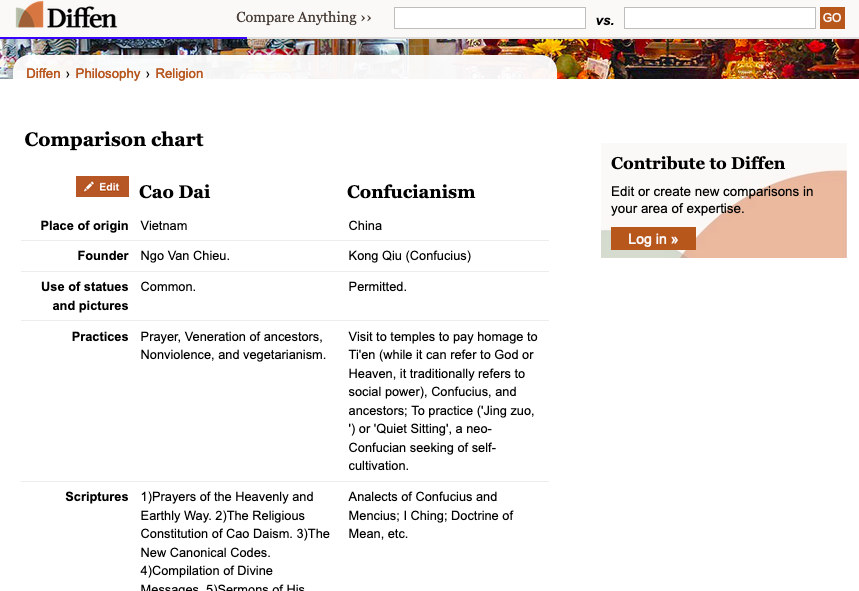
Let’s take one of their comparisons between two religions and pick it apart. Let’s click on Cao Dai vs. Confucianism.
“Place of origin” seems pretty straightforward, right? Clearly, Cao Dai originated in Vietnam, and Confucianism originated in China. Well, sort of. It might be more accurate to say that Cao Dai began in French Indochina; yes, that’s Vietnam, but Cao Dai emerged partly in response to colonial oppression. As for Confucianism arising in China, there was no nation known as “China” when Confucianism began, and indeed the teachings of Kongzi (“Master Kong,” i.e. Confucius) were often a direct response to the political situation of the Spring and Autumn period of the Eastern Zhou empire. Imperial China arose several hundred years after Kongzi lived, during the Qin dynasty.
Emphasizing the historical nature of religion is not mere nitpicking. One of the key goals of religious literacy, according to the American Academy of Religion, is helping people understand that religions change over time. With its simplistic category of “Place of origin,” Diffen removes historical nuance and may even lull you into thinking that religion is some timeless thing outside of history.
Later we come to “Use of statues and pictures.” Maybe Diffen thinks its intended audience isn’t smart enough to understand a term like “material culture.” But to me this feels like another instance of Western bias. We Westerners are still concerned with the split between Protestants and Catholics. We still think it’s important to know if a religion uses a lot of statues and pictures, because we want to know if that religion is more like Catholicism or Protestantism. But a more fruitful, and more nuanced, line of inquiry is to ask about the material culture of a religion. What physical objects are important to the religion? How are physical objects used by the religion?
You see attempts at nuance as you go down the list of comparisons between Cao Dai and Confucianism. There’s an item asking for a comparison of “Concept of Deity,” and under Confucianism it says, “Most [adherents] believe in One God, but this is not necessary since Confucianism is not a religion but a belief system about social ordering.” Whoever wrote this at least understands that Confucianism doesn’t fit well into the Western category of religion; whoever wrote this also understands that there’s at least some internal diversity within Confucianism. But once again Confucianism is reduced to some kind of simplistic East Asian Christianity. The underlying problem here is Diffen assuming that the way you must compare religions is to compare the “Concept of Deity” — given their Western bias, they obviously assume that all religions must have a concept of a deity. And indeed, a little further down the list, Diffen asks for a comparison of “Concept of God.” Because if it’s a religion, it must have a God (capitalized and singular).
I’m trying to be kind to Diffen. But — wow, I thought Wikipedia’s articles on religion have problems, but Diffen is unbelievably bad.
I don’t think the problem lies in Diffen, though. I think the problem lies in the religious illiteracy of Western culture. Most college graduates haven’t reached the basic, low-level standards for religious literacy established by the American Academy of Religion (more about those standards here). Many Americans are actually proud of being religiously illiterate: many American Christians think all they have to know is their Bible, and many American atheists and nones think religion should be ignored. Americans have a sense of cultural superiority and insularity that allow them to ignore the rest of the world. If you’re a white American, you can say: Why should I bother with Black culture, I’m not Black. If you’re a Christian, you can say: Why should I bother about Jewish culture, I’m not Jewish. If you’re an atheist or a none, you can say: Why should I bother about religious culture, I’m not religious.
Unfortunately, when it comes to religion, Diffen plays right into this sense of cultural superiority and insularity. Diffen might be great for comparing two different Apple TV remotes, but it’s not up to the task of comparing religious traditions.
I’ve hated YouTube for a long time, but they finally went too far. I’m going to start moving the videos I make for kids to another platform.
What was the final straw that’s causing me to ditch YouTube?
I created a children’s video for this Sunday’s online worship service. I was careful to use either my own content, or public domain content (e.g., music), or Creative Commons content (e.g., sound effects) I have a great respect for the rights of authors and creators, and I don’t want to violate copyright.
YouTube has a new process whereby when you upload a video, they scan it for copyrighted material. Fair enough. The scan of my latest video claimed to have found copyrighted material on my video. That’s not fair, but that happens because YouTube relies on machine algorithms instead of humans to review copyrighted material, and they give free access to the algorithms of known copyright trolls. So while it’s not fair, I can deal with it. I’ve dealt with it before — you submit a claim showing why the copyright claim is incorrect, wait seven days, and it goes away.
But as it turned out, this time not only did I get a message telling me that there’s a claim, but for the past two hours there’s been another message freezing the video because, so they say, they were still scanning for copyright violations. The effect of this is that YouTube has given me no way to contest the claim. Which is utter bullshit. And don’t tell me to contact customer support. YouTube is notorious for having no customer support at all — because, hey, we’re not customers, we’re the product they’re selling (or more precisely, our data is the product).
There are plenty of other reasons why I hate YouTube. I know they’re collecting unbelievable quantities of user data and using that data for purposes I don’t approve of. I don’t mind so much for myself — I’m going into this with my eyes open — but I’m making videos for kids, and I simply do not trust YouTube with kids’ data. Plus YouTube video compression sucks, producing inferior audio and video quality. Remember, their business model is to provide the absolute minimum of quality, with the least amount of paid human time, while selling the absolute maximum amount of data to advertisers and others; their sole goal is to make tons of money, with no apparent effort to provide any redeeming social value. By saying this, I don’t want to denigrate their workers, who work incredibly long hours and work software engineering miracles; but YouTube’s corporate management is, at best, amoral.
Do I need to add the fact that, as is true of all Big Tech employers, YouTube has insufficient numbers of women, people of color, and people over the age of 40 working at the company? The Big Tech firms are notorious for their sexism, racism, and ageism; YouTube is no exception.
I’ve known for some time that I need to move the children’s videos I make to a paid hosting service. So I finally bit the bullet and opened a Vimeo account. That’s where I’ll be posting all future kid’s videos that I make. Eventually I’ll move older videos there, though that will take time.
It’s been a relief to take this step. I’ve long been uncomfortable with YouTube’s exploitative business model. I’m glad I can stop feeling morally compromised.
I completely forgot that February 22 was the sixteenth birthday of this blog. So here, a week and a half late, is this blog’s sixteenth birthday post.
Blogging is completely different now than it was on February 22, 2005, when this blog started. Back then, blogs were social media; there was no other social media to speak of. Back then, blogs were mostly run by individuals who were willing to learn how to install cranky software on remote servers, and social media was mostly a labor of love. Now, social media is dominated by big corporations like Facebook, TikTok, and YouTube, which seem bent on destroying democracy. Now, social media is a big business where your data is the product that’s being sold. So now that “social media” is a dirty word, I’m proud to say this blog can no longer be considered social media.
Other things have changed over the years. Back in 2007, I attended Podcamp Boston and learned from innovative people called “vloggers” who were using videos to blog. So for the next twelve months, I uploaded a weekly video to my blog; the videos were hosted on a service called Blip.tv, which went defunct a few years later, taking all fifty-plus of my videos with it when it died. (And it’s just as well those old videos are gone: I still have files for one or two of them, and they were pretty crude.) To produce online videos in 2007, I had to purchase a fancy camcorder, edit the video footage on my laptop, make sure the encoding wouldn’t choke the host service, then upload it to the host. But today, people can shoot video with their phone and upload it directly to TikTok or Youtube.
And I’ve watched the audience for this blog change over the years. In 2005, my readers were the forty other UU bloggers, plus some tech-savvy people who thought to do a Web search for “UU blog.” By 2008, the peak of blogging was over; Facebook had begun its climb to dominance of social media; Twitter was just starting to become popular with what was then known as “microblogging”; and Youtube was becoming a destination on its own rather than just a host for video content. I had already begun to see a shift in who was visiting my blog. Half the traffic to my blog was readers looking at the front page to read the most recent posts; but half the traffic was through Web searches that found older posts. Today, most of my visitors are going directly to older posts.
But I still have a few regular readers who stop at the front page to check out the latest posts. I hope I continue to publish material that’s interesting enough that you, dear readers, continue to return here for another sixteen years.