Why Are You You?

I’ve got convention brain. What did I do after yesterday’s business meeting? What programming did I attend? With whom did I talk? It’s a bit of a blur.

But I do know that last night I went to a screening of the documentary “Why Are You You?” a new documentary about the now-defunct youth program Young Religious Unitarian Universalists, or YRUU. I was fairly heavily involved in YRUU as an adult advisor from 1995 through about 2003, serving as an advisor in local youth groups, as well as at district and continental “cons” or conventions. As a result, I got to meet youth leaders and youth advisors across the continent, from Alaska to Maine.

The filmmakers interviewed a number of former YRUU youth leaders, and I recognized several of them. I enjoyed hearing their memories of YRUU conferences and programs; I especially enjoyed hearing about how YRUU changed their lives. Given all those hours I spent supporting youth leaders and UU youth institutions, it’s nice to know that those hours weren’t wasted. But the ending of the movie is a little depressing. The Unitarian Universalist Association (UUA) ended funding for YRUU in (I think) 2007. There was no replacement for YRUU — YRUU was a semi-independent organization with youth leadership, not just another department of the UUA.

Not that YRUU was perfect. The documentary touches on some of its problems. What’s missing are the voices of all those teens for whom district and national YRUU programs held no interest, or those for whom YRUU did not feel safe — I knew quite a few of those teens, some of whom were devoted members of a local youth group. What’s also missing is mention of the adult advisors with poor boundaries — I saw a few too many of those; part of the reason I pulled away from district and national youth events was that I felt YRUU didn’t train adults adequately, nor hold them fully accountable.

Yet these were all solvable problems. The solution was not to get rid of the national youth organization; the solution was to reform that organization. For the past twenty years, I’ve had the sense that Unitarian Universalism broadly construed, especially at the national level, just really doesn’t like children and teens. Children and teens are messy, they take up a lot of time and energy, and if you don’t like them that much, it’s easier to shut them out rather than support them and their families. I feel that the death of YRUU is part of this larger trend.


P.S.: If the issues raised by this film are of interest, you might also be interested in childist theology, a new approach to Biblical interpretation that places children at the center of Biblical interpretation. So… What would it mean to place children and teens at the center of a Unitarian Universalist theology?

South Arabian goddess

The Walters Museum in Baltimore has a small selection of South Arabian art. I’m completely unfamiliar with South Arabian art, and before I went to the Walters Museum yesterday I knew nothing about its long history. According to the Smithsonian National Museum of Asian Art:

“For over a thousand years, from around 800 B.C.E. to 600 C.E., the kingdoms of Qataban, Saba (biblical Sheba), and Himyar grew fabulously wealthy from their control over the caravan routes of the southern Arabian peninsula and, in particular, from the international trade in frankincense and myrrh. Excavations at the capitals of these ancient kingdoms have yielded spectacular examples of architecture, distinctive stone funerary sculpture, elaborate inscriptions on stone, bronze, and wood, and sophisticated metalwork.”

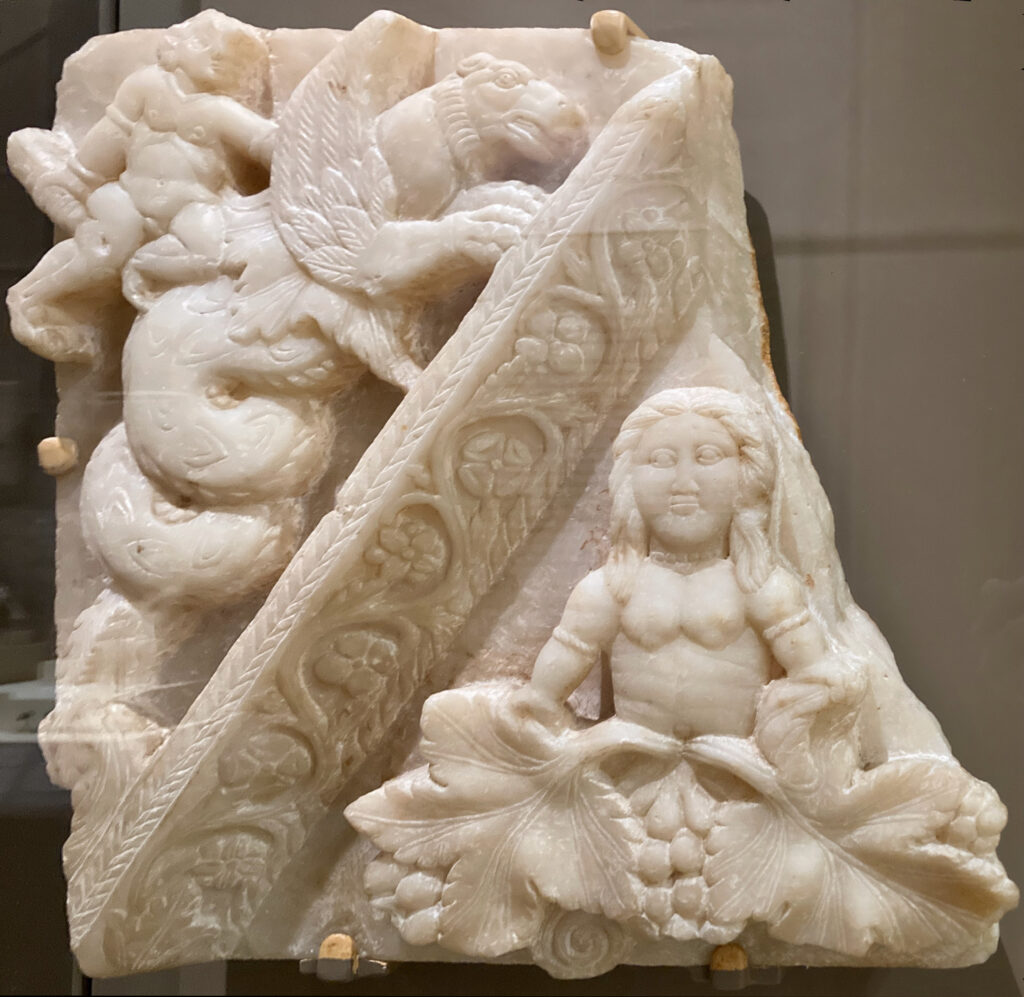
One of my favorite pieces of South Arabian art on the view at the Walters Museum is an unnamed goddess, who appears in a fragment of a pediment. She sits next to a child deity. Due to the lighting, I found it difficult to take a photograph due to the reflections on the glass case which houses this goddess; I had to do a fair amount of digital manipulation to make her look more or less the way she looks in the museum.

Sculpture carved in stone.

Here’s what the museum label says about this sculpture:

I wonder if she was really a fertility goddess, or a goddess of wine. I don’t think we’ll ever know.

Multiplatform GA

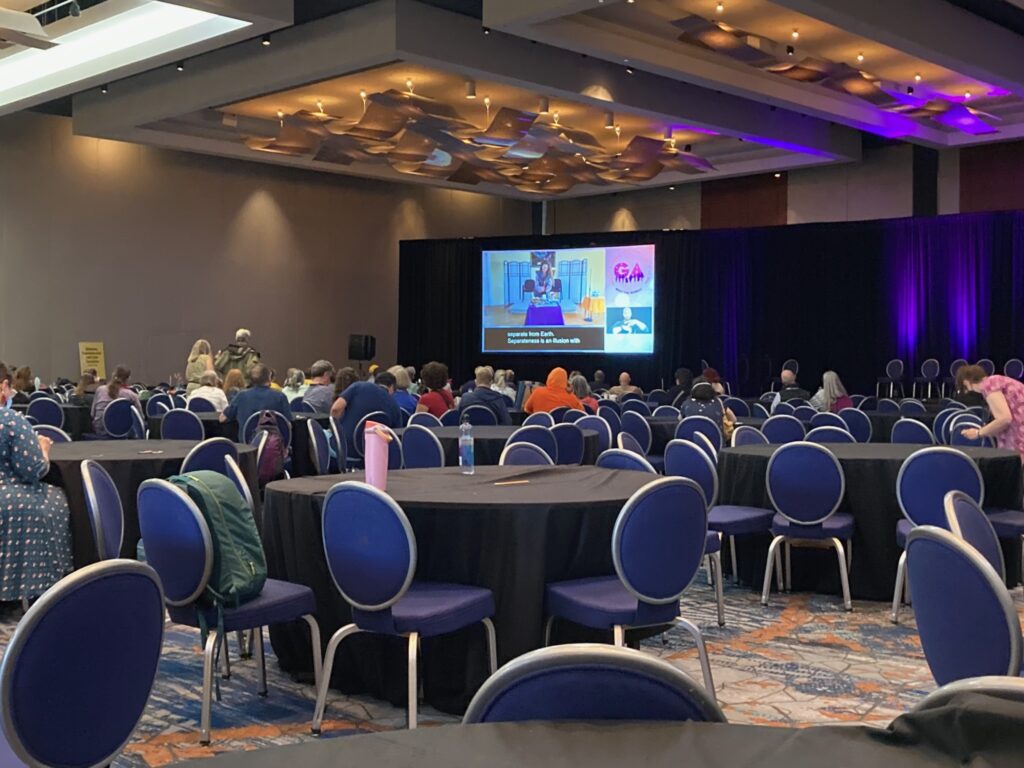
Wednesday evening, Carol, Ms. M., Roger, and I joined the watch party for the opening worship service for General Assembly. The video worship service was well done — the script was good, the performances of the individual elements were well done, and the editing as good. But online worship always makes me feel like a passive consumer, whereas live worship (if it’s done right) makes me feel like an active participant.

Not that many people showed up for the watch party. A few hours earlier, the room looked nearly full, with a few hundred ministers and family members. But for this watch party, the room felt empty.

A hotel ballroom, with a few people clustered near a large video screen.

I also noticed how the audio system boosted the lowest audible frequencies. If you record your audio with a mediocre microphone, your audio track can be filled with low frequency rumble. When you listen to that audio on your laptop, you’re not going to hear that rumble (unless you have really good headphones). But when you pump that audio through speakers big enough to fill a hotel ballroom, that rumble is going to be noticeable. This is something I’m going to remember to be aware of if I ever produce video/audio content that will be heard in a large room.

On Thursday morning, I started walking to the convention center from our hotel. I got almost all the way there when I realized that I had forgotten my face mask. So I walked back to the hotel, and then back again to the convention center, by which time the “Meet the Moment” programming had already started. I tried to figure out which programs were in which room, but I found the Whova event app so user-unfriendly that I gave up and downloaded the PDF program from the UUA website. Then I saw that we are supposed to commit to a single “Meet the Moment” program track for all three days. Frustration set in. Just then, Jen, an old friend, walked up. Jen said she was going to several different “Meet the Moment” tracks, because she was the only person from her congregation and she wanted to be able to go to as many tracks as possible. Yay! I had permission to ignore the rules!

At lunch, I walked through the Baltimore heat to a ramen place about ten minutes away. I was joined by Jen and Abby, who belongs to a UU congregation near my congregation. Abby and I talked about ways our congregations could cooperate. (It’s a little weird that I had to travel all the way to Baltimore to meet someone from a nearby congregation.) Then Jen reminded us both that Spirit Play would be a great kids program for small congregations like ours. So far, this lunchtime conversation is the most valuable thing I’ve gone to at this General Assembly.

Now I’m sitting in the meeting room listening to this year’s Congregational Study/Action Issues (CSAI). Somewhat to my surprise, there’s a CSAI that is fully aligned with one of the big priorities of our congregation — “Housing: Diversity, Equity, and Inclusion.” And one of the speakers in support of this CSAI actually mentioned classism (she’s affiliated with UU Class Conversations). The other two CSAIs are also worthy projects, but as the only delegate from our congregation, I’m going to vote for the issue that I think will be of the greatest interest to us.

Lead-up to GA

It was nine o’clock by the time we checked into our hotel, so I gave up on any notion of attending the last activities at Ministry Days, the annual meeting of the Unitarian Universalist Ministers Association. In the morning, I walked the four blocks to the convention hotel in time for the opening worship service at Ministry Days. The service was fine, but marred both by the horrible acoustics and dreary aesthetics of the hotel ballroom (I never understood why they call it a “ballroom” when no one holds balls any more), and the uncomfortable chairs that always seem to plague hotel ballrooms.

I went for a long walk during our lunch break, and arrived back in time for the afternoon program. The program tracks included “Joy and Creativity,” “Rest Is Resistance,” “Organizing” (community organizing, not organizing your job better), and identity caucuses. None of these seemed like a good match for my professional development needs, so I sat outside the meeting rooms and waited to see if I’d wind up in an interesting conversation. Sure enough, Jay Atkinson sat down and started to tell me about a research project he’s working on. Our Unitarian Universalist leaders, said Jay, often talk about “our theology” as that which unified Unitarian Universalism. But what is that theology? Do we even have a distinctive Unitarian Universalist theology? I especially liked the distinction between “scholarly theology” and “vulgar theology.” Jay told me the name of the scholarly theologian who coined those terms, a name which I promptly forgot, but it’s a useful distinction, analogous to the distinction that sociologists make between “lived religion,” the religion of ordinary people, as opposed to the religion of elite practitioners.

Carol and I had dinner with Ms. M and Roger. Fortunately the restaurant wasn’t crowded, because we were there for two hours catching up with what was going on in each other’s lives.

This morning, I went back to the convention center hotel for the opening worship at Ministry Days. But I just wasn’t in the mood for sitting in a dreary hotel ballroom with a few hundred other people, passively consuming the excellent music, the dance performance, and the spoken word. I ducked out and now I’m headed up to the Walters Art Museum to meet Carol.

Off to General Assembly

I’m leaving tomorrow for “Ministry Days,” the annual gathering of the UU Ministers Association, and after that I’ll be at General Assembly (GA) until Saturday morning. This year, I’ve done very little advance planning. The only session I know I want to attend is the session on Thursday afternoon on ending poverty. I have train tickets, I have a hotel room, I’m registered — beyond that, I’ll be making it up as I go along.

Happy Flag Day

A company of Revolutionary War re-enactors, one of whom has a sign reading "No Kings."

The photo above shows what the Minutemen were fighting for during the Revolutionary War. They wanted no kings, no dictators, no emperors. They wanted the right to rule themselves, without having some old rich guy, someone who thought he was more important than they were, telling them what to do. That’s what the American flag stands for — no kings, no tyrants, no dictators.

And now, two hundred and fifty years later, King-wanna-be Donny is trying to establish a new monarchy and tyranny. But here in Massachusetts, where the Revolution began, we still don’t want any kings. We still don’t want some old rich guy, someone who thinks he’s better than we are, telling us what to do. Way back in 1776, Thomas Paine described people like King-wanna-be Donny as insolent, poisoned, ignorant, and unfit:

“Men who look upon themselves born to reign, and others to obey, soon grow insolent; selected from the rest of mankind their minds are early poisoned by importance; and the world they act in differs so materially from the world at large, that they have but little opportunity of knowing its true interest, and when they succeed to the government are frequently the most ignorant and unfit of any throughout the dominions.”

On this Flag Day, remember the original meaning of the American flag: no kings, no tyrants, no dictators.

Happy Flag Day!

Fishing

Crossing the Border St. bridge, I looked out over Cohasset Harbor. Someone was fishing the whitewater where the tide was running out over the rocks into the harbor. When I got safely across the bridge, I stopped to look, and saw that he was using a fly rod. Mostly I see people using bait and spinning gear. This is the first time I’ve seen someone fly fishing in Cohasset Harbor.

The thought that immediately came into my head was that I’d have to tell Dad about this next time we talked. I gave my head a figurative shake — Dad died nine years ago, I wasn’t going to be talking to him about this. I mean, yes, I could talk with him about it in my imagination, but he wouldn’t be able to tell me whether he had ever gone fly fishing in saltwater (he probably had) and if so, what flies he had used and what he had caught.

Old habits die hard. For the last seven years of Dad’s life, I was living three thousand miles away in California. The last two years, he couldn’t talk any more. Up until then, I’d call him most Sundays, and we’d talk for an hour or so. I wasn’t doing much fishing while I lived in California, and Dad wasn’t doing much fishing those last five years. But we both still thought about fishing and we both still liked to talk about fishing, if either of us had anything new to say. So it’s not surprising that when I saw that guy fly fishing, I’d think about talking it over with Dad.

Here it is, nine years after he died, and there are still a bunch of things I’d like to talk over with Dad. And maybe I’ll go fishing on Father’s Day.

White Rabbit Candy

Kara brought back White Rabbit candy from her visit to China. She gave me a small bag to try.

The candy starts off as very firm, becoming chewy as it warms up in your mouth. There’s an edible inner wrapping made of glutinous rice, which addes to the texture. The original flavor is very mild, milky and vanilla-y, and not very sweet. Interesting. I found out that the candy originated in Shanghai, and I find it reminiscent of the mildness of other Shanghai cuisine.

There were many flavors in the small bag Kara gave me, not just the original flavor. From what I can find out online, there are at least 16 flavors: Original plus Banana, “Brown creamy,” Chocolate, Coffee, “Cooling” (mint), Durian, Lychee, Maize (corn), Mango, Matcha, Osmanthus, Salty plum, Wasabi, Red Bean, Yogurt.

Some of the flavors I liked a lot. One of my favorite flavors was wasabi — it had just a touch of wasabi, not too spicy, a nice contrast to the underlying milky mildness of the candy. My other favorite flavor was what’s called “cooling” (what I’d call mint) — which also provided a nice contrast to the underlying flavor of the candy. Red bean was a little odd to my Western palate, but I did like the way it reminded me of dim sum red bean buns.

Other flavors I didn’t care for as much. Osmanthus was only faintly floral, and overall too bland for my tastes. Matcha didn’t work for me — I guess if you like boba tea this would be good, but I like my matcha unsweetened and with no milk.

The best thing about White Rabbit candy is its mildness. It’s not too sweet; by contrast, I find most American candy far too sweet. And the flavors are subtle, not overpowering like some American candies.

Small paper-wrapped candies on a table top.

Another washtub bass update

I’ve expanded my 2019 post on washtub basses to include two electrified instruments.

You can go read the expanded post, or just click on the image below to check out a video of Barbara LePine’s electric washtub bass in action.

A woman playing washtub bass, and a man playing guitar
Screen shot of “Bucket Babs” playing her washtub bass in her band “Porter McClister’s Box and Bucket.”

More photos below….

Continue reading “Another washtub bass update”

Cohasset ukulele festival

Our twice-monthly ukulele group will be hosting a half-day ukulele festival on Sunday, October 5, 2025. More info here.

This entirely free event is being sponsored by my employer, First Parish in Cohasset, in cooperation with the Cohasset Historical Society. We’re able to make this a completely free event, thanks to a grant from the Gleason Music Fund at First Parish, in-kind support from both First Parish and the Historical Society, as well as a generous anonymous donation. We’re also on a Massachusetts Cultural Council grant application submitted by the Historical Society — if that grant comes through, we’ll be able to increase accessibility with an ASL interpreter for the final concert.

If you’re in the Boston area, hope to see you there. Even if you don’t play ukulele, come join us for the free concert at 4:30.

A graphical flyer telling about the uke festival.
Click on the image above for a PDF of the flyer.