Another in an occasional series of videos that retell Jataka tales:

As usual, full script is below….
Continue reading “The Elephant and the Dog”Yet Another Unitarian Universalist
A postmodern heretic's spiritual journey.

Another in an occasional series of videos that retell Jataka tales:
As usual, full script is below….
Continue reading “The Elephant and the Dog”Several sociologists have found a characteristic that seems to predict with some accuracy who will flout social distancing restrictions designed to prevent the spread of COVID-19: Christian nationalists.
“Samuel Perry (associate professor of sociology at the University of Oklahoma) and his colleagues, such as Andrew Whitehead of Indiana University and Joshua Grubbs of Bowling Green State University, argue in a series of new papers that Christian nationalism is either the single best predictor or a top predictor of whether a person will flout social distancing recommendations, be skeptical of science, find nothing racist about calling COVID-19 the ‘China virus’ or argue that lockdown orders threaten the economy and liberty — all while de-prioritizing the threat to the vulnerable.” — as reported by Religion News Service.
At the same time, the ideology of Christian nationalism apparently has only a weak connection to the Christian religion:
“In fact, religious devotion of any kind often had the opposite effect to Christian nationalism, and was the leading predictor of whether someone would take precautionary measures. ‘We found religious people were more likely to wash their hands, to use hand sanitizer and to avoid touching their face — all the things that were recommended,’ [Perry] said. ‘We find religious people are more likely to say, “If we have the decision between individual liberty and protecting the vulnerable, we’re going to protect the vulnerable”.’…He added: ‘In other words, (religious people) tend to look like pretty good neighbors.'”
Perry explains the trend as an “emerging crisis of authority.” Not surprisingly, Christian nationalists believe in conspiracy theories and distrust both scientists and the media. Christian nationalists feel that their country is being taken away from them; not surprising, then, that they are more likely to trust people like Donald Trump, who they think is going to save their country for them.
I wonder if the rise of Christian nationalism correlates in any way to the rise of the “Nones,” people who have no affiliation to organized religion. I’ve often thought that what really underlies the rise of the “Nones” is a rise of hyper-individualism and a distrust of authority; the Christian nationalists would certainly match that description. And we know from surveys that most of the “Nones” believe in God; might some of the “Nones” in fact be Christian nationalists? But this is entirely speculation on my part.
Remember that neither Trump nor most Christian nationalists actually belong to a church: they are too individualistic to want to submit to the demands that organized religion makes.
Whereas those of us who do participate in organized religion tend to make “pretty good neighbors.”
I am increasingly convinced that the pandemic is accelerating a number of trends that are going to change the way we do religious education in our local congregations fairly quickly. However, I don’t these trends should lead us to proclaim either the “post Sunday school era” or “the death os Sunday school.”
And before you get too excited (“Yay, the death of Sunday school!”) or too sad (“Nooo, I miss Sunday school!”), let’s look at a couple of the trends that affect religious education, trends that are being accelerated by the pandemic…..
1. Current trends affecting religious education
2. Where we came from, 1781 to the present
1965-2005
1900-1965
1781-1900
3. Why the “post Sunday school” advocates are right
4. Why the “post Sunday school” advocates are wrong
5. Expanding our religious education possibilities
6. The whole church as curriculum
7. New models for funding
8. Final thoughts
———
First and foremost among current trends, most American congregations face looming financial difficulties. Staff costs continue to outpace inflation, driven in part by health insurance costs. Staff costs in Unitarian Universalist congregations are also under pressure because we expect our professional staff — both ordained ministers and lay religious educators — to have at least a four year college degree, and often three or more years of graduate study; staffers have to pay off their college debts, and that means they need relatively high salaries. Finally, there’s always Baumol’s Cost Disease: American congregations represent an “technologically stagnant sector” which means congregations experience “above average cost and price increases.” The amount each person gives to a congregation has to increase faster than inflation, just so the congregation can provide the same amount of services.
Continue reading “The evolving state of religious education”The final installment of the Prometheus myth:

As usual, full script is below….
Continue reading “Prometheus, part 4”In the bustle of the pandemic, I almost forgot that the 250th anniversary of Universalism is celebrated today. This is the anniversary of the first sermon preached by John Murray.
Alas, too busy to say much about this now, but more on this soon!
Elizabeth Fisher, a stalwart of the UU Women and Religion movement, and author of the influential Rise Up and Call Her Name curriculum, has died. I learned about her death from David Pollard, who saw it announced on the UU Women and Religion Web site.
Rise Up and Call Her Name expanded the exploration of the feminine divine that had been begun in an earlier curriculum, Cakes for the Queen of Heaven. Rise Up expanded on Cakes by going well beyond the geographical regions that Cakes focused on, Europe and the Middle East; Rise Up included images of feminine divinity from a broad range of cultures, including many non-white cultures. Fisher also published The Circle Model of Shared Leadership, a book which offers group facilitation tools for shared leadership.
I mostly know about Fisher because of Rise Up and Call Her Name, which has had a significant impact on Unitarian Univeralism. I hope someone, somewhere, posts a broader appreciation of her life and work.
The next installment in the series:

Full script below.
Continue reading “Prometheus, part three”The next installment of the Prometheus myth:

As usual, full script is below.
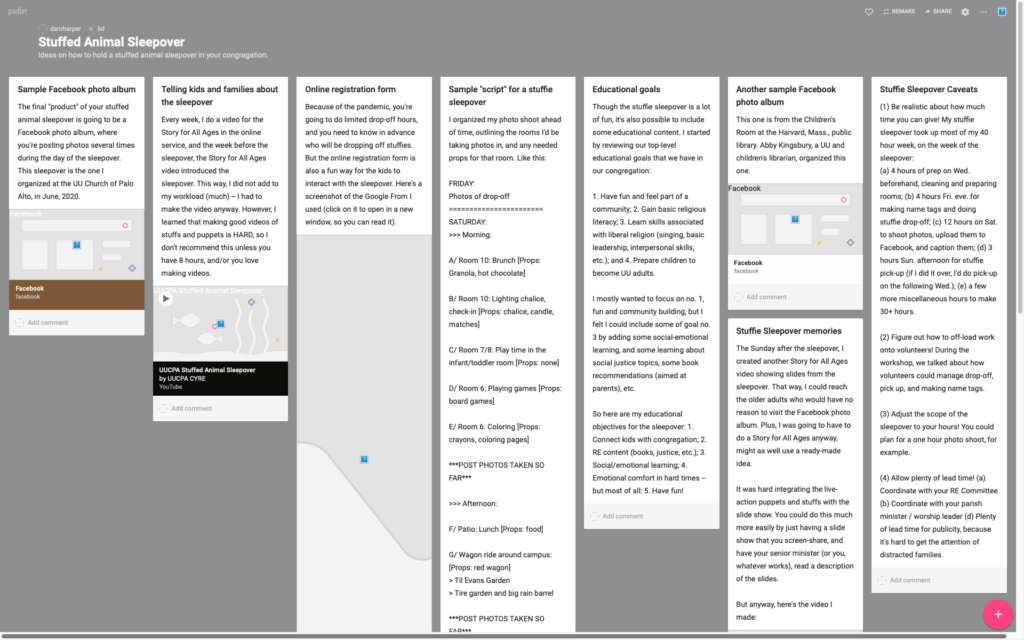
Continue reading “Prometheus, part two”I’ve been looking for a way to extend our congregation’s asynchronous learning, and one of the online tools I’ve looked at is Padlet.com.
Padlet.com is basically an online interactive bulletin board. Some elementary school teachers use padlets to allow students to interact with a teacher presentation — kids can comment on teacher posts, and teachers can also allow kids to make their own posts. (An individual bulletin board is typically referred to as a “padlet.”) Some teachers also use padlets as parent communication tools.
I wasn’t excited or inspired by the gallery of examples on Padlet.com, but since it’s a free service, I thought I’d give it a try. It’s better than I thought.
While it’s hard to imagine that children or teens in a religious education program will voluntarily interact with a padlet — unlike elementary school teachers, those of us in religious education cannot complete students to use something with the threat of a bad grade — I feel that padlets could be useful parent communication tools, to help parents know know what’s going on in a class. I think padlets could work quite well to organize resources to share with adult education classes. And Padlet.com is fairly easy to use for volunteer teachers — there’s not much of a learning curve. Finally, Padlet.com is obviously better for a volunteer-run program like Sunday school than a learning management system like Google Classroom, which has a steep learning curve and requires domain email addresses for all users (who wants another email address?).
However, I don’t think Padlet.com offers much advantage over using existing tools — such as Google Drive — to organize resource materials and allow student interaction. I’m also annoyed because when I just logged on to a padlet I created for other religious educators, Padlet.com refused to display embedded content — see the screenshot below. This does not make me want to pay for a premium account, and if this is what end users are going to see, I’m definitely better off using a Google Drive folder. It also occurs to me that all my volunteers already know how to use Google Drive, and why should I make them learn how to use Padlet.com?
Maybe I’ll return to Padlet.com in the future, but at this point I’m not overly enthusiastic.
William R. Jones, UU theologian and one-time religious educator, pointed out may years ago that the myth of Prometheus serves as a useful counter to the myth of Adam and Eve. For Adam and Eve, rebellion is sinful; for Prometheus, “a response of rebellion is soteriologically authentic.” Although Jones considers the Prometheus myth to be important for humanists, I think Prometheus is important for anyone who is an existentialist — which means almost every Unitarian Universalist today, whether they are humanist existentialists, Christian existentialists, pagan existentialists, Buddhist existentialists,….
That means the myth of Prometheus should be an integral part of Unitarian Universalist religious education for kids. Here’s one attempt to make that happen, as several ordinary people go back in time to relive the myth o Prometheus:
Full script is below….
Continue reading “Prometheus, part one”