Summary session plan below. Also, at the end of this post, a bunch of links and info requested by participants.
My iNaturalist observations for today and yesterday.
Continue reading “Ecological spirituality, day six”Yet Another Unitarian Universalist
A postmodern heretic's spiritual journey.
Summary session plan below. Also, at the end of this post, a bunch of links and info requested by participants.
My iNaturalist observations for today and yesterday.
Continue reading “Ecological spirituality, day six”Fairly complete lesson plans for today’s activities are below.
Continue reading “Ecological spirituality, day five”Summary session plan below.
My iNaturalist observations for today.
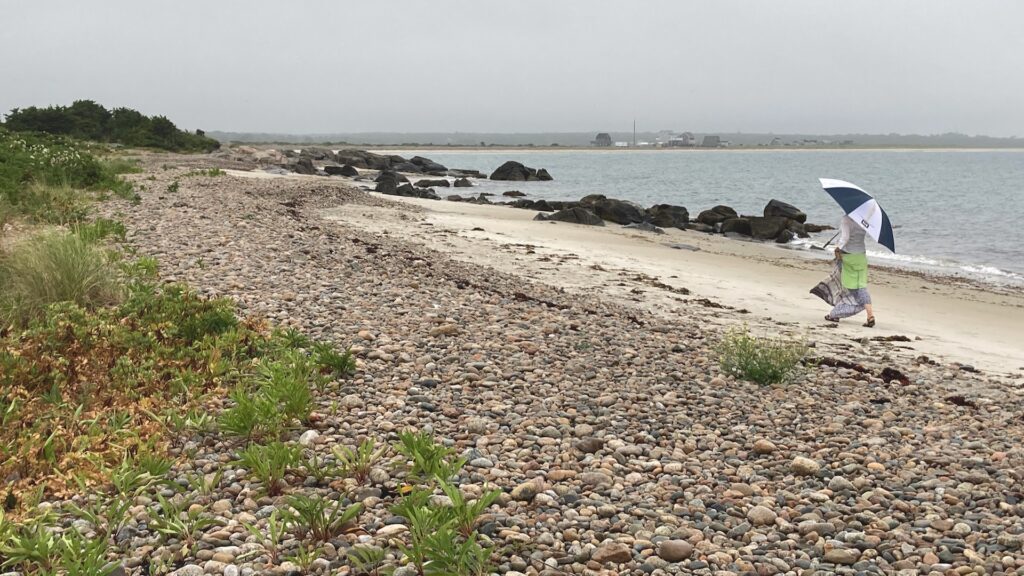
We took a walk from Ferry Beach Park Association to Camp Ellis. We walked along Surf Street until the pavement ended, then walked along the dirt track where Surf Street used to be. We turned inland at Lower Beach Road, where the dirt track ended, turned down Cove Ave and walked down to look at the Saco River, then down North Ave. to Bay Ave. to the jetty. On the walk back, we went along Route 9.
I’ve never written up full instructions on how to lead a suburban or urban nature walk, and unfortunately I’m not going to have time to write that description now. Suffice it to say the following: in a suburban or urban environment, there will be fewer native species and less biodiversity than in a landscape that is less dominated by humans. So a suburban / urban nature walk will look at what non-human species are present (and why they’re there), and in addition will look at the economic forces that shape the landscape.
Remember — the word “ecojustice” means both “economic justice” and “ecological justice.” Some of the thinking behind ecojustice is that economics cannot be separated from environmental concerns.
For reference: Ecojustice curriculum (gr. 6-8) on my curriculum website.
Summary of the activities we did in today’s workshop are below.
My iNaturalist observations for today.
Continue reading “Ecological spirituality workshop, day three”Description of today’s session is below.
My iNaturalist observations for today.
Continue reading “Ecological spirituality workshop, day two”This afternoon, Carol and I drove up to Bath, Maine, to sing Sacred Harp on the gazebo in the center of Bath. It turned out to be an excellent place to sing, which may show that a good singing space does not need walls if you have a wood ceiling and a wood floor. And with no walls, we were much less worried about transmitting COVID, especially with the stiff breeze that was blowing. It also turned out to be an excellent group of people to sing with. As Carol said after the singing, “It was a really tight group.”
After the Sacred Harp singing was over, we got takeout food. We ate dinner in a city park overlooking the Kennebec River. This is the furthest east we will travel on our cross-country trip.

A quick meomry from our cross-country trip that I forgot to write down earlier:
When we drove into Wyoming, a sign directed all vehicles with watercraft to pull into the Port of Entry for inspection — “including canoes and kayaks.” Signs directed us around the weigh station to a small building belonging to the Wyoming Fish and Game Department. A polite young woman carrying a clipboard and wearing a Fish and Game uniform greeted us. She was obviously checking for invasive species. She looked at the canoe on top of our car, and at our California license plates. “What was the last body of water you had the canoe it?” she asked.
I thought for a moment. We hadn’t used the canoe in the whole 13 years we’d lived in California. “The Atlantic Ocean,” I said.
She looked surprised. “Whereabouts?” she asked.
“Coast of Maine,” I said. “Saco Bay.”
She knew Saco Bay, and it turned out that she, like me, was from Massachusetts.
“Where’d you grow up?” I asked.
“Near Essex,” she said, and told me which town.
There was no one behind me waiting to have their boat checked, so we chatted for a bit. We asked what brought her out to Wyoming. She had gotten her degree in wildlife management at a university in New York state, worked for a while in the northeast, then decided she wanted to go some place completely different. So she chose Wyoming.
I told her I was glad that Wyoming was checking all watercraft for invasive species. “I’m a fisherman, and invasives have already ruined too many fisheries,” I said.
“Especially the mussels,” she replied.
So yeah. If you own a boat, remember: clean, dry, and drain.
You’ll find a quick summary of what we did in the ecological spirituality workshop today below the iNaturalist link.
My iNaturalist observations for July 10.
Continue reading “Ecological spirituality workshop, day one”Abby and Jim’s back yard proved to be a very comfortable place to sleep. As we were packing up the car to leave, I noticed these charismatic European Paper Wasps (Polistes dominula) building a nest.

Native to Mediterranean Europe, P. dominula was first introduced to the United States in Massachusetts in the 1970s. Since then, it has spread to Maine, Pennsylvania, Michigan, South Dakota, Nebraska, Arkansas, Washington state, and perhaps elsewhere. Abby said she was going to kill the insects and remove the nest, which I am glad of — according to the Invasive Species Compendium website, P. dominula has been shown to displace native Polistes species.
Another dreary drive today, though only two hours long. Traffic was heavy and aggressive from Acton to southern Maine. We were glad to get off the highway, and set up our tent at Ferry Beach Conference Center, where I’ll be leading a workshop in ecological spirituality for the next week. I’ll post more about that workshop in the coming days.
We had a long breakfast with Paul and Gina this morning. After breakfast, the four of us, plus Allagash the dog, went for a walk at a nearby pond. Paul and I met in a field ornithology class, so we listened for birds: Summer Tanager, Dark-eyed Junco, Wood Thrush, Red-eyed Vireo, Hermit Thrush (maybe), and more. Gina noticed this spectacular Wood Lily:

Then Carol and I started driving east again. After a long drive, we arrived at the house of my sister Abby and Jim. Now we’re sitting outdoors in Abby and Jim’s screen house talking after dinner. What do siblings do when they get together? Talk a lot, and goof around. Here’s a photo Abby took of me:

Just now Abby asked, “What are you doing?” I said, “I’m uploading to iNaturalist.” She doesn’t know I’m actually writing on my blog while we’re sitting here in the screen house.
I attended a morning session of the Religious Education Association annual conference. I wanted to hear two presentations on abuse and trauma as it relates to religious education. A significant part of my career working in congregations has been devoted to addressing the after effects of religious abuse and trauma (RAT). I’ve mostly dealt with the effects of misconduct by clergy and staff, and I found it helpful to learn about the wider scope of RAT. The presentations also introduced me to additional books and academic studies that I want to read.
But attending this REA session meant we got a late start. The drive started out dreary, but as soon as we got off Interstate 90 onto Interstate 86, the driving became much more pleasant — few cars on the road, fewer big rigs, the road winding through rolling green hills. We passed into Seneca Nation, and many of the road signs were in two languages.

We soon arrived at Paul and Gina’s house in Newfield. They live on the edge of a 12,000 acre state park. As soon as we arrived, Paul, Carol, and I, along with Allagash the dog, went for a walk.
The woods were lovely…

When we got back, we set up the tent on their lawn. Then we sat on their deck and ate dinner, and sang until dark.