Fall color

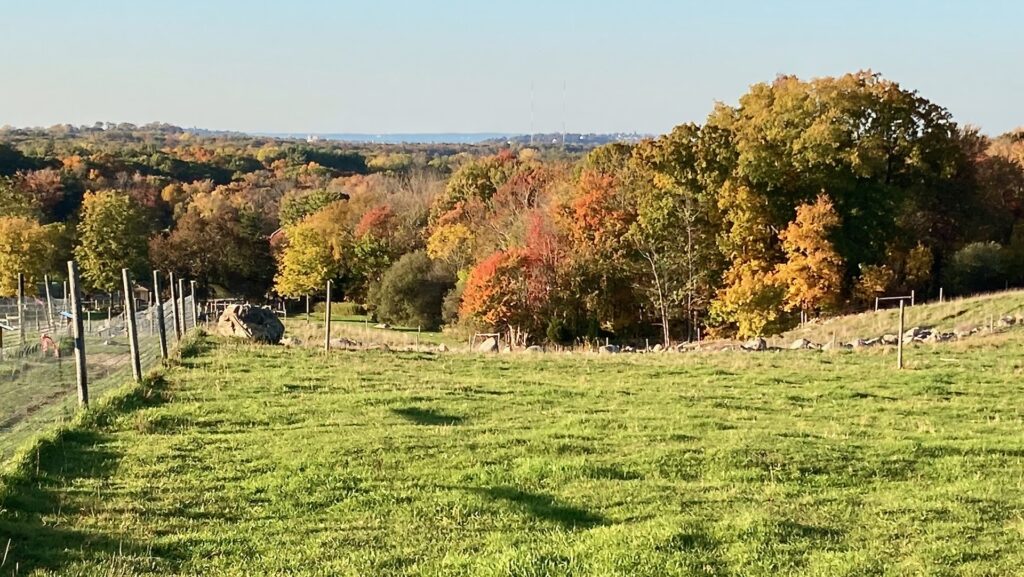
I took a walk at Weir Hill Farm in Hingham today. The fall colors are really starting to come out. Looking at them made me realize how much I missed the bright autumnal colors while we were living in California. There’s something about the fall colors in southeastern New England that really gets to me. Autumn in the San Francisco Bay Area had its own attractions, but nothing as thrilling as what I saw today.

Fifth shot

I got my fifth COVID shot today, the so-called bivalent booster.

Getting a COVID shot is boring now. But it didn’t used to be.

We got our first shots the day after our age group was eligible. We had to drive an hour to find an appointment. There was an elaborate check-in process. After getting the Pfizer shot, we had to sit down for fifteen minutes until they were certain we weren’t going to pass out or go into anaphylactic shock. Four weeks later, we got the second dose at the same drugstore, going through the same elaborate process. I was ill for two days after the second shot. Then it became a big topic of conversation for the next month: Did you get vaccinated yet? Which vaccine did you get? How long were you sick for afterwards?

We felt invincible for about four months, until the Delta variant hit. Then at last we were eligible for our first booster. This time, we got an appointment at a mass vaccination clinic, held at the San Mateo Event Center, formerly called the county fairgrounds. We waited in a long line of cars while volunteers in fluorescent yellow vests directed us into a big barn. Did we want Pfizer or Moderna? We had heard that you should get the one you didn’t get the first time. So we got Moderna. Then we had to drive into a big parking area while they monitored us to make sure we didn’t pass out. Once again, it was all very dramatic. And I was ill for a day after I got the booster.

For the second booster, I went to the Redwood City medical center where my primary care physician had her office. It was just like getting my annual flu shot. A nurse told me I shouldn’t worry about sitting in the waiting area after getting the shot. I got the shot, left the building, and drove home. My arm hurt for the rest of the day, but I didn’t feel ill.

Today I drove to Braintree to get both my annual flu shot and my third COVID booster. My appointment was at an older, somewhat dingy pharmacy. This time I remembered to wear a short-sleeved shirt. After I got my shot, the pharmacist told me to sit and wait fifteen minutes. I heard the man talking to the pharmacist as he got his shot. “Another shot, I can’t believe it! We’re going to be doing this forever,” he said, in his high querulous tenor voice. She murmured something soothing. “I guess it’s like getting your flu shot every year, isn’t it. And these people who don’t get shots. Can you believe them?!” Another soothing murmur. By this time I had waited five minutes. I decided I wasn’t going to pass out and walked out of the store. There was nothing exciting about any of it.

I still worry a little when I hear about people I know getting COVID. But getting your COVID shot is no longer exciting. It’s just part of the annual routine.

Yet another holy book

Rodney Kennedy, in an opinion piece on Baptist News Global, says:

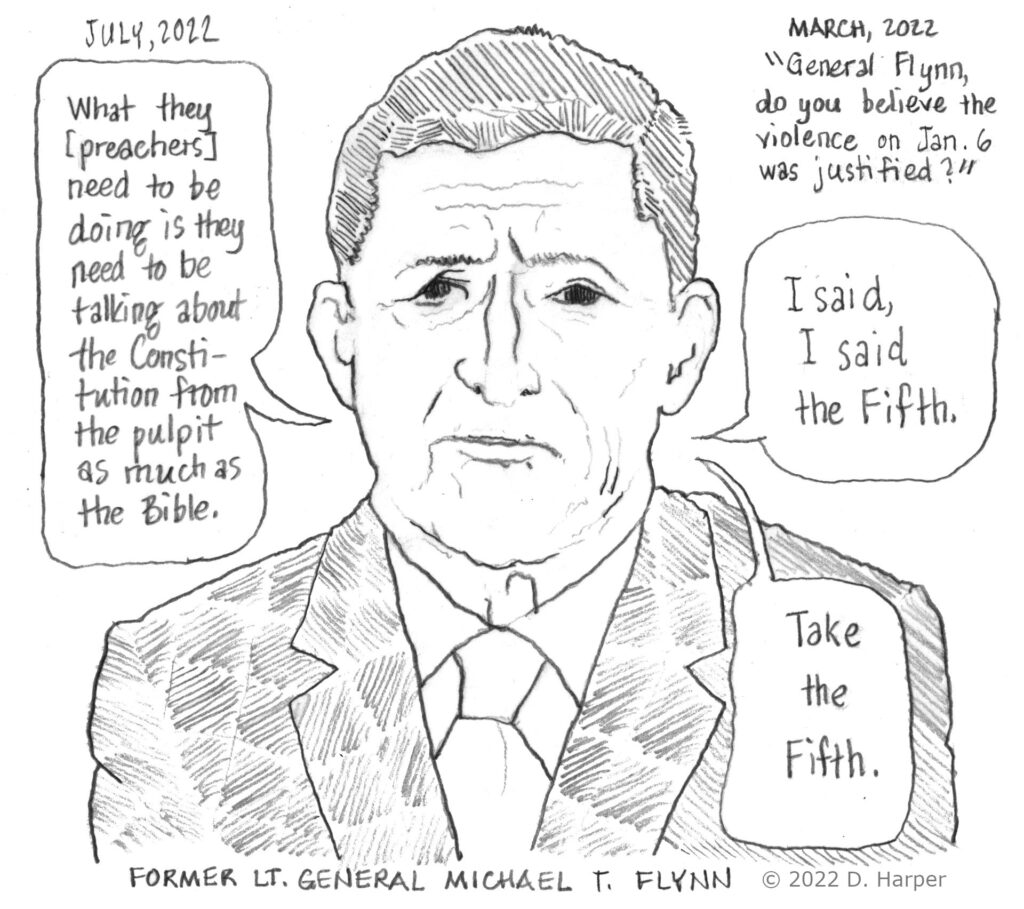
“I’m attempting to wrap my mind around the idea of a former Army general telling me I should preach from the U.S. Constitution. I mention this only because Michael Flynn has been occupying American pulpits, recommending the Constitution as a second holy book for preachers. ‘What (preachers) need to be doing is they need to be talking about the Constitution from the pulpit as much as the Bible. They have to do that,’ Flynn has said.”

Kennedy calls Flynn’s remark idolatrous. From his Christian point of view, the Bible stands alone and does not need to be propped up by any other texts.

I don’t know if Flynn actually believes what he said, or if he just said it to draw audiences. (Time reported that Flynn made $150,000 in 2016 for speaking engagements, a strong motivation to say what his audiences want to hear.) But I do know Flynn is giving voice to an opinion genuinely held by many people in the United States. These folks genuinely believe that the U.S. Constitution is divinely inspired, just like the Bible, and thus should be treated as a sacred text. These folks use short passages from the U.S. Constitution as proof texts, just as short passages from the Bible are used as proof texts, to prove the truth of a certain theological opinion or doctrine.

What a fascinating historical moment. We seem to be watching a sort of new Great Awakening, a movement which curiously adds the U.S. Constitution as a sacred text co-equal to the Bible. Like previous Great Awakenings, these folk are vibrant and adventurous and enthusiastic. My Puritan forebears would have said that enthusiasm results from excessive religious emotions that come from a deluded conceit that one is specially favored by God, and I’m still enough of a Puritan to agree. Nevertheless, what a fascinating historical moment.

Asters

For the past month and a half, I’ve been looking for flowers in the aster tribe (Tribe Astereae). I’ve always liked asters. I don’t know why. There’s something about the off-white and pale lavender colors that gets to me.

Flowers in tribe Astereae, probably genus Symphiotrichum

I guess it’s a kind of spiritual experience when I see asters in bloom. Whatever “spiritual” means.

Flowers in tribe Astereae

I’m not able to tell which species of aster I’m looking at. In the genus Symphiotrichum alone, there are 27 species native to New England. Go Botany has a dichotomous key for Symphiotrichum. However, for some species the key requires 14x magnification of the bracts and disk flowers, but all I have is a 10x hand lens.

Flowers in tribe Astereae, probably genus Symphiotrichum

Nevertheless, I should sit down with one of these plants and try to work through the key. Not that it matters what species I’m looking at. Not that it will make the flowers any more (or less) beautiful. But why not observe them more closely?

Reading list: Keeping Heart on Pine Ridge

Keeping Heart on Pine Ridge by Vic Glover (Native Voices, 2004) is one of the best American spiritual memoirs I’ve read. In a series of linked essays, Glover talks about what it’s like to live on the Pine Ridge Indian Reservation in South Dakota, covering everything from commodity foods to reservations roads to the cars and trucks that drive on those roads.

Through all the trials of life on the reservation — the poverty, the low quality commodity food, the harsh weather — Glover’s spirituality sustains him. He doesn’t make a big deal of his spirituality. He describes, simply and well, his efforts, and the efforts of his tiospaye, to keep traditional spirituality alive.

Glover’s accounts of sweat lodges and the Sun Dance are unsentimental and emotionally powerful. Even when he’s not talking about specific religious rituals, spirituality creeps in to his accounts of every day life: the sense of connectedness of all life, the sense of something larger than ourselves, the necessity for justice work to bring ideals into reality.

I especially appreciate that Glover understands how spiritual community works. More than once, he points out that you can’t just show up at a Sun Dance and expect to be part of the in crowd. Spirituality is not just about one or two big sacred events: spirituality is something that happens day after day. And spirituality happens in community. It takes people in community to keep the rituals alive — people who do the mundane but necessary chores, people who cook the food eaten by the community, people who show up.

Maybe that’s the whole point of this book. You have to show up. Regularly, whenever you can. Like the member of Glover’s spiritual community whose truck breaks down and then walks for miles to show up for a routine sweat lodge. Glover quietly contrasts this kind of person with the spiritual dilettantes (my term, not his) who show up for the big celebration, the Sun Dance, and then disappear. Glover doesn’t pass judgement on these dilettantes; they’re welcome to come and participate at that level; but he makes it clear that it’s the people who show up regularly who keep the tradition alive.

There’s a parallel here with what happens in the Unitarian Universalist congregations I’ve been part of. Lots of people only show up when there’s a special musician, or a Big Name Preacher, or for the Christmas Eve candlelight service. But the ones who actually keep the tradition alive are the people who show up week after week. They just show up, even when it’s boring. They’re the ones who keep it going — by just showing up. That’s how community is nurtured, and that’s how religion and spirituality are passed on, in a community. The traditional spirituality of the Oglala Sioux is very different from Unitarian Universalism, but the common human thread that runs through through both is community.

This is a book worth reading. Buy it if you can, either from the publisher or an independent book store (not from Amazon, please, because their business model screws authors). If you really can’t afford it, you can borrow it online from the Internet Archive.

Protest songs

At the end of August, “The Ongoing History of Protest Music” website had a blog post titled “A Month of Protest.” The first song they featured was “Black AF,” by Crystal Axis, an Afropunk band from Kenya. (Before you crank up the sound be aware that, like a lot of punk rock, “Black AF” is Not Safe For Work.)

I didn’t even know that leftist punk rock still existed. But Crystal Axis are keeping the tradition alive with some really hard-hitting songs. As I started listening to their music, I was particularly struck by their 2017 song “Leopold,” an anti-colonialist song about King Leopold of Belgium. Leopold led Belgium in the brutal exploitation of the Congo, and Crystal Axis’s lyrics provide a concise summary of the king’s self-justification:

“I’m the king and it’s all mine
Under Force Publique and Christ
Your hands are mine tonight
Fingers up one time!”

Leopold was especially notorious for ordering the amputation of the hands of workers if work quotas were not met. Theologically he, like other Western colonial rulers, used the Christian religion both as a cover and as a justification for his crimes against humanity.

“Take the Throne,” a song they released last year, also has some leftist theological comment. First, the lyrics call out the injustice caused by gross economic inequality, where the rich are literally starving the rest of the world:

“You eat, we watch; a revolution’s born
We’ll tear down the walls and then we’ll take the throne”

Now comes their theological commentary:

“The voice of the people is the voice of God
Too many lies, deities we can’t applaud”

This is a theology in direct opposition to King Leopold’s theology. Leopold claimed his God gave him the power to do what he liked to those who had less power, less wealth, those who were not white. By contrast, Crystal Axis are saying that God is in the voice of ordinary people — which is pretty much what Jesus said when he pointed out how difficult it would be for rich people to get into heaven. This is also a theology that’s consistent with an African ethics that privileges the social over the individualistic.

As someone who loves punk rock, I really enjoyed hearing leftist theology in the context of topnotch music. For more, visit their website or their Facebook page.

What Franklin Graham says

We have a post box for our mail, so sometimes we receive mail sent to previous holders of that box number. Today we received the October issue of “Decision” magazine, published by the Billy Graham Evangelical Association.

The editor-in-chief, Franklin Graham, wrote the lead article in this issue, titled “We Can Still Turn Back.” Franklin Graham says, in part:

“On Nov. 8, tens of millions of voters will head to polls across America in the most crucial midterm elections in recent history. To say that much is at stake is a gross understatement. It isn’t just control of Congress; it may be our last chance to stop the immoral and ungodly policies that have brought our national to the moral brink of disaster.”

What are the “immoral and ungodly policies” to which he refers? About what you’d expect: same sex marriage, abortion rights, and “transgenderism.”

In his article, Franklin Graham concludes, “That’s why it is so critical that you go to the polls on Nov. 8 and vote from the candidates who best align with godly, Biblical principles.”

But which Biblical principles? Franklin Graham’s net worth is estimated to be on the order of $10 million, and he has an annual income on the order of $600,000. Yet in Matthew 19:16-21, we hear this story:

“Then someone came to [Jesus] and said, ‘Teacher, what good deed must I do to have eternal life?’ And he said to him, ‘Why do you ask me about what is good? There is only one who is good. If you wish to enter into life, keep the commandments.’ He said to him, ‘Which ones?’ And Jesus said, ‘You shall not murder; You shall not commit adultery; You shall not steal; You shall not bear false witness; Honor your father and mother; also, You shall love your neighbor as yourself.’ The young man said to him, ‘I have kept all these; what do I still lack?’ Jesus said to him, ‘If you wish to be perfect, go, sell your possessions, and give the money to the poor, and you will have treasure in heaven; then come, follow me.’…” [NRSV; emphasis added]

Franklin Graham contributes to good in the world through the global charity he heads, Samaritan’s Purse. But I do not see Franklin Graham actually following this teaching of Jesus in Matthew 19:16-21, to go and sell all his possessions and give the money to the poor. Sadly, this makes it look like he picks Bible passages that confirm his biases while passing over Bible passages that cause him discomfort.

Which makes him appear hypocritical.

No wonder young people are leaving organized religion in droves.

Posts and beams

Some photos from the attic of the 1747 Meeting House in Cohasset:

Truss joint

This image shows the joint in the middle of the second truss from the north end. The ends of the trunnels (treenails) are clearly visible, as are the adze marks.

Beams

This photo shows an unusual joint between a beam and a post. This kind of joinery probably resulted because the carpenters also built boats. This photo was taken along the north wall where the Meeting House butts into the tower. The beam across the top of the photo is sawn, not hewn, and is from a later repair. In the background, you can see a PVC pipe, and coaxial cables running up to the cell phone antennas in the steeple.

People who no longer like capitalism

On Saturday, Pope Francis spoke to a gathering of one thousand people under the age of 35. He said, in part:

“‘The first market economy was born in the 13th century in Europe through daily contact with Franciscan Friars, who were friends of the first merchants. That economy certainly created wealth but it did not despise poverty,’ said [Pope] Francis. ‘Our capitalism, instead, wants to help the poor but does not respect them. … We do not have to love poverty,’ he added. ‘On the contrary, we need to combat it, above all, by creating work, dignified work.’”

We can argue about details of his interpretation of the history of capitalism. Nevertheless, Pope Francis is getting at something important — capitalism today despises people who are poor. Today’s capitalist Titans do everything they can to reduce the number of people they have to hire and make the remaining workers work insanely long hours. Then they speak with disdain of people who can’t find a job. In San Francisco, the rich young Tech Titans want the city to get unhoused people off the streets so they, the Tech Titans, don’t have to be confronted with the tent encampments that they help create.

Pope Francis was wise to make this address to a crowd of people under the age of 35. Pollsters have shown that the younger you are, the more likely you are to distrust capitalism. Among young adults, half prefer socialism to capitalism.

Those who still believe that capitalism is the best economic system have an uphill battle to bring the rest of us around to their opinion. Global climate change appears to have been aggravated by neo-liberal capitalism. Then consider that 11.6% of the U.S. population lives in poverty, while the capitalist system keeps funneling money up to the billionaires.

I think it’s possible to justify something other than the neo-liberal capitalism we’re currently stuck with. It should be possible to have a capitalism that deals with poverty, that creates dignified jobs, that stops the kind of unrestrained growth that leads to ecological disaster. But I’m not seeing anyone working in that direction. These days, capitalism seems to be pretty much divorced from ethical concerns.

As a result, we have mainstream figures like Pope Francis essentially saying that capitalism is evil. We have a growing number of young people who no longer believe in capitalism. We have smart people proposing interesting alternatives to standard capitalist economics.

For myself, I’m no longer able to justify capitalism from an ethical point of view. If the capitalist United States has an 11.6% poverty rate, something’s wrong….

Pharoah Sanders

The man Ornette Coleman called the greatest tenor player in the world, Pharoah Sanders, has died at age 81.

He may have been the greatest tenor player in the world, but I tend to think of Pharoah Sanders as the master of spiritual jazz. His extended musical meditation on peace, called “Hum Allah Hum Allah Hum Allah” on his 1969 album “Jewels of Thought,” remains a touchstone of spiritual pacifism for me.

Click on the image above to listen to listen to “Hum-Allah-Hum-Allah-Hum-Allah” on Youtube.

At the beginning of this fifteen minute musical prayer, Sanders says:

“Peace is a united effort for co-ordinated control
Peace is the will of the people and the will of the land
With peace we can move ahead together
We want you to join us this evening in this universal prayer
This universal prayer for peace for every man
All you got to do is clap your hands.
One, two, three….”

And then he chants:

“Prince of peace, won’t you hear our pleas
And ring your bells of peace,
Let loving never cease.”

That simple chant has stuck in my mind (and heart) ever since I first heard it. It continues to support me in a world that’s inching closer to nuclear war in the Ukraine. That chant, in addition to the warmth and deep spirituality of all of Sanders’ music.

He will be sorely missed.