James T. Kirk, the famous caption of the starship Enterprise, will be born on this date in 2233.
I don’t know what you do for negative birthdays, maybe give cake away? Or sing the Happy Birthday song backwards?
Yet Another Unitarian Universalist
A postmodern heretic's spiritual journey.

James T. Kirk, the famous caption of the starship Enterprise, will be born on this date in 2233.
I don’t know what you do for negative birthdays, maybe give cake away? Or sing the Happy Birthday song backwards?
Back in 1970s, while still in high school, I was really into topographic maps. I tried making topo maps of parts of Concord, Massachusetts, where I then lived. This was back in the days of drawing with pen and ink on paper, so making maps was challenging and fun.
I remember reading somewhere about what was then called the “greenhouse effect,” which would prompt the melting of the polar ice caps. I forget the amount of sea level rise predicted. But when I looked at a topo map of Concord, most of the town would be underwater, with just a few of the tallest hills was islands.
Yep, we knew back then about what is now called global climate change. Then, as Michael Mann has documented in his book The New Climate War, the oil companies conducted a massive disinformation campaign. The oil companies basically hijacked our elected officials while we weren’t paying attention. And here we are today, even more worried about sea level rise.
With all that in mind, I was glad to find the Conspiracy of Cartographers website. They make maps showing what things will look like if the sea level rises 66 meters — the current best estimate assuming all the polar ice melts. Here’s a link to their map of the Boston area. I love their place names: Concord Bay, Lexington Archipelago, Flint Island — this last represents what is now high ground to the east of Walden Pond. Here’s a screen grab of part of their Boston map:
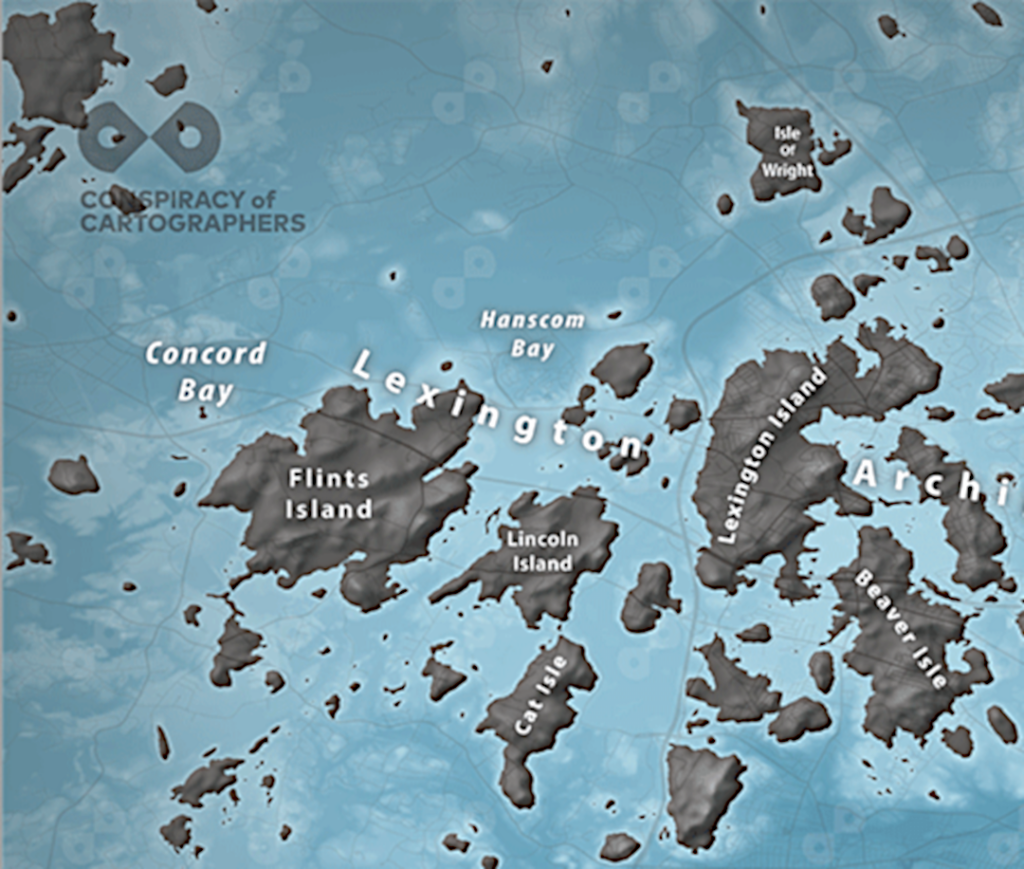
Beautiful maps. And depressing. And a very good corrective to the decades of lies and misinformation emanating from the oil companies.
On Friday when I went for a walk in Whitney Woods here in Cohasset, the marshes were silent. On Saturday, I heard a chorus of frogs calling from a couple of marshes and one vernal pool. When I returned on Sunday, the temperature had dropped 20 degrees, from about 54 degrees to the mid-30s. There were a lot fewer frogs calling on Sunday, but some were still singing away. They sounded like a bunch of ducks gabbling together.
Whenever I tried to get close enough to see them, all I ever saw was a circular ripple where a frog slipped underwater. Nevertheless, identification was relatively easy. Here’s the description of the voice of the Wood Frog (Rana sylvatica) in the Peterson Field Guide to Reptiles and Amphibians: “A hoarse clacking sound suggesting the quack of a duck.” Another source says: “from a distance, a chorus [of Wood Frogs] sounds like a gathering of miniature ducks quacking.”
I’ll let you decide if they sound like ducks or not. Here’s my lo-fi audio recording:
Historian David Hackett Fisher’s latest book is titled African Founders: How Enslaved People Expanded American Ideas (New York: Simon and Schuster, 2022) In his discussion of the eighteenth century in French Louisiana, Fisher says:
“The French know it well and say it best: plus la diversité, plus l’unité. In the age of the Enlightenment, David Hume and James Madison were were both quick to understand the uses of that idea. They helped to invent a new science of politics, and inspired the design of the early American republic, which was grounded in the uses of diversity as keys to liberty and freedom. In a later era, some of us have forgotten what they had learned.” [p.486]
One of my leisure-time projects for this year has been learning a bit of ukulele. So I’ve been watching a lot of videos of young ukulele players. And it suddenly occurred to me that many of the best young ukulele players are racially very diverse: Abe Lagrimas, Jr., Taimane Tauiliili Bobby Gardner, Rio Saito, Honoka Katayma. Yes, there are fabulous young white uke players, like Britni Paiva and Andrew Molina. But more seem to be non-white and/or mixed-race. Maybe this is just because the younger generation is majority non-white. Or maybe because the best uke players seem to come from Hawaii, which is racially very diverse. Of course, the most famous young ukulele player is white — that would be Billie Eilish (not that her ukulele playing is particularly good).
At this morning’s meeting of the South Shore UU ministers, one of the topics we discussed was elder abuse. It turns out that in Massachusetts are not mandated by law to report elder abuse, though we are mandated reporters of child abuse. We do have the option of reporting elder abuse, though people who are not mandated to report elder abuse must use a different reporting method from mandated reporters. After the meeting, I tried to find out what exactly constitutes elder abuse. I was hoping for some kind of online training, similar to the excellent online training for reporting child abuse, but I wasn’t able to find a thing. I found a couple of generalized lists on the state’s website, but nothing that explained in detail.
All in all, this was a real learning experience. Mostly what I learned is that elder abuse is not taken as seriously as child abuse.
According to a recent Pew survey, Americans perceive Jews more favorably than any other religion: 35% have a very or somewhat favorable view of Jews, 58% have no opinion, and 6% have an unfavorable opinion. That’s a 28 point “balance of opinion” between favorable and unfavorable. Mainline Protestants ranked second, with a 20 point balance of opinion.
Evangelical Christians had a 2 point balance of opinion in favor. However, most religious persons have a positive perception of their own religious group. If you remove the opinions evangelical Christians had of themselves, then they wound up with a negative 14 point balance of opinion.
Finally, people apparently tend to have a higher opinion of religious groups where they know someone that belongs to that group. Thus, Muslims and atheists fared poorly on this survey, probably in large part because so few Americans know an actual Muslim, or a real live atheist. However, atheists tend to have negative views of other religious viewpoints.
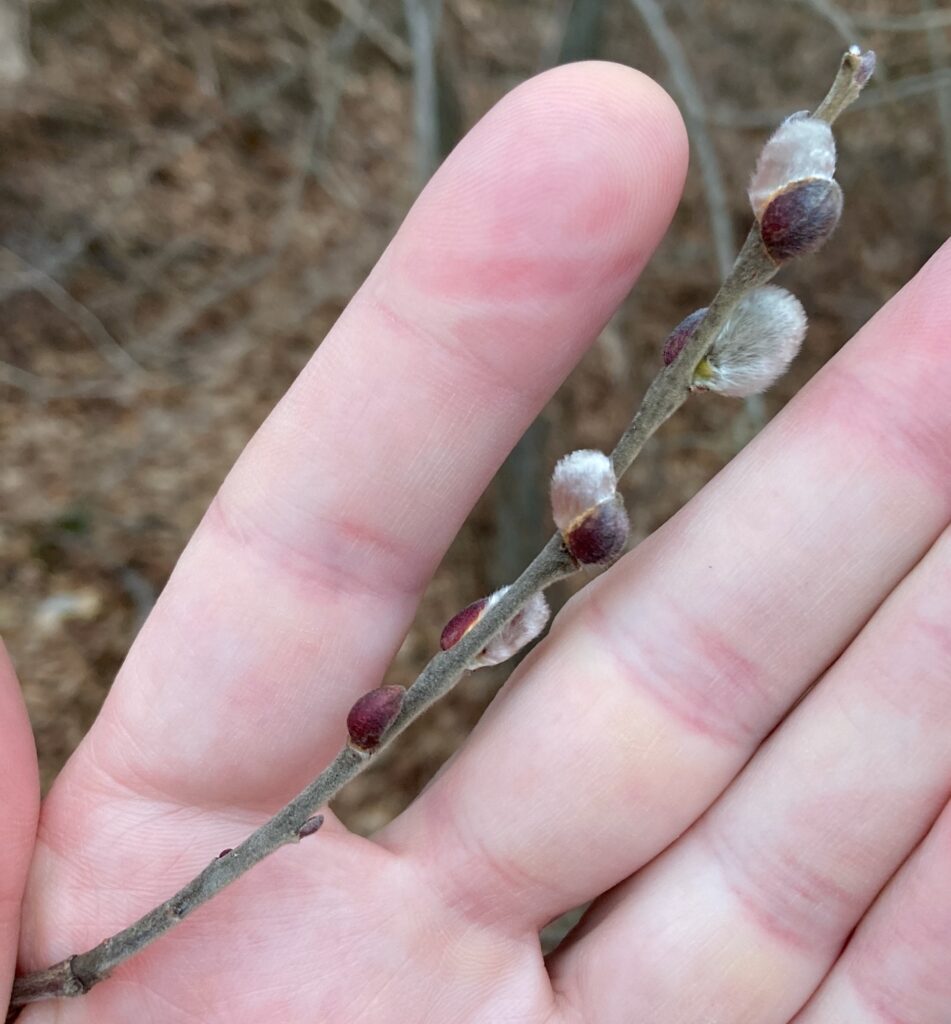
On my Sunday afternoon walk, I came across a small tree covered with little gray catkins just coming out on some of the twigs. We always called these Pussy Willows, presumably because the trees look like willow trees (Salix sp.), and the small emerging flower clusters, true to their name, look like small furry cats. This is the second native plant I’ve seen in bloom this spring.
As to what type of willow tree this is, I have no idea. Flora Novae Angliae states, “Salix is a difficult genus that displays tremendous phenotypic plasticity.” Meaning it’s hard to identify. Not counting hybrids, there are something like 19 species of willow that grow in Massachusetts, one of which is known by the common name Pussy Willow (S. discolor). But when I tried to follow the “Key for carpellate reproductive material” in Flora Novae Angliae, I got stuck at terms like “Decorticated wood” and “Ovaries glabrous.” If I spent enough time, I could look up all these terms and follow the key. But I think I’ll just call this Salix sp. until I learn more of the technical terms in botany.
I realized that I have pretty much abandoned Mastodon. That’s the non-commercial social media site that has been touted as a replacement for Twitter, after Elon Musk took over Twitter and turned it into a cesspool of hate speech. Not that I adopted Mastodon as a replacement for Twitter. I just wanted to find a social media site where I could meet some new people, and have some two-way (or n-way) online conversations.
I abandoned Mastodon because it wasn’t fun any more. It was flooded by self-proclaimed Twitter refugees, whose main goal in life seemed to be to have as many followers as possible — either that, or the goal was to follow those with thousands of followers. Mastodon was becoming dominated people who specialized in polemics, or in responses to polemics.
To put it another way: Mastodon was turning into Twitter — or turning into Facebook. Lots of rage porn and anger memes. Lots of chastising others for their inadequacies. Mind you, these sites can work fairly well if you want to communicate with people you already know, or if you want to plug into an already existing community, or if you want to be a simple consumer of what other people say.
Not that I made a conscious decision to abandon Mastodon. One day, I just didn’t use the site. It felt good to not use the site. So I didn’t use the site the next day. Or the next day, or any succeeding day. I feel a bit sad, because I think Mastodon has been designed well. But perhaps that is now the fate of all social media: to descend into a toxic mix of rage porn, anger memes, and chastising others for their inadequacies.
One of my favorite Youtube videos is titled “Guess: JAKE or Young KID? — Ukulele Challenge.”
If you know anything about the current ukulele scene, you’ll immediately figure out that “Jake” refers to Jake Shimabukuro, a ukulele virtuoso who is probably best known for his ukulele versions of “While My Guitar Gently Weeps” and “Bohemian Rhapsody.” But his range as a musician goes far beyond rock and pop music. He has arranged jazz, classical, funk, and bluegrass music for the ukulele, and written his own compositions. He is known for playing complex music requiring amazing feats with both left and right hands.
The point of “JAKE or Young KID?” is simple: a panel of professional ukulele players listen to only the audio portion of a Youtube video of one of Jake’s arrangements or compositions. Sometimes it will be Jake playing, but sometimes it will be a child or young teen playing. The panelists have to figure out which it is. Given what a virtuoso player Jake is, this should be no problem, right?
Actually, the panelists regularly mistake Jake for the Young Kid, and the Young Kid for Jake. This says a lot for the high level of playing in the rising generation of ukulele players (it also says a lot about the popularity of the ukulele these days, that kids are willing to spend so much time learning the instrument). But it also makes us confront one of the nagging questions of our time: how do we know what is true and what is false? If a ten year old kid can play like Jake Shimabukuro, then what?
But the video doesn’t get into existential questions like that. It’s just hilarious. Although panelist Kalei Gamaio easily beats panelists Abe Lagrimas, Jr., and Aldrine Guerrero, each of the panelists makes hilarious mistakes.
