
I’ve been working on other writing projects this week and haven’t had time to post on this blog. There’s a post in the works, though, to celebrate the nineteenth birthday of this blog….
Author: Daniel Harper
Early signs of spring

The Rabbi and the Basket of Grapes
Another story for liberal religious kids.This story comes from Babylonian Talmud, Kethuboth 105b.
The Rabbis taught that if you are going to judge a case between two people, you must not accept any kind of money or gift from either person, you must not accept anything that might look like a bribe. You must show everyone that you will remain completely neutral, and completely honest.
Obviously, a judge should not accept money from either person in a lawsuit. But the rabbis taught that a judge must be so honest that he or she does not accept anything, no gifts, no favors, not even a kind word.
To show what they meant, they told this story:
Once upon a time, Rabbi Ishmael rented part of his land to a tenant-farmer. The tenant-farmer paid part of the rent by bringing fruits and vegetables to Rabbi Ishmael every Friday, the day before the Sabbath day.
But one week, the tenant-farmer brought some fruit to Rabbi Ishmael on a Thursday — a big basket full of luscious, ripe grapes. Rabbi Ishmael loved grapes, but before he took the basket he said, “Thank you for bringing the grapes, but why do you bring me grapes on a Thursday, instead of your regular day, Friday?”
“It’s like this, Rabbi,” said the tenant-farmer. “I have a lawsuit, and I would like you to be the judge for this lawsuit. And as long as I was coming up here to talk to you about being the judge, I thought I’d bring your regular weekly delivery of fruit. So I brought you your basket of grapes.”
“No, no,” said Rabbi Ishmael, “I cannot be your judge. Take the grapes back to your house, and I will go find two other rabbis to act as judge for you.”
Confused, the tenant-farmer took the basket of grapes back to his house, even though they were really Rabbi Ishmael’s grapes.
Rabbi Ishmael went out to find two other rabbis to act as judge in the lawsuit, and brought them to meet the tenant-farmer. The two other rabbis began to ask the tenant-farmer about the lawsuit, and the tenant-farmer answered as best he could.
Rabbi Ishmael stood to one side, watching and listening, and he thought to himself, “Why doesn’t the tenant-farmer give better answers?” At one point, Rabbi Ishmael was on the point of breaking in and telling the tenant-farmer what to say, but he caught himself in time.
“Look at what has happened to me,” said Rabbi Ishmael to himself. “Here I am, secretly hoping that the tenant-farmer will win his case, and I didn’t even accept a bribe. I didn’t even accept the grapes that were really mine, but came a day early. What would I have done if I had accepted a real gift, a real bribe!”
The Backwards Alphabet
Another story for liberal religious children. This story comes from the Babylonian Talmud, Tractate Sabbath 31a.
One day, a man came to Rabbi Shamai to ask about becoming a Jew. Rabbi Shamai told him that if he wanted to become a Jew, he would have to learn the Torah, or the Jewish law.
The man asked, “Well then, how many types of Torah do you have?”
“We have two types of law, or Torah,” replied Rabbi Shamai. “We have the written Torah, and we have the oral Torah, the law as passed down by oral tradition.”
“I believe in the written Torah,” said the man. “But I don’t trust laws that are passed on by word of mouth. If laws aren’t written down, they are worthless. I will still become a Jew, on one condition: that you only teach me the written laws, but not the oral laws, not the spoken laws.”
Upon hearing this, Rabbi Shamai grew impatient. He said the man would never become a Jew with that attitude, and he told the man to leave.
But the man still wanted to know about becoming a Jew, so he went to Rabbi Hillel, who told him: “We have two types of law, or Torah. We have the written Torah, and we have the oral Torah, the law as passed down by oral tradition.”
“I believe in the written Torah,” said the man. “But I don’t trust laws that are passed on by word of mouth. If laws aren’t written down, they are worthless. I will still become a Jew, on one condition: that you only teach me the written laws, but not the oral laws.”
“I will accept you as a student,” said Rabbi Hillel, who was a patient man. “First, you must learn how to read Hebrew, so I will teach you the 22 letters of the Hebrew alphabet. Repeat after me: aleph, bet, gimel, dalet, he, vav, zayin, khet, tet, yod, khaf, lamed, mem, nun, samekh, ayin, pe, tsadi, kuf, resh, shin, tav.”
The man repeated the entire Hebrew alphabet after Rabbi Hillel — “Aleph, bet, gimel,” and so on, until he had all the letters memorized.
The next day, the man came back to learn the written law from Rabbi Hillel. Rabbi Hillel said, “Let’s make sure you remember the 22 letters of the Hebrew alphabet. Repeat after me: tav, shin, resh, kuf, tsadi, pe, ayin, samekh, nun, mem, lamed, khaf, yod, tet, khet, zayin, vav, he, dalet, gimel, bet, aleph.”
The man looked confused. “But that’s not the way you taught them to me yesterday,” he said.
“Yes, that’s true,” said Rabbi Hillel, “and as you can see, you must learn to rely upon me and my teaching. In just the same way, you must learn to rely upon the spoken law.”
Why I need to get rid of Microsoft products
Microsoft no longer supports Office for Mac 2019. They no longer sell or support anything under the Office brand. No more standalone software. They want you to buy a subscription to Microsoft 365. So now every time I open an MW Word document, I get this little error message telling me that the software “needs updating” — an error message that now will never, never go away. They really want to annoy me into buying an MS 365 subscription.
But the subscription model for software doesn’t work for everyone. It most certainly doesn’t work for me. First of all, subscription software costs more — way more — for low-level users like me. MS 365 costs $100 a year. I bought MS Office 2019 for something like $125 and used it for 5 years, so MS 365 is about four times as expensive. Second, even though MS 365 uses an open file format, I don’t trust Microsoft. It would be all too easy for them to decide to emulate Adobe — when you stop subscribing to Adobe’s software, you lose access to all your work. Third, I actually don’t want my software constantly upgraded to the latest version with all the bells and whistles, I just want to use the same software version that I know and with which I’m comfortable, and with which I’m most productive. Fourth, I have subscription fatigue: I. Don’t. Want. Any. More. Subscriptions.
And finally, the only part of Microsoft’s office suite I really use is MS Word. So if I want to escape Microsoft’s evil clutches, all I need to do is find an alternative word processing program.
I’ve been working down the list of word processors. I’ve tried Scrivener and Nota Bene, but both products are too specialized for my needs. Both Google Docs and ApplePages both strike me as not quite ready for prime time; they certainly don’t meet my needs. I skipped over many other word processors, including Nisus Writer and Apache Open Office, because they appear to have such a small user base that I don’t trust them to be around for a long time.
I’ve finally gotten around to LibreOffice. So far, it does what I want it to do. It has an installed user base of about 200 million (small compared to MS Word’s 1 billion, but still…). There are some things about LibreOffice that annoy me, but so far it’s less annoying than MS Word. I like that it’s free and open source, and because I’m a regular user of GIMP and WordPress I’m accustomed to the quirks of open source software development communities.
I think I like LibreOffice enough to invest the hours needed in order to become as productive with it as I currently am with MS Word. I’m actually relieved at the prospect that if I can get fluent with LibreOffice I’ll never have to use MS Word ever again. I’ve always hated Word, I just felt stuck with it.
Even though I’ve always hated Word, I’m mightily resentful that I’m being forced to learn how to use a new word processor. For no good reason except that the corporate executives at Microsoft need to support their lavish lifestyles on the backs of their customers.
Standing on One Foot
Another story for liberal religious kids. This story comes from the Babylonian Talmud, Tractate Sabbath 31a.
A man came to talk with Rabbi Shamai, one of the most famous of all the rabbis, nearly as famous as Rabbi Hillel.
“I would like to convert to Judaism and become a Jew,” said the man. “But I don’t have much time. I know I have to learn the entire book you call the Torah, but you must teach it to me while I stand on one foot.”
The Torah is the most important Jewish book there is.How disrespectful that this man wanted to learn it while standing on one foot. Why, people spent their entire lives learning the Torah. It was not something you can learn in five minutes! Rabbi Shamai grew impatient. He pushed the man away using a builder’s yardstick he was holding in his hand.
The man hurried away, and found Rabbi Hillel. “I would like to convert to Judaism and become a Jew,” said the man. “But I don’t have much time. I know I have to learn the entire book you call the Torah, but you must teach it to me while I stand on one foot.”
“Certainly,” said Rabbi Hille, who was a very patient man. “Stand on one foot.”
The man balanced on one foot.
“Repeat after me,” said Rabbi Hillel. “What is hateful to you, don’t do that to someone else.”
The man repeated after Rabbi Hillel, “What is hateful to me, I won’t do that to someone else.”
“That is the entire Torah, the whole law,” said Rabbi Hillel.
The man nodded.
Rabbi Hillel continued, “Everything else is there to explain this simple law. Now, go study.” And because of Rabbi Hillel’s patience with him, the man spent the rest of his life studying the Torah.
Seiji Ozawa
Seiji Ozawa, long-time music director of the Boston Symphony Orchestra (BSO), has died.
From 184 to 1987, I had subscription tickets to the BSO — Thursday nights, the so-called “jump seat” in the second balcony, one of the cheapest seats in the house. I remember several transcendent experiences with Ozawa on the conductor’s podium.
The Mahler symphonies; as I recall I heard the second, third, fifth, seventh, and the ninth. Although I can no longer remember the specifics — I have a terrible musical memory — I remember the emotional and spiritual effect Ozawa’s Mahler symphonies had on me.
Three Tableaux from Messiaen’s opera “St. Francis of Assisi,” complete with bird song written into the score, had a tremendous effect on me as well. I hadn’t realized that music could do that — could draw directly on the natural world, could bring the non-human world directly into the concert hall. Messiaen was in the audience that night, which added to the magic.
I mostly remember Ozawa conducting twentieth century music. I had little interest in music from the Baroque, Classical, or Romantic eras. But that’s what Boston audiences wanted: Beethoven, Bach, Brahms, Mozart, over and over again. I still remember attending one of the Friday afternoon concerts (I must have gotten a day off from work), and watching as the rich old blue-haired ladies deliberately stood up and pushed their way out of their seats five minutes into some piece of new music, their nasty way of stating to the whole world that They Did Not Approve. And the hell with the concert-goers whose toes they crushed on the way out.
The self-proclaimed cognoscenti in Boston were exactly like the rich old blue-haired ladies in that they never approved of Ozawa. Take Richard Dyer of the Boston Globe — he seemed to hate Ozawa, and never missed a chance to badmouth him. Sometimes my father and I would attend the same concert, and we’d read Dyer’s review and wonder if he went to the same concert as we did. Even after Ozawa’s death, Dyer couldn’t resist taking potshots at him in the obituary he wrote for today’s Globe — if you only read Dyer’s obit, you’d wonder why in hell the BSO kept such an incompetent socially awkward idiot as their music director for so many years. (I wish I hadn’t read Dyer’s obit; it only served to sully the memory of a brilliant, charismatic, dynamic musician.) Why did the Boston cognoscenti hate him so much? Probably because he was dashing, charismatic, exciting, innovative — all of which are character traits which Boston has historically despised. Plus he wasn’t White. I still say Boston is the most racist city I’ve ever lived in, and hating on Ozawa seems to me to be yet another manifestation of that racism. God knows why Ozawa put up with it for so long, but I’m grateful that he did.
I’ll end with a brief memory of the most memorable concert I ever experienced.
It was Thursday night, November 29. On the program: one of the greatest of all symphonies, Mahler’s Ninth. I took my seat at the back of the second balcony in Symphony Hall, excited to hear the Ninth live for the very first time in my life. The orchestra was much larger than usual, filling the entire stage. Ozawa entered to the usual applause.
The first movement was mind-blowing — I just didn’t realize how huge the sound of a Mahler orchestra was, and I didn’t realize how deeply moving Mahler’s music got towards the end of his career. Looking back, I think my brain was being rewired by what Mahler was saying. The movement ended, and Ozawa stepped off the stage. And we waited. And waited. For nearly twenty minutes. Ozawa’s brother Katsumi had died of a stroke the day before, at age 56, and Ozawa must have been crippled with grief. But he came back on stage. He finished conducting the Ninth, and somehow all the emotion and grief and feelings of love for his brother came through. No doubt Richard Dyer wrote a scoffing review of the performance, but it remains one of the most memorable musical experiences of my life. Ozawa had created music with the deepest feeling possible.
Ozawa wasn’t able to conduct the performances of the Ninth on Friday or Saturday; the BSO had to bring in a substitute. We who were there on that Thursday were the only ones to hear music from Ozawa’s deepest soul; at what cost to him I cannot imagine. But I’m eternally grateful to him for that gift he gave us that night; I’ve never forgotten it; it change me and made me a better person. What more can we ask of the arts?
Noted without comment
“It may not surprise you that the data show that people who regularly participate in faith communities are likely to live years longer than those who do no. People connected to communities of shared purpose are less lonely, more motivated, more hopeful, and more fulfilled. Even still, I don’t know anyone who ever joined a church because of advanced metrics.”
— Rabbi Sharon Brous, The Amen Effect: Ancient Wisdom To Mend Our Broken Hearts and World (2024), p. 41.
The Fox and the Fish
Another story for liberal religious kids. This story comes from the Babylonian Talmud, Tractate Berakoth 61b.
Once upon a time, the wicked Roman government issued a decree: no more would the Jews be allowed to study the Torah and the law.
But Rabbi Akiva seemed to ignore the decree. He gathered people together quite openly, and taught them the Torah and the law. Pappas, the son of Judah, took him aside and said, “Rabbi Akiva, do know what could happen to you? Aren’t you afraid the Romans will punish you?”
“Let me tell you a story,” said Rabbi Akiva, and he told this story….
Once upon a time, there were many small fish who lived in a stream. One day, fox walked alongside the stream, and noticed that all the fish were darting to and fro, as if they were afraid of something.
“O fish, o fish,” said the fox, “why are you swimming around so? What is it that you are trying to escape?”
“We are trying to escape the nets that the humans have put in the stream to catch us,” said the fish.
“Oh, ho,” said the fox. “Then perhaps you should come up here and walk on dry land alongside me, just as your ancestors used to walk beside my ancestors years and years ago. That way you can escape from the nets of the humans.”
“What, go up on dry land!” said the fish indignantly. “You have a reputation for being smart, but that is a stupid thing to say. We may be afraid of what’s going on here in the water where we feel comfortable, but it would be much worse for us up in the thin air where we would surely die.” And so the fish stayed in the water, and did not try to walk beside the fox on dry land.
Rabbi Avika said, “Now you can see that we are just like the fish in the stream.”
Pappas asked the rabbi to explain.
“It’s like this,” said Rabbi Avika. “If we neglect the Torah, if we neglect what is central to our religion, we would be like fish out of water, and we would die. It is written in the Torah, ‘For that is your life and the length of your days.’ Perhaps we will suffer if we do study the Torah, but we know we will surely die if we don’t.”
Not long after that, the wicked Romans arrested Rabbi Akiva for teaching and studying the Torah. He was roughly thrown into the Roman prison, and there to his surprise he found Pappas.
“Pappas, what are you doing here?” asked Rabbi Akiva.
“O rabbi,” said Pappas, “you were right. I have been thrown into prison for nothing important. At least you have been thrown in prison for something worth dying for.”
And when Rabbi Akiva was killed by the Romans, he died in peace with the words of the Torah on his lips.
Botany in winter
I spent most of this past week at a retreat center in western Massachusetts where there was no internet service, and my cell phone service was spotty. I was staying in an isolated cabin. And there was hardly anyone else at the center the whole time I was there. Just me and the wood stove and the outhouse, and a hundred acres of woodlands.
I went there to do some reading, but I also found time to do some winter botany. Turns out you can identify trees in winter by looking at their bundle scars, stipules, and bud scales. Then I had to learn what bundle scars, stipules, and bud scales were.
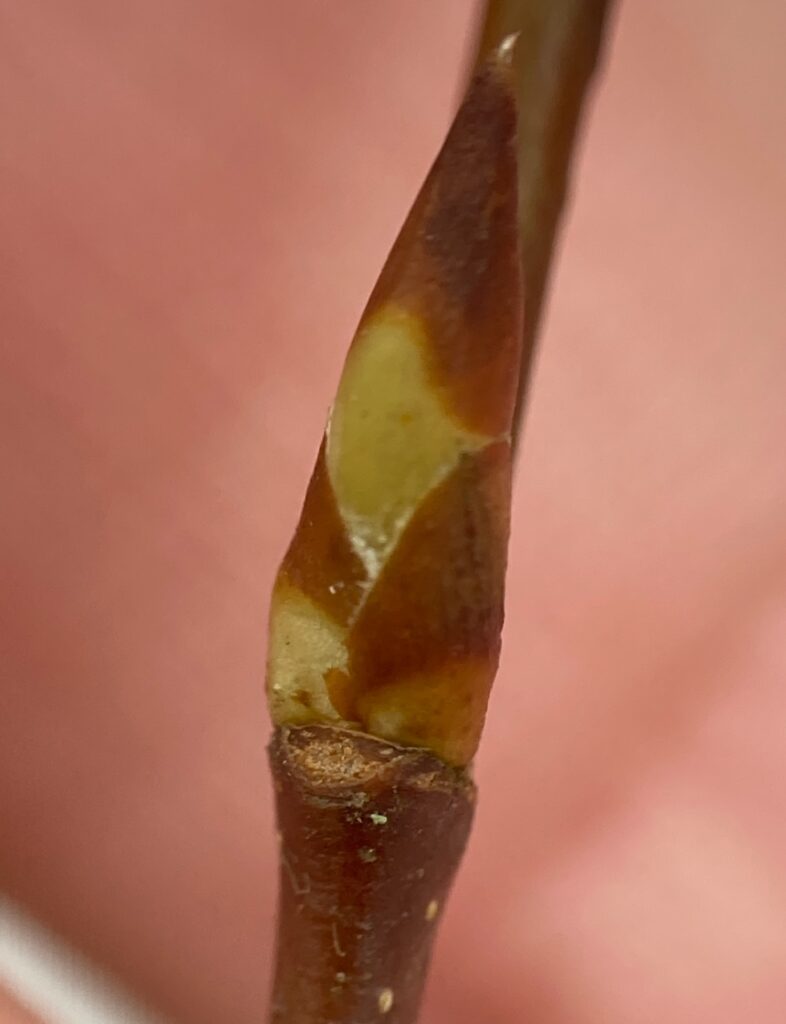
There was only an inch or two of snow on the ground, so I could also look at moss. I found Dicranum sp., Thuidium sp., Callicladium haldanianum, and several others.
So even though it’s winter, you can still do botany.