The Walters Museum in Baltimore has a small selection of South Arabian art. I’m completely unfamiliar with South Arabian art, and before I went to the Walters Museum yesterday I knew nothing about its long history. According to the Smithsonian National Museum of Asian Art:
“For over a thousand years, from around 800 B.C.E. to 600 C.E., the kingdoms of Qataban, Saba (biblical Sheba), and Himyar grew fabulously wealthy from their control over the caravan routes of the southern Arabian peninsula and, in particular, from the international trade in frankincense and myrrh. Excavations at the capitals of these ancient kingdoms have yielded spectacular examples of architecture, distinctive stone funerary sculpture, elaborate inscriptions on stone, bronze, and wood, and sophisticated metalwork.”
One of my favorite pieces of South Arabian art on the view at the Walters Museum is an unnamed goddess, who appears in a fragment of a pediment. She sits next to a child deity. Due to the lighting, I found it difficult to take a photograph due to the reflections on the glass case which houses this goddess; I had to do a fair amount of digital manipulation to make her look more or less the way she looks in the museum.
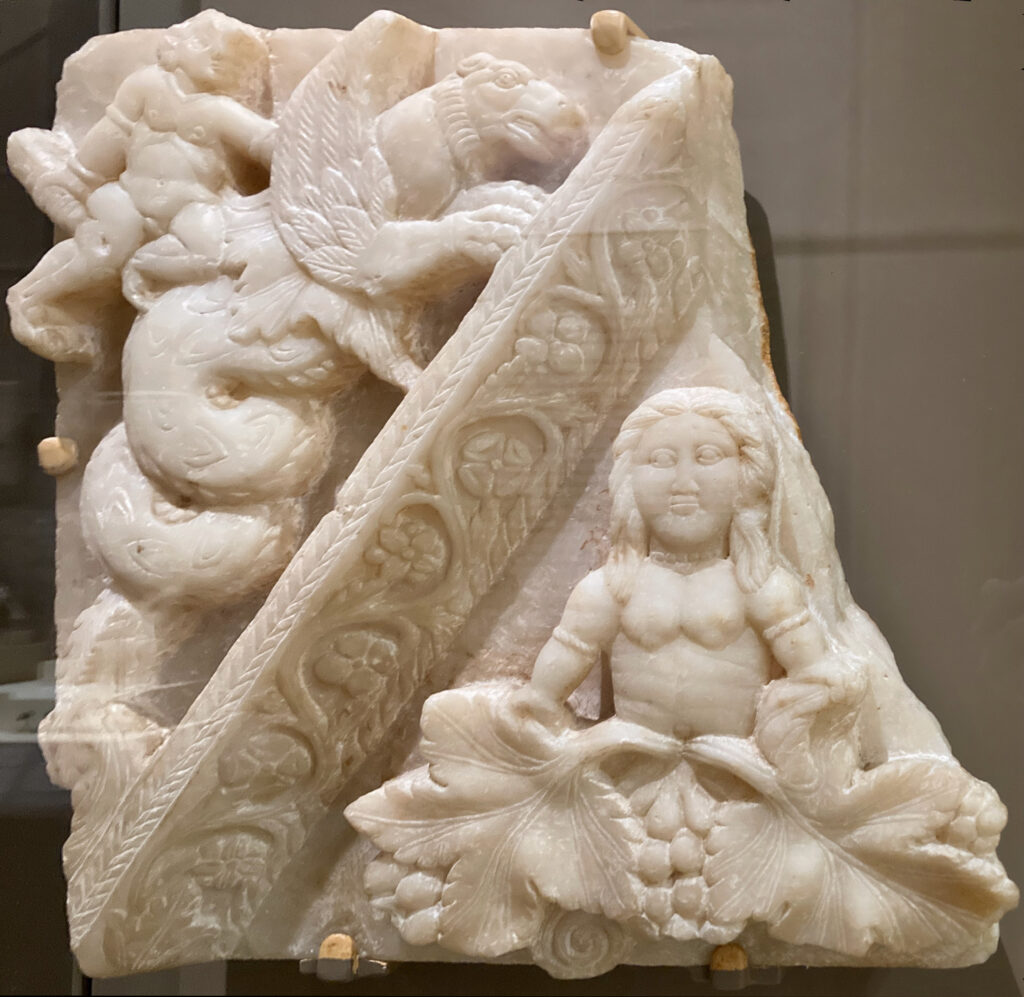
Here’s what the museum label says about this sculpture:
Fragment of a Pediment with a Goddess
South Arabia (Marib), 2nd century A.D.
The upper left side of this composition depicts an imaginary creature composed of an Asiatic lion’s head, a serpent-like body, a fishtail, and wings. A nude child deity grasps one of the creature’s wings with his left hand and holds a short sword in his right hand to control it. A smaller fragment containing the head of a similar composite beast in the British Museum might be the complement to this vignette. The lower right section depicts a nude fertility goddess emerging from vine leaves and grapes. With the increasing influence of Greco-Roman culture curing the 2nd and 3rd centuries A.D., new artistic styles and motifs, such as this female deity, became a part of South Arabian culture.
Calcite-alabaster
21.74, gift of Girard and Carolyn Fester, 2014
I wonder if she was really a fertility goddess, or a goddess of wine. I don’t think we’ll ever know.