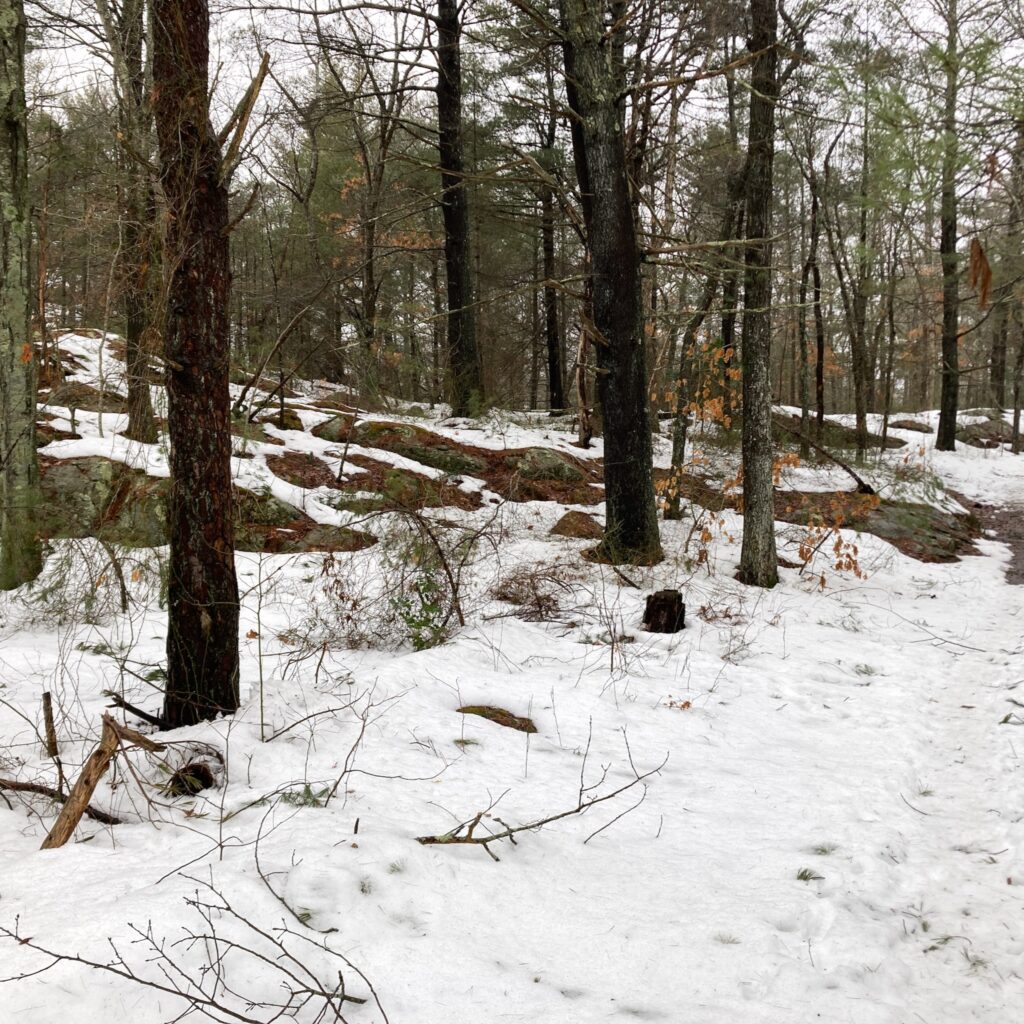
The temperature has been above freezing most of the week. This afternoon, it got up to about 38 degrees F. (3 C.) with light rain and drizzle. I wanted to see how much the snow was melting in the woods, so I went for a walk. I did see some places that were now bare of snow, mostly on south-facing slopes or where the high winds of the blizzard hadn’t allowed much snow to accumulate.
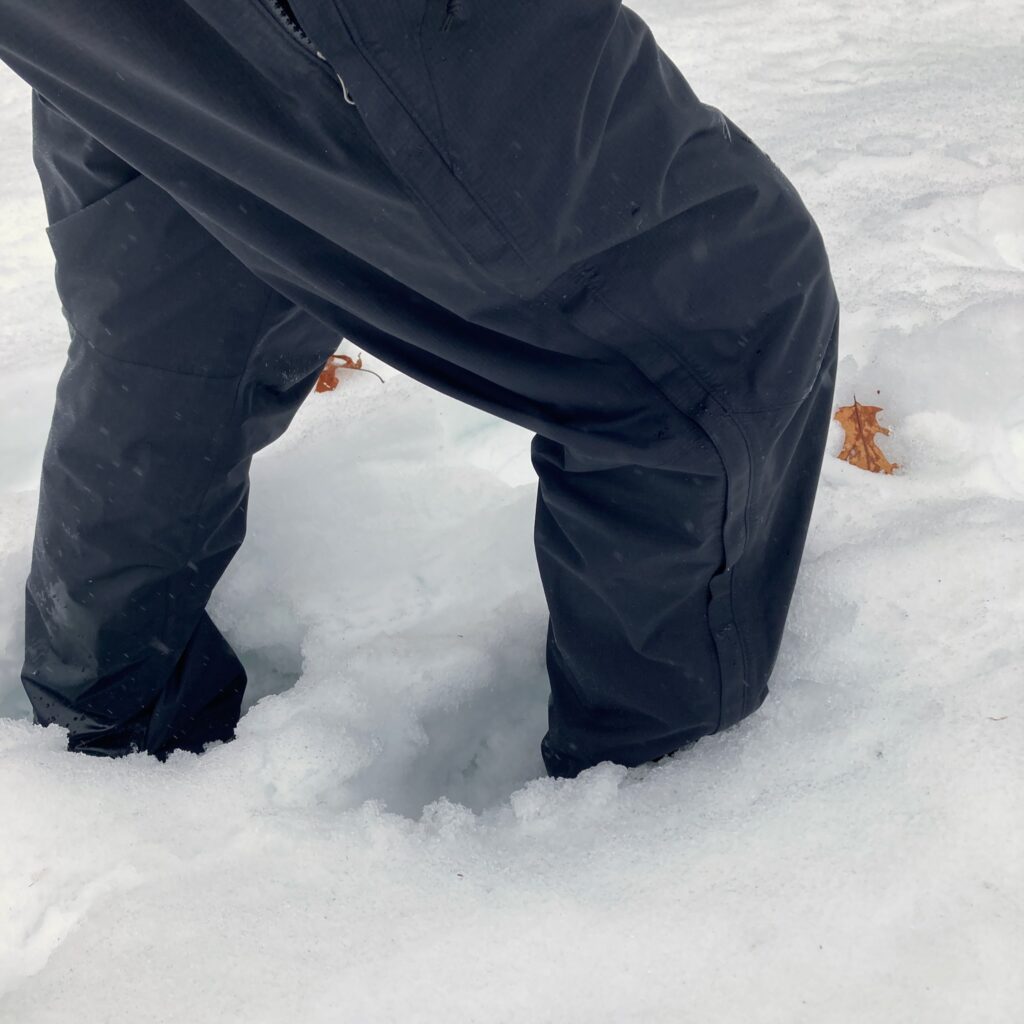
Most of the ground remains covered by snow, though. There are still places with a foot of snow or more. Crossing one field, I had especially tough going. Sometimes I’d sink up halfway up to my knees. In one of the deepest snowdrifts I stopped and stuck my hand down to see how deep the snow was. I didn’t manage to reach the ground, but I’d guess there was still a foot and a half of snow.
In many places, meltwater ran underneath the snow. Some of the trails had turned into shallow streams. My wet boots grew heavy from the weight of the water. I walked to a place where skunk cabbage (Symplocarpus foetidus) usually grows, but I couldn’t get close enough to see if any had emerged from the snow due to a foot of water flooding the area.
At last I made it back to the car. What should have been an hour long walk took two hours. My boots were soaked, my raincoat and hat were dripping with rain. I only wish I could have stayed out longer.
8:15 p.m. — Power went out two houses down from us, but so far we still have it. We’ll see how long it lasts.
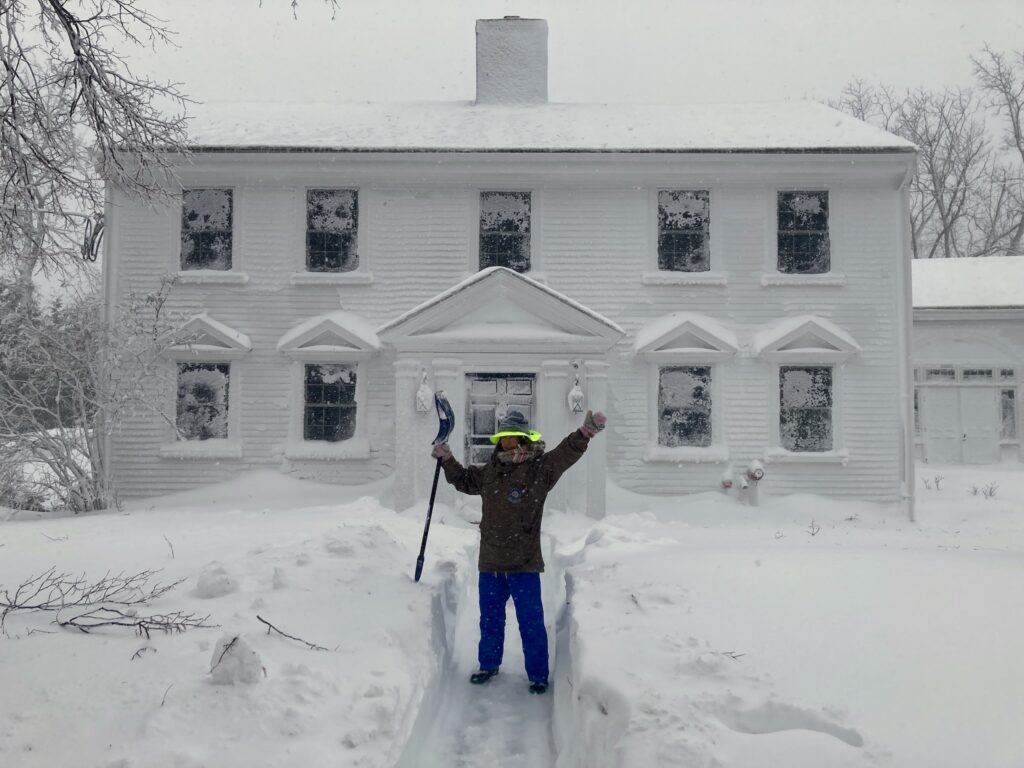
Latest National Weather Service (NWS) reports show more than 30 inches of snow from Rhode Island up through southeastern Massachusetts. The nearest trained NWS spotter is in North Scituate, which is about 3 miles from here; that observer recorded 29 inches of snow as of 5:00 p.m.. Carol and I shoveled at about 5, and another couple of inches has fallen since then, so I’m pretty sure we have more than 30 inches at this point. And it’s still snowing.
Early to bed tonight. Beginning at seven tomorrow morning, we’re both volunteering with Cohasset Emergency Management to help staff the warming center for people who have lost power.
Blizzard conditions are defined by the NWS as visibility of 1/4 mile or less and wind speeds (sustained or frequent gusts) of 35 mph or higher, for 3 hours or more. These conditions were officially reached throughout eastern Massachusetts, from Providence, R.I. and Martha’s Vineyard, west to Worcester and north to Beverly, Mass. I guess we start calling this the Blizzard of ’26.
Carol and I shoveled a path to the front door of the church’s Parish House. Carol is wearing the anorak that her father had when he wintered over in Antarctica. The snow wasn’t very deep where we were shoveling, because the wind had scoured it away. A friend with an anemometer saw 60 mile an hour wind gusts this morning.
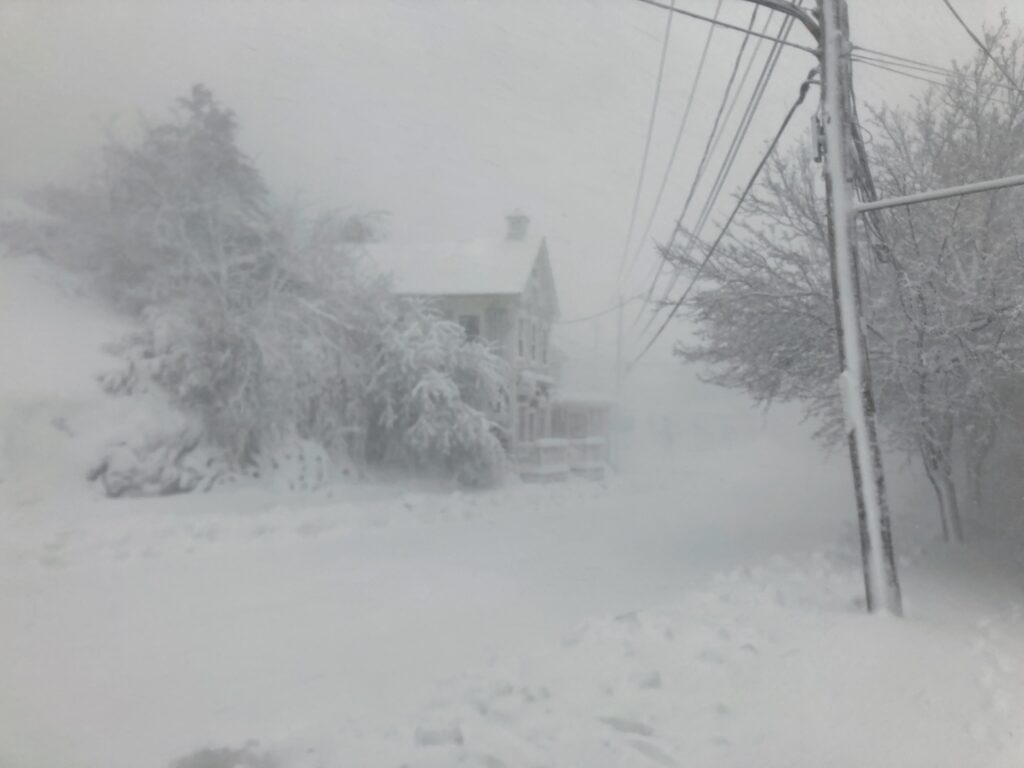
I went out for a short walk. A few wind gusts strong enough to knock me off balance. Lots of downed branches, mostly fairly small. Heavy snowfall, an inch of two an hour, with very low visibility. It’s a wild storm.
The lights keep flickering, so I’ll post this while we still still have power.
Some people here at the retirement community in Wisconsin measured up to 15 inches. But the temperatures are above freezing now, and the snow on Ed’s balcony is already starting to slump. People who live here are saying, “This is the last storm of winter. I hope.”
We got up early, and kept working from six thirty to twelve thirty. We put a few last items in the moving container, tied the canoe on the car, did some more last minute cleaning, loaded up the car, argued about little things, did a walk-through of the house with Kathy the cemetery superintendent and Joe from the cemetery’s board of trustees. The truck came by at about 9:30 to pick up the moving containers — what a relief that was. The car was packed by noon. It was a “Spare the Air” day, and the smog was unpleasant. We were ready to go.
Thank goodness it was a holiday, the new federal holiday to commemorate Juneteenth. A holiday reduced the traffic from intensely unpleasant to merely horrible. We drove out through the inner Coast Range and into the Central Valley. We stopped at Dixon Fruit Stand, but they had mediocre fruit and durly clerks. We kept driving. Just past Davis, I said, “Let’s get off at Yolo Bypass.” “Where?” said Carol. “Right here, this exit,” I said. Carol zipped off the freeway at the last minute, saying she was willing to do something I wanted to do; meaning I should be nice to her when there was something she wanted to do later in the trip.
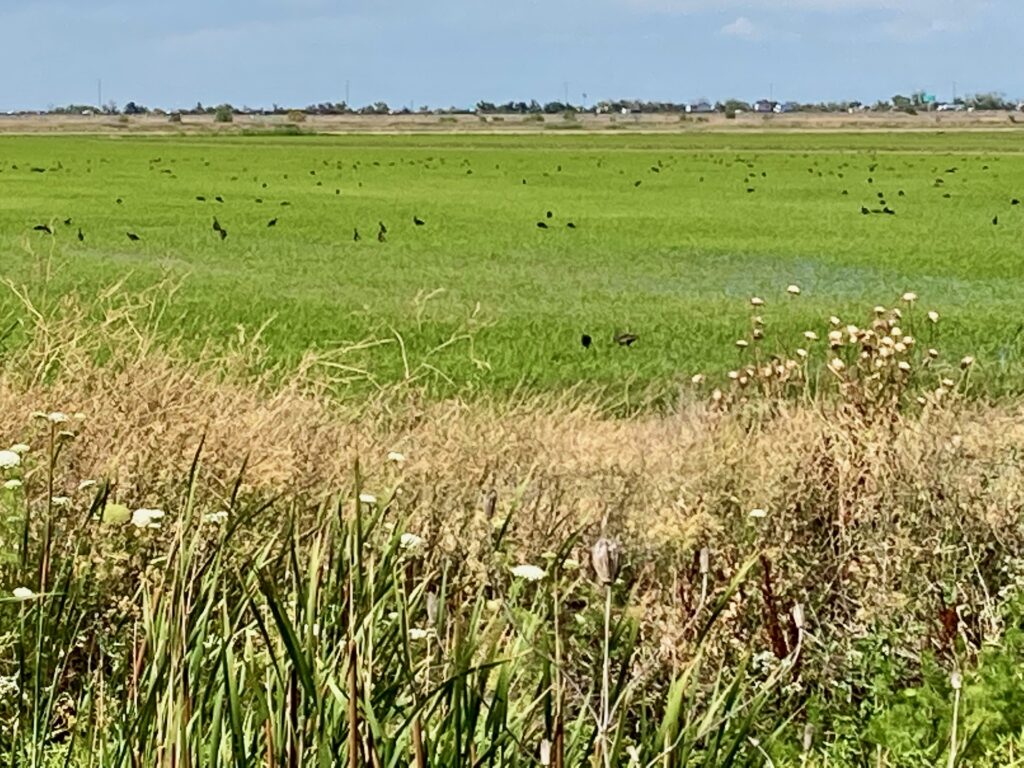
We drove to Parking Lot B, three quarters of a mile into Yolo Bypass Wildlife Management Area. Carol stayed in the car to take care of some business on her phone. I got out into the Central Valley heat, into the intense sunlight. I walked down a road. Yellow Star Thistle (Centaurea solstitialis) lined the road, but just a yard or two from the road, there was a band of tall Bisnaga (Visnaga daucoides), the white umbrels of flowers waving above the feathery green foliage. Beyond that, bulrushes (Schoenoplectus sp.?) grew where the road dropped off into marshlands. Off to my right, green rice fields stretched into the distance. A large flock of White-faced Ibis circled overhead, then settled into the rice fields.
White-faced Ibis in a rice field, Yolo Bypass Wildlife Management Area
After this stop, I felt different. I felt sane. Packing up and emptying out the house had felt strange, not completely moored in reality. The first two hours driving in the car still felt a little detached from reality. But the brilliant sunlight, the flowers, the pollinators, the birds, the jackrabbit loping lazily across the road — it felt like I was reconnecting with reality.
While I was photographing a flower, a man pulled up in his car, and spoke through the open window. “Um, I was just curious what you’re doing there. Not that you have to tell me, but…”
“Do you know this social media app iNaturalist?” I said. He didn’t. I explained that you could take a photo of a plant or animal, upload it, and get an identification. “I got into flowers recently,” I said, “and that’s how I’m learning them.” He asked me a few questions, then got ready to move on. “I’m Thomas, by the way,” he said. I introduced myself, then he drove off.
I walked slowly back to the car. Carol got out to take a short walk with me, but we agreed it was too hot, so we started riving again.
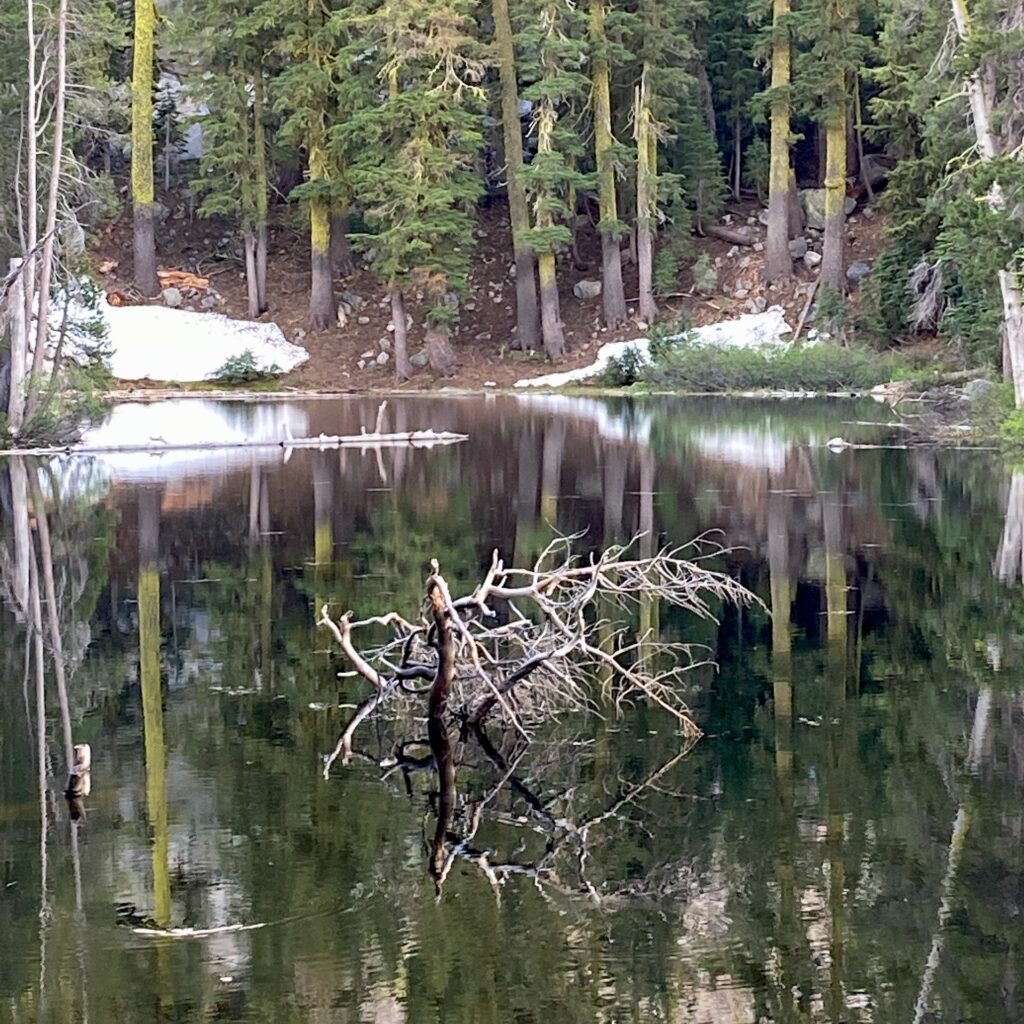
We stopped again at the Donner Pass rest area, and walked the little half mile loop next to the parking lot. It was already summer in the Central Valley, but it was still spring in the High Sierras. I saw a manzanita (Arctostaphylos sp.) still in bloom. We came to a small pond, and on the opposite shore there was still some unmelted snow.
Unmelted snow near Donner Pass
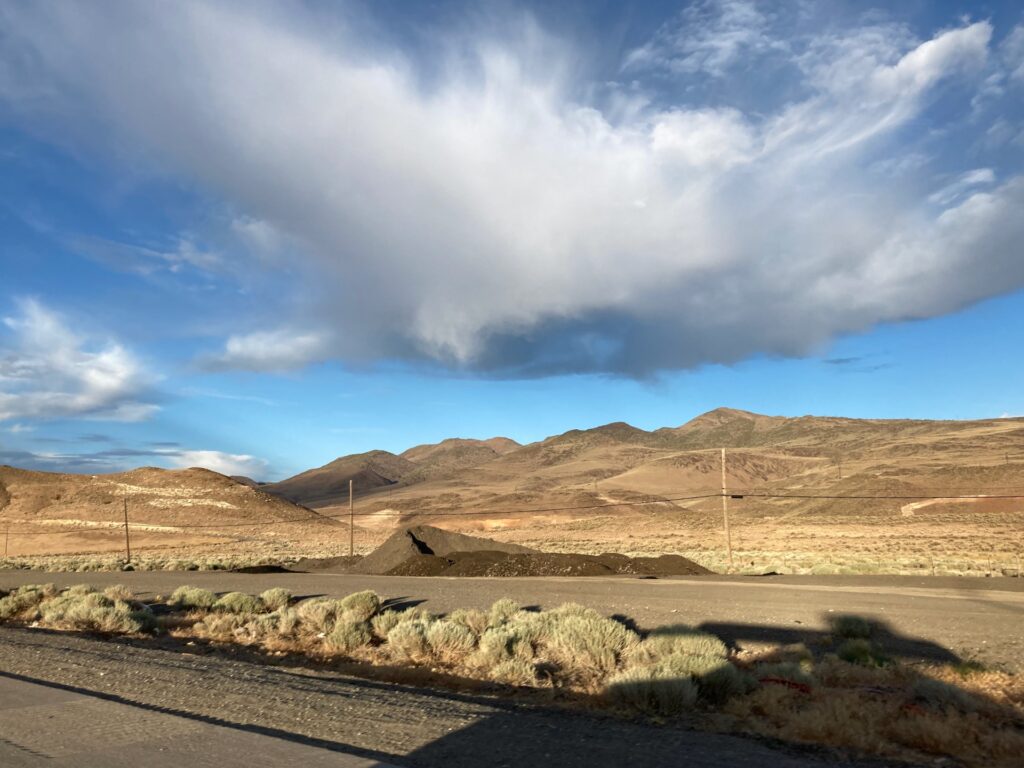
Then down the eastern slope of the Sierras into Nevada. Now we were in the dramatic landscape of the Great Basin. I noticed the canoe on top of the car cast an odd shadow as we drove.
Near Reno, on I-80
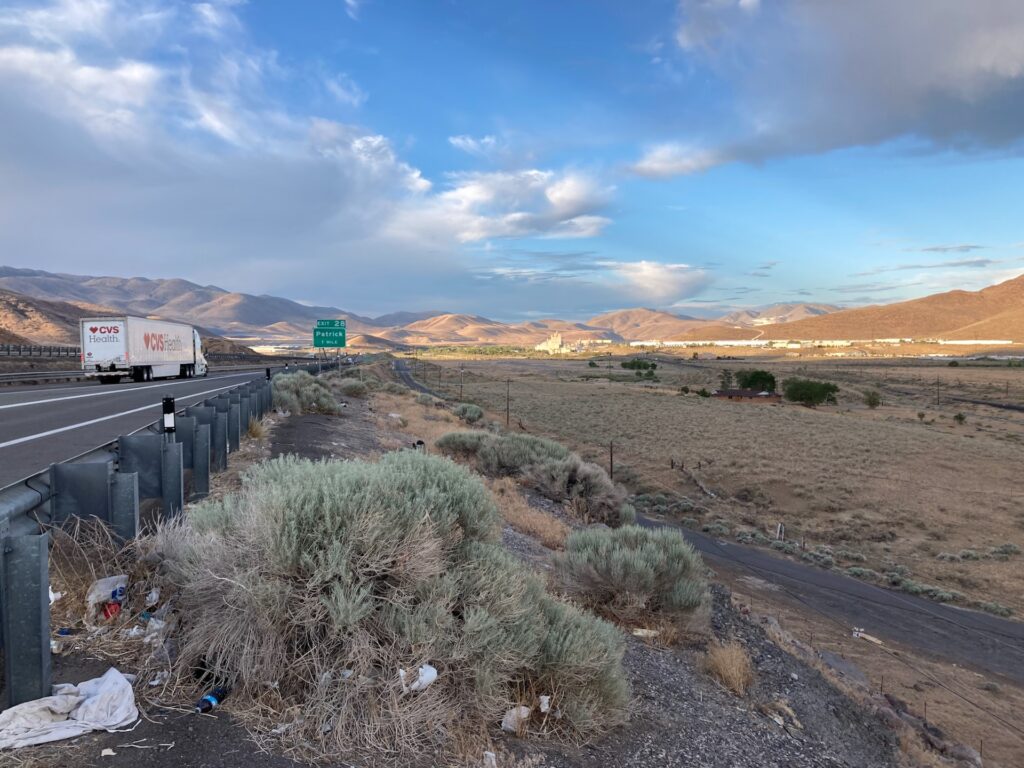
As sublime and awe-inspiring as the landscape was, it had been permanently marked by humankind. The philosopher Martin Heidegger, Nazi sympathizer though he was, had a useful insight with his concept of “Enframing”: part of the logic of modern human technology is to exclude all other ways of thinking about the world.
Patrick, Nev.
That sublime Nevada landscape is completely surveyed, marked out with roads and power lines, dotted with trash and effluvia; the habitats of plants and territories of birds must fit into the interstices of that human framework.
We drove on under the awe-full evening sky, and checked into our motel in Fernley, Nev.
We had periods of heavy rain and hail on Monday, then when the storm passed it got quite chilly. It still felt downright cold, by Bay Area standards, late Tuesday morning when we went out to the car.
We drove down the hill from the cemetery to where there’s a panoramic view of San Francisco Bay. We both exclaimed, “Snow!” The peaks of the mountains on the east side of the Bay were white with snow, from the mountains around Mission Peak (elev. 2,520 ft.) southwards to the mountains around Mt. Hamilton (elev. 4,265 ft.). Since a good portion of Mission Peak range was white, I figured the snow must have come down well below 2,000 feet.
I dropped Carol at work, and drove south to Palo Alto, periodically marveling at the sight of snow when the mountains across the Bay came into view. When I got off the highway and headed west into Palo Alto, I tried to see if Black Mountain (elev. 2,812 ft.) and the ridge of the Santa Cruz Mountains had snow; but I had to keep my eyes on the road and couldn’t get a clear view. But a page one story in Tuesday’s edition of the San Mateo Daily Journal said that there was indeed snow on the Santa Cruz Mountains:
“The highest elevations in San Mateo county saw snow Monday night…. Snow fell just about everywhere above 1,000 feet Monday, including in parts of the Santa Cruz Mountains, with temperatures as low as 32 degrees around that area.”
And according to Palo Alto Patch, not only was Page Mill Road in Palo Alto closed Tuesday due to snow and ice, but:
” ‘One spotter in Morgan Hill said he saw snow at 700 feet,’ [National Weather Service meteorologist Matt Mahle] said. ‘It started accumulating … at about 1,000 feet.’ “
When I drove to work on Thursday (yesterday), the Hamilton range was still mostly white with snow; I don’t remember the last time snow lasted that long, but it was several years ago. And there is more snow coming Saturday night, according to the National Weather Service:
The latest models bring snow levels down to around 1,500 feet over the North Bay and around 2,000 feet over the Central Coast during the day Sunday.
This is nothing like the polar vortex in the eastern U.S., but it is unusual weather for us.
In the middle of the day yesterday, I looked out of the window here in Seattle and it was snowing steadily. The snow didn’t stick to the ground where we were, and it was soon over. This afternoon when we went for a walk, we saw frozen puddles by the side of the road, and frozen mud crunched under our feet when we stepped off the paving. We passed a pickup truck with a couple of inches of packed snow on its roof; it must have been driven into the city from some place nearby at a higher elevation, where there had been more snow, and the snow had stuck. And as it turns out, the same cold front swept down to San Mateo, where the National Weather Service reported “an active morning with passing showers and snow showers,” with the showers ending by this afternoon.
There is a long and honorable literary tradition in which events in the natural world are linked to human affairs, and I can’t help thinking about what Robert Frost said about fire and ice. If he had to choose between the world ending in fire or ice, Frost said, he’d bet on fire, based on what he knew of desire. But, he said:
…if [the world] had to perish twice,
I think I know enough of hate
To know that for destruction ice
Is also great
And would suffice.
Consumer capitalism provokes our unending desire for cheap consumer goods, and cheap consumer goods require the ever-increasing use of cheap energy, which in turn has led to the frightening rise in average global temperature: so the odds are pretty good that Frost is right, and the world will end in fire. But all the hatred that has broken out into in the United States in the past couple of years has made it clear that is we don’t die of fire and desire, we will freeze to death from icy hatred.
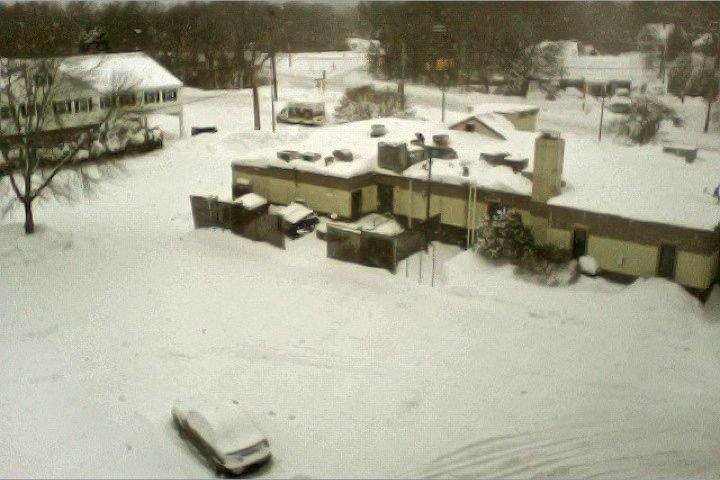
I’m in Massachusetts visiting my dad. It’s snowing. And snowing. And snowing. It’s been snowing for two days now. They had something like three feet of snow when I got here, and it looks like this storm is going to dump another foot or foot and a half of snow. Here’s the view from my motel window:
That road behind the buildings? That’s the interchange of Route 110 and Interstate 495. At this time of day, you’d expect lots of cars. But everything is closed due to snow, so as you can see there is hardly any traffic out there. And the parking lot for the restaurant next door is basically empty.
I just wish they could send some of this snow to the Sierra Nevada mountains in California, where it is desperately needed.
On the drive down to Palo Alto, there’s an overpass from which you can see the range of mountains south of San Jose. The highest peaks were still white today from the snow that fell early in the week. Today’s San Francisco Chronicle reported that up to eight inches fell on Mount Diablo (elev. 3,864 ft.), eastwards across the bay from us.
And the Chronicle reports that meteorologists say there’s a possibility that the Alaskan storm now heading southward could possibly deliver snow at sea level over the weekend. It probably won’t happen, but what if it does? — If it does snow, I’ll try to get a photo of snow on the orange tree in our back yard, which still has ripe oranges on it.
It seemed like there was a lull in the rain, so Carol and I walked over to the neighborhood supermarket to buy some dinner. On the way back home, the chilly damp wind blew fine raindrops at us. “It’s cold,” said Carol. “It can’t be more than forty degrees,” I said.
When we got back, I checked the weather forecast: it’s supposed to dip down into the thirties tonight in San Mateo; there’s a possibility of snow down to the two thousand foot level tonight and tomorrow, and there’s even been a report of snow on Grizzly Summit in the Berkeley Hills, which is a mere 1,750 feet high. We won’t get any snow down where we live, but if the fog lifts tomorrow we might be able to see snow on the mountains across the bay.