Solar oven prototype

Tomorrow, the middle school ecojustice class in Sunday school is going to make solar ovens. So of course I had to make a prototype:

BlogSep0614

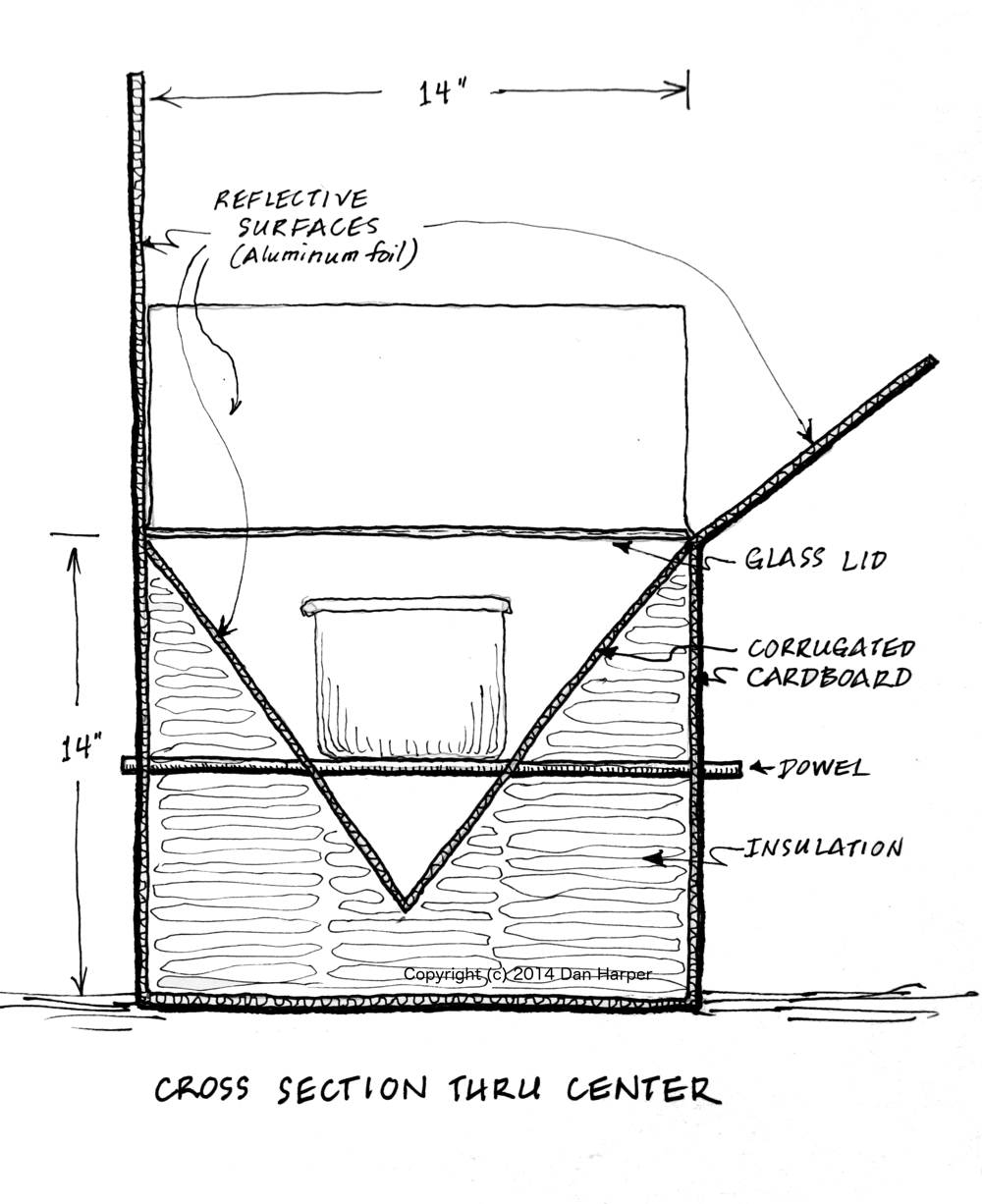
I started with a basic design made out of carboard boxes, a design that is sometimes called the “Minimum Solar Box Cooker.” But instead of just nesting one smaller box inside another box, I took the smaller box, cut out the ends, and turned it 45 degrees:
BlogSep0614a

While this reduces the amount of cooking space inside the oven, it also reduces the amount of air that has to be heated. And then, too, it’s easy to run a couple of dowels through the inner box to make a support for a cooking pot.

In preliminary tests, the oven worked reasonably well. I set the oven out at 2:45 p.m., stuck a meat thermometer in one end of the oven, and within twenty minutes, the thermometer was reading between 190 and 200 degrees F. (the thermometer only goes up to 200). At about 3:10, I put in a cup of water in a glass container. By 3:40, the water temperature was 155 degrees F., and the glass container was more like 190 degrees F. (Air temperature is 75 degrees F. this afternoon.)

Tomorrow comes the real test: we’ll set the oven out at the beginning of Sunday school and see how quickly we can make solar s’mores.

Update, one year on: This solar oven prototype proved to be only marginally effective. After using it fairly extensively, it has one big problem: when you open the lid, much of the hot air escapes; there is very little thermal mass, aside from the heated air. At the very least, I need to provide a significant thermal mass (preferably black in color, to better absorb heat). In addition, it would make sense to place the door low on one side of the oven, to minimize the loss of heated air.
Better easy bubble juice recipe

Back in 2012, I posted an easy bubble juice recipe for making soap bubbles 9-12″ in diameter. Here’s a better easy bubble juice recipe, which uses easily obtainable ingredients, and features a superior mixing procedure for the lubricating jelly. With this mixture, I’ve made bubbles that start out at 4-5 feet long tubes, then stabilize into two or more spheroids up to 30 inches in diameter. The glycerin isn’t absolutely necessary, but it does seem to make the bubbles last a bit longer, an important point in our dry Bay area climate.

Ingredients:
4 oz. tube of personal lubricating jelly (store brand is fine)
2 oz. container of glycerin
12 oz. of Dawn Ultra dishwashing liquid (do not substitute another brand)
water to make up about 1 gallon
Total cost: $12-15

Method:

Put 3 quarts of water in a gallon container. Continue reading “Better easy bubble juice recipe”

What I did on my vacation, pt. 2

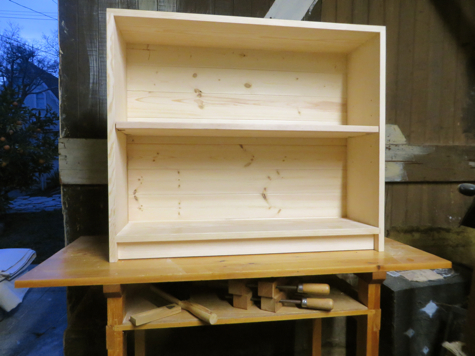
Ms. M and Mr. O, old friends of ours, are adopting two girls. I’m supposed to make two shelf units for them by this weekend. So far, one is completed and ready for finishing. Here’s the completed unit (the fish-eye lens makes it look out of square, but it’s not):

DIY shelves

I’m supposed to have both shelf units completed by this weekend. I don’t think I’m going to make the deadline. The sad truth is that it’s been something like eighteen or nineteen years since I worked for the cabinetmaker, and I’ve gotten out of shape — I can’t put in an eight hour day in the shop any more.

(The details: 28 x 33 inches, 9-1/4 inches deep. Adjustable middle shelf. Solid pine construction throughout.)

Maker Faire and lobsters

Carol and I went to Maker Faire today. It was held just a couple of miles away in San Mateo, so we were able to walk there — which was good, because so many people attended that some of the parking lots were four miles away from the event. If you’ve never heard of it, Maker Faire is kind of like a state or county agricultural fair for geeks and engineers.

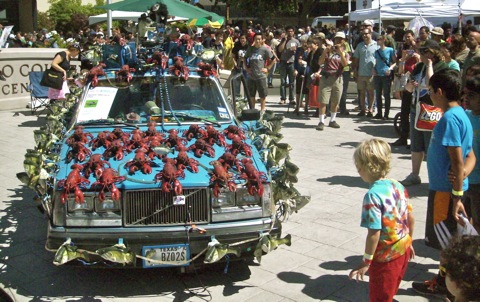
We saw the gee-whiz showy things you’d expect to see at Maker Faire: strange metal constructions that belched fire; all kinds of robots; people riding around inside giant self-propelled cupcakes; a Rube Goldberg-style giant mousetrap powered by simple machines and a bowling ball; the CO2 eruptions that happen when you drop Mentos into carbonated beverages. My favorite gee-whiz showy thing was the Sashimi Tabernacle Choir, an art car covered with fish and lobsters that danced in carefully choreographed movements:

BlogMay1813

And we saw the geeky technical things you’d expect to see at Maker Faire: conventional automobiles converted to electric power; too many projects made with Arduino microcontrollers; robots; drones; giant soap bubbles; a blacksmith; ham radio operators.

We also saw things that you might not expect at Maker faire: goats; chickens; beekeepers; a guy selling New-Agey devices to protect you from EMF radiation; a steam-powered scale-model train; lessons on how to walk on stilts; a really good drummer who used plastic trash barrels and other found objects for his drum set.

It was very satisfying, if for no other reason than being able to spend time hanging out with thousands of other geeky people who like to make things instead of consuming things.

Update: Because a commenter asked, here’s a video (taken by Carol) of the Sashimi Tabernacle Choir:

Keyboard table

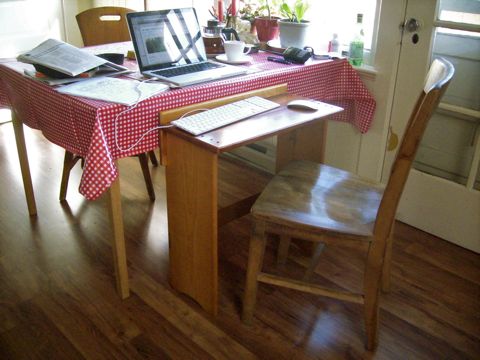
I spend too much time typing, and have been getting little twinges in my hands and fingers. It was past time to pay attention to my typing position. So I made a keyboard table out of salvaged and scrap wood, to hold my keyboard at the correct height for typing:

BlogMar1313

The top is salvaged Douglas fir that Carol got from one of the building material exchanges in the Bay area. The two side pieces are scraps of #2 common Western pine left over from bookcases I made fifteen years ago, which we have carted across the country two or three times. The spreader bar in the back is a short piece of moulding that I found in the basement of our building.

This is not a fine piece of furniture, nor did I want to hide the fact that it’s made by hand of salvaged materials. So I left nail holes, chips, dents, and rough patches visible on the salvaged Douglas fir top; and the top is screwed onto the base, with the black drywall screws left exposed. All cutting and joinery was done with hand tools, and I didn’t bother eradicating scribe marks or tool marks. I even left the grade marking on one of the uprights — it reads “212 STERLING WWP S-DRY IWP” — as well as a fluorescent orange lumber crayon mark.

This keyboard table might not be suitable for polite company. But it makes a good surface to work on and write on: imperfect, scarred, comfortable, with a wealth of associations you don’t get with something bought at a big-box store.

Below: a closer look:

Continue reading “Keyboard table”

Kraut

A gloomy, rainy, chilly, enervating, soul-sucking December afternoon. Carol and I were sick of being stuck in the house doing chores, sick of short days and long dark nights. We went to Wisnom’s Hardware across the street and spent a long time buying five dollars worth of hardware, just so we could get out of the house. But eventually we had to go back home, and watch the world outside the windows turn ever grayer and darker.

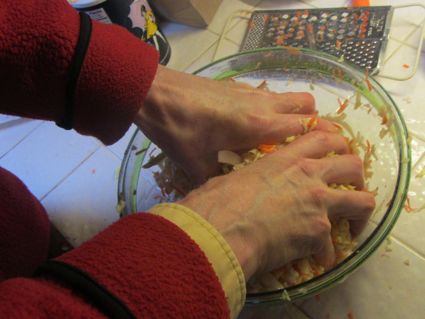
So we decided to make sauerkraut. I chopped a two-pound head of cabbage into thin strips, grated some carrots into the cabbage, and dumped everything into a glass bowl. We grabbed big handfuls of cabbage and carrots and squeezed hard to bruise them and begin to release their liquids (this was the best part; very satisfying):

I added five teaspoons of salt (two for each pound of cabbage plus one far the carrots), and mixed it in. We smushed the mixture down with a plate until the liquid rose up over the vegetables: Continue reading “Kraut”

Making labels

Yesterday, my friend Lewis came over to our apartment. Lewis is a luthier who makes (among other things) Celtic bouzoukis, and he wanted me to make some labels for them.

He brought a bouzouki to show me where the labels would go. I talked to him about light-fast pigments and archival papers, while for his part he told me about the instruments he makes:— His Celtic bouzoukis are beautiful instruments, and each one differs slightly in small details from the others — a slightly different bracing pattern, an inlaid piece of ebony inside the sound box with the number of the instrument. When you look at one of his bouzoukis, he wants you to know that it was made by hand, not by a machine. And he wanted each label to look hand-made, beautiful but with small imperfections.

So we sat at the kitchen table, eating home-made soup Lewis brought, and we made labels. I had some 100% rag vellum which I cut into 1-1/2 by 2-1/2 inch rectangles. Lewis signed each one using a magic marker with light-fat archival ink. I carefully wrote the serial number and “CELTIC BOUZOUKI / Oak. CA” under his signature, and then put a band of red watercolor paint along the top edge of the label. I don’t make many things like this any more; most of the things I make are text or photos or videos meant to go on Web sites, things you cannot touch. Real papers have different textures; they feel good under your fingers and hands, the pen moves over them in different ways, the ink soaks in or adheres to the surface differently. Paints are incredibly sensuous: the pigments finely ground into some luscious medium — linseed oil, gum arabic, casein, beeswax, whatever — and you dip a brush or knife into that vivid blob of color, and as you spread it the color changes as it interacts with whatever you’re painting, and you can smell it, and feel it when you use your fingers to smooth or blend.

The tools you use to make things have their own sensuality. To put the paint on the labels, I used a red sable watercolor brush, a gorgeous tiny little cluster of perfect animal hairs at the end of a delightfully balanced wooden handle. I remember one painting teacher, years ago, who used to insist a good watercolor brush should be as firm as a partially tumescent penis (yes, he was a man). The subject of art is always love or sex or death, but making things is all about sex, all about the act of creation. Creating things to be viewed on a screen is very satisfying — I love the way the completed image or text glows with that faintly blue light that comes out of your screen — but you can’t touch it or smell it while you’re making it. If making things is like sex, then making things for the screen is like reading about sex; it all happens in your mind and eyes, not in your body.

But the metaphor has overwhelmed the subject, because all I was doing was making labels. What amazes me is that the labels I made yesterday — cutting out a rectangle of paper, adding some lettering and a spot of color — will wind up inside musical instruments which are works of art and which may well outlive me. Far fewer people will see the labels I made than will see this blog post, but making the labels was far more satisfying.

Shower planter

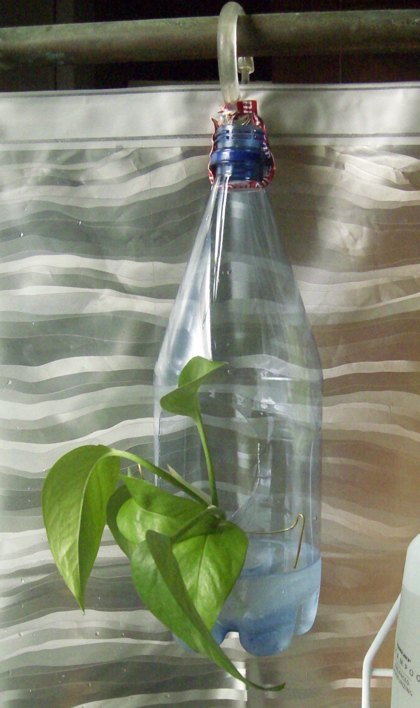
We had to trim our pothos plant. Rather than compost the trimmings, Carol decided to make a home for them in the shower. She got me to cut a big round hole in the side of a plastic soda water bottle using my pocket knife; then she got me to drill two holes at the top of the bottle so we could hang it; I drilled those two holes using the awl in my pocket knife. She attached the bottle to the shower rod using a big twist tie left over from something, added some water, and put the pothos cuttings through the big round hole.

Over the next few days, the pothos cuttings twisted towards the light, and their butt ends pulled out of the water. So I drilled two small holes about an inch back of the big round hole on either side, above the water level, and threaded a piece of straight brass wire through; the wire keeps the pothos cuttings aimed down at the water.

Our shower planter has been up for a month now. Here’s what it looks like:

Easy bubble juice

I’m going to be leading a workshop tomorrow at the “Pot of Gold” religious education conference. For the workshop, I’ll be demonstrating bubble juice that makes medium (9-12 in.) soap bubbles. Below is a recipe, and instructions for making a bubble wand.

Easy bubble juice for 9-12″ bubbles

Ingredients:

4 oz. very hot (not boiling) water

3 oz. Dawn brand Ultra Concentrated dishwashing detergent

3 oz. personal lubricating jelly (K-Y Jelly or any generic brand)

water to make up approx. 1 quart, about 22 oz.

Continue reading “Easy bubble juice”

The DIY chronicles: Fortified Altoids

Once upon a time, Altoids brand peppermints were strong. That ended when the brand was bought by Wrigley. In 2006, Wrigley closed the old Altoid manufacturing plant in Wales, and began producing the candy in the United States. They first adulterated it with artificial flavor; when they removed the artificial flavor, they reduced the amount of peppermint oil until Altoids tasted bland and boring. So I stopped buying Altoids.

But I still miss the old Altoids: when you were preaching (or singing) for an extended period and needed to soothe your throat, the old Altoids had enough peppermint to do the trick. So I decided to try an experiment: I would buy some Altoids and add peppermint extract to them to try to recreate the old strong peppermint flavor.

I purchased a tin of Altoids for 2.99, and a one ounce bottle of peppermint extract (alcohol 89%, peppermint oil, and water) for 5.99. Altoids have a rough side and a smooth side, and I found the rough side absorbs peppermint extract more easily, so I laid out the Altoids rough side up on a dinner plate. I then dropped peppermint extract on them one drop at a time, starting at one side of the plate and working across to the other side, allowing each drop to soak in before starting the process again. After about seven or eight drops, each mint looked like it had absorbed about all it could hold. I turned them over, and added additional drops to those mints which still looked dry. Then I let them dry.

When I was done, Carol and I each tried one. Carol said: “Not as strong as the old Altoids.” I agreed. She crunched hers up, and then said, “But you can feel it in the back of your throat.” And she was right.

Verdict: The fortified Altoids were much better than un-fortified Altoids, but still not as good as the old ones.
Total cost: 2.99 + 1.50 (a quarter of a bottle or peppermint extract) = $4.49; plus 15 minutes. Probably not worth it.
Next steps: Try essential oil of peppermint instead of peppermint extract.