
Transparency check

I feel like such a grouch. I keep writing blog posts about ways the Unitarian Universalist Association (UUA) could be more transparent in the ways it handles clergy misconduct. But I’m not one of those people who post criticism of the UUA but who aren’t looking for actual improvement, they just want to badmouth the UUA. My purpose is different. I actually like the UUA. But like all human institutions, the UUA could be better, and I’d like to contribute in some small way to making it better. Since I have no skills for committee work or denominational governance, what I do is write about possibilities for improving the UUA.

So I’m really not a grouch. I hope.

Anyway, I’ve been thinking about ways the UUA could be more transparent in its handling of clergy misconduct. And I’d like to point out three other religious groups who inspire me with their attempts to be more transparent.

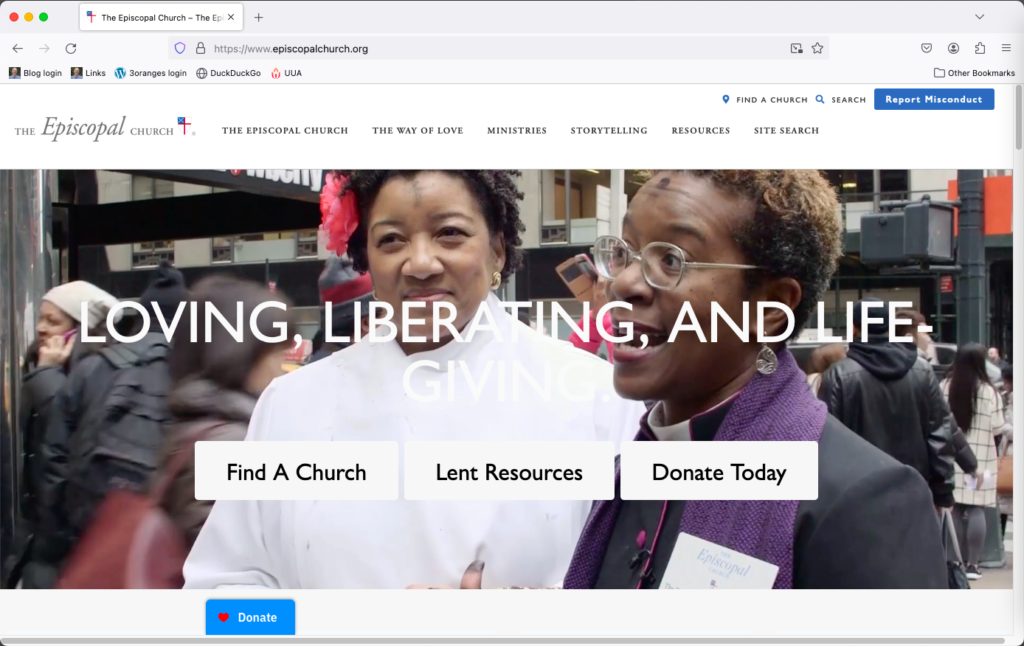
First, I’d like to point out the website of the Episcopal Church here in the U.S. Take a look at the screenshot below that shows the front page of their website:
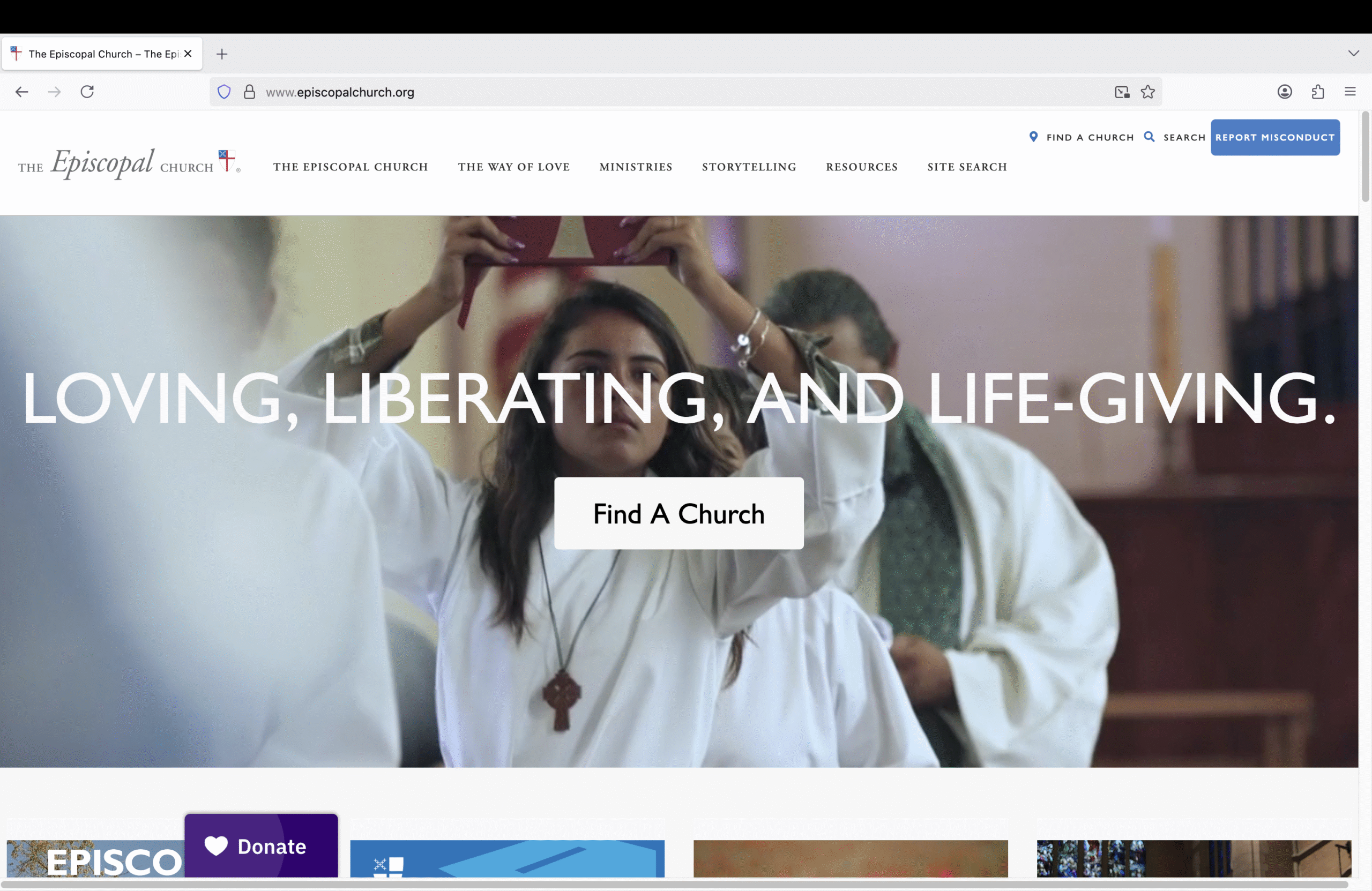
Screen grab of a website

It’s a little hard to see in my screen grab, but in the upper right hand corner there’s a prominent button that reads “Report Misconduct.” If you click on that button, you are taken to another webpage with detailed and (to my mind) confusing instructions about how to report misconduct by clergy. Indeed, there has been criticism from within the Episcopal Church about how their actual processes are not especially transparent.

But forget about their problems with their internal processes for a moment. I applaud their decision to post a prominent link on the very front page of their website that takes you right to instructions on how to initiate a complaint about clergy misconduct. Contrast that with the UUA website, which has no such prominent link. I find it very difficult to locate any information on the UUA website about how to initiate a complaint regarding clergy misconduct.

One final point — given all the publicity around clergy sexual misconduct in the past twenty years, it seems to me to be a smart marketing move by the Episcopal Church to have that prominent link on their front page. It says to people who are looking for a religious home — “We’re serious about stopping clergy misconduct.” It signals that they might be a safer religious home than, say, Unitarian Universalism.

Second, I’d like to point out this webpage from the Rabbinical Assembly, the organization for Conservative Jews in the U.S. The webpage is titled “Rabbis Expelled or Suspended from the Rabbinical Assembly for Ethical Violations”:
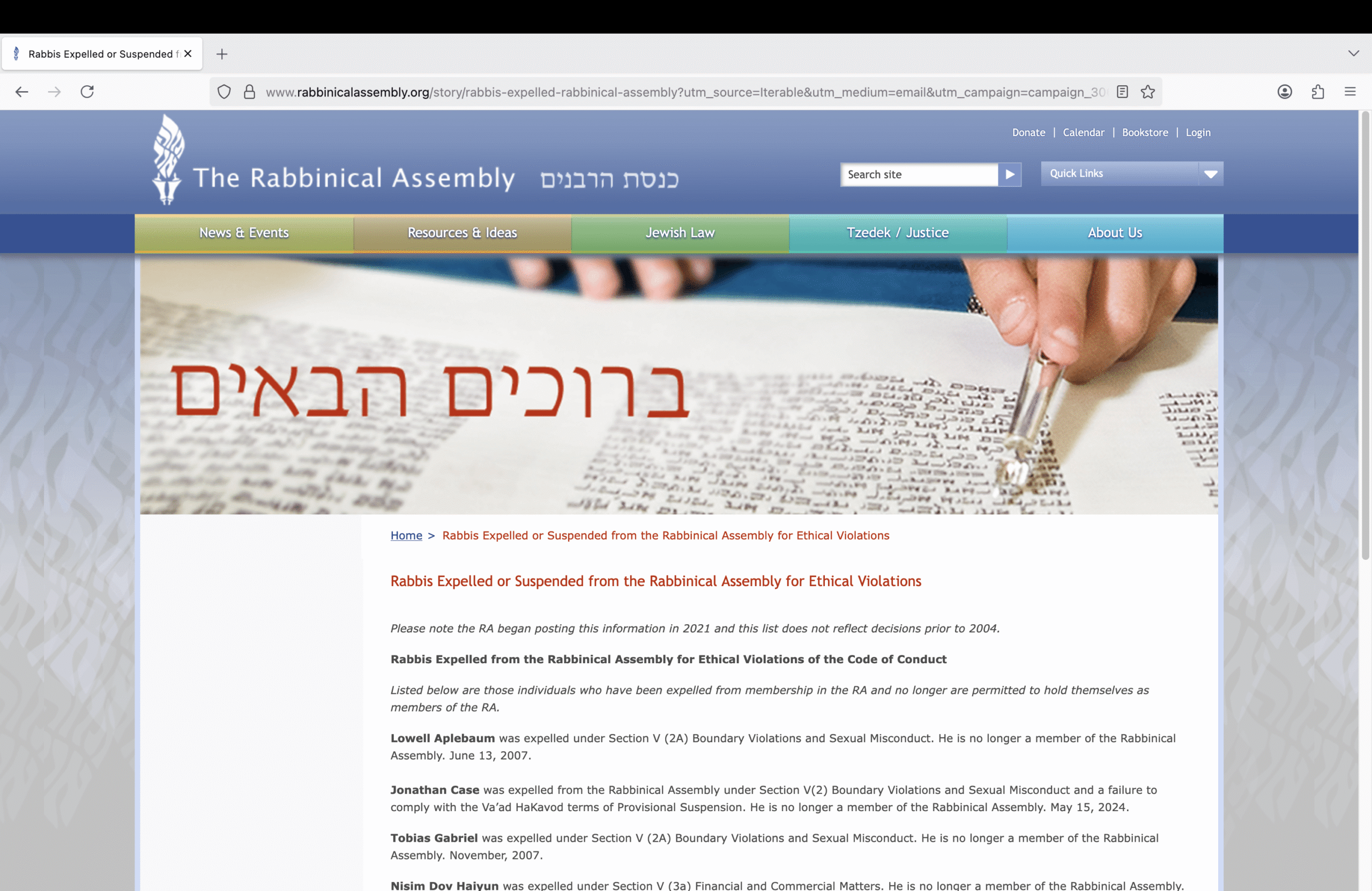
Screen grab from a website

On this page, freely visible to anyone visiting their website, the Rabbinical assembly lists the names of seven rabbis who were expelled from the Rabbinical Assembly since 2004. This is exactly what should happen — if a clergy is expelled from a denomination of association of congregations, then the denomination-level website should make their names freely accessible in the interests of transparency.

The UUA tried doing this for a while, beginning in 2021. Then, a couple of years ago, that list was hidden from public view. You can still see a webpage titled “UUA Credentialed Religious Professionals Resigned or Removed from Status Due to Misconduct” on the UUA website — but when you get to that page, you are instructed: “To access the list of ministers removed from fellowship by the Ministerial Fellowship Committee, Ministers who resigned fellowship pending misconduct reviews, and religious educators whose credential was terminated by the Religious Education Credentialing Committee, you must log in or register.” You can just about read these instructions on the screen grab below:
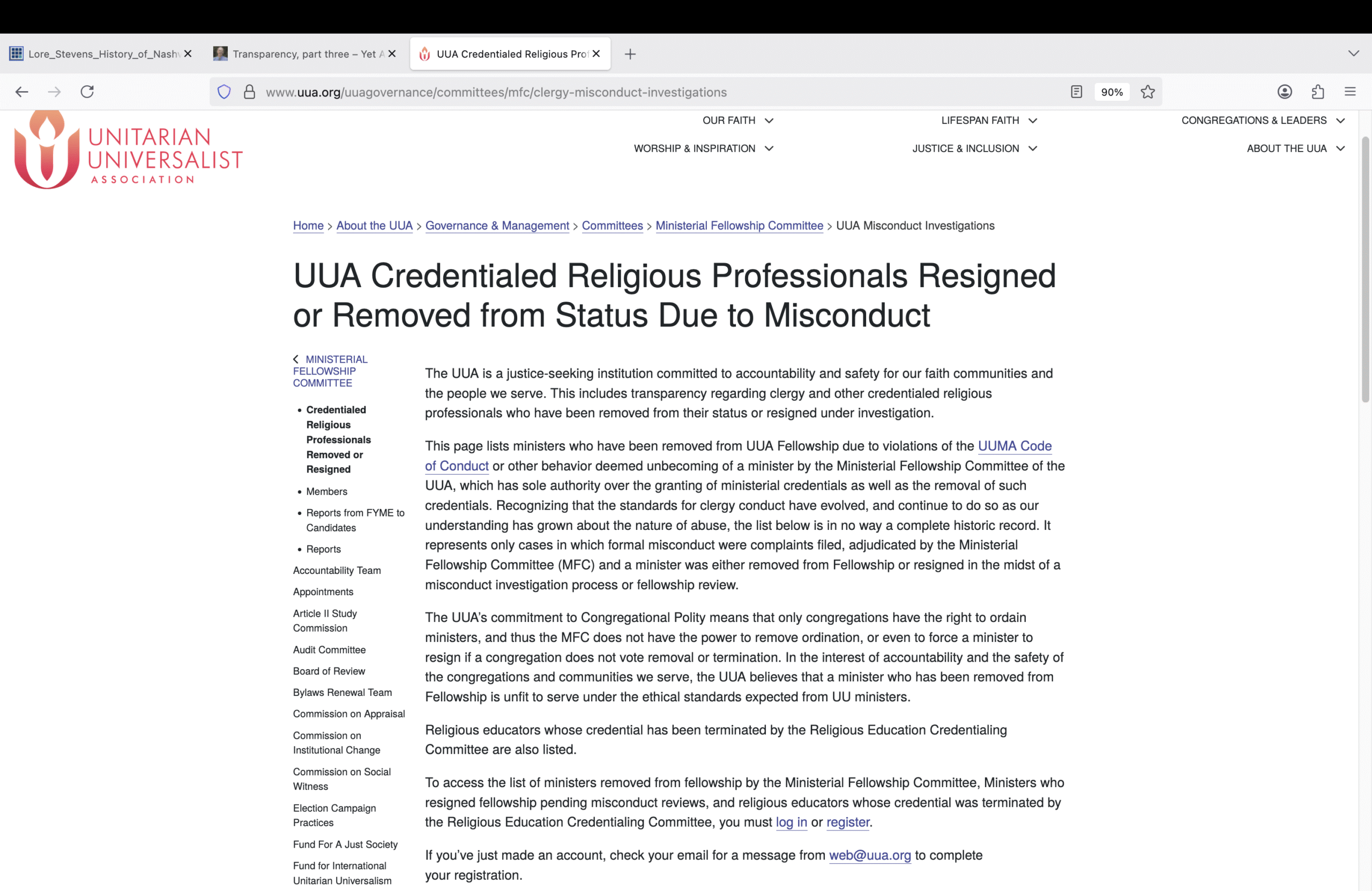
Text-heavy screen grab from a website

I can understand why this page has been restricted —I imagine that in an era of increasing violence, the UUA has the admirable goal of keeping names and personal information hidden. But there are several names that do not need to be hidden, such as ministers who have been convicted of sex offenses, so that their misconduct is a matter of public record. Examples include David Kohlmeier, Ron Robinson, and Mack Mitchell. In addition, this webpage should clearly state why access to the list is restricted — I’ve imagined a charitable reason why the UUA has hidden this page, but someone else could imagine the UUA has hidden the list for nefarious reasons.

Third, the Presbyterian Church USA actually has a phone hotline that you can use to report abuse, as shown on this screen grab:
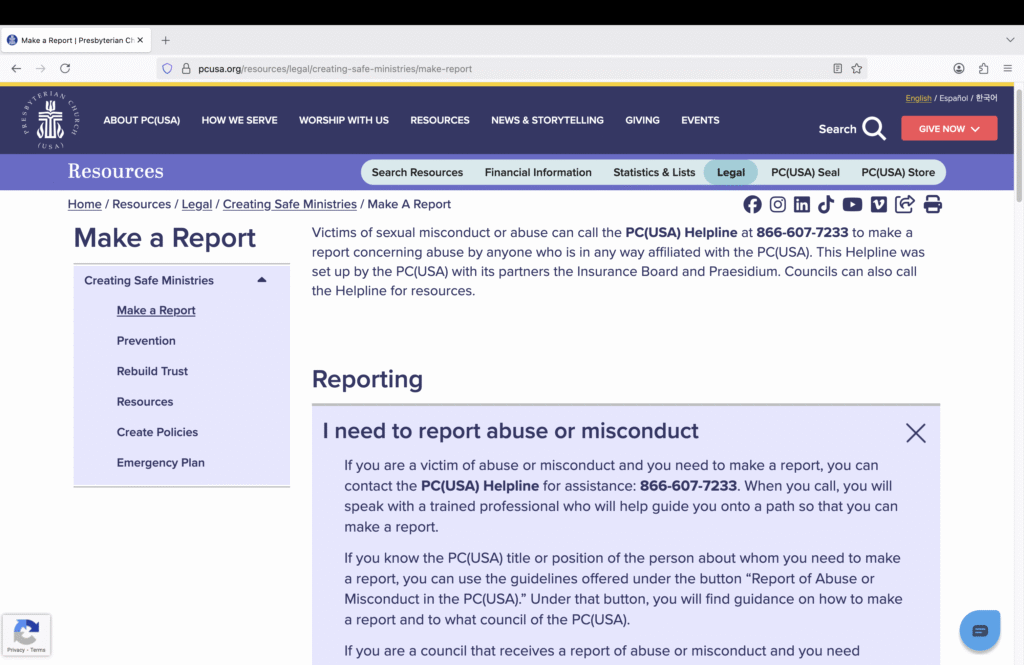
Screen grab of a website

Admittedly, there are all kinds of potential problems with this helpline. Most obviously, who is the “trained professional” who answers the helpline? If it’s a denominational staffer, someone paid by the denomination, I’m going to be skeptical of their ability to remain neutral; I’d hope the “trained professional” is actually employed by their insurance carrier (which seems to be implied here), because an insurance carrier is somewhat more likely to take misconduct allegations seriously. Also, I could wish that the helpline would offer both voice calls and texting (I hate talking on the phone, but I love texting). And finally, I would like to see a guarantee of confidentiality — please tell me that if I call, and I feel uncomfortable with the “trained professional,” that you’re not going to track me down through my phone number.

Nevertheless, this makes it really easy to report misconduct, and I applaud this attempt at making the reporting process as transparent as possible. (I also applaud the fact that the “trained professional” can also provide information about abuse prevention resources — great idea.)

How might this apply to the UUA? Here are three practical suggestions — and the first two are actually very easy to implement.

First, the UUA should have a prominent link on the landing page of their website that with one click provides specific, actionable instructions on how to report misconduct.

Second, at least a partial list of ministers removed from fellowship should be publicly accessible on the UUA website without requiring registration — and there should be a clear explanation of why seeing the full list requires registration.

Third, ideally the UUA would provide an easily accessible service for reporting misconduct. And ideally, this service will be provided by an independent contractor, not by a denominational employee.
Follow up to a clergy misconduct allegation

Back in 2022, I mentioned in a year-end blog post that Rev. Kathryn J. Rohde had been removed from fellowship by the Ministerial Fellowship Committee (MFC) of the Unitarian Universalist Association (UUA). Now it turns out there’s a (publicly available) sequel.

The following year, 2023, Rohde sued the UUA for removing her from fellowship, and further for ending the retirement stipend she received from the “Unitarian Service Pension Society” (an organization I didn’t even know existed). You can read the basic court documents here, but I read about the case in a blog post by Daniel Dalton on the website of Dalton-Tomich, a law firm specializing in “religious properties” (a legal speciality I didn’t even know existed).

According to the court filings, and Daniel Dalton’s blog post, Rohde got in trouble because of a social media post made in 2020:

[Parenthetical note: “private Facebook group” is an oxymoron; social media is never private.]

[Another parenthetical note: Both the court filing and the Daniel Dalton blog post state that Rohde alleged she was the victim of sexual harassment early in her ministerial career — an allegation I would expect to be true, based on what older women ministers told me about the way they were treated by male ministers and denominational officials in the late twentieth century.]

Daniel Dalton goes on to reveal what the court decided; or rather, didn’t decide:

I have not been able to find out whether Rohde filed an amended complaint. I did find out that the usual vocal critics of the UUA — the Fifth Principle Project, the North American Unitarian Council, etc. — have been trumpeting Rohde’s case as another example of how “wokeness” has overtaken the UUA. Rupert Murdoch’s New York Post also picked up the story, using it to castigate so-called cancel culture.

Daniel Dalton, however, draws different conclusions from this case. First, he points out that most of Rohde’s claims were dismissed, not necessarily on their merit (or lack of merit), but rather on the legal notion of “ministerial exception.” As I interpret this, the dismissal, then, does not necessarily represent a judicial judgement (for or against) on Rohde’s claims.

Second, he notes that the Rohde case “prompts questions” in the area of “governance and accountability” regarding disciplinary procedures. Such question could lead to “greater transparency in internal investigations.” While Dalton seems to direct this comment at the UUA, I would imagine that local congregations should also pay attention to this — disciplinary procedures should always be clear and transparent.

Among other conclusions, Dalton points out that this case highlights the need to balance freedom of expression over against “community values.” Dalton suggests: “UU congregants and leaders may need to find ways to balance inclusivity with respecting diverse viewpoints.”

Dalton also highlights “ideological splits within the denomination,” and he then speculates if this might prompt “wider discussions on political polarization, identity politics, and theological diversity” within Unitarian Universalism. I think we Unitarian Universalists try to ignore the divisions among us, but Dalton shows us just how visible those divisions are to outsiders.

So that’s the inconclusive sequel to the 2022 removal of Kate Rohde from ministerial fellowship. Yet even though this sequel is inconclusive, there’s one conclusion I’d like to draw. Expanding on what Daniel Dalton says, I think it would be good to have additional clarification on Unitarian Universalist disciplinary policies for ministers (at both the denominational and local levels), as well as “greater transparency in internal investigations” (again, at both the denominational and local levels). The problem is that I don’t know how to make that happen. Our individualism means we find it hard to work together. 25 years of budget cuts have left the UUA understaffed in some key areas. Wider American society has grown polarized, and people are tender and raw. All these factors are going to make it extremely hard to come together to talk openly about a difficult topic like how we discipline clergy.

12 Oct. 2025: Minor edit made that didn’t change basic content (added brackets and intro phrase to the second parenthetical note).

Another

Email piled up while I was on vacation. I missed the fact that the Ministerial Fellowship Committee sent out another notice back on July 16:

As I’ve said before, I do wonder who the independent investigator was. Does the UUA have enough money to pay for an outside law firm or consulting firm to carry out these reviews? If not, who is the independent investigator? In any case, Kaaren Anderson has her own website, where you can her employment history.

What ministerial bullying looks like

Last month, there was a dust-up at Winchester Cathedral in England. Not surprisingly, as a cathedral of the Church of England they have an unbelievable music program. The long-time music director and organist was Andrew Lumsden, led the Winchester Cathedral Choir to a Grammy award in 2024 for their soundtrack to a Star Wars video game. Lumsden suddenly resigned last summer with no explanation. At about the same time, half the adult choristers — so-called “lay clerks” — quit. In addition, the boy choristers were also well below the usual number. Upon receiving numerous complaints, including a negative social media campaign, the bishop commissioned an outside review. Very Rev. Catherine Ogle, Dean of the cathedral — the senior management position in the Cathedral organization — announced she would retire in May, 2025, but after the outside review was completed she announced an immediate departure and left in early March.

So why all these departures?

According to Living Church magazine — an international periodical of the Anglo-Catholic wing of the worldwide Anglican communion — the problem was bullying by the Precentor of the Cathedral, Rev. Canon Andy Trenier. Back on July 3, 2024, Living Church reported:

Living Church quotes from other news sources that point to management practices that sound questionable to me, including possible mismanagement of funds:

The idea of start-up choral groups sounds good, but if those start-up groups sued funds earmarked for the main music program, to me that doesn’t sound so good. I’d pay more attention, however, to the decline in the number of choristers. Reportedly, that decline was the result of the alleged bullying. Living Church went on to report what the bullying looked like:

“Ali Kefford of The Mail on Sunday wrote about Trenier: ‘He is said to have berated the Director of Music Dr Andrew Lumsden in front of the boy choristers, and told singers they could leave if they didn’t agree with his approach. Those targeted by his volcanic temper are said to have been left trembling.’ Kefford added: ‘Canon Trenier’s relationship with the eight adult male lay clerks is said to have irretrievably broken down amid allegations that he has been coercive, manipulative, and belittling. They are four short of their usual tally of 12 because, his critics say, working at Winchester is now seen as a poison chalice.'”

These days, the term for people who behave in the way Trenier is alleged to have behaved is “bully.” I often use a different term. Back in 2007 Robert I. Sutton, professor of business at Stanford University, called this kind of manager an “asshole.” In his book The No Asshole Rule, Sutton details how abusive supervisors — bullies, if you will — often prove to be a detriment to the overall performance of an organization. Thus, it’s not just that assholes are a pain to work with, they actually damage the organization.

Best of all, Sutton has a fairly precise definition for what constitutes an asshole. “Bully” often proves to be a vaguely defined term, but Sutton turns “asshole” into a precisely defined term so you can clearly identify who’s an asshole, and who isn’t. According to Sutton, there are two main tests for determining who is an asshole:

From the few reports that I’ve read on the situation at Winchester Cathedral, it does sound like Andy Trenier might pass both tests. If it’s true that he has a “volcanic temper” that leaves underlings “trembling,” then he appears to pass the first test. And according to reports, he yelled at people he supervises, i.e., people who have less power than he, which would mean he passes the second test.

For our purposes, though, we don’t need to try to judge the facts of the Winchester cathedral case. The allegations, whether true or not, give a pretty good feel for what ministerial bullying looks like — it’s “coercive, manipulative, and belittling”; it can leave the target “trembling”; it may include a my-way-or-the-highway demand; and people do in fact leave the organization rather than have to deal with the ministerial bully.

If you’re in a situation where you think you’re seeing ministerial bullying, you might want to check out Robert Sutton’s books on assholes: The No Asshole Rule and The Asshole Survival Guide: How To Deal with People Who Treat You Like Dirt. Or, if you’re a minister or supervisor, you might want to read Sutton’s book Good Boss, Bad Boss: How To Be the Best…and Learn from the Worst.


Part of a series of posts on clergy and bullying — Sigh. Not Again.What ministerial bullying looks likeWhat ministers didn’t learn in theological schoolWhen clergy get bulliedThe opposite of a bullying boss

Sigh. Not again.

I got one of those emails today, informing me that a Unitarian Universalist minister has been removed from fellowship. It read:

A quick web search (including what appears to be his Facebook page) shows John L. Saxon as a professor of public law and government at UNC-CH, retiring from there in 2010. He graduated from Meadville/Lombard Theological School in 2009, serving as hospital chaplain for Alamance Regional Medical Center, beginning c. 2010. He was assistant at the Unitarian Universalist Fellowship of Raleigh, N.C., beginning in 2010, then later lead minister; he left the latter position in 2017. From 2017 to 2020 he was Executive Director of the Unitarian Universalist Social Justice Ministry for North Carolina, and then apparently from 2020 to 2022 he was president of the organization (online sources are not clear). One brief bio of him says he retired in 2022, so it’s not at all clear where he allegedly engaged in the actions that led the Ministerial Fellowship Committee to remove him from fellowship.

As usual when I publish these announcements, I’m making no judgements on the truth of the allegations. I’m publishing these because up until a few years ago the UUA did not maintain a public list of this sort of thing; and since then it has become increasingly difficult to find out where the accused ministers have worked.

I will make one general comment, though, which is that removing a minister from fellowship for bullying now appears to be more common than removing a minister from fellowship for sexual misconduct. Does this mean I believe UU ministers are no longer engaging in sexual misconduct? No, I suspect it’s simply more difficult for victims of sexual misconduct to come forward. [Plus as I outline in a later post in this series, there are societal factors leading to more bullying.]


First in a series of posts on clergy and bullying — Sigh. Not Again.What ministerial bullying looks likeWhat ministers didn’t learn in theological schoolWhen clergy get bulliedThe opposite of a bullying boss

Another one

Well, sadly the Ministerial Fellowship Committee (MFC) of the Unitarian Universalist Association (UUA) just sent out another notice of a minister removed from fellowship.

I keep on posting these notices here, just so there’s more of an online record of these events. By posting this, I’m not making any judgement about the minister in question, nor about the MFC’s decision. Since I’m not privy to the facts of the case, there’s no way I could make a judgement. My only purpose in posting this is to hopefully increase transparency just a teeny bit when ministers are removed from fellowship.

Here’s what the email from the MFC said:

Note that Rule 26 doesn’t appear to mean that a minister has engaged in, or been convicted of, abuse, domestic violence, etc.; the rule merely says that a minister must notify the MFC if such a complaint is lodged against them; i.e., even if there’s a false accusation, a minister still has to notify the MFC. This makes sense. But this also makes me realize that I haven’t read the MFC rules in a couple of decades, and if I ever knew about this rule I’ve long since forgotten it. Now I feel ignorant. And it looks like I had better review the MFC rules in the very near future.

Update, 10/23: Another email from the MFC came in at 7:56 yesterday evening: “The Ministerial Fellowship Committee voted recently to remove the Rev. David Kohlmeier from fellowship for egregious violation of the MFC’s rules and UUMA Guidelines, as well as our fundamental Unitarian Universalist values.” Kohlmeier had already been suspended from fellowship in 2022. Online, you can find plenty of news stories about Kohlmeier, but here’s a quick summary: In September, 2022, he was arrested in a sting operation and charged with using social media to solicit sex from minors. In March, 2024, he pleaded guilty to “felony attempted involuntary deviate sexual intercourse with a child under 16.” To make an obvious point: in this case, the legal facts are clear. Kohlmeier worked at the Falmouth, Mass., UU congregation from 2017 to 2021, and at the Harrisburg, Penna., UU congregation from 2021 t0 September, 2022.

June, 2025: Edited.

Minister out of fellowship

The Ministerial Fellowship Committee (MFC) of the Unitarian Universalist Association (UUA) just sent an email to congregational leaders saying:

Marian Stewart has already been removed from the online UUA database of professional staff. But her name is not listed on the UUA webpage “UUA Clergy Removed of Resigned from Fellowship with Completed or Pending Misconduct Investigations.” So maybe this is not misconduct? If so, then what’s this all about? Your guess is as good as mine as to why she was removed from fellowship.

Another website says that Stewart is retired from active ministry. So the violation of MFC probation could be anything from she just didn’t bother filling in MFC paperwork (because: retired), to — who knows what.

I understand the desire for transparency has to be balanced with the need for privacy and confidentiality. But somehow this email makes me feel that the balances have tipped well away from transparency in this case.

I also understand how hard it can be to come up with a process that covers all eventualities, so I’m willing to cut the MFC a fair amount of slack. But still, this email feels like it’s aimed at insiders, people who are already in the know — and those like me who are not insiders are left outside wondering what’s going on.

Part of my angst here is that I’ve spent a good part of my career in Unitarian Universalism cleaning up after clergy misconduct (and misconduct by other paid professionals). Clergy misconduct, in my view, thrives in secrecy and ambiguity. Thus when I see ambiguous statements like this one coming from the UUA, it bothers me.

Oh well. Listen to me whining. Heck, lots of things bother me. Just because something bothers me, don’t let it bother you.

How not to handle sexual abuse

This week, the Southern Baptist Convention (SBC) provided a demonstration of how not to handle sexual abuse claims.

The U.S. Department of Justice has been investigating sexual abuse in the SBC. Two days ago, on March 6, SBC officials told Religion News Service that the DOJ investigation is over:

“‘On February 29, 2024, counsel for the SBC Executive Committee was informed that the US Attorney’s Office for the Southern District of New York has concluded its investigation into the EC with no further action to be taken,’ Jonathan Howe, Executive Committee interim president and CEO, told Religion News Service in a text….”

The next day, on March 7, abuse survivor Tiffany Thigpen told Religion News Service that the DOJ investigation had not been closed:

“‘The lead investigator from the DOJ concerning this investigation was as surprised as we were by these reports. She answered both Megan [lively, another abuse survivor] and I immediately when we called (separately) and said the investigation is very much open and active,’ Thigpen told Religion News Service in a text….”

The DOJ is unable to comment publicly about ongoing investigations, so they refused to comment to Religion News Service. The fact that they can’t comment is in itself revealing. And on March 7, Baptist Press reported that SBC legal counsel has confirmed that the investigation is ongoing.

Obviously, this is a bone-headed move on the part of SBC leadership. But the rest of us can learn from this. The main takeaway — learn from Yogi Berra that it isn’t over till it’s over. So don’t do any victory laps until it’s actually, really and truly, finally over.

How to report clergy misconduct

According to a Religion News Service article, the Episcopal Church has beefed up its procedures for reporting clergy misconduct:

“A blue ‘Report Misconduct’ button now appears in the top right corner of the Episcopal Church’s homepage. The button leads to an informational page on Title IV with a step-by-step breakdown of Title IV processes involving bishops and a link to report bishops.”

Good for the Episcopal Church for making it easier to report misconduct. Here’s a screenshot showing the blue misconduct button:

Mind you, it’s not perfect. When you view the website on your phone (and half of all web use is now from phones), the blue misconduct button disappears into a menu.

But it’s a heck of a lot better than the UUA website, where it’s quite difficult to figure out how to report misconduct.

Year in review, pt. 2

In part 1, I reviewed the year in U.S. religion. In this second part, I’ll review they year in Unitarian Universalism.

How non-UUs viewed us

Let’s start with how others perceived us this past year. Unitarian Universalists are a tiny, tiny group, but we made the news with four stories this year. I’ll start with the lesser stories, and save the big one for the end.

1. Religion News Service (RNS) covered the annual General Assembly of the Unitarian Universalist Association (UUA) back in June, and wrote about two main stories. One story, with the headline “Unitarian Universalism revisits identity, values at 2023 gathering,” talked about the proposed revision to ARticle II of the UUA bylaws. It was the kind of article where you felt the reporter was working pretty hard to make it sound newsworthy. Revising bylaws isn’t going to be of much interest to non-Unitarian Universalists.

2. RNS was much more interested in the fact that the “Unitarian Universalists elect first woman of color, openly queer president,” especially considering the fact that this new president was taking over from the first woman who served as president. They wrote (by my count) four separate articles on this basic story.

Continue reading “Year in review, pt. 2”