What youth engagement can look like

In the last 1990s, I took Prof. Robert Pazmino’s course in teaching practices and principles, aimed at education in local congregations. One of Bob’s memorable insights was that congregations should have a teen voting member on every church committee, including the governing board. As Bob pointed out, not only is that the best way for teens to learn how congregational governance works, it’s also good for congregations who want to figure out how to meet the emerging needs of the rising generation.

This principle holds true for all nonprofit organizations. In 2014, when the Religious Education Association annual conference was in Boston, I went with a group to visit the Dudley Street Neighborhood Initiative (DSNI). This community group, which served a white-minority low-income neighborhood, had 4 seats on its 25-seat board dedicated to teens. Not only did DSNI benefit from the insights of its teen board members — not only did the teens benefit enormously from this real-life experience — but serving on the DSNI board as a teen provided a direct path into city government for ambitious teens; this helped both the teens, and DSNI, who now had a sympathetic ear in City Hall.

Now Hamilton Ontario is applying this same principle to the public sector:

So… now you have even more motivation to get teens on your congregation’s board and committees.
Noted with comment

I’ve been rereading Dave Van Ronk’s memoir The Mayor of MacDougal Street (2006). Van Ronk was a musician best remembered for his fingerstyle guitar and his interpretations of blues music, although he thought of himself as more of as a jazz musician manque. He was one of the core musicians of the 1960s Folk Revival, though he never hit it big like his friend Bobby Dylan. Van Ronk was also a serious leftist. He started out as an anarchist, joined the IWW, and wound up as a Troskyite. In his memoir, he reflected on the politics of the 1960s:

Interestingly, I feel the current Republican party actually does have a serious theoretical grounding. I disagree violently with the Republican party’s economic policies, but you have to admit that they are firmly grounded in Milton Friedman’s economic theories. Even if today’s Republicans have drifted away from Friedman in some respects, still a great deal of their agenda — doing away with Social Security, privatizing the National Park System, getting rid of the Post Office, etc. — comes straight out of his work.

Who on the American left offers any theoretical grounding to compete with Friedmanism? If Dave Van Ronk were still alive he’d no doubt advocate for Trotskyism, although to my mind that’s a non-starter in 2025 America. Personally, I’d vote for William J. Barber’s Poor People’s Campaign. However, I suspect Barber’s Christian affiliation is a dealbreaker for many of today’s pissed-off liberals; plus it has proved difficult to get pissed-off liberals to focus on poverty as a central issue.

Reading list: more on Asian history

Brief notices of other histories of East Asian and Southeast Asian countries that I’ve been reading

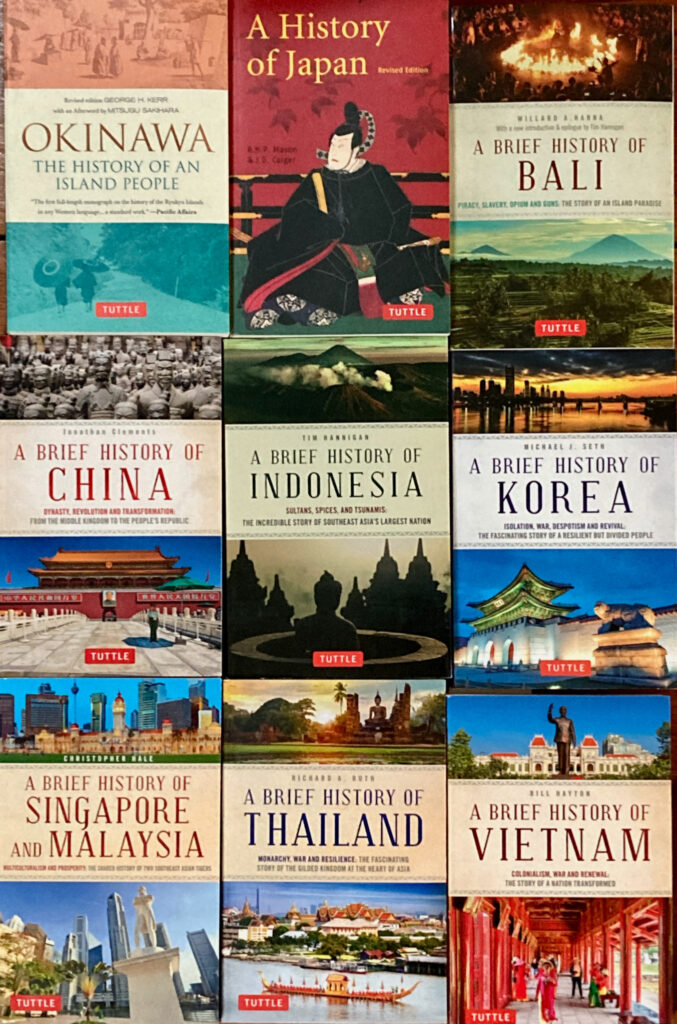
Tuttle Publishing’s “Brief History of…” series

Tuttle Publishing says that its core mission is “to publish best-in-class books informing the English-speaking world about the countries and peoples of Asia.” Founded in Rutland, Vermont, back in 1832, they now have offices in Vermont, Tokyo, and Singapore. Their “Brief History” series provides popular one-volume histories of various countries in East Asia and Southeast Asia. Current titles in this series cover the following countries: China, Indonesia, Japan, Korea (including North and South Korea), Singapore and Malaysia, Thailand, and Vietnam. An although Bali is part of Indonesia, there’s also a separate book on Bali in this series.

I’ve read all these titles except the ones on Bali and Japan. I can affirm that each book I’ve read gives exactly what they promise: a brief introduction to the history of each country. Each one is competently written and entertaining, and each one generally relies on secondary (and tertiary) sources rather than primary sources. If you want something more than a Wikipedia article, but something less than a dry scholarly history, these are the perfect books to read. While the quality of the books is consistently high, I’ll offer brief comments on the relative strengths of each volume. Then I’ll discuss two other books published by Tuttle that offer more in-depth accounts of two polities.

Nine books on Asian history arranged in a grid.
Continue reading “Reading list: more on Asian history”

Reading list: Southeast Asia

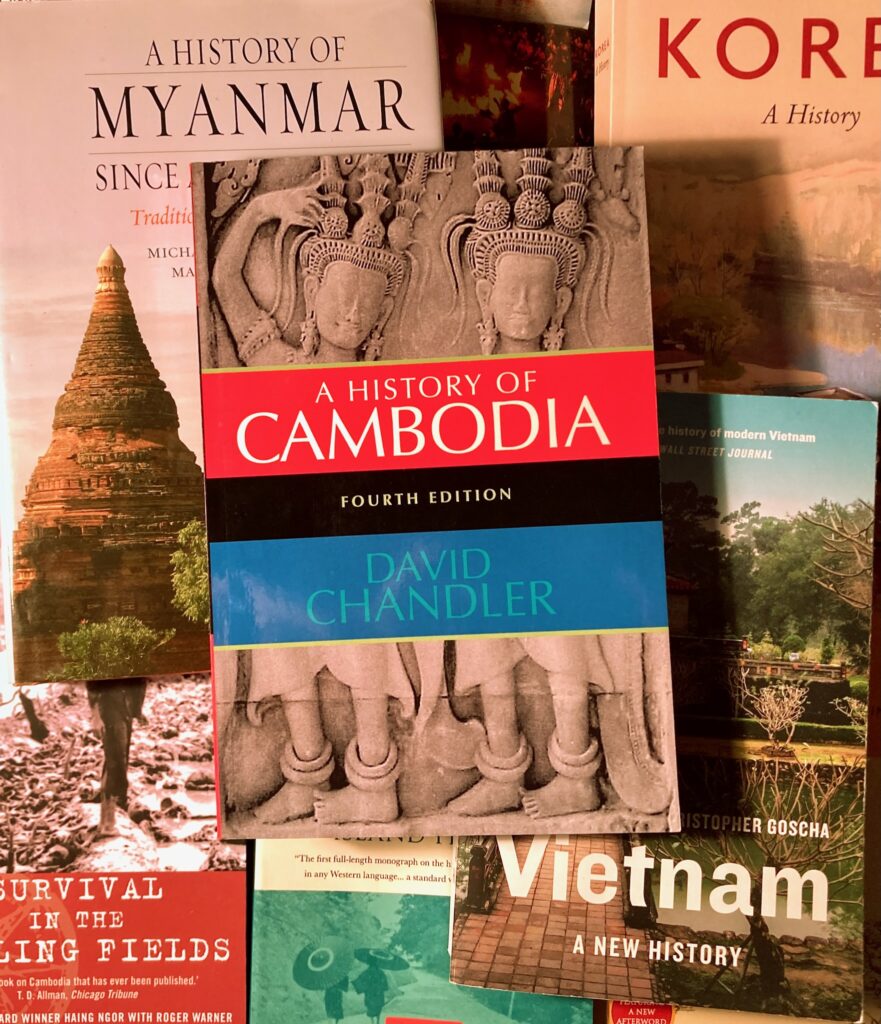
For some reason, I got interested in the history of Southeast Asia a year or so ago. Mostly I was interested in learning more about a part of the world that was completely neglected in my schooling. Below are brief summaries of three of the books I’ve been reading.

Books piled on one another.
Continue reading “Reading list: Southeast Asia”

Reading list

Reviews of three books I’ve read recently.

The Tenant of Wildfell Hall by Anne Bronte

This romance novel from 1848 begins with Gilbert Markham, the male protagonist, telling how he saves a small boy from falling off a high wall. The boy’s mother, the widowed Mrs. Helen Graham, sees him do this; but instead of thanking Gilbert, she treats him coldly and with suspicion. Nevertheless — or perhaps precisely because she treats him so badly — Gilbert falls in love with Mrs. Graham, abandons his previous sweetheart, and pursues this mysterious widow despite her attempts to keep him at arms’ length. So ends the first part of the book. Gilbert manages to portray himself as weak-willed and foolish, and thus not the typical hero of a romance novel.

The second part of the book consists of entries from Helen Graham’s diary, whose real name turns out to be Helen Lawrence Huntington. Helen has given this diary to Gilbert so he can understand her better. In the diary, Helen tells how she fell in love with Arthur Huntingdon, a weak-willed and unscrupulous man. She foolishly marries him. To her astonishment — but not to ours — after their marriage, Arthur reveals himself to be abusive, irrational, domineering, and nasty. Helen puts up with him until she sees that their son is beginning to imitate his father. This she cannot stand, so she flees the marriage with her son, and hides in the country under an assumed name, where she meets Gilbert Markham. So ends the second part. Will her life improve in the third part?

Continue reading “Reading list”

Questionable quotes

While researching the provenance of quotes from the UUA’s “Wayside Pulpit” quote collection, I’ve uncovered a number of questionable quotes. Some of the quotes are clearly spurious or otherwise wrong. Others, however, may be real quotations, but my research didn’t happen to turn up a firm attribution. Since some of my readers enjoy working on this kind of puzzle, I’ll post some of the results of my research below.

Continue reading “Questionable quotes”

Quotes for the Wayside Pulpit

The “Wayside Pulpit” is a long tradition for Unitarian Universalist congregations. In the old days, the Unitarian Universalist Association (UUA) would print up large poster-size sheets with various inspirational quotes on them, and congregations would purchase those sheets, and post them in signboards outside their church or meetinghouse. Nowadays, the UUA provides free PDFs and you print them yourself.

When we installed a Wayside Pulpit outside the meetinghouse of First Parish in Cohasset, Mass., I started looking for some more (and more recent) quotations to add to the ones I found in the UUA website. I quickly discovered that the web is inundated with spurious quotes, and quotes with inaccurate attributions. Then I noticed that some of the quotes provided by the UUA had problems. As an example, the quotation “All that is necessary for the triumph of evil is that good people do nothing” gets attributed to Edmund Burke, but the Quote Investigator website states that this attribution is wrong. Or take the quotation that says “If I cannot do great things, I can do small things in a great way” — the UUA attributes this to James Freeman Clarke, but I couldn’t find it in Clarke’s published works (which are mostly digitized and easily searchable online), and various online sources attribute this same quote to Napoleon Hill or Martin Luther King, Jr.

After many hours of research, I finally came up with 77 quotes where I had reasonably good evidence that (a) the quote was actually said by the person it’s attributed to, and (b) it represents pretty much the same words that the person actually said or wrote. For each quote, I included attributions showing their source. (In a couple of cases, I shortened quotes so they’d fit into the Wayside Pulpit format; I’ve noted where I’ve done so, and I also give the original wording.)

Several of these quotes date from the past five years, including words from Brene Brown, Joy Harjo, Tricia Hersey, Yara Shahidi, Taylor Swift, and Greta Thunberg. I’ve also added a couple of quotes from non-White UUs including Mark Morrison-Reed and Imaoka Shin’ichiro. (Update: just added a bunch of quotes from scientists, for those of us who are geeks.)

You can see this collection of quotes here.

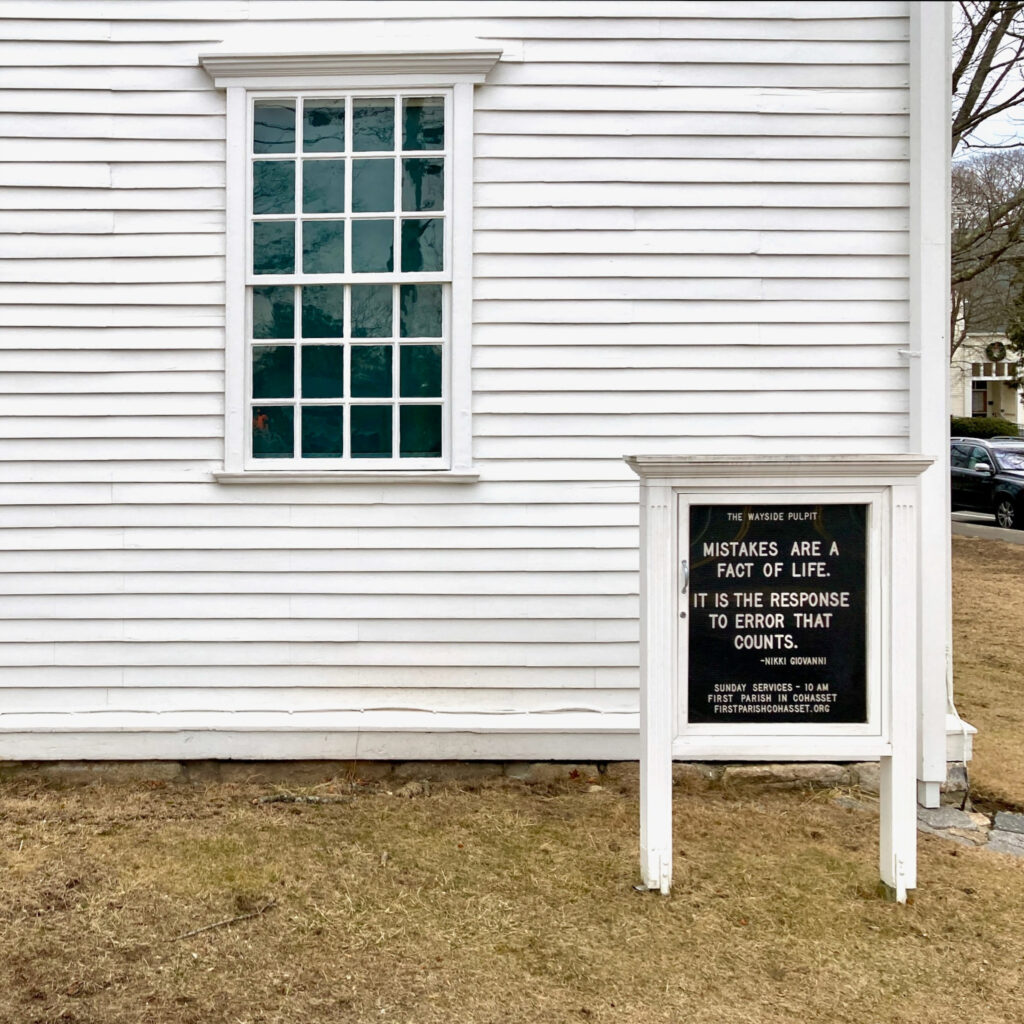
A sign in front of the corner of a New England clapboard meetinghouse.
The Wayside Pulpit in front of the 1747 Cohasset Meetinghouse.

Turning twenty

(I wrote this a few days ago, then forgot to post it. Here it is now….)

On February 22, 2005 —twenty years ago last Saturday — I wrote my first blog post. If you want a summary of this blog’s boring history, try here, here, and here. But I don’t want to look at the past, I want to think about the ongoing role of independent blogs like this one.

Twenty years ago, most blogs were a mix of day-to-day trivia, snarky commentary, and a few more serious long-form posts. All three of these have now migrated to other platforms.

The day-to-day trivia gets posted to social media outlets like Facecrook, TikFok, YouCrude, Instacrap, etc. Much of it consists of images, graphical memes, and videos. There’s no longer much interest in text-based day-to-day trivia.

Snarky commentary has also moved to social media outlets. Again, there’s been a movement away from text-based snark to videos, graphical memes, and images. Snark has also declined in intelligence, creativity, and kindness; I wouldn’t even call it snark any more, I’d call it Rage Porn.

Long-form text-based posts have moved to outlets that cater to that format, such as Substack and Medium. This move is generally a good thing; writers can focus on writing, and they can stop worrying about the technical challenges of publishing online.

In short, most of what appeared on independent blogs twenty years ago has now moved to other platforms. There’s a good reason for these moves: it has become increasingly challenging to stay current with web technology.

Take, for example, WordPress, the blogging platform I use. I started out in 2005 using WordPress 1.5, when it was simple and uncomplicated blogging software. Today, WordPress has morphed into a major CMS capable of running today’s most complex websites. I no longer have the time to stay current with its capabilities. That’s one of the reasons I still use a nine-year-old theme: I don’t have the time to make the move to a new theme. Sure, I could hire a WordPress consultant to do it for me; but that gets away from the DIY ethos that I found so appealing about blogging back in 2005.

Whatever platform you choose, web security has become increasingly difficult, as the evil hackers get bolder and more skilled. I’m lucky I have a good web host who helps me keep current with security issues. But it’s getting harder and harder for me to stay current with web security. I can thoroughly understand why writers would want to move to a platform like Substack or Medium.

Beyond the challenge of staying current with technology, I don’t think there’s much of an audience for independent text-based blogs any more. Most of my early readership long ago migrated to social media platforms. Once you’re hooked in to a social media platform, there’s not much reason to go visit an independent website. Potential new audiences tend to prefer audio or visual podcasts; they don’t want to read text, they want to watch or listen to content.

The only reason to write an independent text-based blog like this one is because you like to write. That describes me. I enjoy the process of writing, and I write all the time. As long as I’m writing something, I might as well publish it. And even though publishing a blog has gotten more difficult in the past twenty years, it’s still far easier than the printed fanzines I used to publish in the 1980s and 1990s.

So what if the audience for independently hosted blogs is tiny? I’m still having fun, which has always been the point of this blog. I hope you’re still having fun, too — and thank you for continuing to read.

When to open

Since COVID, I’ve noticed a growing trend among Unitarian Universalist congregations — decisions about whether to close on a given Sunday. Here in New England, that often takes the form of deciding whether to open up when there’s a winter storm on Sunday morning. This has been especially noticeable because we’ve had a winter storm hit on each of the past Sundays.

Typically, three options are considered — (1) Have both an in-person service and a livestreaming option; (2) No in-person service, service available via livestream only; and (3) Cancel the service entirely. Congregations within a couple of miles of each other can wind up making different decisions based on their livestream capabilities vs. their in-person capabilities, as well as the needs and interests of their members and friends. There is no one correct answer. Yet although there is no one correct answer, canceling in-person services carries a significant risk.

Here’s how I explain that risk: Congregations are operating in an increasingly competitive market for people’s leisure time. We used to place based on the assumption that congregations were in competition with one another, e.g., the Unitarian Universalist congregation was in competition with the local Congregational church and Reform Jewish synagogue. But now our primary competition is with other leisure time activities. For many people, our primary value may not be religion and spirituality, but community and interpersonal contact. So here at First Parish in Cohasset, our most direct competition includes both the liberal UCC church across the street, and the local coffee shop a block away.

As it happens, I live above the local coffee shop. The past two Sundays, the coffee shop opened promptly at 7 a.m. as usual, regardless of the winter storms. Because I’ve noticed that the coffee shop is always open, I’m reluctant to cancel in-person services for a winter storm — if we do cancel, we’re essentially saying that we’re less important than a cup of coffee. At the same time, we offer livestreaming for anyone who’s still snowed in, or who feels physically unable to wade through snow and ice to get to services. (And maybe there’s a sense in which livestreaming allows us to out-compete the coffee shop.)

Yes, in-person attendance was low both weeks (on 2/9, 11 in person, 32 livestream log-ins; on 2/16, 20 in person, 20 livestream log-ins). Foot traffic at the coffee shop was also low, from what I could see. But First Parish wants to remain competitive with other leisure time activities, and that’s reason enough to stay open for both in-person and livestreaming during both winter storms. — Mind you, that’s me speaking as someone who’s worked in sales and marketing; I can totally understand why other congregations would think this strange.

Noted without comment

From “The American Taboo on Socialism” by Robert N. Bellah in The Broken Covenant: American Civil Religion in Time of Trial, 2nd Edition (Chicago: Univ. Chicago Press, 1992), chapter 5, pp. 112-138: