Reading list: Hans-Georg Gadamer

I just finished re-reading Jean Grondin’s Hans-Georg Gadamer: A Biography (trans. Joel Weinsheimer, part of Yale Studies in Hermeneutics series, 2011). I read this biography not long after it came out, but decided to re-read it due to the rise of fascism and totalitarianism in the United States.

Gadamer lived through the Nazi Party’s rule of Germany, and after the end of the Second World War wound up in the eastern sector of Germany watching the rise of totalitarianism under the rule of the Soviet Union. He was neither a Nazi nor a Communist, and somehow managed to survive both those totalitarian regimes — though admittedly, he got out of East Germany just a few years after the war, before the border close completely.

So how did Gadamer manage to navigate two forms of totalitarianism? He did not support either regime, but did his best to work around them, in order to maintain the tradition of humanistic scholarship. Looking back from our privileged vantage point, we tend to valorize those who engaged in dramatic acts of resistance. We tend to forget that in a totalitarian regime, just living your day-to-day life puts you at risk — you don’t have to engage in dramatic resistance to be killed or imprisoned. Reading about Gadamer’s life is a salutary reminder that totalitarianism is a threat to everyone living in a totalitarian regime.

Throughout the Nazi and Soviet years, Gadamer did his best to keep the tradition of humanistic scholarship alive. That may not sound like much, but it was actually an act of major resistance — quiet resistance, but still major resistance. He wanted to keep core cultural values and traditions alive for the day when totalitarianism would at last be defeated. Again, this may not sound like much, but when you remember that totalitarianism thrives by effacing humanistic culture, then you realize that what Gadamer was doing was in fact serious resistance to totalitarianism.

As I said, I re-read this biography because I’ve been watching the rise of totalitarianism in the United States. The rapid rise in the number of books being banned, the misogynistic anti-abortion laws being passed, the Christian nationalists trying to impose their perversion of Christianity on everyone else — these are all very worrying. And maybe Gadamer’s life provides one example of one approach to the fight against totalitarianism. Some people will gladly take on the high profile resistance, the public protests, fighting fire with fire. But we also need people to keep humanistic culture alive.
Killer

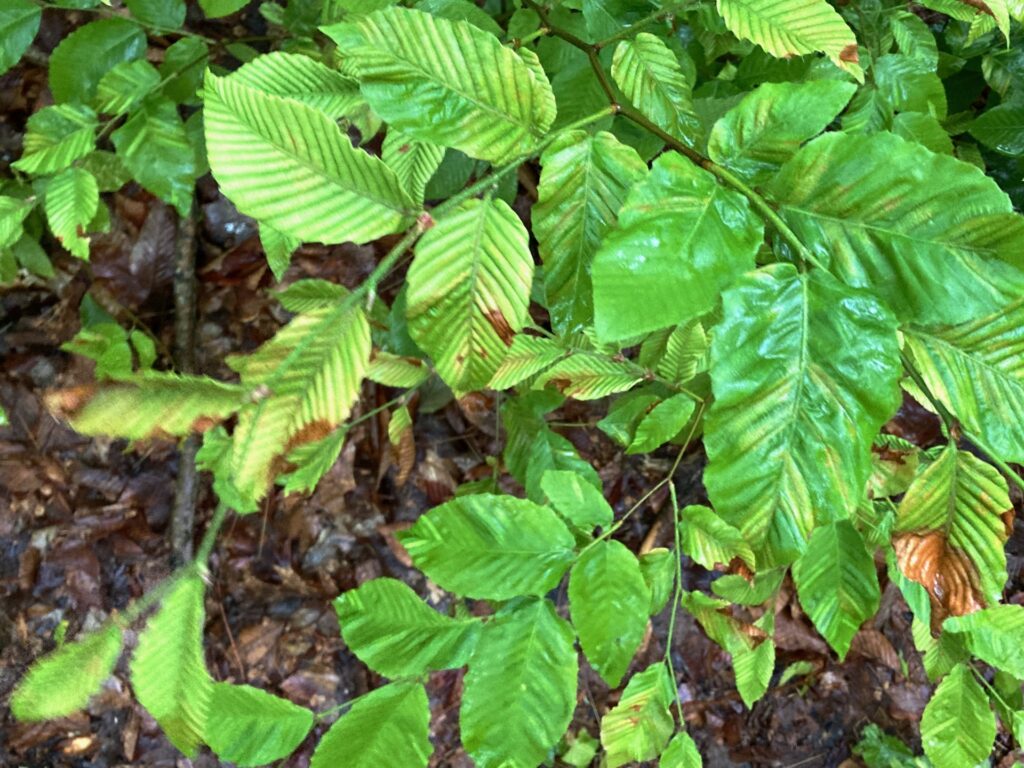
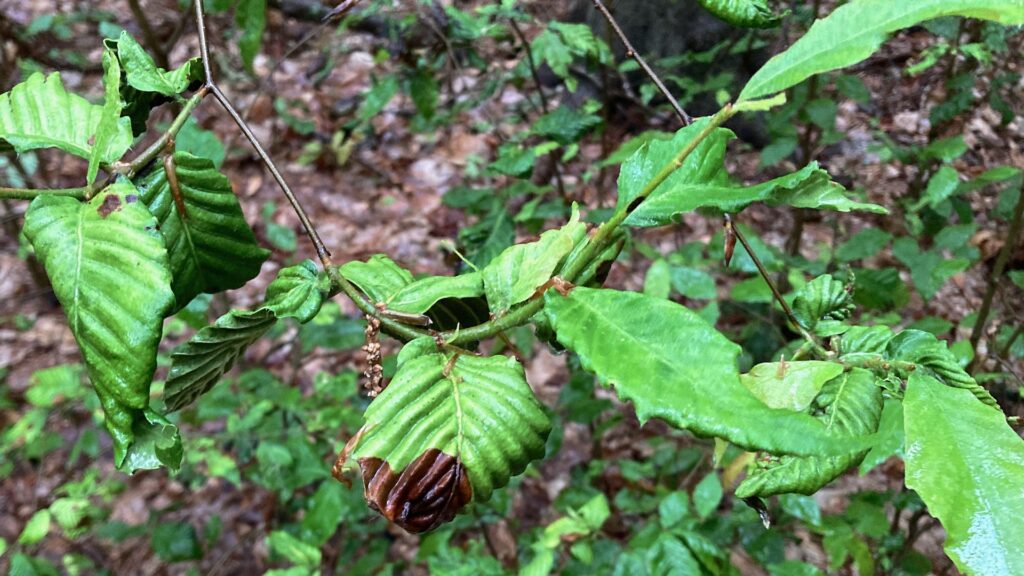
Beech leaf disease (BLD) has arrived in Cohasset. I’m seeing leaves on American Beeches withering and dropping off both in Wheelwright Park and in the Whitney Thayer Woods. In some places, stands of beeches have lost so many leaves that it no longer feels like you’re walking in the forest.

Withered leaves on an American Beech sapling.
American Beech sapling in Whitney Thayer woods with BLD

A scientific article from two and a half years ago — Sharon E. Reed, et al., “The distribution of beech leaf disease…,” Forest Ecology and Management, vol. 503, January, 2022 — found that BLD is a worse threat to American Beech stands than two previous invasive pathologies, beech scale (Cryptococcus fagisuga), and beech bark disease (C. fagisuga and Neonectria spp. complex).

Withered leaves on an American Beech sapling
American Beech sapling in Whitney Thayer Woods with BLD

An invasive nematode from east Asia, Litylenchus crenatae, is always present when BLD is present. But a scientific article from Sept., 2021 — Carrie J. Ewing et al., The Foliar Microbiome Suggests that Fungal and Bacterial Agents May be Involved in the Beech Leaf Disease Pathosystem, Phytobiomes Journal, pub. online 29 Sep 2021 — also found that organisms from four bacterial genera — Wolbachia, Erwinia, Paenibacillus, and Pseudomonas — and one fungal genus, Paraphaeosphaeria — are always present with the nematode when BLD is present.

A few withred leaves among healthy leaves in an American Beech sapling
American Beech sapling in Whitney Thayer Woods with BLD

From what I can gather, our understanding of BLD is still incomplete. However, a few things are quite clear. The University of Rhode Island suggests a couple of strategies to try to save trees from BLD: heavy applications of phosphite fetilizer twice a year, and/or application of pesticide to kill the nematodes. If trees with BLD are left untreated, they will die within 6 to 10 years. Since we cannot treat most trees in our forests, we can expect most infected American Beeches to die within a decade.

Yet another reason for eco-grief.

And this is another reminder that as dire as the situation might be with climate change, invasive species are also devastating our New England forest ecosystems. A hundred years ago, we lost our American Chestnuts to invasive Chestnut Blight. Fifty years ago, we lost most of our American Elms to invasive Dutch Elm Disease. We’re in the process of losing all our Eastern Hemlocks to an invasive insect, the Woolly Adelgid, and all our ash trees to another invasive insect, the Emerald Ash Borer. Now we’re losing all our American Beech trees to yet another invasive organism.

Yes we need to stop climate change, but that’s only a part of the threat to Earth’s life-supporting systems. There’s a lot of work for us to do….

UFOs

Actually, they’re no longer called Unidentified Flying Objects, but rather Unidentified Anamolous Phenomena (UAP). According to the Office of the Director of National Intelligence, there were 144 UAP reported from 2004 to 2021. Although these remain unexplained, possible explanations include: airborne clutter (including “airborne debris like plastic bags); natural atmospheric phenomena; “developments [by inudstry and government] and classified programs by U.S. entities”; “foreign adversary systems”; and other possible explanations.

NASA recently held a public meeting — a video of this meeting are now available on Youtube — to cut through the cult of secrecy that has long surrounded UFOs…um, I mean UAP. Previously, NASA has spent all its energy debunking UFO sightings. Now NASA is trying to be more open its data collection and data analysis efforts. So, as you’d expect, one of the questions they got during the public meeting was: “What is NASA hiding?”

No amount of public meetings is going to convince people that NASA has nothing to hide. Belief in UFOs is now a part of the U.S. mythos, and the mythos of other so-called developed countries. There are even New Religions Movements based on UFOs, most notably Raelism, for which the influence of extraterrestrial intelligence on humanity is integral to their worldview. Many of these New Religious Movements now downplay any mention of UFOs or alien intelligences (for example, Unarius Academy of Science and Scientology emphasize their self-development coursework, not UFOs). Nevertheless, belief in UFOs remains central to the U.S. mythos. One meeting my NASA is not going to dislodge this firmly-held belief.

Memory

I awakened this morning in the grip of an unpleasant memory.

The memory was from the end of the last semester of my last year of undergraduate study. I had majored in philosophy because it had the least amount of required coursework. That meant I had plenty of time to take classes in fine arts and music, and do lots of reading on my own.

Even if I had taken more philosophy classes, I knew I was a mediocre and uninspired philosophy student. I knew it, and the department chair knew it, and I knew he knew it. But I didn’t think I was anything worse than mediocre and uninspired. So I was a little taken aback when the department chair pulled me aside one day and said that sometimes the philosophy faculty needed to talk a little more with one of the seniors….

At first I had no idea what he was talking about. He seemed to be talking around in circles. Then it became clear he was saying I had to meet with philosophy faculty for some kind of oral exam. The exam would take place in two days.

Two days. Holy shit. I still didn’t understand what was going on. I felt too burned out to study.

By the time of the oral exam, I was terrified. I have a vivid memory of walking into an office and confronting the entire philosophy faculty. As soon as they started questioning me, though, I realized I had been mistaken about the purpose of the oral exam. Apparently someone had proposed me for academic honors. That’s what they were going to examine about. This was not at all what I had expected. I froze, and could barely speak. Some of the faculty looked disappointed and even disdainful. It was humiliating. At least they had the kindness to let me go quickly.

Of course I didn’t get honors. Nor did I deserve them — I had done as little coursework as possible in philosophy. I was pretty sure that the department chair also felt I didn’t deserve honors, which helped explain why he couldn’t bring himself to tell me that I was being considered for honors. He and I had clashed a number of times — I thought he was a pompous ass who had coasted on a brilliant PhD dissertation but never published anything — and he thought I was intellectually immature and needed his special guidance. He cornered me at breakfast on graduation and insisted on telling me that he knew I was a prejudiced New England Yankee who hated French Canadians like him and that’s why we never got along. Actually, in my town there were no French Canadians, and that just happened to be the one form of New England ethnic/racial hatred that I had not learned. But I knew what he meant. No wonder he found me distasteful. And recognizing the justice of his opinion of me didn’t change my opinion of him: that he was a pompous ass and an intellectual pretender.

At graduation, we had to sit through an incredibly boring commencement speech about the glories of capitalism (I’m not making this up). I hadn’t wanted to attend graduation, but my parents insisted. Since they had paid for a third of my college degree, I knew they deserved something for their investment, so I bought the robe and the funny hat and sat there through the boring ceremony. We had been instructed that when it came our turn to walk across the stage and receive our diploma, we were supposed to shake the hand of the college president first, then take our diploma from his other hand. I grabbed the diploma first, then shook his hand — I wasn’t taking a chance on them yanking it away from me at the last minute on some pretext or another.

A couple of footnotes: After failing miserably in that oral exam, I was asked to apply for the department prize in philosophy by submitting a list of books I had read on my own, outside of coursework, during my final two years of college. It was an impressively long list, and I got the prize — a gift certificate for $40 worth of books (worth $120 in 2022 dollars). Those books probably were worth more to me than honors, because after graduation I spent 12 years in the residential construction business where no one cared if I went to college, let alone whether I got honors or not. And I met a fair number of former philosophy majors working construction who didn’t use their degrees, either.

The next frontier

We all know about the sex abuse crisis in the Catholic church. It continues to get a lot of press, to the point where if you say “child sexual abuse” a lot of people immediately think “Catholic church.” Which isn’t all that fair. While the Catholic sex abuse crisis has gotten the most publicity (and honestly, it deserves all the publicity it has gotten), it’s pretty clear that other institutions have their own sex abuse crises. The Boy Scouts come to mind, again because they’ve gotten a lot of publicity. But I’m willing to bet that the sexual abuse crisis goes beyond religion and scouting….

I suspect the next big frontier for the revelation of sexual abuse could be in sports. I’ve been thinking about this as I read about what’s happening in India. Olympic medalists have accused a politically-connected wrestling coach with child sexual abuse. There’s the usual denial and obfuscation. Eventually the coach has to step down from his coaching duties, but he doesn’t get arrested or prosecuted. The Olympic medalists engage in public protests, and the government arrests them instead of the former coach.

I’m willing to bet that school and youth sports provides many opportunities for sexual predators on the prowl. Many school sports programs have little accountability to anyone outside of the tight little world of sports — too often, coaches are essentially free from oversight by school administrators, and no one else is trying to hold them accountable. Some youth sports leagues might have even less accountability. When you hear coaches screaming and swearing at the kids during practices, you begin to wonder. If I acted like that towards kids in a church program, I’d lose my job — so if coaches can get away with that kind of abusive behavior, I have to wonder.

Sports is even more sacrosanct than religion. I’m not expecting any movement towards reform to come from sporting organizations (remember how everyone covered for Larry Nasser?). We might wish that more athletes blow the whistle, as is happening in India — but look at the price they’re paying.

I now believe the best solution is uniform child protection regulations that cover all youth programs, like California’s Assembly Bill 506, enacted in 2022. AB506 has some major problems — honestly, it’s not a well-written law — but the fact that it applies to all youth programs is really important. Sports programs have to comply, along with churches and schools. Of course, laws like AB506 still doesn’t address sexual abuse of persons over age 18. But it’s a start, a step in the right direction.

Florence Price children’s song

Composer Elaine Fine found a children’s song by composer Florence Price. This is kind of cool because Florence Price has recently been rediscovered by the classical music cognescenti as an exceedingly talented mid-twentieth century American composer who got forgotten because she was both Black and female.

Now I wonder if Price wrote other children’s songs. And this also makes me think of another fabulous mid-twentieth century American woman composer, Ruth Crawford Seeger, who produced some books of children’s songs, containing her transcriptions and harmonizations of American folk tunes. And finally, wouldn’t it be nice if some of today’s “serious” composers turned their talents to children’s music?

Slight change

For many years, the tagline of this blog read: “A post-modern heretic’s spiritual journey.” I finally decided a more accurate tagline is: “A post-modern heretic’s journey through ecological spirituality.” Maybe that’s too specific… but for now it feels like “ecological spirituality” is a better descriptor.

Update, 1 Aug 2023: I changed the tagline back to the original one.

Ordination

Someone left a comment asking me to ordain them as a minister in their own made-up religion. Uh, yeah, no. An easy web search would have revealed that only Unitarian Universalist congregations (not individuals) can ordain. Another easy web search would have revealed lots of websites that will ordain you upon request. So I deleted the comment, because I’m guessing it’s one of the spammers and scammers who attack this blog on a daily basis.

But this does raise the interesting question of the meaning of ordination. There is not a universal understanding of what it means to be ordained.

Unitarian Universalists in the United States have our own understandings of what ordination means. Not only that, our understandings may differ from congregation to congregation. And U.S. Unitarian Universalist understandings of ordination differ substantially from Unitarian Universalists in, say, Romania or the Philippines.

That’s just within one religious tradition. Beyond that, Unitarian Universalist understandings of ordination may differ greatly from other religious traditions. For example, Roman Catholics understand ordination as a “sacrament” (honestly, I’m not quite sure what a sacrament is). In another example, some Buddhist groups ordain people into monastic orders, which is a different thing than ordaining someone to be a leader of a congregation consisting mostly of lay people. Then there are all those religious traditions that do not have ordination rituals.

This brings us to the interesting point about ordination. In a multicultural, multi-religious society like the United States today, ordination can only be understood in relation to a specific religious tradition — or even only in relation to a specific local religious community. What you mean by ordination might not be what I mean by ordination. This is not to say that ordination is meaningless. Ordination does have meaning, but only in relation to a specific religious tradition.

Eco Fest

This afternoon, Eco Fest took place on Cohasset Common, right across the street from First Parish in Cohasset. Four of us — Ngoc, Matt, Carol, and I — staffed a table where kids could make seed bombs.

(What’s a seed bomb, you ask? Make a thin wafer, maybe two inches in diameter, out of some air-dry clay. Put a pinch of potting soil in the middle, add a dozen or so seeds, then fold the clay up around the seeds and soil to make a little ball. That’s a seed bomb. You can toss it anywhere. The clay holds in moisture, and the soil provides a medium so the seeds can begin sprouting.)

Our seed bombs were made with seeds from native plants. When older kids made seed bombs with us, we explained about the importance of native plants, and how native plants can attract a wider diversity of pollinators. Ngoc had a cool book with photos of 50 or so native pollinators, which I showed to kids, pointing out pictures of my favorite native pollinators — metallic green bees (genus Agapostemon).

We had a constant stream of kids coming to our booth, so I never even got to visit any other booths. But I could see there were some interesting groups present. In addition to commercial vendors, I saw booths staffed by the Cohasset High School Green Team, the North and South Rivers Watershed Association, a group providing recycling information, the Cohasset Garden Club, and more. I’m already looking forward to next year.