At my sister’s house,
Weeding her garden in bright
Fragrant summer heat.
The jet rises up,
Takes me to the distant shore
Where summer is cool.
At our house, gray fog
Drifts in from the cold ocean,
And is gone by noon.
A postmodern heretic's spiritual journey.

At my sister’s house,
Weeding her garden in bright
Fragrant summer heat.
The jet rises up,
Takes me to the distant shore
Where summer is cool.
At our house, gray fog
Drifts in from the cold ocean,
And is gone by noon.
I’m preparing to write a sermon on the Unitarian Universalist Association’s purposes and principles, titled “Why the Seven Principles Must Change.” I’m thinking of using one of several passages from Agatha Christie’s murder mystery A Pocketful of Rye as one of the texts on which the sermon will be based; Christie, whatever her faults may be, is fairly sound on the topic of wickedness. At this point, I think the second passage below best captures what I’m trying to say in the sermon. If you have any similar quotes that could serve as a necessary corrective to the excessive optimism of the “Seven Principles,” I’d love it if you left them in the comments.
———
1. Calming himself, [Inspector Neele] said, “Oh, there are other possibilities, other people who had a perfectly good motive.”
“Mr. Dubois, of course,” said Mis Marple sharply. “And that young Mr. Wright. I do so agree with you, Inspector. Wherever there is a question of gain, one has to be very suspicious. The great thing to avoid is having in any way a trustful mind.”
In spite of himself, Neele smiled.
“Always think the worst, eh?” he asked. It seemed a curious doctrine to be proceeding from this charming and fragile-looking old lady.
“Oh yes,” said Miss Marple fervently. “I always believe the worst. What is so sad is that one is usually justified in doing so.”
———
2. “It sounds rather cruel,” said Pat.
“Yes, my dear,” said Miss Marple, “life is cruel, I’m afraid….”
———
3. “…It’s very wicked, you know, to affront human dignity….”
———
4. “…One needs a great deal of courage to get through life….”
My sister Abby and I did some experimenting with Google+ last night. Its real strength appears to be the way it has both integrated and implemented various online communications tools together. It integrates email, microblogging, social networking, chat, videoconferencing, etc., in the same interface.
And each of these online communications tools has been implemented reasonably well. You can send a message directly from Google+ to any email account using a simple, straightforward procees. Microblogging from Google+ is as easy as Twitter (though I haven’t yet figured out how to do it from my phone). The social networking feature seems better designed than Facebook or MySpace, and presumably draws on Google’s extensive experience running Orkut (which has never been popular here in the U.S., but is hugely popular in Brazil). Abby says the chat feature is identical with Google Talk, which she has been using for some time; in addition to chatting via text, you can also use video chat. The videoconferencing tool, called Hangouts, allows up to ten persons at once, although we were only able to test it with the two of us.
Some people are claiming that Google+ is going to kill off Facebook. But I’m not convinced that they are aiming at the same market. I can immediately imagine how I might use Google+ at work, whereas I can’t imagine using Facebook at work except for the most rudimentary communication. Google+ is not primarily a social networking tool; it is an online communications tool.
At this point, I can say that I like Google+ pretty well. I’m already thinking of ways I can use it at work (interoffice communication, online committee meetings and small group ministries, interoffice communication, text-based discussions about sermon topics, etc.). It’s good enough that I’m willing to invest some time in experimenting with it. But I’m not yet willing to say it is the best most awesomest online communications tool ever. Ask me again in a month, and I’ll have a better answer for you.
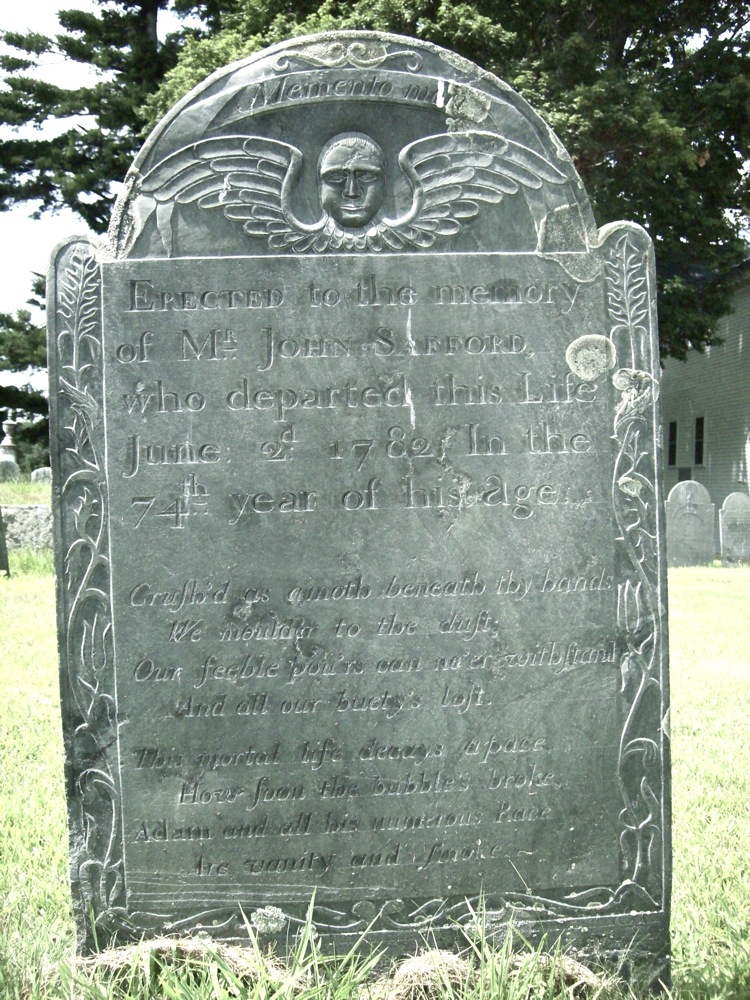
This gravestone, commemorating John Safford who died in 1782, stands in the old burying ground off the town common in Harvard, Massachusetts. The poetry at the bottom is two verses from Isaac Watts’s metrical version of Psalm 39:3, part three. As rendered by the gravestone carver, it reads as follows:
Crush’d as a moth beneath thy hands
We moulder to the dust;
Our feeble pou’rs can ne’er withstand
And all our beuty’s lost.
This mortal life decays apace
How soon the bubble’s broke
Adam and all his numerous Race
Are vanity and smoke.
Over in the U.K., Metropolitan Police head Sir Paul Stephenson resigned yesterday, and Met Police Assistant Commissioner John Yates has just announced that he too is resigning. I’m watching a live press conference on the BBC Web site with Boris Johnson, the Mayor of London. The press are asking very pointed questions, like sharks circling bloody meat. “Do you regret being so whole-heartedly in support of the Murdochs?” “Er, well, in light of what New of the World … democracy … we’ve begun … nothing has been proved, by the way, against any of these officers … blah blah blah.” “It is a question of your judgement that is in question as well here, as mayor of London.” “I gave an answer based on what I knew then … blah blah blah [defensive coverage of his rear end]….” “Do you apologize mocking the people who brought this up, those people who were right all along?’ No he doesn’t, next question please.
I asked Dad yesterday about this Murdoch phone hacking mess. Dad’s father was a newspaperman, so Dad has been watching the news business for a long time. Dad’s answer: “Murdoch is worse that Hearst.” That’s really bad. So it’s looking like British democracy is owned by the rich corporations just as is American democracy, which is a chilling thought.
I’m posting a link to the sermon I gave this morning in the Concord, Massachusetts, church so that Susi can argue with me about it. Here’s the link.
A score of ten or better on this checklist is required for satisfactory completion of week-long stay on New England coast.
Walked along beach and picked up shells — check
Clambered over rocks on a jetty or breakwater — check
Ate fried clams (fresh, tender, and sweet, not the frozen crap you get inland) while sitting on beach — check
Sat in rocking chair on porch and looked at ocean — check
Got too much sun — check
Ate lobster roll (with identifiable claw meat, not that chopped up crap that you get inland) — check
Conversed in eastern New England dialect — check
Took afternoon naps — check
Got drenched in a sudden squall — check
Had weather cool enough to need a jacket, and hot enough to sweat while sitting still — check
Watched guys fishing for stripers and not catching anything — check
Watched seagulls and terns fishing and catching a lot — check

Moonrise over Camp Ellis, Maine
Dear Ms. M.,
Saw the moon come up over Saco Bay tonight. Sat on the beach and ate fried clams from Huot’s, and watched the moon change from pink to pale orange to gold.
Wish you were here,
Dan
The “Sustainable World Radio” podcast recently interviewed my partner Carol about composting toilets. here’s part one of the interview, and here’s part two.
I was coming back from a long walk down the beach to see if there were any Piping Plovers nesting at Goosefare Brook, looking down at my feet in the fading light to see if there were any interesting shells or stones worth picking up. Ahead of me, a man was aiming a camera with a large telephoto lens on a tripod at something. I looked in the direction his camera was pointed, and there was the moon rising up out of the Atlantic Ocean. If the moon is about 30 arcminutes wide, it was about 90 arcminutes above the surface of the ocean when I first looked. It was pink and a little brighter than the medium blue sky; it hung just above a distant line of darker blue clouds tipped with pink along their tops.
The moon sat in the sky above the gap between Eagle Island and Wood Island. As I walked on down the beach, past the man struggling to aim his camera, the moon appeared to move towards Wood Island, until it stood over the eastern end of the island. The last light of the sun lit up the distant white tower of Wood Island lighthouse; a long shimmering reflection of the moon shone in the waters of the bay.
A couple of hours later, I was on the beach with forty or fifty other people for a bridging ceremony for this year’s high school seniors in the youth program at the Ferry Beach religious education conference; these were youth I had watched grow up summer after summer; one of them was the daughter of someone who had been in my own high school youth group. The moon was high in the sky; a long white reflection of it brightened up the calm bay; it was almost bright enough to read by. The air was cool enough to require a jacket and to keep the mosquitoes away, and two foot waves crashed regularly on the beach below us. What a perfect night, said the person next to me.