Indiana Universalism, 1807-1916

Back in 1917, Rev. Elmo Arnold Robinson published a two-part history of Universalism in Indiana in the Indiana Magazine of History; the numbers of the journal were vol. 13 no. 1 (March, 1917) and vol. 13 no. 2 (June, 1917). You can find these articles in various places online, but perhaps the most convenient way to obtain them is through JSTOR; unusually for JSTOR, both articles are offered free of charge.

“Universalism in Indiana,” part one

“Universalism in Indiana,” concluded

Robinson later wrote the book-length history The Universalist Church in Ohio (Ohio Universalist Convention, 1923). And yes, there is a connection to Palo Alto: Robinson served as the minister of the old Palo Alto Unitarian Church from 1921 to 1926; he was fellowshipped as both a Unitarian and a Universalist minister.

Twelfth day

It’s the twelfth day of Christmas. What to do on the twelfth day of Christmas? You could read Shakespeare’s “Twelfth Night.” Or some family traditions hold that this is the day to take down your Christmas tree.

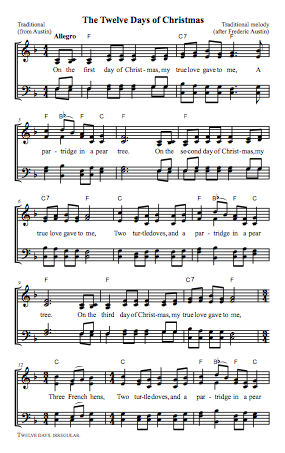
Or, if you have a certain kind of obsessive personality, you could sing every verse of “The Twelve Days of Christmas.” And, in case you want to engage in this last effort, I’m posting a PDF of sheet music with guitar chords and a SATB/piano accompaniment.

twelvedays

N.B.: The first five verses are written out completely. Then the last page shows all twelve verses, and you’ll have to figure out on your own where to start each new verse.

16 SATB Xmas carols and songs

I’ve added a new Web page with 16 Christmas carols and songs, in basic SATB arrangements (one is STB) — including carols not in the current Unitarian Universalist (UU) hymnals (like “Jingle Bells”), carols with words from older UU hymnals (like “Joy to the World”), etc. You can find the page here.

(Yes, I know Christmas is over for the year. I’ve been meaning to put these online for a couple of years, I never seem to have time to do it before Christmas, so I’m going to put them up now.)

The year in review: UU social media in 2013

It feels to me as though there was a resurgence of energy and creativity among Unitarian Universalists using social media in 2013. I’m not sure we were always as effective as we could have been, but I saw energy and enthusiasm amongst Unitarian Universalist (UU) social media creators that led to some of our best use of social media ever. Here’s my list of the 2013 UU social media top three — two exemplars of how to use social media and one milestone in the evolution of UU social media:

1. CLF: This year, the best producer of UU social media was, without doubt, the Church of the Larger Fellowship (CLF). When you go to their Website, delightfully titled “Quest for Meaning,” you’re immediately presented with several ways you can engage with the CLF community: you can share your joy or concern; you can light a virtual chalice; you can click through to one of their blogs; you can register for an online course; you can find out about their online worship services; you can donate money or buy books that will provide them with a small kickback; and more. The front page of their Website lets you know that they really do have an online community — and their Website draws you in and offers you many ways to participate, at multiple levels of commitment. I’m pretty jaded by online engagement these days, but even so simple a thing as lighting their online chalice brought a smile to my face.

I’m even more impressed by CLF’s video offerings, which are easiest to track down on Youtube. You can watch video meditations, you can listen to their religious educator, Lynn Ungar, tell stories, you can hear homilies by their senior minister Meg Riley and others, and you can watch “The VUU,” an online UU talk show. I was particularly impressed by “The VUU”; I was prepared not to like it, I thought there was no way that I’d watch an hour-long video, I half-suspected it would be the usual overly-serious religious liberal talkfest. But it turns out that “The VUU” is funny, entertaining, thoughtful, and definitely worth watching. Ever since I watched the early videoblogs by Steve Garfield and others, I’ve been waiting for some Unitarian Universalist to figure out how to do something fun and creative with online video — and “The VUU” has finally done it; indeed, it exceeds my expectations.

2. UU World’s “Interdependent Web”: When Kenneth Sutton stopped curating “The Interdependent Web,” a weekly list of the most interesting posts from UU blogs, I was a little bit worried; I didn’t think anyone could be as good a curator as Kenneth. But I can say without diminishing Kenneth’s achievements in the least that Heather Christiensen, the new curator of “The Interdependent Web,” is even better. Heather has cast a very wide net, and tracked down new and unusual UU blogs that I otherwise would never have heard about; she has been unafraid to mention posts on controversial subjects (and her editors at UU World have obviously supported her in this); and she has been pretty consistent at finding good and thoughtful writing. Continue reading “The year in review: UU social media in 2013”

Sunny and seventy

I’m getting ready for the Christmas Eve candlelight services at the Unitarian Universalist Church of Palo Alto. It’s over seventy degrees and sunny, and while the sun was hitting my office window it got warm enough that I had to have the door open to cool off. At this point, some of you who live in places where it is now cold and dark and maybe snowy might be saying to yourselves, “Warm and sunny? That doesn’t feel like Christmas Eve!”

Ten years ago, I spent a year working part-time as the religious educator for Church of the Larger Fellowship, an online congregation that serves religious liberals around the world, including in the tropics and in the Southern Hemisphere. On my first week on the job, the senior minister and the administrator both warned me to remember that given our congregation it was a mistake to draw parallels between Easter and springtime, and between Christmas and the winter solstice. If I did so, I was further warned, I would be sure to get complaints from our members in places like Australia and New Zealand and equatorial Africa. That’s how I learned to be able to separate Christmas from the seasons.

Now that I’m in the Bay Area, however, I’m living in a so-called Mediterranean climate, a climate that is similar to the climate of Bethlehem and Nazareth (though we are farther north so we have much longer nights at this time of year). Our seasons correspond reasonably well with the seasons of ancient Judea. We’ve had a very dry year, so this year at Christmas because it’s sunny and warm we’re praying for the winter rains to hit — like the people of the Ancient Near East, we’re less concerned with snow and crackling fires and short nights, and we’re far more concerned with where our water is going to come from.

So this year here’s what I’m humming to myself:

   I’m dreaming of a wet Christmas,
   Just like the ones in El Nino years,
   When the treetops glisten
   And children listen
   To hear raindrops falling near….

Caroling

Michele, my voice teacher and friend, sent out an invitation to some caroling in her neighborhood. Even though she lives way over in north Berkeley, I decided to go — I didn’t know anyone who was going to go caroling near where we live, and I wasn’t up to organizing caroling on my own.

Close to twenty people gathered in Michele’s living room yesterday evening. We introduced ourselves, and ran through two carols where we thought we might sing some harmony — “Silent Night” and “Deck the Hall.” Fortunately there was another bass there who helped me through “Deck the Hall,” and I was able to help him once or twice in “Silent Night” — it’s always easier to sing your part when there’s someone else singing with you.

We headed out into Michele’s neighborhood. Michele said we would only sing at houses where we could see Christmas decorations. There were half a dozen children with us, and they ran ahead to scope out likely houses. We’d gather on the sidewalk in front of the house, Michele would quietly tell us which carol — “‘Frosty the Snowman,’ page 3 of the packet!” — the kids would ring the doorbell, and as soon as someone showed up, we’d sing.

Some people listened to us while standing indoors; in one case because there were dogs that desperately wanted to get out; in other cases maybe because it’s a little weird to have a score of people standing in front of your house singing. Other people came out and listened. Reactions ranged from politely tolerant to very enthusiastic. One woman, who had a foreign accent (maybe Middle Eastern?), was really very touched by the singing; we sang her another song.

After an hour, we were getting cold, and some of the younger kids were getting a little bit tired. So we all said “Good night!” and “Merry Christmas!” and dispersed into the night; the younger kids probably heading for bed. As for me, I had some errands to run in downtown Berkeley; but I found myself humming Christmas carols all the way home.

Why you should get your child dedicated

On her blog “All Together Now,” Karen Bellavance-Grace describes the child dedication ceremony that her Unitarian Universalist congregation held for her children:

“I trusted the words that came from our minister, Rev. Barbara McKusick Liscord: ‘For years to come, these children will be a part of our community of mutual caring, concern, responsibility and affection. Wherever they are in the world, they will always be tucked in the heart of this community. Do you, this gathered congregation, dedicate yourselves to nourish their spiritual growth, to welcome and value them, to share with them what you know of life and to learn from them what they have to teach us?’

“I heard the words, thought they were lovely, and trusted the members of the congregation would be kind to my children, smile at them, make small talk at coffee hour, and teach their Religious Education classes. I heard those words, prayed they would hold lasting meaning, and assumed that at the least, this congregation would witness their growing up….”

Well, now her daughters are entering their teen years, and their parents are splitting up, and Bellavance-Grace rightly worries about the girls:

“I knew we had a potential recipe for disaster. There were days when they didn’t want to talk to either of us to process this transition. We asked who the adults were in their life that they would be willing to speak to. One by one, they listed the names of members of their home congregation. Their minister, their OWL teachers, the woman who had taught their RE class when they were in kindergarten, a member of the congregation they thought of us a second grandmother, a Mystery Pal from a few years back. In that moment, I knew they would be okay.”

This is one of the hidden aspects of religious education, an aspect which actually has little to do with education, or with theology. In today’s U.S. society, kids have very few places where they can get to know ordinary adults. Most of us don’t live with extended families any more, and most of us don’t live in true villages or small towns where there is a lot of intergenerational contact. Most of the adults in kids’ lives are authority figures who are focused on specific goals that kids are supposed meet, adults like teachers and sports coaches. One big exception to this societal trend is congregations, where kids can meet and get to know a number of adults, adults who are not going to grade them, or get them to win games.

I like child dedication ceremonies because lying at the theological center of a child dedication ceremony is a promise to support parents and child as that child grows up. The congregation is entering into a set of promises, a covenant, with one particular child, while reminding itself of a wider covenant it has with all children in its purview. When Bellavance-Grace’s children were dedicated, that covenant was explicitly named by the minister, which is a good thing — but even if that covenant isn’t explicitly stated, it is still a core element of a child dedication ceremony.

I also like child dedication ceremonies because they remind congregations of their responsibilities. And because they remind older kids who see the ceremonies that they, too, are part of a covenant. And (maybe most of all) because they keep us focused on one of most important functions congregations have: raising kids.

If you haven’t gotten your child or children dedicated, think about doing it. It’s good for you, good for your kids, and good for everyone.

An open letter to the UUMA Board

Dear friends,

When I received my renewal notice from the Unitarian Universalist Ministers Association (UUMA) this year, I faced a tough choice.

This fiscal year, I had decided to attend both the annual conference of the Religious Education Association (REA), an international, interfaith organization of scholars and practitioners, as well as Religious Education Week at Ferry Beach Unitarian Universalist conference center in Maine. These two conferences each provided me with professional development that specifically addressed my needs as a minister of religious education. The REA conference was especially fruitful for me this year — I had an opportunity to attend workshops and have informal interaction with people like Thomas Groome and Siebren Miedema, scholars with an international reputation in my field, and to spend time with colleagues and former mentors, people who are facing many of the same issues and concerns that I face in religious education. Religious Education Week at Ferry Beach was also very fruitful, as I was able to take a graduate-level class with Mark Hicks of Meadville/Lombard Theological School in an intergenerational setting where we could both learn about religious education for young people, and watch it happening around us.

The basic issue for me is a cost-benefit analysis: as a minister of religious education, the UUMA provides me with very little benefit for the cost. And the cost is very high. My salary is $80K a year. The UUMA sliding scale means I pay $825 (10% of gross salary + housing), minus $100 for my membership in the Liberal Religious Educators Association, yielding a total cost of $725. It’s interesting to compare this to my REA membership: the REA also has a sliding scale, but for the same salary I pay only $105 per year.

You may be thinking that with a salary of $80K a year, I shouldn’t be whining. But I live in Silicon Valley, which has one of the highest costs of living in the United States. According to relocation Web sites that calculate cost of living across the country, $80K in Silicon Valley provides about the same standard of living as $40K in Rochester, New York. So it’s not like I’m getting rich (indeed, according to a recent newspaper article, my salary is below average in Santa Clara County). If I lived and worked in Rochester, New York, and made an equivalent salary providing about the same standard of living, I would pay about $325 for UUMA dues. Continue reading “An open letter to the UUMA Board”

The “New Mutualism”

Sara Horowitz, founder of the Freelancer’s Union (my union) and a winner of a MacArthur “genius grant” in 1999, defines the “New Mutualism” on her blog:

“Do It Ourselves — The people (the builders, the makers, the consumers) have to be in control. That could mean a worker-owned cooperative or maybe a membership organization. It’s not about venture capitalists funding the next fancy app and receiving all the profits. New Mutualism is about working together and a community reaping the benefit.

“Driven By a Social Mission — New Mutualist organizations are driven by a social good and serve a true need in their community. Their income makes them sustainable but isn’t their sole priority. They care about the greater good instead of fixating on profiteering.

“Do Together What You Can’t Do Alone — New mutualist groups draw their power from the strength of community and a feeling of solidarity, those spiritual and economic connections that make a group more powerful than any individual. A single freelancer might not be able to afford their own office space, but fifty freelancers working together can have a fantastic office that’s all the more powerful because of the like-minded individuals who built it.”

— The values behind Horowitz’s New Mutualism are not all that different from the values behind our liberal congregations: we, too, do it ourselves; we are driven by social mission; and we do together things that we could not do alone. Seems to me there are some striking similarities between our liberal congregations and the New Mutualism.

New Mutualism

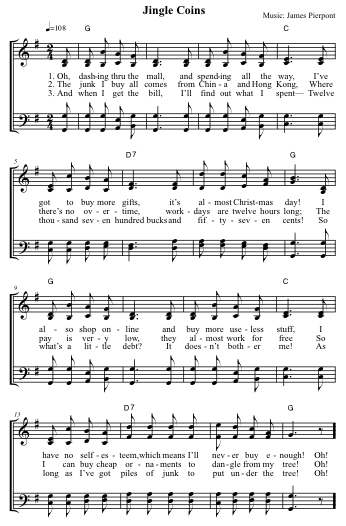
Jingle Coins

Another parody Christmas carol — an anti-consumerism parody this time. I got the words from some singing friends, and typeset it with a SATB arrangement which is based on James Pierpont’s original paino/vocal score for “Jingle Bells” (click on the image below for a full-size PDF):

Jingle Coins thumbnail

We sang it in our junior high Sunday school class this past Sunday, and the kids loved it. We also sang it during social hour on Sunday with the adults, again people seemed to like it.