Join the elite

Those of us who are religious progressives continue to try to understand conservative Christianity in the United States, and more specifically to understand how a religious option that asserts the leadership of Jesus of Nazareth also seems to advocate for consumerism, individualism, and intolerance.

I’ve spent some time learning about the theology of the prosperity gospel, so I feel that I have some sense of how conservative Christians can support consumerism and individualism — and honestly, conservative Christians aren’t very different from many religious moderates and progressives in the U.S. If you live in the U.S., it’s hard not to see consumer capitalism and individualism as normative.

But I have had a harder time understanding premillennial dispensationalism. That’s the theological position that there will be a Rapture, at which time a select few persons will be raptured away by Jesus Christ to be the Bride of Christ. The best known pop culture representations of remillennial dispensationalism is probably the “Left Behind” series of books and movies; a reboot of the movie series just came out, starring Nicholas Cage. And most of us religious progressives stop with the pop culture representations of premillennial dispeansationalism. But a closer look at premillennial dispensationalism is worth our time.

On recent post at the Sojourners Web site, Dr. LeAnn Snow Flesher points out that premillennial dispensationalism is “an elitist theology”: a few people get raptured, the rest of us don’t because the rest of us are disposable. This helps explain why premillennial dispensationalism is compatible with the prosperity gospel, that is, with theologies of economics that privilege the few at the expense of the many.

Flesher goes on to point out how premillennial dispensationalism is compatible with intolerance:

“The entire doctrinal belief system necessitates a separatist perspective and lifestyle, an emphasis on individual salvation, and adherence to a homogeneous set of doctrinal beliefs. It does not in any way foster tolerance for an interracial, intercultural, and interfaith context, and certainly has no tolerance for many of the social issues we struggle with in our nation and world today.”

It’s worth reading Flesher’s complete post here.

Link to Flesher’s post from @anglobaptist.

Talent, Oregon

BlogOct2314

The old railroad depot at Talent, Oregon. The sign reads: “To Portland 336 mi. / TALENT / To San Francisco 436 mi. / Elevation 1,635”

My cousin Sue tells me that up until a few years ago, two trains a day passed through Talent, carrying lumber south to Redding, California. With the collapse of the timber industry in this part of Oregon, there are no more regularly scheduled trains — this, along with the mills closing down, and good working class jobs disappearing, represents the changing economy of southwestern Oregon. The railroad depot has been converted into shops, perhaps a symbol of the growing importance of service industry jobs.

UNCO 14: the vocation of ministry

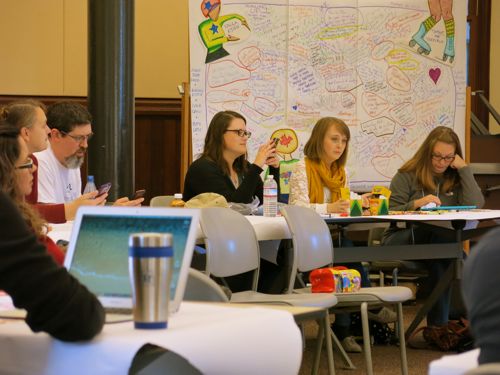
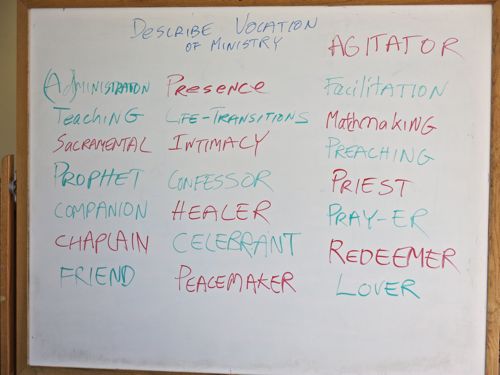
Christy led a session at UNCO 14 on the vocation of ministry. First, he had us list everything that a minister does, or should do, or that people want them to do, under the heading of “Describe the vocation of ministry.”

BlogOct2114b

We came up with: (Ad)ministration, Presence, Agitator, Facilitation, Teaching, Life-Transitions, Matchmaking, Sacramental, Intimacy, Preaching, Prophet, Confessor, Priest, Companion, Healer, Pray-er, Chaplain, Celebrant, Redeemer, Friend, Peacemaker, Lover.

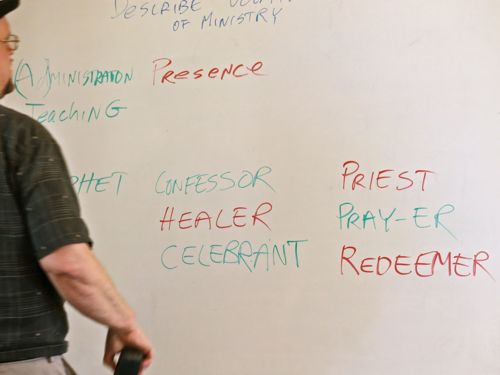
Assuming one minister can’t do all those things, Christy said we had to choose one thing to take off the list. And then another thing to take off the list. Then another thing. And another thing.

BlogOct2114c

Christy erased one thing after another from the list, until there was only one thing left…

BlogOct2114d

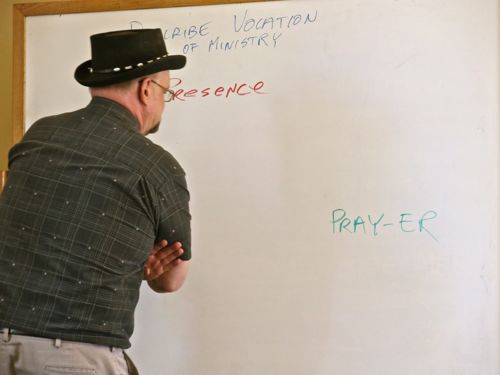
…until the only thing that was left was “Presence.”

If there’s one thing a minister absolutely has to do, to be a minister, it is to show up and be present.

UNCO 14: writing as a spiritual practice

Mindi convened a session at UNCO 14 on writing as a spiritual practice, and as a way to make money. Participants in this session included several bloggers, a novelist or two, and nonfiction writers writing about contemporary religion. We talked a bit about the mechanics of the publishing world, and the pleasures of writing, but what interested me most was to hear about the writing projects people were working on or contemplating.

And I felt the most interesting writing project anyone described was a memoir by an unchurched young adult who became a progressive Christian. We hear too much from people who leave organized religion (usually in a huff), and from people who convert (often loudly and spectacularly) to conservative Christianity — it’s about time we heard from a None who became a religious progressive.

We also talked about how to make money writing. Carol said one editor told her that since 2008, books sell about half as many copies and make about half as much money as they used to make. Beyond books, no one seemed to have a good plan for monetizing a blog. There was quite a bit of talk about niche markets, and how to reach them. One final tip from this workshop: Mindi said that many agents use the Twitter hastag #mswl to request manuscripts on specific topics.

UNCO 14: pastoral self-care

Derrick convened a very helpful UNCO session on self care for pastors. As the 15 pastors who were present talked about this issue, one thing stood out for me: most congregations may be willing to hear about the health issues of their pastor, except they mostly don’t want to hear about any mental health issues their pastor may have. If a pastor is struggling with, e.g., depression, do they dare to tell their congregation about this health issue? Probably not. Since ministers are at higher risk for the mental health issues of depression and substance abuse, this is a bit of a problem.

On the other hand, I get the feeling that many ministers don’t want to talk about mental health issues until they are actually facing trouble. In my opinion, ministers should have an ongoing relationship with a mental health professional, e.g., I talk every month with someone who is both a congregational consultant and a licensed family therapist. If a minister has such an ongoing relationship, if they do develop mental health problems they have someone they can turn to immediately; they also have someone who can help them identify a growing problem and get treatment before the problem affects work or personal life. Perhaps congregations could take more responsibility for their minister’s mental health by requiring and funding regular consultations with a therapist.

UNCO 14: ecclesiology and entrepreneurship

During the UNCO 14 session on ecclesiology and entrepreneurship, convened by my old friend Ms. M, I got to hear a little about innovative ministries, and innovative approaches to ministry, that UNCO participants are engaging in right now. Some of these innovative ministries are outside traditional congregations; some are innovating within traditional congregations. But it seemed like all of us are trying to figure out how to find money to fund these ministries.

Mindi, who is working part-time in a traditional congregation and part-time in a non-traditional start-up ministry, pointed out that the old donation model — asking church members to donate money to their congregation — is on its last legs. What will take its place? Amy said her new non-traditional congregation has a business model where worship services are open and free, and everything else is on a fee-for-service basis; they still solicit donations, but donations will go to allow sliding-scale payment for the fee-for-service programs. A number of people talked about using crowd-sourced funding. Anna said she will be trying patreon.com, a platform for crowd-sourcing ongoing funds for arts projects through a monthly payment scheme, to fund her non-traditional arts-based congregation — she said she’ll let us know how that goes. Jeff said he had tried Kickstarter, and had had less then stellar results.

During this session, we talked quite a bit about using capitalist methods to fund organized religion. Should we just accept that consumer capitalism is our cultural milieu, and use it to fund good projects? Or should we in organized religion stay in tension (to a greater or lesser degree) with consumer capitalism? Carol argued for staying in tension with capitalism; Amy seemed to not worry about it, focusing instead on the good she could do by using consumer capitalist techniques. While this discussion was going on, I was asking myself: If the old donation model is over, what’s our theology for new funding sources? — this is the question at the heart of an ecclesiology of entrepreneurship.

UNCO arts and crafts

UNCO is not all talk.

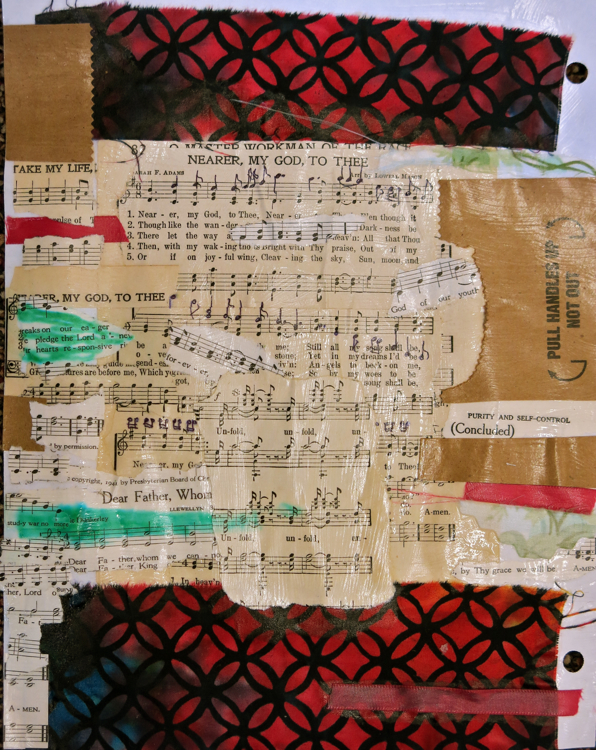
Deb brought supplies from her crafts closet to UNCO 14, and set up a table with collage materials, including a couple of old hymnals. She put a placard on this table: “Revision A Hymn.” Yesterday I found a hymn written by the British Unitarian Sarah Flower Adams — “Nearer My God to Thee,” set to a tune by Lowell Mason — and spent half an hour revisioning it while I chatted with other people who came to play with Mod Podge and paper and cloth:

BlogOct2114a

Totally meaningless collage. But I do admit to loving Lowell Mason’s enjoyable singable humn tunes.

UNCO 14 West day one

The theory behind an unconference: some of the most interesting conversations take place in the times between the formal sessions. The reality of an unconference: some of the most interesting conversations take place in the times when nothing is scheduled.

At dinner tonight, I wound up talking to Jeff and Amy who have started Sanctuary for the Arts in Oakland. They offer monthly kinesthetic arts-filled worship services, based in part on InterPlay improvisational movement. I wound up talking to Amy about her theological grounding for movement-based worship services. She found theological grounding in process theology (in the sense that creativity is co-creation, that it is with our hands that God creates), in feminist theology (in the sense that worship cannot be in the head alone, it must be fully embodied), and also in post-colonial and queer theologies (in the sense that bodies which have been subjugated and colonized can be decolonized).

And during the social hour after dinner, I talked with J.C., a Disciples of Christ minister. The Disciples of Christ, like the Unitarian Universalists, refuse to have creeds, and last year J.C. and I talked a little about our common non-creedalism. J.C. talked about how the German Confessing Church had to define what it meant to be a Christian, not in the sense of having a creed, but in the sense of being able to stand up against evil in the world. We both agreed that our non-creedal faiths could be so reluctant to adopt anything that sounded like a creed, that we went so far as to not adequately define what our religion stands for (or stands against, for that matter). I can’t comment on the struggles that the Disciples have in this matter, but in our own quest for non-creadalism we Unitarian Universalists have too often equated religion with politics, or with inadequate an inadequate profession of faith.

Some excellent, thought-provoking conversations. This is why we go to unconferences.

Only a fool

Children and youth attendance at the congregation I serve was up 45% in September, compared to the same month in 2013. These are not large numbers — up from about 50 to about 70 — but the increase in attendance has been enough to require more staff time, more volunteer time, more space, and to generate more conflict. No wonder I am writing so little on this blog recently.

If you are wishing for your congregation to grow, remember that growth injects stress into the institution. In the short term, it is much easier and more pleasant to stay the same size, even if it does mean chasing lots of newcomers away. Only a fool, or someone committed to making the utopian ideals of liberal religion accessible to all who want them, would seek congregational growth.