Preparing for a road trip

We’re about to head off on a road trip across the country. Carol is stopping the newspaper and asking the neighbors to keep an eye on our apartment; I’m ironing and packing. Tomorrow we’ll start driving towards Charlotte, North Carolina, planning to arrive in time for General Assembly.

Along the way, I’ll spend the Friday and Saturday before General Assembly at the National Sacred Harp Convention, and that Sunday at the annual all-day singing at the Macedonia Church outside Section, Alabama. I’ll be at Ministry Days before General Assembly. At General Assembly, I’ll be reporting for the UU World Web site, and I’ll be making a brief appearance at workshop no. 3049.

If you’re going to be at any of those events, look for me — I’d love to say hi!

Reasons for decline

In yesterday’s post, I talked about the numerical decline of Unitarian Universalism, and asked why we are declining. Readers left thoughtful and interesting comments giving their ideas of why we’re declining. In tomorrow’s post, In Thursday’s post, I’ll suggest some ways we might reverse our numerical decline. Now are some of my thoughts about why the numbers of certified members of Unitarian Universalist congregations are declining:

(1) During the Great Recession, congregations have been facing budget shortfalls, and one obvious way to cut costs is to reduce the number of certified members. Congregations pay dues to the Unitarian Universalist Association (UUA) and to their local district for each certified member; fewer members means less dues to pay.

(2) UUA salary guidelines are pegged to congregation size, so a congregation that is hiring a new staffer may have motivation to have fewer certified members in order to drop down to a lower salary range in the guidelines.

(3) People who come from no previous religious background may see no benefit in becoming members of a congregation, or may not understand membership.

(4) Membership is declining because there are fewer people in our congregations — more on this in this next set of comments.

Now, here are my thoughts on why Sunday morning attendance is declining:

(1) The target audience for most Unitarian Universalist congregations is upper middle class white people living in wealthy suburbs. This is a declining group. Whites are headed towards being a minority group in U.S. society. And younger white people are returning to live in cities, and often can’t afford to live in wealthy suburbs.

(2) Patterns of religious participation are changing. Instead of participating in a traditional congregation, people in the U.S. may be doing something else. They may choose to attend occasional weekend workshops in spirituality; or may choose to adopt a home-based “do-it-yourself” approach to spirituality; or may be experimenting with alternative religious communities such as intentional communities, the so-called “new monasticism,” etc.; or may choose to participate in two or more religious communities simultaneously (possibly with a lower level of commitment in each); or may be experimenting with the various forms of online religion; etc.

(3) Many Unitarian Universalist congregations have become de facto ethnic churches — white upper middle class enclaves. Such ethnic churches are increasingly unattractive to younger people who are accustomed to living and working in multiracial, multicultural environments.

(4) Sunday is no longer a day when no one has anything to do (except for real estate agents). Many people work on Sundays; children have sports and extra curricular commitments on Sundays; adults have sports and extra curricular commitments on Sundays; etc. On top of that, people these days are used to 24/7 shopping online, gyms that are open until late, etc. — we are a society that wants to be able to do what we want, when we want. This is one reason why voting by mail has increasing so quickly. yet most of our congregations offer only one service on Sunday mornings.

(5) Services in many Unitarian Universalist congregations do not have particularly high production values. Opera singers are having to learn how to act — no more planting yourself center stage and singing as loud as you can — so that opera can survive in competition with TV, online videos, video games, etc. Just so, those who lead Sunday services need to incorporate stagecraft, visual excitement, etc., into their skills — it’s no longer enough to plant a preacher behind a pulpit.

(6)Many Unitarian Universalist congregations have lessened their commitment to providing programming for families with children — more on this in this next set of comments.

And here are my thoughts on why religious education enrollment is declining:

(1) Professional religious educators are a dying breed. The economic situations of most congregation has led to cuts in religious education staffing. Positions calling for a minister of religious education are being downgraded to director of religious education, or associate or assistant minister. Full-time positions are disappearing, and part-time positions are losing hours. Sabbatical leave for religious educators is almost unheard of. As a result, religious education as a profession is not attracting many high quality candidates; many religious educators are part-timers who take the job because it’s convenient, not because they are actually inspired to do religious education as a career. Furthermore, the number of career religious educators (trained professionals who plan to make this their career) is dwindling; in the past, career religious educators helped support the untrained, part-time and temporary religious educators.

(2) UUA and district support for religious education is down. Many districts have replaced district religious education consultants with district program consultants. Staff and funding for the religious education department of the UUA has been cut.

(3) The UUA religious education department is inward-focussed and seemingly unaware of wider developments in the fields of religious education, and education more broadly. The UUA’s religious education department has insisted in recasting itself as the “Lifespan Faith Development” department; but religious education is a well-recognized field with an international professional organization, scholars doing relevant research, and many practitioners in other liberal denominations and faiths; whereas “faith development” is a field restricted to a few developmental psychologists following in the footsteps of James Fowler. Two examples of the inward focus of the UUA when it comes to religious education: while the rest of the U.S. prioritizes assessment within education, the UUA still focusses on curriculum; and while the broader educational world grapples with all the new insights from cognitive science, UUA materials show little or no influence of cognitive science insights.

(4) Current congregational leadership is often drawn from empty nesters and retired people, some of whom don’t want to spend money on kids. In more than one congregation, I’ve actually heard older people advocate that their congergation be a sort of “over-55 community.” Even one or two people like this can be enough to scare away families with children.

(5) The religious education programs of too many congregation are woefully out of date. Our best curriculum guides are from twenty or more years ago — and in any case, today’s families are accustomed to educational programs that are driven by assessment, not by curriculum. Youth groups still mostly operate using a model that became popular about 1970. Sunday school facilities are typically outdated, and often have a lot of deferred maintenance.

Time to panic

According to a story released today on the UU World Web site, total membership in Unitarian Universalist congregations dropped again this year, from 164,196 members to 162,796 members. If I did my math right, this represents a drop of about 1.58%. (The story incorrectly states that these represent the numbers of adults, but some congregation allow legal minors to become full members; therefore, it is more accurate to simply say the number of members has dropped.)

Since U.S. population is growing at about 1% a year, that means Unitarian Universalism is shrinking even faster considered as a percentage of the total population. But there’s an even bigger reason to worry about the decline, because as UU World reports:

Religious education programs has been perhaps our most effective entry point for adults in their late 20s through early 40s — they bring their kids to Sunday school, then sometimes stick around after their kids grow up. Dropping religious education enrollments indicate that we are going to see dropping numbers of adults in the 25-45 age range.

If you’re not panicking yet, UU World also reports that:

A drop in Sunday attendance often precedes a decline in membership, since usually someone stops attending services months or even years before ending formal membership affiliation. The drop in attendance prompts me to predict that membership will continue to decline next year.

Why are we declining? I’d love to hear your comments first. I’ll summarize some of my thoughts on the matter tomorrow.

Link to report on District Assembly

Although I went to the annual meeting for Pacific Central District (also known as “District Assembly”), I spent most of my time on business that had nothing to do with the business of the district.* Fortunately, my good friend Pastor Cranky has written a long and detailed report on District Assembly so I can find out what I missed. If you want to find out what happened at Pacific Central District’s annual meeting, go read Pastor Cranky.

* I’m the secretary of the district chapter of the Liberal Religious Educator’s Association, and incoming Good Officers Person for the district minister’s chapter, and needed to do some face-to-face communication relating to those two positions; I also did lots of professional networking with district staff, other ministers, and other religious educators. Important stuff, to be sure, but not exactly district business.

Good news from PCD

The Pacific Central District and the Unitarian Universalist Association (UUA) have a process for finding a replacement for the recently terminated district executive — first, find an interim:

The UUA and the PCD Board have decided to hire an interim District Executive for at least a year in order to assist with transitional issues until a settled District Executive is hired.

The hiring process for an interim is more streamlined than it will be when we hire the settled employee. The general plan is to post the job before April 15. Ideally, the job will start on July 1, 2011.

Questions, comments, or suggestions? Please contact us at: PCD-UUA-InterimDE AT pobox DOT com

from the March 30 district newsletter

This is welcome news from my perspective. With an interim, we all have a chance to improve the working relationship between the district and the UUA, to revise policies on performance reviews, etc. This will also give the district a chance to have at least two annual meetings before a permanent replacement has been hired, allowing (I hope) for greater participation by congregations in the district.

Web version: Hank Peirce’s Hot Stove Report

Hate Facebook, but still want to check Hank Peirce’s list of which ministers will candidate where? Here’s a list of all congregations currently in search from Hank’s famous Hot Stove Report.

Now moved to a new post — click here!

  Continue reading “Web version: Hank Peirce’s Hot Stove Report”

Regionalization webinar

This afternoon, I attended a webinar offered by Linda Laskowski, on “regionalization” — that’s the current catchphrase for a jumble of attempts to reorganize the field staff of the Unitarian Universalist Association (UUA). Like most for-profit and non-profit organizations, the UUA has been forced to look for ways to increase efficiency and reduce staff expenditures; personally, I suspect some form of regionalization will eventually be necessary as a way to cut costs and increase efficiency.

Many of the regionalization ideas floating around include shutting down or merging one or more of the 19 districts; districts are the organizations which provide some of the funding for UUA field staff. But Laskowski said that this kind of regionalization is not something with which the UUA Board is concerned, or with which the Board can be concerned. She pointed out that the UUA Board cannot have a plan for shutting down or merging district organizations because they are all 501(c)3 organizations with a separate corporate existence from the UUA.

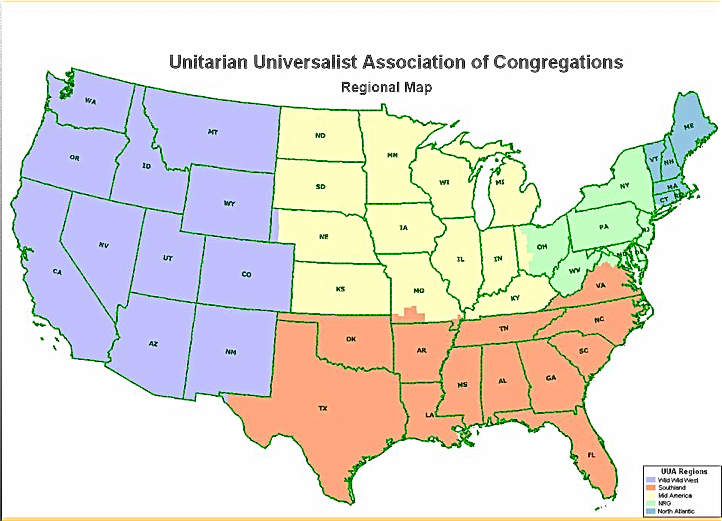
Laskowski said the UUA’s regionalization initiatives include a couple of instances of helping districts share staff. More importantly, the UUA assigns districts to one of five large geographical regions (see map below), and appoints one district executive to serve as the head district executive for that region (e.g., Ken Brown, district executive for the Pacific Southwest district, serves as the lead district executive for the far western region). Most importantly, the UUA Board will ask General Assembly to reduce the number of its members; currently, each district elects one board member, so a reduction in the number of board members would mean that would no longer be the case.

Regionalization Map
The current UUA regions

Susan Ritchie, Visiting Professor of Unitarian Universalist Heritage and Ministry at the Starr King School for the Ministry, offered historical perspectives on districts and regionalization. She offered a wealth of details which served to demonstrate that much of the current district governance structure within the UUA is a result of historical accidents. Laskowski expressed her opinion that the current organizational structure of the UUA does not work as well as it should, to the point where some kind of reorganization is necessary.

This webinar was offered to ministers of the Pacific Central District (PCD). A couple of webinar participants pointed out that one significant barrier to regionalization in the PCD will be the negative feelings that have resulted from the UUA’s decision to withdraw from co-employing Cilla Raughley, PCD District Executive; because of the way Raughley’s contract was written, that led to her termination. Laskowski reminded webinar participants that the Pacific Central District is a separate corporate entity, and that regionalization cannot be imposed by the UUA; it will be up to the PCD to decide whether or not to participate in any regionalization efforts that may happen.

A brief footnote: I attended the webinar on site at the Starr King School for Ministry, along with half a dozen other PCD ministers. After the webinar was over, some of us chatted briefly. Susan Ritchie said that it’s remarkable how many people continue to believe that UUA Board has some kind of plot to take over the districts, when that is clearly impossible and clearly is not on the Board’s long-range agenda. I said the UUA needed to pass out tin-foil hats. You know, to protect us all from the evil rays that the UUA is beaming into our heads to convince us to give up our individual identity and become part of the UUA Borg. In fact, I’m wearing mine now:

Tin Foil Hat
Me in my tin-foil hat. Look, you can see the evil rays coming in at me from the skylight behind me.

Repost: letter on PCD politics

The letter below was sent out by the executive committee of the Unitarian Universalist Ministers Association of the Pacific Central District (PCD-UUMA). The letter gives the “understanding” of the PCD-UUMA regarding the recent termination of Cilla Raughley as District Executives of the Pacific Central District. N.B.: This letter came with explicit permission to “post it on your blog, FaceBook page, tweet a link….”

I don’t really run a news blog, but there has been a dearth of official communication on this issue, and for that reason only I’m willing to repost this here. Please note that while I have received an apparently official statement via email from both the Pacific Central District Board and staff at the Unitarian Universalist Association, those email messages did not come with explicit permission to post them on a blog, and I’ve always had a policy of not posting email messages to this blog without explicit permission (see About this blog).

If you want to reply to this letter, please communicate directly with one of the signers. I have zero interest in moderating comments on someone else’s letter, so I’m going to shut off comments on this post. And before you complain that I’ve turned off comments, please remember that this blog is my hobby: I do it for fun, I do it in my spare time, and I get to choose to not moderate comments on something I didn’t write.


February 18, 2011

To our fellow Unitarian Universalists of the Pacific Central District,

As the members of the Executive Committee of the Pacific Central District (PCD) chapter of the Unitarian Universalist Minister’s Association, we write to share our understanding of Cilla Raughley’s departure from the position of District Executive.

Personnel practices require discretion and a respect for privacy; our response, therefore, probably will not satisfy everyone’s desire to be fully informed, but we believe it important to acknowledge our own influence on this action by the UUA. While we gratefully acknowledge the many long hours Cilla Raughley devoted to Unitarian Universalism in general and our district in particular, from the beginning of Cilla’s tenure there have been some strains in her relationships with some congregations and some ministers, as well as with the UUMA chapter specifically. We responded to these concerns, in part, by devoting numerous meetings, holding a day-long workshop, and creating a standing subcommittee to engage in mutual conversations with her to build on strengths and sort out difficulties.

At our Fall 2010 minister’s meeting and retreat in October, it became apparent to those attending that Cilla’s relationship with many ministers and congregations had become strained to the point that, from our perspective, she was no longer serving the whole effectively. In a congregation, if a minister is no longer effective with a large percentage of the congregation, the minister is no longer in good ministry with the whole congregation. Similarly, when the District Executive is no longer in right relationship with a large percentage of the congregations, something vital is no longer working. In our business meeting, we expressed with a 40-0 vote (5 abstaining) our lack of trust and confidence in Cilla’s leadership as District Executive, and we requested new leadership for our district.

We realize that many people have not been aware of our on-going efforts over the years to work these things out — it is the nature of such conversations that their content be confidential. But we want you to know that we have been working diligently and in good faith to reconcile these difficulties. Please understand that our decision to write this letter of non-support — a decision which did not come easily — came only after we had exhausted many other alternatives.

We first conveyed the results of our October 2010 vote to Cilla via a face-to-face meeting, and then via a letter to Cilla’s joint employers, the PCD Board and the UUA’s Congregational Life Department. We sent another letter a few days later, giving the names of 19 ministers who affirmed their support of the vote and were willing to relate their experiences and their reasons for voting as they did. The PCD Board’s Personnel Committee invited seven of these ministers to a meeting a few weeks later, to ask further questions and hear their concerns. The meeting lasted three and a half hours and was both frank and respectful.

The contracted employment agreement with the District Executive stipulates that if any of the three parties to the contract (the UUA, the PCD Board or the DE) withdraw their consent, the contract is ended. As we ministers are not one of the three parties to this contract, we have not been privy to the negotiations between the UUA and the PCD Board that resulted in the Feb. 11th end of Cilla’s employment. We have been in regular communication with the UUA and believe they have acted in good faith and in the best interests of the congregations in our district.

In a personnel matter of this nature, there will always be unanswered questions and often painful feelings. Many of the details must necessarily remain private, by law and out of respect for privacy. While we are not Cilla’s employers, you are welcome to contact those of us named below to discuss this matter further. The Rev. Dr. Terasa Cooley, Director of Congregational Life at the UUA and Cilla’s former UUA supervisor, is not legally permitted to comment on the details of Cilla’s departure but is glad to address your concerns about the systemic issues of this situation.

Our Pacific Central District has abundant strengths and enormous potential. The ministers in this district are completely committed to healing the strained and broken relationships that hinder this potential and to participating in the creation of a system of accountability and support that will bring renewed health and strength to our district.

We have confidence in our congregational leaders, in the PCD Board, in the UUA leadership, in our fellow ministers and religious educators. We believe we can and will move ahead together, and we pledge ourselves fully to that work. We look forward to continuing to serve in partnership with our district lay leaders on the PCD Growth Committee, the PCD Board, the planning committee for our District Assembly, at the Starr King School, and in our congregations.

Rev. Meghan Conrad Cefalu
President, PCD UUMA
Minister, Grass Valley

Rev. Christopher Bell
Vice-President, PCD-UUMA
Minister, Santa Rosa

Rev. Neal Anderson
Secretary, PCD UUMA
Minister, Reno

Rev. Roger Jones
Treasurer, PCD UUMA
Family Minister, Sacramento Society

Rev. Elizabeth Banks
Minister, Davis

Rev. Julia Older
Minister, Redwood City

Rev. Doug Kraft
Senior Minister, Sacramento Society

Rev. Grace Simons
Minister, Modesto

This entry was posted on Sunday, February 20th, 2011 at 11:52 am

One possible litmus test for “UU culture”

Wisconsin governor Scott Walker is in the middle of an attempt to cut the state budget, and at the moment he’s focusing on passage of a bill that will end collective bargaining for state employees. This action sparked protests and a Democratic walkout, and for four days now state workers and their supporters have basically taken over the Rotunda of the state capitol building.

As a Unitarian Universalist, I am fascinated by our religious response to this event. For anyone with a union connection, the events in Wisconsin will be seen as a watershed event — indeed, if Scott Walker’s bill passes, what’s happening in Wisconsin could be as important to union supporters as last year’s anti-immigration legislation in Arizona was to those working on immigration reform. But Unitarian Universalists have been basically ignoring what’s going on in Wisconsin; aside from a blog post by Patrick Murfin, I have seen no UU response.

It will be interesting to see how this develops. When Arizona passed anti-immigration legislation, Unitarian Universalists were furious, and a number went and got arrested in protests. However, Unitarian Universalists generally do not show much support when it comes to unions and worker’s rights. If Scott Walker’s bill passes (as it is likely to do), I do not think we will see a massive upwelling of support among Unitarian Universalists for collective bargaining rights.

This, I believe, reveals something about what Chris Walton and UU World magazine have been terming “Unitarian Universalist culture”. While Unitarian Universalists have a strong tendency to support politically liberal causes, they do not support all politically liberal causes equally, and unionism is one cause that gets little or limited support. Because of this, I predict that we will not be seeing prophetic statements from the president of the Unitarian Universalist Association condemning Scott Walker; I also predict that the Standing on the Side Of Love campaign will not start including love for union workers the way it included love for immigrants in the wake of Arizona.

I’m fascinated by the way Unitarian Universalists pick and choose among politically liberal causes, and I’d love to hear your thoughts on why this might be so. Specifically, why don’t we support unionism (with the exception of Cesar Chavez’s farmworkers union, but then maybe that was more about immigrants than about unions)? Is it because our strong strain of individualism is repelled by collective bargaining? Is it because so many of us are members of the managerial class that we tend to distrust unions? Or what? Maybe this will help better define what “UU culture” really is.