1700 years of Nicene Creed

According to tradition, the Nicene Creed turns 1,700 years old tomorrow.

I was born into a Unitarian family, and as old-school New England Unitarians, we didn’t think much about the Nicene Creed. I mean that literally, and not in a snide sense: obviously the Nicene Creed was never recited in our Unitarian church, but beyond that no one even talked about it; it just wasn’t something we ever thought about.

If we ever thought of the Nicene Creed, we thought about it in negative terms, much the same way Professor Francis Christie of Meadville Theological School wrote about it in 1910:

Today, I’d be less doctrinaire about the Nicene Creed. Even though the Nicene Creed’s trinitarian theology has never made much sense to me personally, I have friends for whom it remains a profoundly moving statement of theology (including some good Universalist friends). Part of being staunchly non-creedal is remaining open to the possibility of truth in creeds you don’t feel much emotional sympathy with. Yet Transcendentalist that I am, I continue to feel that Thoreau got it right when he wrote:

To use Theodore Parker’s terms, when it comes to religiou, there is that which is transient, and that which is permanent. Using these terms, Thoreau is talking about that which is permanent: “no time has elapsed since that divinity was revealed.” A creed, on the other hand, is a fallible human invention, and while it is useful for a time, it is nonetheless transient. The Nicene Creed has been useful to many Christians for 1,700 years, which is a very long time indeed; but it only points toward the divine, it is not itself divine. — At least, so sayeth my Unitarian forebears, with whom I entirely agree.

With those caveats, happy birthday to the Nicene Creed.

Noted with too much comment: the price of ignoring economic inequality

A couple of weeks ago on the Patriotic Millionaires site, Emily McCloskey posted a rant — sorry, a well-reasoned essay — laying out why, when Trump has a national approval rating of just 43%, the Democratic party approval rating is just 27%:

These days, it can seem as though the leadership of the Unitarian Universalist Association has basically adopted the Democratic party line. I especially notice this as someone who is proudly registered as an independent voter, someone whose political views (such as they are) could be called something like “Jesus socialism.” Not Christian socialism — most Christians in the world would not recognize me as Christian; and for my part, given what Christianity has become here in the United States, I don’t want to be a US Christian. Yet while there’s no way you can call me a Christian, I’ve been deeply influenced by the teachings and philosophy of Jesus. I think Bernard Loomer got it right when he argued that Jesus should be recognized for a major contribution to Western thought, his conception of the universe which places the interdependent web of all existence at the center of everything. Sometimes Jesus called that interdependent web “the Kingdom of Heaven,” sometimes maybe he refers to it obliquely as “God,” sometimes he didn’t really give it a name. However you name it, once you acknowledge the centrality of the interdependent web of all existence, the first thing you’re going to notice is….

Quiz time: If the interdependent web of all existence is your central reality, as it was for Jesus, what’s the first thing you’re going to notice?

Nope, not environmentalism. The first thing Jesus noticed was human beings living in poverty.

Environmentalism is not a bad guess. It’s true that we’re connected to all living things, and Jesus did indeed speak about how his God would know when even a small insignificant animal like a sparrow dies. So we should be concerned with all living beings, and indeed with the non-living world (air, rocks, and so on) as well.

But mostly, it appears that Jesus focused on poor people. In the fragmentary records we have of Jesus’s teachings, sparrows are mentioned once, but he talks about poor people any number of times. Unfortunately, Jesus’s thinking and philosophy have been somewhat obscured by later religiosity, and even atheists tend to think of Jesus as somehow divine. When you think of Jesus as a human being, as a human animal (Homo sapiens), however, then it makes sense that in his widening circles of concern, he begins with human beings.

Then when Jesus looks at what damages human animals, he acknowledges the damage done by what we now call racism (this is the point of the story of the Good Samaritan, as Dr. King made clear), and sexism, and all the isms we like to talk about these days. But Jesus starts with people who are poor — people who don’t have enough to eat, people who struggle to find the basic necessities of shelter and physical safety. So reducing poverty is going to be the starting point for anyone who wants to follow Jesus’s moral example. (Both Pope Francis and now Pope Leo get this; Pope Leo’s first official “exhortation” calls on Catholics to care for the poor.)

Dr. William J. Barber II, one of the few public US Christians whom I respect, has pointed out that poverty cuts across the lines of race, sexual orientation, and all the other isms. Barber, who is Black, reminds us that while it’s true that a greater percentage of Black people than White people live in poverty in the US, in terms of absolute numbers there are more White people than Black people living in poverty. As a result, Barber says, we can’t fall into the trap of believing the myth that poverty in the US is a Black problem — poverty is a White problem, a Black problem, and a problem for every racial group.

This brings me back to the Unitarian Universalist Association (UUA). On the national level, Unitarian Universalism does not spend much time worrying about poverty. When you look through the denominational magazine, UUWorld, you will find lots of articles about environmentalism, LGBTQIA+ rights, anti-racism initiatives, feminism, and other worthy causes. I’m glad that the UUA promotes anti-racism, feminism, LGBTQIA+ rights, environmentalism, and so on, and I’m proud to be associated with those causes. But I rarely see articles in UUWorld about poverty. Looking beyond the denominational magazine, here’s another example: at the most recent General Assembly, the annual meeting of the UUA, delegates chose between three Congregational Study Action Issues (CSAIs) to serve as a focus of our social justice efforts. Of the three, only one CSAI touched even remotely on poverty — the CSAI on housing justice — and, not surprisingly, it did not win. I’m glad housing justice made it on the ballot, but I’m not surprised that it did not win.

My take on all this is that the UUA has the same problem as the Democratic party. Like the Democratic party, the UUA supports many worthy causes and initiatives. But, like the Democratic party, the UUA does not spend much time or energy on addressing poverty. Yet William J. Barber II points out that by some measures, nearly half of all US residents are poor (where poor is defined as: a household for which one major expense, e.g. a $1000 car repair, would push that household over the economic edge). Nearly half the US is poor. That’s just astonishing in a so-called First World country. That’s an issue that deserves our full attention.

I’m one of the 73% of US residents who don’t give their full approval to the Democratic party. Unfortunately, I’m starting to feel that way about the UUA. I’m seeing poverty everywhere in the US. Even here in Cohasset, Mass., a supposedly wealthy town, I’m seeing people with their economic backs to the wall. They range from a few people who are homeless to quite a few people who are just one unexpected expense away from economic disaster.

So I’ll repeat that advice that Emily McCloskey of Patriotic Millionaires gave to the Democratic party — but I’m going to direct that advice to Unitarian Universalists (UUs) in the US. We US UUs need to “adopt an economic populist platform for people to rally around [with] policies that are simple, straightforward, and effective at reducing inequality.” Or to put it more bluntly: US UUs, we need to stop ignoring poor people.

Christian Socialism in 1935

I’ve been reading Capitalism and Its Critics by John Cassidy. According to Cassidy, Karl Polanyi criticized capitalism as being essentially undemocratic. After watching the rise of fascism in Europe, in 1935 Polyani wrote:” The mutual incompatibility of Democracy and Capitalism is almost generally accepted today as the background of the social crisis of our time.” Why? Because “only an authoritative State can deal with the contradictions inherent in Capitalism.” (Quoted by Cassidy, p. 283, originally from Polyani’s “The Essence of Fascism.”)

There was a religious side to this. Polyani was a Christian Socialist. Today, Christian Socialism is a concept that would probably cause the heads of many U.S. Christians to explode. (It would also probably cause the heads of Bernie Sanders and the Democratic Socialists of America to explode, but I digress.) Yet Christian Socialism used to be a widely-known option that boasted adherents ranging from Dorothy Day (a Catholic) to Adin Ballou (a Universalist turned Unitarian).

From Polyani’s viewpoint as a Christian Socialist, the rise of fascism not only threatened socialism, it also threatened Christianity. In that same 1935 essay, Polyani wrote: “Victorious Fascism is not only the downfall of the Socialist Movement; it is the end of Christianity in all but its most debased forms.” As a theological point, I think this is true — when people allow a central political authority to make moral choices for them, you’re going to see an attenuation of their individual moral capacity, which will similarly attenuate their religious capabilities.

AI and UU sermons

Should Unitarian Universalists use so-called AI (Large Language Models, or LLM) to write sermons?

Since Unitarian Universalists don’t have a dogma to which we must adhere, there will be many answers to this question. Here are my answers:

I/ Adverse environmental impact of LLMs

Answer: No. The environmental cost of LLMs is too great.

First, we all know about the huge carbon footprint of LLMs. And the more complex the answer required from the LLM, the more carbon that is emitted. Deborah Prichner, in a June 19, 2025, Science News article on the Frontiers website, sums up the impact by quoting someone who researched energy use of LLMs:

“‘The environmental impact of questioning trained LLMs is strongly determined by their reasoning approach, with explicit reasoning processes significantly driving up energy consumption and carbon emissions,’ said … Maximilian Dauner, a researcher at Hochschule München University of Applied Sciences…. ‘We found that reasoning-enabled models produced up to 50 times more CO2 emissions than concise response models.’”

Thus, not only do LLMs have a big carbon footprint, but handling something as complex as a sermon could result in a carbon impact 50 times greater than the lowest LLM carbon footprint.

Second, the data centers running LLMs use a tremendous amount of fresh water. In their paper “Making AI Less ‘Thirsty’: Uncovering and Addressing the Secret Water Footprint of AI Models,” Pengfei Li (UC Riverside), Dr. Jianyi Yang (U Houston), Dr. Mohammad Atiqul Islam (U Texas Arlington), and Dr. Shaolei Ren (UC Riverside) state:

“The growing carbon footprint of artificial intelligence (AI) has been undergoing public scrutiny. Nonetheless, the equally important water (withdrawal and consumption) footprint of AI has largely remained under the radar. For example, training the GPT-3 language model in Microsoft’s state-of-the-art U.S. data centers can directly evaporate 700,000 liters of clean freshwater, but such information has been kept a secret. More critically, the global AI demand is projected to account for 4.2 – 6.6 billion cubic meters of water withdrawal in 2027, which is more than the total annual water withdrawal of … half of the United Kingdom.”

Third, on 1 May 2025, IEEE Spectrum reported that “AI data centers” cause serious air pollution. The article, titled “We Need to Talk About AI’s Impact on Public Health: Data-center pollution is linked to asthma, heart attacks, and more,” raises several concerns. The authors write:

“The power plants and backup generators needed to keep data centers working generate harmful air pollutants, such as fine particulate matter and nitrogen oxides (NOx). These pollutants take an immediate toll on human health, triggering asthma symptoms, heart attacks, and even cognitive decline.”

In sum: Because my religious commitments call on me to aim for a lower ecological impact, the environmental impact of LLMs alone is enough to stop me from using them to write sermons.

II/ Sermons as human conversations

Answer: No. I feel that sermons should be the result of human interaction.

You see, for me, a sermon should arise from the spiritual and religious conversations that people are having in a specific congregation or community. As a minister, I try to listen hard to what people in the congregation are saying. Some of what I do in a sermon is to reflect back to the congregation what I’m hearing people talk about. At present, a LLM cannot access the conversations that are going on in my congregation — a LLM can’t know that P— made this profound observation about their experience of aging, that A— asked this deep question about the reality of the death of a family member, that C— made a breakthrough in finding a life direction, that J— took this remarkable photograph of a coastal wetland. Some or all of those things affect the direction of a sermon.

Mind you, this is not true for all religions. Deena Prichep, in a 21 July 2025 article on Religion News Service titled “Are AI sermons ethical? Clergy consider where to draw the line,” states that “The goal of a sermon is to tell a story that can break open the hearts of people to a holy message.” In other words, according to Prichep, for some religions the role of the preacher is to cause other people to accept their holy message. Prichep quotes Christian pastor Naomi Sease Carriker as saying: “Why not, why can’t, and why wouldn’t the Holy Spirit work through AI?” I can see how this would be consistent with certain strains of Christianity — and with certain strains of Unitarian Universalism, for that matter, where the important thing is some abstract message that somehow transcends human affairs.

But that’s not my religion. My religion centers on the community I’m a part of. Yes, there is a transcendent truth that we can access — but as a clergyperson, I don’t have some special access to that transcendent truth. Instead, truth is something that we, as a community of inquirers, gradually approach together. Any single individual is fallible, and won’t be able to see the whole truth — that’s why it’s important to understand this as a community conversation.

As a clergyperson, one thing I can do is to add other voices to the conversation, voices that we don’t have in our little local community. So in a sermon that’s trying to help us move towards truth, I might bring in William R. Jones, Imaoka Shinichiro, or Margaret Fuller (to name just a few Unitarian Universalist voices). Or I might quote from one of the sacred scriptures — i.e., from one of the sources of wisdom traditions — from around the world. Now it is true that maybe a LLM could save me a little time in coming up with some other voices; but given the huge environmental costs, it seems silly to save a small amount of time by using a LLM.

III/ Biases built into LLMs

Answer: No, because of hidden biases.

LLMs are algorithms trained on digitized data which has been input into them. For a LLM, the digitized data is mostly in the form of text. But we know that certain kinds of authors are going to be under-represented in that digitized data: women, non-Whites, working class people, LGBTQ people, etc. The resulting biases can be subtle, but are nonetheless real.

As a Universalist, I am convinced that all persons are equally worthy. I have plenty of biases of my own, biases that can keep me from seeing that all persons are equally worthy of love — but at least if my sermons are affected by my own biases, my community can successfully challenge me about my biases. If I use a LLM model to write a sermon, a model that’s riddled with biases that I’m not really aware of, that makes it harder for my community to help me rid my sermons of my biases.


IV/ Final answer: No

Would I use a LLM to write a sermon?

No. It goes against too many things I stand for.

Should you use a LLM to write your sermons?

I ‘m not going to answer that question for you. Nor should you ask a LLM model to answer that question for you. We all have to learn how to be ourselves, and to live our own lives. Once we start asking others — whether we’re asking LLMs or other authority figures — to answer big questions for us, then we’re well on the road to authoritarianism.

Come to think of it, that’s where we are right now — on the road to authoritarianism. And that’s a road I choose not to follow, thank you very much.

Noted without comment

From “The American Taboo on Socialism” by Robert N. Bellah in The Broken Covenant: American Civil Religion in Time of Trial, 2nd Edition (Chicago: Univ. Chicago Press, 1992), chapter 5, pp. 112-138:

Another point of view

My friend Rabbi Michael is a member of the South Jersey Board of Rabbis and Cantors. They just issued a statement about the Trump administration’s proposal to turn Gaza into a luxury condo development. Not surprisingly, they oppose it on several reasonable grounds. But what I especially like is that they call out the Trump proposal as a kind of ethnic cleansing — something that they are adamantly opposed to. Here’s a PDF of their statement.

As politicians spin off into fantasy worlds, it’s nice to see how religious folk can help keep us grounded in reality. Theology has a bad name amongst the elite classes these days, but training in theology and philosophy includes both training in analyzing texts and discourse, and training in moral and ethical analysis. The latter training is especially important — and seems to be almost entirely lacking amongst the elite classes and the politicians these days.

Critiquing the concept of “White privilege”

I’ve long been uncomfortable with the concept of “White privilege,” mostly because I feel that the concept doesn’t really tell White people why they should give up their White privilege. I envision a conversation that goes something like this: “Hey, check your White privilege.” [reply spoken externally] “Oh, right, sorry!” … [reply spoken internally] ((Wow, I got White privilege? that sounds pretty good, I’m gonna hang on to it.))

That’s not a serious critique of the concept of White privilege. It’s just this feeling of discomfort that I have. Yet the feeling is strong enough that I find myself not wanting to use the phrase “White privilege,” due to some kind of nameless fear that it’s just going to reinforce the behavior in us White people that the phrase is supposed to put an end to.

In an essay titled “How ‘White Privilege’ Obscures Black Vulnerability,” Mukasa Mubirumusoke, a professor at Claremont McKenna College, provides a more serious critique of the shortcomings of the concept. Mubirumusoke ends his essay with this rhetorical question:

(Parenthetical note: The essay appears on the Public Seminar website, which I hadn’t seen before. Looks like a lot of good stuff there.)

But wait, there’s more. In a recent post on the American Philosophical Association blog, Lewis Gordon offers a constructive critique of Mubirumusoke’s critique. SCroll way down to find it, and (as I understand it) Gordon’s basic point is that Mubirumusoke’s critique is based on Afropessimism, an intellectual approach that Gordon finds unsatisfactory.

In the course of his longer discussion of Mubirumusoke, Gordon asks a question that may provide a better grounding for a critique of “White privilege”:

Gordon’s philosophically nuanced critique of Mubirumusoke takes the critique of “White privilege” to a whole other level. It’s a level above my pay grade, to be honest. But let’s be clear, Gordon is not some “anti-Woke” political conservative, like the ones who dominate U.S. politics these days. Trump and company cannot take comfort from this philosophical conversation. By the same token, political liberals who get uncomfortable when their White privilege is called out aren’t going to find much comfort in Gordon’s critique, either. Gordon even goes so far as to criticize that idol of liberalism, the individual:

Whoa. Take that, Ralph Waldo Emerson. Gordon is striking at the root of our theological commitment to “the individual.” Because — following Emerson — we Unitarian Universalists really do have this tendency to treat the self as a god. Which is idolatry. And we are fundamentally opposed to idolatry.

Well, as I say, all this is well above my pay grade. But I’d also say both these essays are worth reading. Every time I read Lewis Gordon, I find myself getting insight into problems that have been bothering me. And based on what Gordon says about Mubirumusoke, he might be another one of those thinkers….

Online resource for practical theology

Practical Theology Hub is a website that says it’s “a space for anyone with an interest in practical theology to share their reflections and explore new ideas.” It’s “not an academic website” but rather publishes short articles from partitioners, academics, students, and “retirees.”

Here are some of the titles of recent articles that caught my eye: “Growing closer to God through stained-glass windows: A dyslexic autistic perspective” (Christianity); “Neoliberalism, Social Inequality, and Christianity of Liberation” (Christian); “Food and interdependence: Responsibility in food donation” (Buddhist); “Avatar Discipleship – Who am I engaging with the avatar or the person?” (Christian); “My Friend, Siddhartha” (Indic religions); “Two Peoples Living in This Land” (Judaism); “Armed Resistance, Islam, and the Limits of Secular Approaches” (Islam).

Jacob Flint’s history sermons

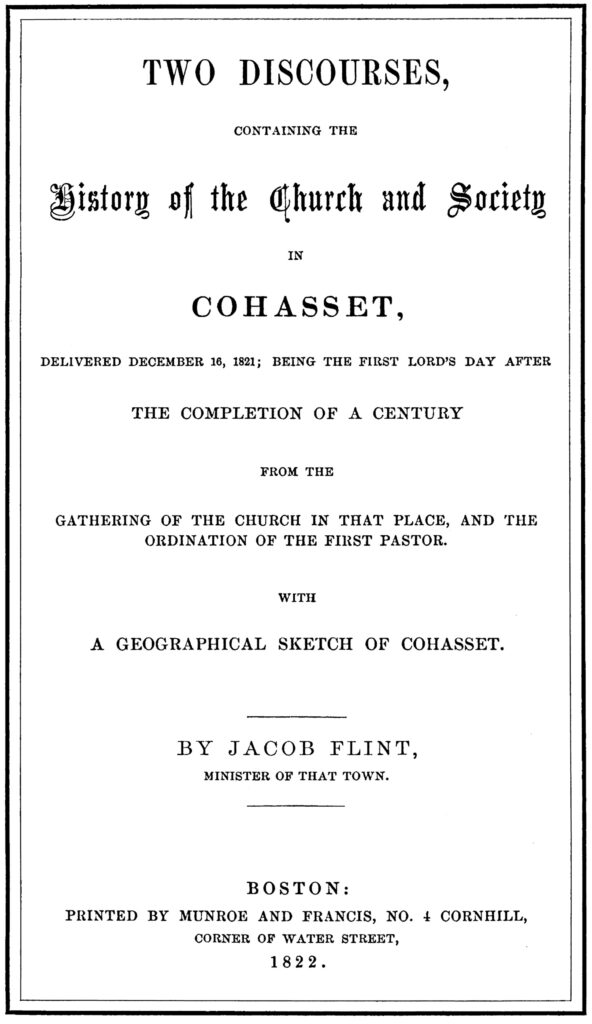
Below you’ll find the text of two sermons (with some annotations) published in 1822 by Rev. Jacob Flint of Cohasset, Massachusetts. While these sermons might appear to be of little interest to anyone except students of Cohasset history, they also contain some interesting theological content for those interested in the battles between the Unitarians and Trinitarians in 1820s Massachusetts.

Two years after Flint gave these two sermons, in December of 1823, he preached two sermons stating in no uncertain terms that trinitarian beliefs were supported neither by the Bible nor by human reason. The 1823 sermons precipitated a split in the Cohasset congregation. In the present sermons, preached in December of 1821, Flint claims that a couple of his predecessors were Unitarians in thought if not in name; in addition, he makes it clear that he agrees with his allegedly Unitarian predecessors. Anyone who heard the 1821 sermons could not have been surprised by the 1823 sermons.

Interestingly, the second of the 1821 sermons includes a long footnote in which Flint carefully outlines how the Cohasset congregation had lived in unanimity for most of a century. He must have been aware of the trinitarian leanings of some of his congregants; was this his way of trying to keep them from splitting the congregation?

I also noticed the way Flint erases the Indians from his account of Cohasset history, confining any mention of them to a short section labelled “Curiosities.” He never mentions how there were Indians who were members of the church in the mid-18th century. As it happens, I’ve just been reading Jean O’Brien’s book Firsting and Lasting: Writing Indians out of Existence in New England (Univ. of Minnesota: 2010), which examines the ways in which the authors of local histories in New England created the myth of the “vanishing Indian.” Flint’s sermons are early examples of that myth.

So there’s more going on in these two sermons than just boring local history!

Notes on the text: OCR-generated text found online was checked against a physical copy of the sermons in the archives of First Parish of Cohasset, and a number of corrections were made. Footnotes in the original have been numbered consecutively, with numbers enclosed in square brackets, and moved to the end of each section (Discourse I, Discourse II, and Geographical Sketch). A few editorial notes have been added, enclosed in square brackets. Pages breaks in the original have been indicated by enclosing “page X” in square brackets. One or two long quotations have been placed in separate paragraphs.

The 1823 sermons: Earlier this year, I put Flint’s 1823 Unitarian sermons (the ones which precipitated the split with Second Congregational Church) on this blog: the first sermonthe second sermon.

Facsimile of the title page; full text appears below.
Continue reading “Jacob Flint’s history sermons”

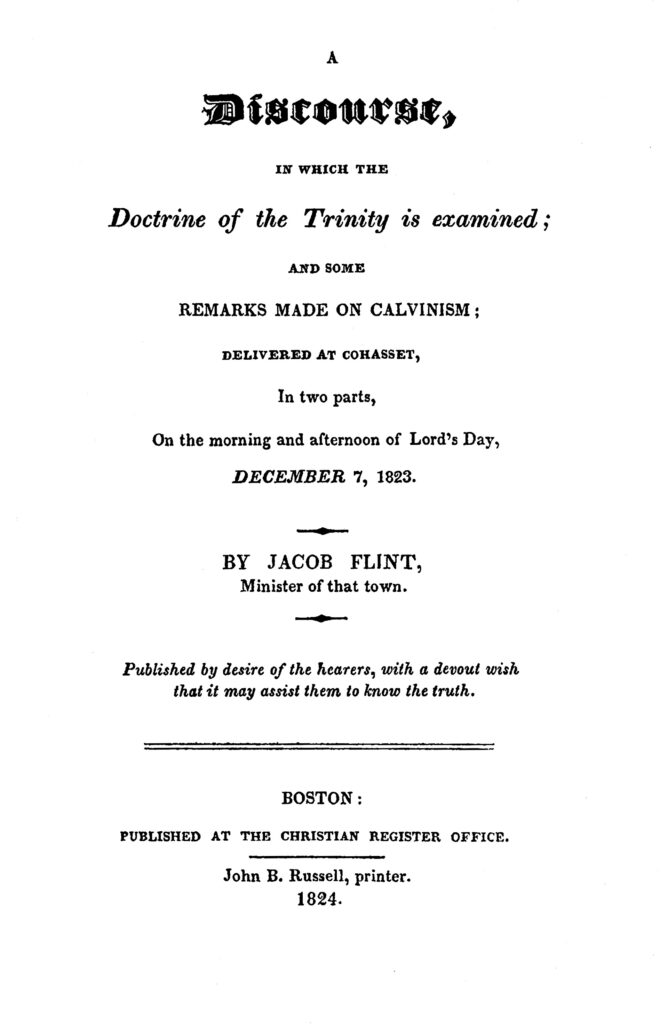
The sermon that split a congregation

Back in 1823, Rev. Jacob Flint was the minister of the one church that then existed in Cohasset, Mass. He had been ordained in Cohasset in 1798. He was fairly liberal to begin with, but over the quarter of a century he served the congregation he had become an outright Unitarian. So on December 7, Flint decided to preach a sermon on Unitarianism.

I can imagine the scene. He preached this sermon in the Meetinghouse that we still use today, but the old box pews were still in use in 1823. Wood stoves had been put in the Meetinghouse for the first time the previous year, in 1822, so at least people would have been relatively warm for the two lengthy sermons that were delivered each week. Flint would have climbed up into the high pulpit, suspended halfway between the main floor and the gallery. Sadly, he was not a good speaker — John Adams wrote that “his elocution is so languid and drawling that it does great injustice to his composition” (John Adams, Diary, 19 Sept. 1830).

Despite his poor elocution, at least some people in the congregation must have been paying close attention to this day-long Unitarian sermon. Within months the Trinitarians had left in a body to start building their own church just a hundred feet away across the town common. I can just imagine how angry the Trinitarians were after the morning service on December 7, 1823, and how little they looked forward to the second sermon in the afternoon when they would hear even more about how wrong the doctrine of the Trinity was. How they must have steamed and stewed as Flint preached, especially since his preaching seems specially designed to infuriate anyone with Trinitarian leanings.

But this was probably to be expected of Flint, who was an uncompromising man. Years later, Capt. Charles Tyng remembered a time from his boyhood when he had to live in Flint’s house:

“…I was then put under the charge of the Rev. Dr. Jacob Flint, the minister at Cohasset. I soon found that the change was from the frying pan to the fire. Doctor Flint was a large man with a forbidding countenance. He was morose & cross in his family, which consisted of his wife, three sons, and an infant daughter…. I dreaded Sunday, the Dr. was so very strict, made us boys sit in the house, reading our Bibles, or learning hymns…. Dr. Flint was a tyrannical man, and very severe, particularly with his own children. Hardly a day passed without his whipping them. Us Boston boys did not get it so often, although I often felt the effects of the rod. He probably was deterred from whipping those who boarded with him, as his disposition would have induced him, had he not thought our parents would take us away.” (Charles Tyng, Before the Wind: The Memoir of an American Sea Captain, 1808-1833, chapter 1.)

With that preface, here’s the first part of Flint’s divisive Unitarian sermon of December 7, 1823:

Image of the original title page
Continue reading “The sermon that split a congregation”