REA 2013 conference: Marshall Ganz

Marshall Ganz was the main speaker at the first plenary session of the Religious Education Association annual conference. Ganz is a senior lecturer in public policy at the Kennedy School of Government, Harvard University. Ganz dropped out of college in 1964 to work with the Student Nonviolent Coordinating Committee (SNCC) during the Mississippi Summer project; following his time with SNCC he worked with Cesar Chavez for 18 years.

In order to talk about leadership and organizing, Ganz began by quoting Rabbi Hillel, from the Pirkei Avot: “Hillel used to say: If I am not for myself who will be for me? Yet, if I am for myself only, what am I? And if not now, when?” (Avot 1:14)

Ganz pointed out that the first of these questions is not about being selfish, but about caring for oneself. Hillel’s second question forces us to realize that we are inevitably wrapped up with others. And the third question prompts us to find a middle way between “jumping off a cliff” on the one hand, and getting ensnared by endless preparation on the other hand. Ganz said that these are questions, not answers — so Hillel was not urging us to assert control in order to avoid uncertainty, but rather to find purpose through “embracing uncertainty.”

Thus leadership is a set of practices in which the leader accepts responsibility, and enables others to achieve a purpose under conditions of uncertainty; leadership is also a form of social interaction. So leadership is less about a person or a position of authority than it is about purpose and real-world work that needs to be done. Continue reading “REA 2013 conference: Marshall Ganz”

REA 2013 conference: pre-conference trip to DSNI

The pre-conference session for this year’s Religious Education Association was a trip to the Dudley Street Neighborhood Initiative (DSNI) in Roxbury (Roxbury is a section of Boston). DSNI is a non-profit devoted to community-based planning and organization.

During our trip to DSNI, we learned that the Dudley area is poor — average annual income is about $12,300 — and its residents are primarily people of color, with about a third of the population 19 or younger. It’s also just two miles from the heart of downtown Boston, which says to me that it’s an area that’s ripe for gentrification (just as West Oakland is now being gentrified by young white people moving away from the high rents of San Francisco, forcing long time minority residents to move out).

Starting in the 1980s, the Dudley area was hit by a rash of arson, which resulted in large tracts of land left vacant. DSNI managed to get power of eminent domain within the limits of its neighborhood, and over the years they have acquired 32 acres of land which has been place in a community land trust. They then engaged in a community planning process, and built the kind of housing the community members really wanted. The houses are purchased by the residents, but the land continues to be owned by DSNI, in order to keep the housing affordable and to prevent gentrification that would force out long-time residents.

But what’s really remarkable about DSNI, and the real reason we made a trip to see what they’re doing, is that they reserve four seats on their 35-member Board of Directors for youth aged 15-17. They also have a Youth Council which engages youth in community organizing, and they give substantial power to the youth to plan projects, manage budgets, etc. Youth are mentored into leadership by adult community members, and the whole organization supports them as they mature skills as leaders. Significantly, these youth stay with DSNI as adults, either as volunteers or paid staff, and a couple of their former youth have moved into wider city or state politics as a result of their DSNI experience.

(Parenthetical note: As I was hearing about the way DSNI does youth empowerment, I couldn’t help thinking about what is called youth empowerment in Unitarian Universalist circles. DSNI youth are empowered to work in the wider community, working towards sustainable economic development, working for things like better housing and food security; the youth have an outward focus, tackling real-world problems. Unitarian Universalist youth ministry “empowers” youth to run weekend-long events for themselves; the youth wind up having an inward focus, where they support each other. Of course, the same thing happens in many adult Unitarian Universalist communities and congregations: we also maintain an inward focus, training our adult leaders mostly to run programs for ourselves.)

It was a good trip — hearing DSNI staffer May Louie speak about what they do and how they do it, seeing their accomplishments, getting the faith-based perspective of Father Walter Waldron, pastor of nearby Saint Patrick’s Parish in Roxbury. I just wish I had been able to learn more about how they mentor and empower youth to do real-world community organizing and project management.

———

After spending six hours learning about and visiting DSNI, six of us went out to dinner in downtown Waltham. We all know some of the best conversations at conferences take place in the informal interactions you have with other conferees; and tonight’s dinner conversations were both inspiring and helpful. Charles Chesnavage, who teaches at a Catholic high school in New York City, told us about his interfaith work in Yonkers, including regular meetings with Christian, Jewish, and Muslim interfaith partners. We asked the Catholics at the table what they thought of the new pope. Someone whose name I didn’t catch (the restaurant was noisy) heard I was a Unitarian and said Sophia Lyon Fahs was one of her inspirations, and we talked about the need for some kind of lab school for religious education, along the lines of what Fahs did at Union Theological School in the 1920s.

Perhaps most interesting moment from my point of view was listening to Leslie A. Long of Oklahoma City University talking about her work training lay youth workers for small congregations. She emphasized the need to train and retain older adults who will stay with youth work for the long haul, helping teens build intergenerational connections. (I couldn’t help but notice similarities between her approach and the approach of the Dudley Street Neighborhood Initiative.) I was also struck by her comment that research shows what youth are looking for is intergenerational connection and mentoring, while the usual model of youth ministry that looks like fun and games and parties is failing both youth and congregations.

That’s just the pre-conference session; the real conference starts tomorrow — and already I have learned enough to justify taking this time away from my local congregation.

How to be a peace activist

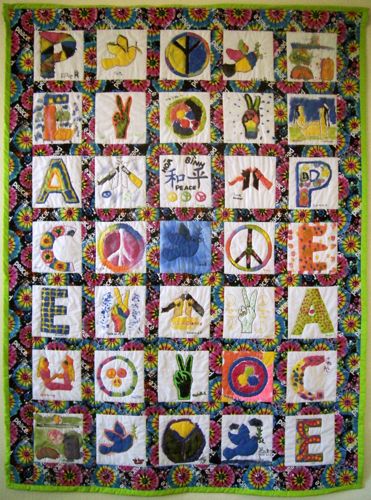
The fall, 2013, issue of Geez magazine is all about being a peace activist, and there’s a short eight-paragraph piece by James Wilt on the Peace Experiments program we did in Sunday school in our church (“Playing with peace,” p. 68). There’s even a nice picture of the peace quilt that the kids made under the direction of quilter Kathy Swartz. (Unfortunately, this short piece didn’t make it up on the Geez Web site so I can’t link to it from here.)

I don’t think we’re going to put this article up on the church bulletin board where kids can read it, only because I’m quoted saying: “Dan Harper, a long-time peace activist in California, calls the idea of of getting more conservative with age ‘bullshit.'” It’s a true statement, I’m not ashamed of saying it, but eight year olds don’t need to know I said it.

But it is true; I find myself getting more radical with age. The older I get, the more I realize how foolish and unproductive and morally bankrupt war is; the more I feel we have to protect our kids from war and violence. And increasingly I think most radical thing we can do is turn our kids into peaceniks. As James Wilt puts it in the article: “Now, however, instead of going to peace rallies, [Harper] hangs out with children. ‘I really think it’s the way to change the world,’ he told Geez….”

So — you want to be a peace activist? Go teach Sunday school.

Peace Quilt

A summary of the curriculum we used for Peace Experiments in online here. If you want to run Peace Experiments in your congregation, feel free to contact me for ideas.

UNCO13 — last thoughts

A few last thoughts and observations from UNCO13 West:

— The worship services were very low church. UNCO worship reminded me a little bit of the very best youth and young adult worship in which I have participated in Unitarian Universalist circles — highly participatory, lots of singing and guitars and drums, often mildly chaotic and planned at the last minute — but UNCO worship services were led with more skill, and with far more theological depth.

— The worshipping community of UNCO welcomed kids wholeheartedly. Kids could play on the floor, or sit on parent laps, or vocalize, and no one minded. The service was not dumbed-down to kid level; there were no “moments for children,” no talking down to children during the sermon. Everyone accepted, with love, the autistic five year old who needed to run around (and occasionally be corralled by his parents) during the services. Yes, it could get a little chaotic, but between the love in the community, and the seriousness of purpose, it all worked out. I want to belong to a church that worships like this every week.

— Online connections and face-to-face connections were nicely woven together. I liked watching the Twitter feed which was projected at the front of the room during the plenary sessions; sure it got silly at times, but it also allowed for a much higher level of interaction than just having one person talking at a time. I also liked the combination of low-church and high-tech. (By the way, Megan told me that finding a location for UNCO is difficult because of the heavy technology demands — fast Internet service, plenty of bandwidth, lots of IP addresses, etc.)

— The unconference format worked well. Of course it worked well: most of the attendees at UNCO are clergy with advanced degrees, and with tons of experience in widely varied settings and ministries. Too often, I have seen clergy conferences built around expensive “experts,” who only give one approach to an issue, and who may in fact be less expert than one or more of the participants. (Which makes me want to say: Humility may be a virtue, but underestimating the expertise of oneself and one’s professional colleagues is foolish.)

— The unconference format does away with that jockeying for position that you see when planning traditional clergy conferences. In traditional clergy conferences, there can only be a few presenters; plan a traditional clergy conference, and watch as clergy jockey for position to try to land a precious slot as one of the presenters, or to try to get their favored “expert” called in as a presenter. The result: politics rather than relevance decides what gets presented; important viewpoints get left out; and the expertise of the participants is deprecated. (Alas, Unitarian Universalist clergy seem to prefer their outside experts and the associated hierarchical approach to clergy conferences; and I think they prefer their methodological rigidity, too;— don’t expect Unitarian Universalist clergy unconferences any time soon.)

— And finally, this Twitter exchange from two UNCO participants made the whole thing worthwhile: “Talking worship styles. That whole debate is a boomer debate, not a question for young adults.” (David L. Hansen) “Exactly. And it’s not helping to project it onto the Gen-X and Millennial generations.” (Anna Woofenden)


Back to the first post in the series


BlogOct2413

Megan took this photo of me racing B—— through the labyrinth during Kid UNCO. He won. (What can I say? Four year olds can turn corners better than adults.)

UNCO13 pt. 3

UNCO is an unconference. According to Carol Howard Merritt, one of the organizers of UNCO 13 West, here’s how the UNCO process goes:

“• First step — Create a graffiti wall. We write down all of the cares/concerns/dreams/ideas that we carry into the conference.
• Second step — Host discussions on particular topics.
• Third step — If there’s a particular project that needs further fleshing out, then we hold a planning session to decide who/what/how it’s going to happen.
• Fourth step — Report back to the group.
• Fifth step — Stay in contact with one another, encouraging one another throughout the year.”

So a brief worship service this morning, we were all asked to write on the graffiti wall, and within half an hour we had generated a list of half a dozen discussion topics for each of the four hour-long breakout sessions — and had identified a facilitator for each discussion session. In addition to the discussions sessions, Megan also needed an assistant each hour to help out with Kid UNCO, the children’s program. I decided to spend the first two hours with Kid UNCO.

Since we’re meeting during the week, most older kids had to be in school. And kids have to be toilet trained to attend Kid UNCO. So we had just two boys, Adrian and Burke (not their real names to protect their privacy). Adrian is 5 years old, likes to play horsie with adults, and is autistic; Burke is 4 years old, brought two Dinobots with him, and showed us he can count to 100.

Megan talked about the story of Noah while she and Burke (mostly Burke) drew a mural of the Noah story. Adrian didn’t feel like drawing, although he did enjoy playing with the crayons. Since the kids were just 4 and 5, their attention wandered, and I was impressed by the way Megan kept bringing us back to the story, and back to the mural. I mostly work with older kids — school-age children and up — so it was helpful for me to spend two hours with a four year old. It was also really helpful for me to spend two hours with a child with autism. It was perhaps the best two hours of RE professional development I’ve done since Ferry Beach Religious Education Week last summer.

BlogOct2213

Above is the Noah mural Kid UNCO made this morning. The rainbow is at right; lots of water and an ark in the middle.

More on the afternoon sessions in part 4….

A letter about learning and experience

Dear Mark,

In my last letter, I outlined a possible theology that might relate to religious education, and religious experience more broadly. In this letter, I’m going to start with a description of some real-life religious education, and then get into some thoughts about education and experience.


A couple of Sundays ago, I was helping out with our summer Sunday school program. We had a dozen kids ranging in age from not-quite-five to thirteen, as well as four adults. Our plan was to walk over to Mitchell Park, a city park right behind our congregation’s campus, play on the play structures, have snack, and return. This was in service of the first of our four big educational goals: we want children to have fun and feel they are part of a community.

On the walk to the park, Edie, our lead teacher, set off in front and the rest of us followed. We got to the nearest set of play structures in the park, and some children went to the swing set, while others climbed on the oddly shaped climbing structure, and a couple of children stayed next to a large tree. Mitsuru, who is about 8, climbed up the tree a few feet, and when he was close to my height, we chatted for a while until he got bored and climbed back down. (1) Pretty soon all the children were bored, and we all decided to go over to the farther play area, which has many more things to play on and is much more fun.

As we walked over, I fell into conversation with Rose, who is thirteen. Some of the little kids were talking about sports so I asked Rose if she was involved in any sport. She said, “Only if you count horseback riding as a sport.” I said that I did, and that my older sister was an avid horsewoman. She told me how she gets to ride when she visits a cousin who lives far away, but has no place to ride nearby. I told her about a college that has horses, and lets you take horseback riding for physical education credit. And by this time we were at the farther play area.

(By now you might be saying: What a long description of seemingly trivial conversations! But it is experiences of these seemingly trivial conversations that build networks of relationships between people, that help us fulfill our first big educational goal — to have fun and build community. In order to reach this goal, we are not using root-tree model of learning here, we’re using a rhizome model — we’re not trying to nurture one deep tap root, we’re trying to nurture lots on interconnections.) Continue reading “A letter about learning and experience”

Ron Hargis, an obscure religious educator

The story of Ron Hargis, the minister of religious education at the Unitarian Universalist Church of Palo Alto (then called the Palo Alto Unitarian Church) from 1971-1977, offers an interesting insight into the changes facing congregations in the 1970s, particularly the decline in the number of children, and the emergence of new educational approaches.

Ronald Irving Hargis was born on May 26, 1924, in Battle Creek, Michigan. His father was Gerald C. Hargis (b. Aug. 18, 1896 in Des Moines, Iowa), and his mother was Marian Adelle Howard (b. Mar. 25, 1893 in Newark, New Jersey). I know little about his childhood except that he apparently was raised a Seventh Day Baptist; this denomination observes the sabbath on Saturday.

Hargis received an A.B. from Western Michigan University. He then moved to Connecticut, where he received a B.D. (1949) and an M.A. (1950) from Hartford Seminary Foundation. He did a student pastorate from 1948-1950 in Waterford, Conn. This congregation was founded in 1784, according to the Seventh Day Baptist General Conference Web site [http://www.seventhdaybaptist.org/content/churches accessed 12 June 2013 13:25 PDT] Then from 1950-1952, Hargis served as the Executive Secretary in Religious Education of the Seventh Day Baptist denomination. Continue reading “Ron Hargis, an obscure religious educator”

Portrait of a religious education program

This is a portrait of the religious education program at the Unitarian Universalist Church of Palo Alto (UUCPA), where I am the Associate Minister of Religious Education. While I focus on religious education for children and youth in this portrait, I also look briefly at religious education for adults.

While this is way longer than the average blog post, nevertheless I thought some of you might be interested in reading this portrait — both to see what another religious education program looks like, and as an example of one approach to describing religious education programs. I wrote this portrait based on questions asked by Dr. Mark Hicks for the course “Religious education in a changing world.” Continue reading “Portrait of a religious education program”

How to take your Sunday school back to the year 29

Every couple of years, we run a five-week Sunday school program called “Judean Village,” in which we travel back to the year 29 to be in a predominantly Jewish village in the Roman-controlled territory of Judea.

The Judean Village program has us travel back in time during Sunday school. We gather in the village square, where the artisans and shopkeepers of the village (i.e., the Sunday school teachers) exchange gossip and rumors — gossip about what the hated tax collector has been up to this week, what the Roman overlords are doing, etc. — and rumors about the wandering rabbi named Jesus of Nazareth who is rumored to actually sit down to share meals with tax collectors (horrors!), who is rumored to be healing people and even raising them from the dead, and who may or may not be planning a revolution that will drive the Romans out of Judea and reestablish Jewish rule. The artisans and shopkeepers are all wearing long tunics with rope belts and head cloths (available from www.christiancostumes.com). We supplemented the costumes we purchased with ones made by volunteers in the program.

The village song leader comes by, and teaches the villagers a song: Continue reading “How to take your Sunday school back to the year 29”

Why we still need OWL

Every once in a while, I hear someone say that we Unitarian Universalists don’t need the Our Whole Lives (OWL) comprehensive sexuality education curriculum because “we live in a progressive community, and our kids can get adequate sexuality education in the public schools.”

However, a recent controversy in the relatively progressive communities of Los Altos and Mountain View show that school systems are always subject to the pressure of popular opinion and loud voices in the community. Recently, the student newspaper at Mountain View High School (which also serves Los Altos) ran a spread on sex and relationships that aimed to supplement and fill out what is not taught in health classes — and some very vocal parents objected:

The paper recently ran a two-page feature, “Sex & Relationships,” including the piece “What they teach you in health and what you really need to know.” The article upset many parents, who attended the Feb. 11 Mountain View Los Altos Union High School District board meeting to voice their objections.

Mountain View High parent Nathan Sandland described the article as “too forward” and said it “counteracts parental advice.”…

Daniel Ledesma, whose four children are not yet in high school, said he was concerned with the content being “too explicit” and that he didn’t want his children exposed to it.

“It sends the wrong message,” he said. “It approves sex before marriage.”

Superintendent Barry Groves acknowledged that the article contained content that should not have been published and apologized for it.

“Parents sound off over Mountain View High newspaper content,” Los Altos Crier, 27 Feb. 2013

My read on this is that the opposition is religious in nature — the key quote above is “It approves sex before marriage.” Of course we Unitarian Universalists would like to see sex happen within committed relationships, but since gays and lesbians can’t get married in this state marriage is not an option for them. Those who demand that people have to be married before they have sex is probably against same sex marriage, and that kind of attitude is typically linked with conservative religion.

Since that article, the school board and superintendent have had to backtrack. Fortunately, California has laws in place that protect student journalists:

As objectionable as the articles may have been to some parents, there is little school officials can do to prevent the Oracle from publishing such articles in the future, according Adam Goldstein, attorney advocate for the Student Press Law Center.

“Very, very little can be censored in California,” Goldstein said, explaining that while the Supreme Court precedent set in the 1988 case “Hazelwood v. Kuhlmeier,” dictates that districts can censor school publications, laws have since been passed in the state which supersede that ruling. The only way a school administration could legally exercise prior restraint on an article in a student newspaper, Goldstein said, would be if that article incited students to act in way that presented a “clear and present danger” to the operations of the school, or if the articles were defamatory, libelous or obscene.

While Robinson and other parents have said that they felt certain articles printed in The Oracle met the criteria for obscenity, Beare pointed out that U.S. courts have had trouble defining exactly what “obscenity” means.

There is a good reason behind California’s strong legal protections for journalists, no matter their age, Goldstein said. “Whenever you have a question to err on the side of fewer rights or more rights,” he mused, “you always produce better citizens by giving them more rights.”

“Calmer heads prevail in aftermath of sex discussion: Support for student journalists who wrote controversial articles,” Mountain View Voice, 1 March 2013.

But in this instance, the dissemination of information on sexuality is allowed by protections for student journalists — not because it’s inherently good to give adolescents comprehensive information and education on sex and sexuality. Those protections would not apply in the classroom, and given their initial response, the school board might well give in to any demands made by religious conservative parents who objected to comprehensive sexuality education in the public schools.

This helps explain why we continue to need OWL programs in our congregations, even in relatively progressive communities like Mountain View and Los Altos. Too much pressure can be brought to bear on school boards for us to certain of comprehensive sexuality education in the public schools. Indeed, I would argue that we need to expand our OWL programs so we can offer them at no charge to people outside our congregations — and doing so might be the most important social justice effort we could take on right now.