The afterlife, according to Socrates

Another in a series of stories for liberal religious kids.

The great philosopher Socrates, who lived two thousand five hundred years ago, once had a long conversation with another philosopher named Gorgias. And during that long conversation, he told a story about what happens to human beings after we die.

Listen, then (said Socrates), as story-tellers say, to a very pretty tale, which I dare say that you may be disposed to regard as a fable only. But I believe this is a true tale, for I mean to speak the truth.

The poet Homer tells us in his immortal poem The Iliad, how the gods Zeus and Poseidon and Pluto divided the empire which they inherited from their father. Poseidon ruled the oceans, Hades ruled the underworld, while Zeus ruled over everything, including over the other gods and goddesses.

Now in the days of Cronos there had existed a law about what happens to human beings after we die. This law has been in force since the beginning and remains so today. The law decrees that human beings who have lived their whole lives in justice and holiness shall go, after they die, to the Islands of the Blessed, where they will dwell in perfect happiness. On the other hand, human beings who have lived unjust and irreverent lives have to go to Tartaros, the house of vengeance and punishment.

In the time of Cronos, and even into the early days of Zeus’s reign, the judgement was given on the very day on which people were to die — the judges were alive, and the people were alive — and the consequence was that the judgements were not well given. So Hades and the authorities from the Islands of the Blessed came to Zeus, and said that some of the people who had died had found their way to the wrong places.

“Well, first of all,” Zeus said, “we must put a stop to human beings knowing the time of their death; for this they at present do know. However, Prometheus, the god of foresight, has already been given the word to stop this in them.

“Next,” said Zeus, “human beings must be stripped of their clothing and indeed of their very bodies, and stripped of everything else before they are judged. In other words, the human beings must be fully dead when they are judged, and not alive as they currently are. Furthermore, whoever judges them also must be dead and covered over with no clothing nor a body, nor with their wealth and families or other fine array. In this way, the judge’s naked soul will be able to perceive the truth of the other naked souls. If the judgment is carried out in this way, then it will be just.”

Zeus then decreed that three of his own human children should become judges, once they died. These three were Minos and Rhadamanthus from Asia, and Aeacus from Europe. When they died, they were assigned to stay in the “meadow at the parting of the ways.” Two roads left this meadow: one road went to the Islands of the Blessed, and the other road went to Tartaros. Rhadamanthus judged all the humans who died in Asia. Aeacus judged all the humans who died in Europe. And Minos served as the final court of appeal, if either of the others had any doubt about a human being who came before them.

Brief commentary

[A couple of points you might want to mention if you talk about this story with actual children:] This “fable” was written nearly half a millennium before the Christian era. And it’s worth remembering that Socrates spoke a different language from us, and his word for truth — aletheia — meant something more like “revealing” or “disclosing.” Aletheia was not the opposite of falsehood, but rather the opposite of forgetfulness. Aletheia was also a goddess.

Source:

Plato, Gorgias 523a – 524a, trans. Benjamin Jowett (1871), with reference to the translation by W. R. M. Lamb (1925).

Quaker Checkers revisited

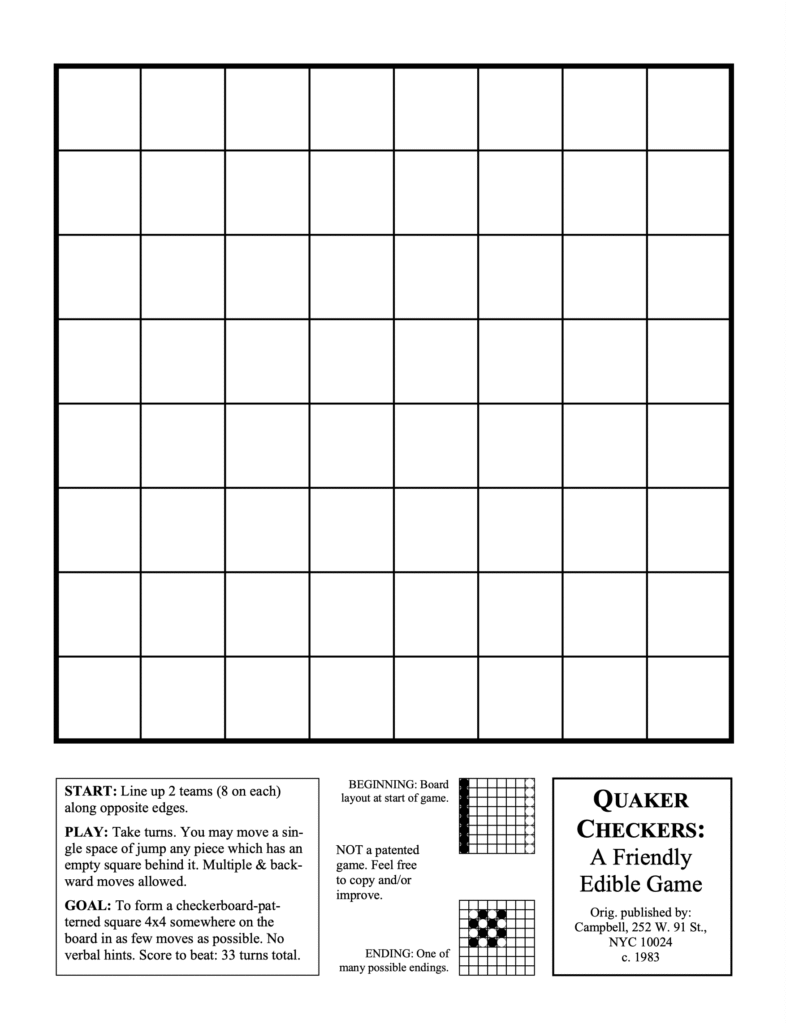
Back in 2012, I posted a game board and rules for playing “Quaker Checkers.” Photocopies of that game had been passed around for years between Unitarian Universalist Sunday schools. I decided to create a clean copy, and put it online where maybe more people could access it. And if you read the comments on that 2012 post, you’ll see that Quaker Checkers has been played with great success in Unitarian Universalists Sunday schools (and maybe in one or two Quaker First Day Schools as well).

This week, I received email from Sally Q Campbell, who invented the game. Sally said she’s currently talking with a friend of hers about developing an online version of Quaker Checkers. Actually, I would have loved to have an online version during the pandemic when Sunday school had to meet online.

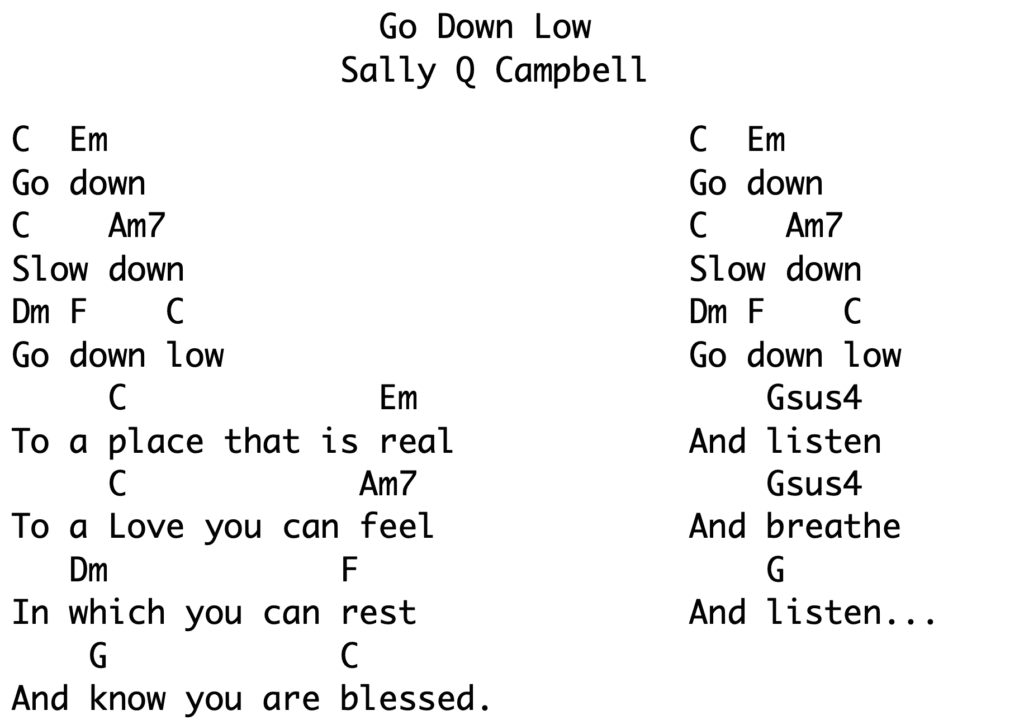
It appears that Sally is one of those endlessly creative people. She is also a songwriter, with a number of songs about peace and spirituality to her credit. On her her Youtube channel, she writes: “I’m a Quaker Singer/songwriter. Many of my songs are given to me in the silence if I will S l o w D o w n.” In fact, I especially like her song “Go Down Low,” which is all about slowing down and centering down. She hadn’t come up with chords for it, so I did. Here’s the standard warning for online chord/lyrics sheets: this is my interpretation of someone else’s song, posted here for educational purposes only; the songwriter Sally Campbell retains the copyright.

Graphic with lyrics and chords

(N.B.: she sings “Go Down Low” in B flat.)

All the above is by way of digression. My real point in writing this blog post is to correct something Sally pointed out in her email. She said: “You did make one error when you tidied it up. My board does not have dark and light squares, it’s just a grid. Makes it more of a challenge.”

She’s absolutely right. To make amends, here’s a corrected version of the game board:

Graphic of the game board for Quaker Checkers.
Click on the image above for a printable PDF of the game.

Hammer dyeing for nature journals

“Hammer dyeing” is a technique where you transfer the shape and color of leaves and flowers to cloth or paper by hammering. The process is fairly simple: you place plant material on cloth or heavy paper; cover with cloth, heavy paper, or plastic wrap; then hammer the plant material to release its juices which stain the cloth or paper. This article covers hammer dyeing projects that are intended for inclusion in nature journals.

The technique goes under several different names: “flower pounding,” “hammer printing,” “hammer staining,” “leaf hammering,” “tataki-zome,” “hapa-zome,” “Cherokee leaf pounding,” etc.; but I prefer to call it “hammer dyeing.”

Origins of hammer dyeing

I found no well-documented source giving the origins of hammer dyeing. I suspect the technique arose independently in several cultures.

Some online sources call this technique tataki-zome or hapa-zome, and claim it’s an “ancient Japanese art form,” but without citing any sources. A search on Google Books turns up many references to tataki-zome from 2000 on, but I could find only one reference prior to that date: Rita Buchanan, in Dyes from Nature (Brooklyn Botanical Garden Record, Plants and Gardens, vol. 46 no. 3, autumn 1990), p. 79, says that students learning how to dye in Japan practice tataki-zome: “Using their own plants, they learn dyeing techniques such as batik, itajime — a sort of variegated effect made with wood chips, and tataki-zome, a way of mashing plants on the cloth.” More research is needed to determine if tataki-zome is actually a traditional Japanese art form.

Alabama quilter Bettye Kimbrell (1936-2016), named a National Heritage Fellow by the National Endowment for the Arts, used a hammer dyeing technique she called “Cherokee leaf pounding.” It’s not clear this technique was actually used by the Cherokee people, so it’s best to consider this an American folk art with uncertain historical roots. Kimbrell used this technique in her quilts: “Cherokee leaf pounding is a technique where a fresh green leaf is taped to the backside of muslin fabric with masking tape. Using a hammer, gently pounding the leaf allows the chlorophyll to stain the fabric. After transferring each leaf to the fabric, the stain is set with a vinegar and water solution. The fabric is then dried and entirely hand quilted.” (Kristin G. Congdon and Kara Kelley Hallmark, American Folk Art: A Regional Reference, vol. 1 [Bloomsbury Publishing, 2012], p. 226.) More about her process here.

Screenshot from a video about hammer dyeing.
Screenshot from a PBS video on Bettye Kimbrell, showing her hammer dyeing a quilt. Click on the image to watch the video on the PBS website.

Books and references on hammer dyeing

For a comprehensive reference book on this technique, see Laura C. Martin, The Art and Craft of Pounding Flowers (Mt. Kisco, NY: QVC Publishing, 2001; Rodale Press, 2003). Martin covers which types of flowers, and which types of leaves, produce the best results; mordanting fabrics so the image is perhaps more light-fast; setting the image with a hot iron; etc. Unfortunately the book is now out of print. Used copies can be found on Thriftbooks (please do not buy from evil Amazon). The Internet Archive has a copy online that can be borrowed. The first 32 pages of the book are available on Google Books.

I’ve found references to two other books about the process: (1) Ann Frischkorn and Amy Sandrin, Flower Pounding: Quilt Projects for All Ages (Concord, Calif.: C & T Publishing, 2001); and (2) Linda Rudkin, Flower Pounding (London, U.K.: A & C Black Publishers, 2011). I haven’t seen either book, so can’t comment on them.

PBS has a video with Bettye Kimbrell demonstrating her leaf pounding technique. Sadly, the video does not show her technique for setting the image in vinegar (see below).

My curriculum website has instructions for doing flower pounding with children, using inexpensive watercolor paper. Scroll down to “V/Printmaking,” then go to project “D/Pounding flowers.” The technique I describe has been extensively field tested with children from grade 1-8, and produces reliable results. However, this technique is more focused on process than product (“process art”), and is not suitable for use in a nature journal curriculum.

Cloth with hammer-dyed impression of a fern on it.
Hammer-dyed fern on bleached cotton muslin, 36 inches wide. No mordant or scouring, but the image was set using a steam iron. The darker places are plant material deliberately left on the finished image. Image copyright (c) 2025 Dan Harper.

Hammer dyeing process

Earlier this month, during a week-long family conference at a Unitarian Universalist summer camp, I was leading an ecology workshop that centered around participants recording thoughts, feelings, and observations about the nature in journals (i.e., nature journaling). My co-leader, Rebecca, who is a middle school teacher, contributed to the development of this activity (thanks, Rebecca!). During this workshop, we field-tested a procedure for hammer dyeing. The process, outline below, is easy to set up, and is designed to help participants become more aware of the details of leaves and flowers.

Tools needed

  • Hammer, at least 1 for every 2 participants (see discussion of hammer types below)
  • Disposable foam ear plugs
  • Table with a hard flat surface

Materials

  • Thin cotton muslin cloth, 36 or 45 inches wide
  • Leaves, flowers

A rule of thumb for collecting leaves and flowers: Collect just 1 out of 20 similar leaves/flowers.

A note about fabric: I used to go to Joann Fabric to buy cloth for class projects, but they went out of business this year. Michael’s purchased Joann Fabric intellectual property, and one of the local Michael’s stores does carry 45″ cotton muslin in stock. My preferred online source for fabric is Dharma Trading Post, but as of this writing their popular 45 inch cotton muslin is out of stock.

Continue reading “Hammer dyeing for nature journals”

Asian art scavenger hunt

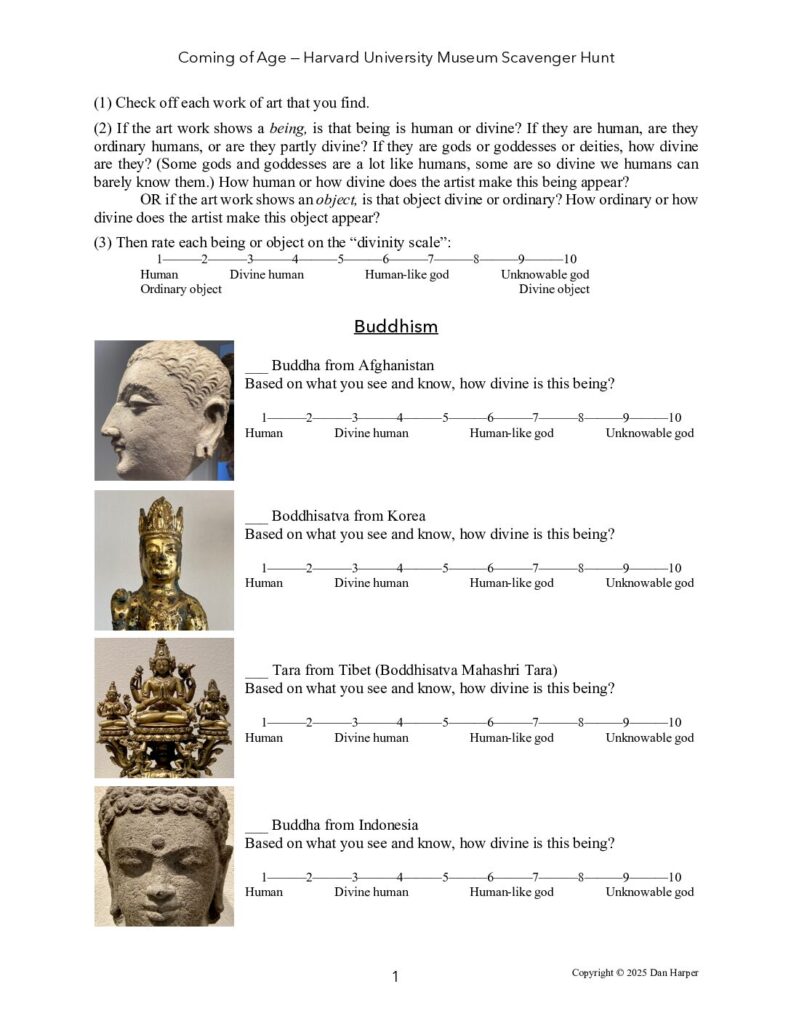
On Sunday, Tracey and I are taking the Coming of Age class for First Parish in Cohasset and First Parish in Norwell into the Harvard University Art Museum.

The point of the trip is to look at Asian art that depictions deities and sacred objects. This gets interesting because Asian religious/cultural traditions have different understandings of divinity than Christianity (or the other two Abrahamic traditions).

For example — is Buddha a deity, or not? The answer: It depends. In some art works, Buddha appears very human; in other art works, Buddha appears more than human. (Similarly with Jain tirthankaras.) And what about Hindu deities? They are clearly gods, but they also have human-like characteristics.

In Western culture, we tend to think all deities are like the Christian God, transcendent and far above humanity. But Asian art reminds us that there is a scale of divinity, from ordinary mortals through divine humans, and through human-like deities, all the way to transcendent unknowable deities.

So that’s the purpose of the scavenger hunt — look for works of art, then figure out how divine a being is portrayed in the art work. To show you better what I mean, here’s the first page of this year’s scavenger hunt:

Updated Greek Myths curriculum

I spent the last two days doing an update of the Greek Myths curriculum on my curriculum website.

Tessa Swartz, then 12 years old, and I developed this curriculum back in 2014. Teachers at the UU Church of Palo Alto did a field test in 2015, and I did a quick revision that year incorporating field test feedback. I was supposed to do a final edit the following year (2016), but that was the year my father died and I wound up dropping the project. Nevertheless, the curriculum continued in use at the Palo Alto church right up through the pandemic.

This final revision retains the same stories originally curated by Tessa and me in 2014. But the following changes were made: revised the lesson plans (some quite heavily); added more illustrations; upgraded existing illustrations; rewrote the introduction; and did an overall edit.

If you have any comments on the curriculum, please leave them here or email me.

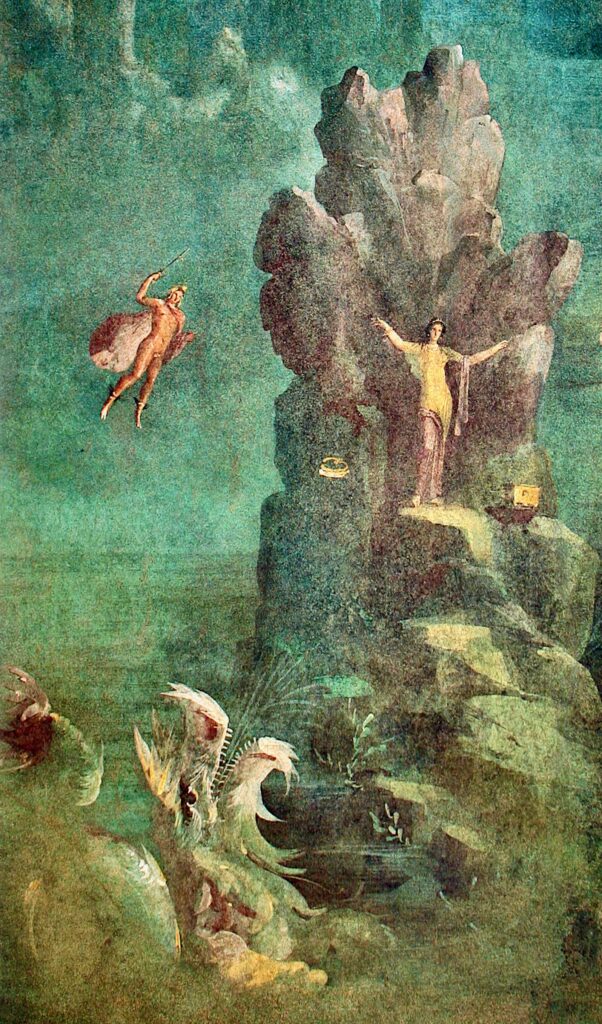
A woman chained to a rack cliff, with a sea monster below her and a man hovering above her.
A new illustration just added to the Greek Myths curriculum: Andromeda chained to the rock. This is a detail from a Roman wall painting of the first century BCE, from the Boscotrecase, Italy (public domain image).

Updated curriculum

I just finished an update of an 8-session curriculum (with an additional ninth alternate session) titled “From Long Ago.” This curriculum is based on stories from the old Sophia Fahs book From Long Ago and Many Lands. To avoid some of the biases Fahs had, I went back to the original sources she used, and referred to other translations and sources, to completely rewrite all the stories.

Version 2.0 of the curriculum has now been released — see it here. In addition to cosmetic changes and light editing throughout, I’ve added more illustrations. I also added several stories; version 1 of the curriculum required access to the 1948 Fahs book, but with the addition of these stories, Version 2 is now completely independent of the Fahs book.

I’m planning to release additional over the next few months. These new releases will be numbered as Version 2.x. I’ve already rewritten some other stories from the Fahs book, and am working on new session plans for those stories.

To allow for updates, this is an online-only curriculum for now. Someday if I have time, I may create a print-on-demand version, for those who prefer a hard copy (it’ll be expensive, though, due to the numerous color illustrations).

Ecological board games

The Religious Education Association is holding an online talk this evening. One of the presenters will be on ecological board games:

Although the paper will tell about games in Christian communities, I imagine the findings will be applicable to Unitarian Universalist communities as well (perhaps with some tweaking and language changes).

This is actually a topic that I’ve been working for some years now. I’ve used various ecological games in Unitarian Universalist religious education for children and teens since at least 2006. Recently, I’ve been working on ecology games for adults. To this end, I recently attended an online talk by Thomas Maiorana, professor of design at U.C. Davis, where he introduced a board game he’s developing that’s intended to promote wildfire resiliency in local communities. (You can watch a recording of the talk here.)

Local congregations and faith communities should be ideal settings for ecology board games. So I’m looking forward to tonight’s presentation, in hopes that I’ll learn about some new games, and more importantly learn about implementation strategies.

For the record, some of the ecology board games I’ve used in UU settings include:

  1. Wildcraft: A Cooperative Herbal Adventure Game teaches players about some common wild herbs. It plays well with mixed age groups, and in my experience kids up through middle school have fun with it. At approx. $50, it’s expensive.
  2. NOAA’s Carbon Cycle Game shows how burning fossil fuels affects the carbon cycle. You can play this as a tabletop game, or as a run-around game.
  3. Family Pastimes publishes several board games with ecological themes. I’ve played three of their games — A Beautiful Place, Earthquake, and Dragonfly with young children, and all three were fun and well-designed. Better yet, they were inexpensive, just $12-15 each. (But these aren’t adult-friendly games.)
  4. Promoting Wildfire Resilience. Thomas Maiorana hasn’t yet made the board game publicly available, but will do so soon on this website.

In addition, the following are run-around games, not board games, but worth playing:

  1. Lynxes, Hares, and Leaves is an active run-around game I got from environmental educator Steve van Matre’s book Acclimatizing. I’ve played this successfully with mixed age groups including adults and kids. Here’s an old version of my adaptation of this game. Someday I’ll get around to posting my updated rules.
  2. The Food Chain Game is another run-around game that I’ve played successfully with mixed age groups. This is my heavily adapted version of a game from the old Project WILD curriculum. Again, one of these days I’ll post my rules.

Other games I’m intrigued by, but haven’t yet played, include the following:

  1. Several ecology games in this listicle on the Edge Effects website
  2. Wildfire: A Learning Game, a free game which you download and print yourself
  3. Two adult-friendly games from Family Pastimes: Climate Crisis and Somewhere Everywhere Water Rising

New edition of the “Ecojustice Class” curriculum

Not many blog posts recently, as my spare time has been taken up with revising religious education curriculum.

I just completed a version of my full-year middle school “Ecojustice Class” curriculum for southern New England. Congregations in similar climates in the eastern U.S. should probably be able to use this curriculum as well. This is a beta test version — entirely teachable, but the curriculum is still a little rough around the edges.

Much of this is adapted from the northern California version of the curriculum, which we developed over ten years at the UU Church of Palo Alto. For New Englanders, I adapted this curriculum to a four-season climate. I added several proven session plans which have been adapted from Ecojustice Camp, as well as from my summer eco-spirituality workshops that I’ve led off and on since 2006 (mostly at Ferry Beach Conference Center).

Read about the Ecojustice Class concept on my curriculum website. Then if the concept works for your congregation, you can click through to Ecojustice Class Southern New England.

Updated curriculum on truth

I just updated my story-based curriculum “Beginnings,” aimed at middle and upper elementary ages. This is a “light revision,” mostly cosmetic but with a few major changes.

This eight-session curriculum features explorations of truth — what is true, how do we know what truth is? This topic seems quite relevant in this presidential election year.

See “Beginnings” on my curriculum website.

Garlic Mustard song

The invasive species problem remains one of the top threats to Earth’s life-sustaining systems. Yes, global climate change is scary, especially now that it looks like we’re now on track for a 2.5 degree increase. Sigh. But it’s also scary to watch familiar landscapes rapidly lose their biodiversity as they are overrun by invasives — native trees literally being pulled down by Oriental Bittersweet, native songbirds being driven out their nesting sites by invasive House Sparrows, native plants being killed off by the chemicals released into the soil by invasive Garlic Mustard…. Anyway, I decided to write a song about what we can do to Garlic Mustard.

Image of sheet music

(Yes I claim copyright, but I hereby grant you permission to sing it, reproduce it, record it, etc.)

Recipe for Garlic Mustard Pesto.