Heat and humidity

The National Weather Service calls this “oppressive” heat and humidity. When I got up at 6:00 a.m., the temperature inside the house was 81 degrees Fahrenheit, and it was maybe two degrees cooler outside.

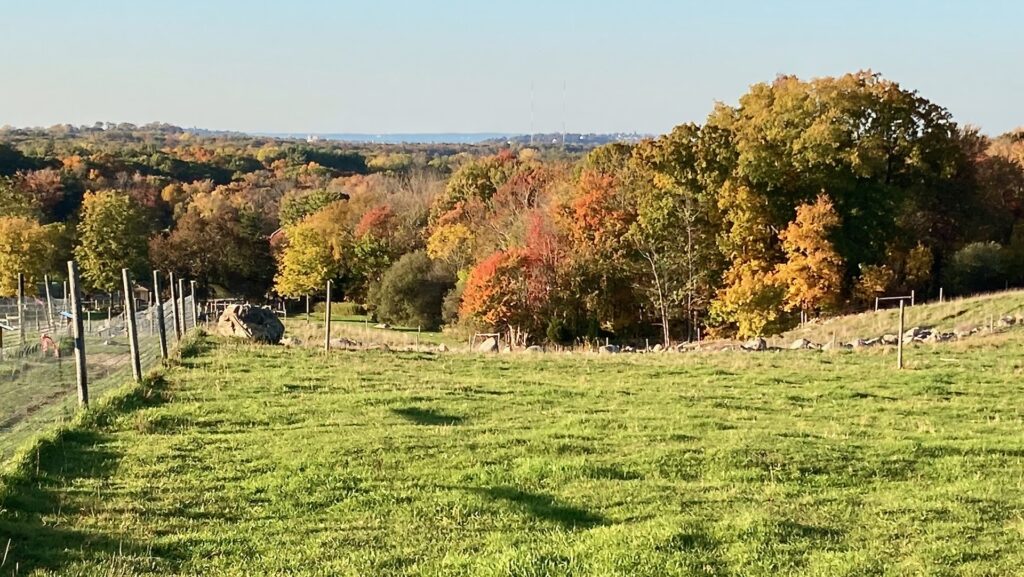
I went for a walk while it was still relatively cool. A light breeze was coming in off the water, just strong enough to blow the deer flies away. Down on the town beach, you could see maybe a few hundred yards out into Buzzard’s Bay — it wasn’t exactly fog, the air was just murky with moisture. There was no horizon: the gray water shaded into the gray murk which got slightly brighter as it shaded into the gray sky.

Double Crested Cormorants rest on rocks in Buzzard’s Bay

I walked slowly, stopping to look at the periwinkles slowly making their way along the sand, and at green seaweed (Ulva intestinalis?) waving in the water. Though I walked slowly, within a quarter of an hour I was drenched in sweat.

This heat humidity has been going on for weeks now, with only an occasional break. This is not the summer weather we had in New England twenty years ago. It feels more like summers in Philadelphia when I lived there in the 1980s. Or maybe even summers in the Deep South.

Scientists tell us that you can’t tell if climate change is happening based on one weather pattern of a few weeks. So OK, I’m willing to trust the scientists on this one. Nevertheless, this doesn’t feel like the New England weather I remember from the past. Maybe I’m just another old guy waxing nostalgic for lost youth. (Or maybe I’m just an old guy who can’t take the heat any more.) Then I read about the extreme heat in Europe this summer, and what I’m experiencing fits into a larger pattern. Climate change is happening.

Lughnasa

The pagan holiday of Lughnasa traces its roots back to old festivals that celebrated the first fruits of the harvest. In northern Europe, early August was the time when agriculturalists would begin to know what kind of grain crop they’d harvest this year. And they’d begin to have fresh grains again, instead of having to rely on what was left from the previous year’s harvest.

When I’ve lived in New England, as I am once again, Lughnasa becomes a bitter-sweet celebration. More and more fresh vegetables make their appearance at farm stands and farmer’s markets. Raspberries are at their peak, and it won’t be long until we start getting the first summer apples.

Yet at the same time, this is the time of year when you first begin to sense that the days are growing shorter. Some birds begin to drop out of the morning chorus; when I went out for a walk early this morning, I didn’t hear any more Willow Flycatchers. In a drought year like this year, you even begin to see red leaves in early August; we took a long walk on Sunday and here and there were Poison Ivy vines with brilliant red leaves.

It’s both the peak of summer, and the beginning of the turn towards winter.

Westport, Mass., to Cumberland Center, Me.

We drive up to the Cumberland County Fairgrounds in Maine to sing shape note music. We tried to check into the campground on the fairgrounds, but there was no one to check in with. We called the number of the man who supposedly oversees the campground. He sort of grunted at us over the phone, and we assumed that meant we should just take whatever campsite we wanted. No picnic tables in the campsites. The restroom and shower are pretty foul. We thought about finding another campground, but this one is right next to where we’ll be singing. So we stayed, and set up our tent.

One bonus of this campground: We got to watch horse racing while we waited for the evening singing to begin. I’m not very interested in horse racing, but it was fun to see and hear the sulkies rumble past.

Sulky racing, Cumberland County Fairgrounds

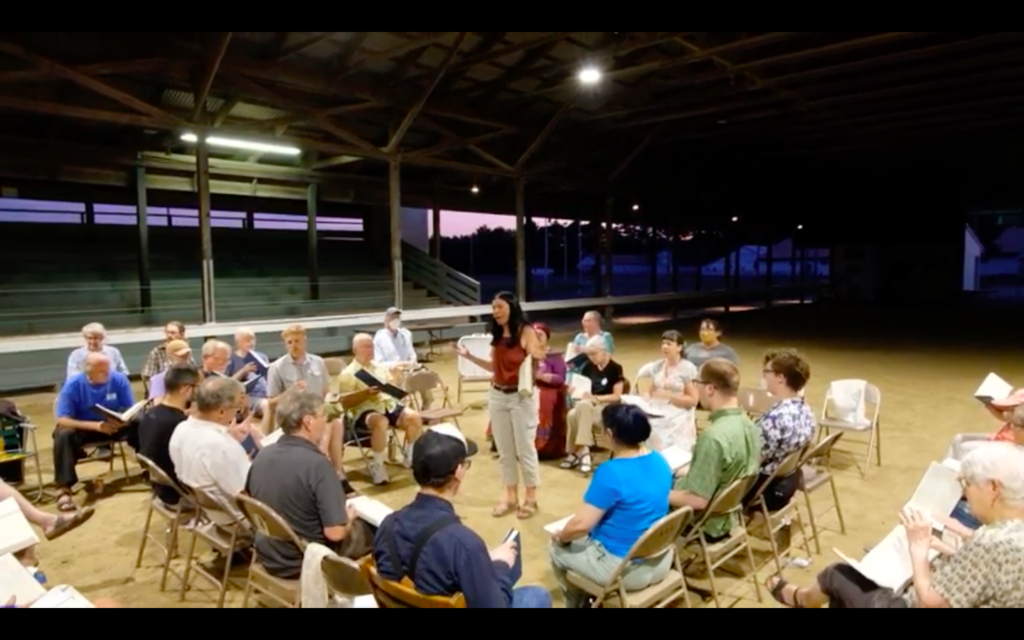
The evening singing was preceded by a chili dinner, with food shared by Maine shape note singers. Then we went into the Pulling Arena. A bunch of folding chairs were set up in the usual “hollow square.” We settled down to sing. The sound went up into the dim reaches of the pole barn far above us.

Cooper Book singing, Cumberland County Fairgrounds, Maine

We sang out in the middle of the dirt floor. At the end of the evening’s singing, I noticed a man, a woman, and a girl were watching us from the stands. I went over and told them they should come sing with us tomorrow. Then a couple of Maine singers came over, and told them about Maine shape notes singings. The Maine singers handed the man and the woman a Cooper book each.

I could see that the girl was also interested, so I handed her one of the Cooper books so she could look at it, and follow along. The Maine singers directed their comments to the adults. I made sure to tell the girl that lots of kids sing this music, too. She looked to be about nine or ten, a perfect age to learn how to sing four-part shape note music. I told her that kids always sing the tenor part, because it’s the melody, and the most interesting part. But this is the Maine singers’ territory, and I was overstepping the bounds by butting in and talking to the girl. So I quietly stepped away. And children in our society are so often ignored, I’m sure the girl wasn’t bothered in the least. It’s just something I happened to notice.

Fog

When I got up at about six this morning, there was fairly heavy fog. I went for a walk, but my glasses soon fogged up and I couldn’t see very well. So I listened for birds. A Lesser Yellowlegs remained unseen, but I could hear it calling tu — tu — tu as if flew overhead. A Seaside Sparrow in the bush next to the road, sounding a bit like a Red-winged Blackbird with a head cold, finally showed itself quite close by. Then I was on the beach where the sound of the waves drowned out the other sounds. The fog was even thicker on the beach, and I could barely see at all, my glasses were so fogged up. I looked down at my feet to keep from stumbling on the round stones of the beach, and saw this:

Sea Sandwort (Honckenya peploides)

Allens Pond at sundown

Allens Pond, Westport, Mass.

I took a walk after dinner, past the crowd waiting at Bayside Restaurant, across the street to Allens Pond. In the field within sight of the road, a man was talking to a twelve year old boy who had earbuds dangling around his neck. “There are probably foxes in here,” he said, gesturing to a field. The boy didn’t seem impressed. I said hello, and the man returned my greeting. “Perfect day,” I said. “Yeah, it is!” he said with a big smile on his face.

A few people were walking the Beach Loop, but as soon as I turned onto the Quansett Trail, there were no more human beings — just a rabbit. I walked down to where I could see Allens Pond. An Osprey sat on a nesting platform in the distance. The sun slowly sank behind the trees, leaving a few patches of salt marsh grass looking golden. A Willow Flycatcher gave its “Fitzbew!” call. I took a photo, and then just stood there watching the light slowly change. It wasn’t mindfulness so much as mindlessness — there was nothing in my mind, including my mind.

This was the most engaging thing I’ve done all day. I think I’m badly in need of this vacation.

Saco, Me., to Westport, Mass.

We stayed up late last night singing around the camp fire. Glenn mostly led the singing, with help from Amy, and drumming by Richard. Jon and I helped out where we could with uke and guitar. At Jean-Pierre’s urging, Milene sang us a traditional French Canadian song. Chantelle and some others went to bed at ten, but we kept going until quiet hour. It was after eleven when we got to sleep.

We had a leisurely morning. We packed up our campsite and loaded up the car. I enjoy packing up campsites and loading cars, so this proved to be a pleasurable morning for me. Then we ate an early lunch at a picnic table. Richard happened to be there, and we had a long talk, covering everything from Gilles Deleuze and the relationship between colonialism and religion on the one hand, to updating each other on the details of our personal lives on the other hand.

After lunch, I went out into the woods behind Ferry Beach Park Association, while Carol-the-extrovert went off to talk with people. I took a number of photographs of plants and other organisms which I uploaded to iNaturalist. I was sad to see that nearly all the Eastern Hemlocks (Tsuga heterophylla) were infested with Hemlock Woolly Aldegids (Adelges tsugae), an invasive insect from Asia. Many hemlocks were badly infested, and I also saw several dead hemlocks. I have also noticed that there were almost no Black-throated Green Warblers nesting in the woods this year, in contrast to past years when they were numerous. I wonder if the Black-throated Green Warbler prefers hemlocks for nesting, so that the loss of the hemlocks may mean the loss of the warblers.

On a more pleasant note, I came across a Glossy Ibis in the pond just to the north of Ferry Beach Park Association. I’ve never seen a Glossy Ibis there.

We began driving south at a quarter to four. I asked Carol if she’d mind driving because I didn’t think I was alert enough to drive. It was a good thing she drove, because I slept for most of the three hour drive.

We arrived at our summer rental at a quarter to seven. We got dinner at Lee’s Market in Westport. We met one of our neighbors, a skunk who appears to be living under the house. We feel quite settled in, and now we’re ready for bed.

Saco, Me., to Bath, Me.

This afternoon, Carol and I drove up to Bath, Maine, to sing Sacred Harp on the gazebo in the center of Bath. It turned out to be an excellent place to sing, which may show that a good singing space does not need walls if you have a wood ceiling and a wood floor. And with no walls, we were much less worried about transmitting COVID, especially with the stiff breeze that was blowing. It also turned out to be an excellent group of people to sing with. As Carol said after the singing, “It was a really tight group.”

After the Sacred Harp singing was over, we got takeout food. We ate dinner in a city park overlooking the Kennebec River. This is the furthest east we will travel on our cross-country trip.

Carol looking east over the Kennebec River

A quick meomry from our cross-country trip that I forgot to write down earlier:

When we drove into Wyoming, a sign directed all vehicles with watercraft to pull into the Port of Entry for inspection — “including canoes and kayaks.” Signs directed us around the weigh station to a small building belonging to the Wyoming Fish and Game Department. A polite young woman carrying a clipboard and wearing a Fish and Game uniform greeted us. She was obviously checking for invasive species. She looked at the canoe on top of our car, and at our California license plates. “What was the last body of water you had the canoe it?” she asked.

I thought for a moment. We hadn’t used the canoe in the whole 13 years we’d lived in California. “The Atlantic Ocean,” I said.

She looked surprised. “Whereabouts?” she asked.

“Coast of Maine,” I said. “Saco Bay.”

She knew Saco Bay, and it turned out that she, like me, was from Massachusetts.

“Where’d you grow up?” I asked.

“Near Essex,” she said, and told me which town.

There was no one behind me waiting to have their boat checked, so we chatted for a bit. We asked what brought her out to Wyoming. She had gotten her degree in wildlife management at a university in New York state, worked for a while in the northeast, then decided she wanted to go some place completely different. So she chose Wyoming.

I told her I was glad that Wyoming was checking all watercraft for invasive species. “I’m a fisherman, and invasives have already ruined too many fisheries,” I said.

Especially the mussels,” she replied.

So yeah. If you own a boat, remember: clean, dry, and drain.

Acton, Mass., to Saco, Me.

Abby and Jim’s back yard proved to be a very comfortable place to sleep. As we were packing up the car to leave, I noticed these charismatic European Paper Wasps (Polistes dominula) building a nest.

Native to Mediterranean Europe, P. dominula was first introduced to the United States in Massachusetts in the 1970s. Since then, it has spread to Maine, Pennsylvania, Michigan, South Dakota, Nebraska, Arkansas, Washington state, and perhaps elsewhere. Abby said she was going to kill the insects and remove the nest, which I am glad of — according to the Invasive Species Compendium website, P. dominula has been shown to displace native Polistes species.

Another dreary drive today, though only two hours long. Traffic was heavy and aggressive from Acton to southern Maine. We were glad to get off the highway, and set up our tent at Ferry Beach Conference Center, where I’ll be leading a workshop in ecological spirituality for the next week. I’ll post more about that workshop in the coming days.

Newfield, N.Y., to Acton, Mass.

We had a long breakfast with Paul and Gina this morning. After breakfast, the four of us, plus Allagash the dog, went for a walk at a nearby pond. Paul and I met in a field ornithology class, so we listened for birds: Summer Tanager, Dark-eyed Junco, Wood Thrush, Red-eyed Vireo, Hermit Thrush (maybe), and more. Gina noticed this spectacular Wood Lily:

Wood Lily (Lilia philadelphicum)

Then Carol and I started driving east again. After a long drive, we arrived at the house of my sister Abby and Jim. Now we’re sitting outdoors in Abby and Jim’s screen house talking after dinner. What do siblings do when they get together? Talk a lot, and goof around. Here’s a photo Abby took of me:

Just now Abby asked, “What are you doing?” I said, “I’m uploading to iNaturalist.” She doesn’t know I’m actually writing on my blog while we’re sitting here in the screen house.