How to annoy someone from Indiana

My older sister lives in Indiana. We were talking on the phone yesterday when she idly asked, “So how’s the weather out there?”

“Oh, you know,” I said. “Just so-so. The fog stayed in longer than usual in the morning so I don’t think it got above seventy-two degrees yesterday. And last night it was down in the fifties, so cold I had to close the window.”

“Augh!” she said, or at least she said something that might have been spelled that way. “I hate you! It’s been over ninety here for days, and it doesn’t get any cooler than about seventy-eight at night!”

That’s how to annoy someone from Indiana.

Checklist for week on New England coast

A score of ten or better on this checklist is required for satisfactory completion of week-long stay on New England coast.

Walked along beach and picked up shells — check
Clambered over rocks on a jetty or breakwater — check
Ate fried clams (fresh, tender, and sweet, not the frozen crap you get inland) while sitting on beach — check
Sat in rocking chair on porch and looked at ocean — check
Got too much sun — check
Ate lobster roll (with identifiable claw meat, not that chopped up crap that you get inland) — check
Conversed in eastern New England dialect — check
Took afternoon naps — check
Got drenched in a sudden squall — check
Had weather cool enough to need a jacket, and hot enough to sweat while sitting still — check
Watched guys fishing for stripers and not catching anything — check
Watched seagulls and terns fishing and catching a lot — check

Moonrise

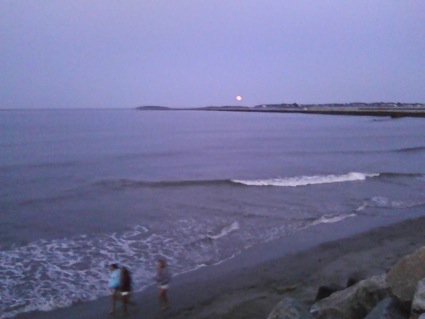
I was coming back from a long walk down the beach to see if there were any Piping Plovers nesting at Goosefare Brook, looking down at my feet in the fading light to see if there were any interesting shells or stones worth picking up. Ahead of me, a man was aiming a camera with a large telephoto lens on a tripod at something. I looked in the direction his camera was pointed, and there was the moon rising up out of the Atlantic Ocean. If the moon is about 30 arcminutes wide, it was about 90 arcminutes above the surface of the ocean when I first looked. It was pink and a little brighter than the medium blue sky; it hung just above a distant line of darker blue clouds tipped with pink along their tops.

The moon sat in the sky above the gap between Eagle Island and Wood Island. As I walked on down the beach, past the man struggling to aim his camera, the moon appeared to move towards Wood Island, until it stood over the eastern end of the island. The last light of the sun lit up the distant white tower of Wood Island lighthouse; a long shimmering reflection of the moon shone in the waters of the bay.

A couple of hours later, I was on the beach with forty or fifty other people for a bridging ceremony for this year’s high school seniors in the youth program at the Ferry Beach religious education conference; these were youth I had watched grow up summer after summer; one of them was the daughter of someone who had been in my own high school youth group. The moon was high in the sky; a long white reflection of it brightened up the calm bay; it was almost bright enough to read by. The air was cool enough to require a jacket and to keep the mosquitoes away, and two foot waves crashed regularly on the beach below us. What a perfect night, said the person next to me.

Dinner for gulls

Walking down the beach this afternoon, I paused to watch a Herring Gull flying along with something in its mouth. It landed near me, and dropped a good sized crab on the sand. The crab landed on its legs and started to scuttle away, but after fumbling once, the gull expertly flipped the crab on its back. The crab weakly waved its legs in the air while the gull tilted its head on one side so it could look at the crab with one eye.

I walked over so I could better see the crab. The gull kept an eye on me, and when I got within ten feet of it, it flapped its wings, rose in the air, and settled down twenty feet away, screeching at me. The body of the crab was a good four or five inches across — perhaps a foot across with the legs. With the toe of my shoe, I flipped it over to get a better look. The upper side of the carapace was a reddish-brown color, so it was probably Cancer irroratus or Cancer borealis. The crab plowed its head end into the sand and began to move slowly and feebly along. I walked about twenty feet away, and turned to watch.

When I was a safe distance away, the gull flew back in. Again, it expertly flipped the crab onto its back. Then it stabbed sharply into the crab’s vulnerable underside; the crab’s legs waved feebly; the gull stabbed again; and once more, on this last stab bringing a chunk of flesh up. The crab’s legs twitched a little. The gull flipped its head back and swallowed the piece of flesh, then stabbed again and again. The gull was a messy eater, and little chunks of carapace and flesh and bits of leg got scattered around on the sand. The crab had stopped moving by this point. I left the gull to its dinner, and walked on down the beach.

Cookie blog by a UU

Someone introduced me to My Cookie Project. This isn’t a recipe blog, although blogger K. Grober provides links to the recipes, usually on the Martha Stewart Web site. I’d call it a documentary blog: using photos and text, the blog documents baking process, ingredients, cookies, taste and texture of the cookies, and sometimes the positive reaction of the local soup kitchen upon being given the gift of dozens of cookies. Of course a Unitarian Universalist blogger would give cookies to the local soup kitchen.

Travelers’ story

Waiting for the bus to Portland, Maine, I turned to the man and woman standing near by and said, This is the place you pick up the bus to Portland, right? They said it was; and that they were going to Portland, then getting on another bus to go to Bangor, and from there heading on down the coast. They both had eastern New England accents, so I asked them if they were heading back home.

Well, they said, not exactly. They were from Alaska, living in a small town near Juneau.They had been sailing a 34 foot sloop, a live-aboard, but it sank.

It sank? I said.

Well, it was sunk. They had been sailing in among a pod of humpback whales. The whales were all around them, and some of them were breaching, coming completely up out of the water and crashing back down. Usually when the whales started doing that, they moved their boat farther away. But a big bull humpback came up right where their boat was. Drove the keel up through the boat. The whale almost tipped them over, the whale rolled over, they were on its belly, they almost capsized, they could see the flukes up in the air next to the boat, the whale rolled back, so at least they didn’t tip over. The whale was feeling a little stunned, they said.

They had enough time to send off a mayday call. The Coast Guard picked up the call and relayed it to a fishing vessel that was nearer to them. The boat sank in about five minutes. She had just enough time to grab her credit cards and driver’s license, and then they were in the water. Fortunately, the fishing vessel came within ten minutes of the time the boat sank, because the water was cold, in the forties.

So you lost everything? I said. Yup, they said cheerfully, but we’re alive. And you know, he said, it’s hard to see everything go down like that, but then you feel — lighter. Well, I said, you’ll be dining out on that story for the next twenty years. They laughed. We already have, they said, we told some of the Tlinglit in our village, and even they were impressed. They’re water people, and they could relate to us.

I said goodbye to them in Portland. They’re going to sell a house they own beyond Bangor, and buy another boat, and head back to Alaska.

Back in the homeland

Carol’s flight into Boston was on time, but mine was delayed, and it was late when i got to the hotel. I went straight to the hotel bar to get a burger.

The Red Sox game was showing on the TV in the hotel bar. Bottom of the eighth, the Sox leading the Orioles 9 to 3, and big David Ortiz is at bat. Gregg, the Baltimore pitcher throws a pitch so far inside that Ortiz has to take a step back. “Didja see that look Ortiz gave him?” says the guy next to me in his Boston accent. Two more pitches exactly like that, and Ortiz yells something at Gregg. The guy sitting next to me says, “Jeez, Ortiz is not happy with that.” One more pitch, Ortiz pops up to center field, Gregg makes some kind of gesture at him, next thing you know both dugouts and both bullpens are out in the field mixing it up — desultory commentary provided by two guys with Boston accents sitting at a Boston bar.

OK, I live in the Bay Area now, and of course I like northern California weather better, and yes everyone is friendlier there, and people don’t drive like crazed maniacs the way they do in Boston. But for someone who grew up in eastern New England, there’s nothing like sitting in a bar watching the Sox with other people who speak God’s own English. It’s like being back in the homeland or something.

Barstow to home

I awakened sometime in the middle of the night, and had a hard time getting back to sleep: too much caffeine too late in the day. So I listened to the freight cars in the railroad yard behind the hotel. As the cars were moved around the yard, their wheels gave off flute-like, almost musical, tones. First a tone held for three long beats, the basic tone of which was maybe as high as the C above middle C; then it would change in pitch, shifting suddenly to a higher note or notes. I began listening to the change in pitch, using standard solmization syllables to determine the rise in pitch. Do, re, mi, no not quite mi; a slightly flatted third, like the blue notes in jazz or blues. Do, re, mi, fa, sol, la, ti; that’s a major seventh. The notes began to blur into each other, there were chords, I was fast asleep.

The next morning, we took a long walk along the Historic Route 66 in Barstow. The sun was incredibly bright, the air clear and very dry, and because it was so dry we didn’t feel uncomfortable walking through the desert heat. We went down a short side street where there was a big sign that read “Barstow Classification Yard,” and another sign that read “BNSF Barstow CA.” Carol stood around waiting while I took some photographs of the rail yard beyond. We walked past that, taking photographs of the motel and restaurant and other signs next to or on buildings along the highway: “Palm Court American-Chinese Food”; “Yahweh Flooring”; “Entrance /Low Rates / Office,” with an arrow pointing, and a Hindu “Om” symbol; “Route 66 Motel / Vacancy / Free WiFi — Round Beds — HBO — Remodeled Rooms — Best Prices”; “Robertiroz Mexican Food / Open 24 Hours 7 Days a Week.”

On one side of the highway, side streets led to neat modest homes; on the other side of the highway, beyond the Barstow Classification Yard, we could sometimes see the desert. If this strip of highway, with its big bright signs and bright gaudy roadside architecture, was anywhere else, it would have looked gaudy. But the highway was competing with the intense desert sun, and the glare, and the hot dry air, and it was no competition at all for the sun and glare and dry air won handily.

Driving west, we climbed up towards the Tehachapi Pass, through the high desert with Joshua trees here and there on either side. Erle Stanley Gardner, in one of his detective books, writes about driving through the desert at night and seeing “the weird Joshua trees on either side”; they do look weird, they look vaguely humanoid, but to me they have a friendly and very satisfying look to them.

Once in Tehachapi, the humidity set in. Visibility dropped, distant hills looked blue, the most distant ones disappeared in the haze, and I kept wanting to polish my glasses so I could see again. We began feeling the heat more. All during the long drive through the Central Valley, the air was blue with humidity, and the heat felt uncomfortable, even in the air-conditioned car. Finally we wound through the Coastal Ranges, and arrived at home near the shores of San Francisco Bay, where at last the air felt cool and comfortable.

from July 2, posted July 3