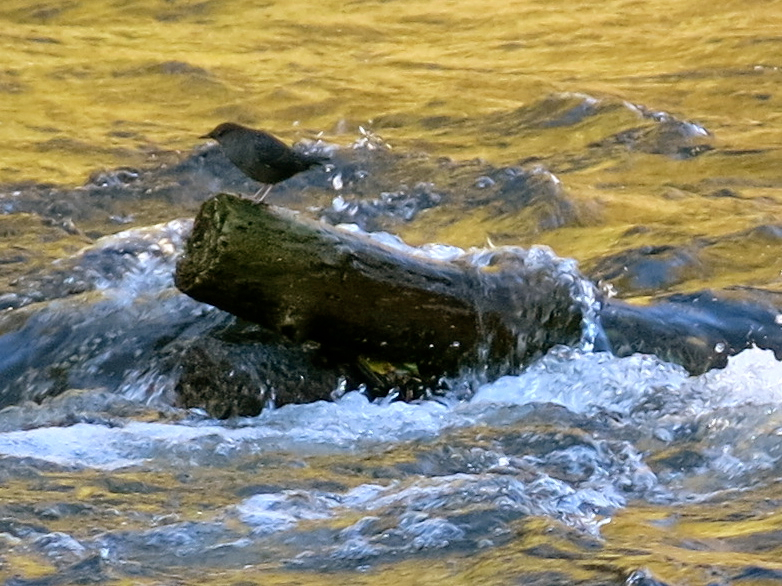
American Dipper in the Applegate River, Applegate, Oregon, near the Applegate Store and Cafe.
(As my cousin Sue pointed out, this bird is also called an ouzel, which sounds much more mysterious.)
Yet Another Unitarian Universalist
A postmodern heretic's spiritual journey.
American Dipper in the Applegate River, Applegate, Oregon, near the Applegate Store and Cafe.
(As my cousin Sue pointed out, this bird is also called an ouzel, which sounds much more mysterious.)
The last session I attended at UNCO 14 West was the session on the spiritual and mental health of pastors on Wednesday morning.
The purpose of the Wednesday morning breakout sessions is to figure out what “has legs,” that is, which of the ideas that emerged during UNCO are worth following up on. One of the key ideas that came up during UNCO 14 West was the idea that innovative ministries need to find new funding sources. This is an important step in the evolution of Unco, as Carol Howard Merritt tweeted: “#unco14 discussions at year 5: We have gone from complaining to dreaming to planting. Now we’re looking at funding. It’s really beautiful.”
And I think the idea that we need to support the mental and spiritual health of pastors engaged in innovative ministries is just as important the idea that we need to support the financial health of innovative ministries. Ministry is, in many ways, an essentially conservative profession: we are supposed to conserve the tradition of which we are a part. My own denomination is theologically liberal, but methodologically conservative and risk-averse: a few innovative ideas have been given the imprimatur of the denominational bureaucracy, but most other innovation is ignored. I’d guess my denomination is typical of all mainline denominations.
And what happens if a minister or lay leader tries innovation goes beyond the innovative allowed by the bureaucracy? What happens when a minister or lay leader tries something risky? Well, because of the conservative nature of ministry, and because of the conservative nature of denominations, anyone who goes beyond the allowed limits of innovation had better be well-connected. If you are well-connected, if you have friends in powerful positions, your innovation may be allowed, and if it is allowed, it will likely be funded. But if you are not well-connected, you may well feel like the goat in Leviticus 16 who gets sent into the wilderness: “The goat shall bear on itself all their iniquities to a barren region; and the goat shall be set free in the wilderness.” [Lev. 16.22, NRSV]
Innovative and/or risky ministries are stressful enough in and of themselves. If you are engaged in innovative ministries but are not well-connected within your denomination, you are likely to feel more stress, and have less support. You are also less likely to be held accountable in appropriate ways, and your ministries may well be judged by the wrong standards. This is a recipe for burn-out. I suspect that pastors engaged in innovative ministries are at higher risk for mental illness, something that is already an occupational hazard of professional ministry.
This would suggest that those who are engaged in innovative ministries need additional support. In our breakout session on Wednesday morning, we brainstormed a few ideas: setting up some kind of online chaplaincy for UNCO participants; mutual support and accountability groups meeting via Google Hangouts or Skype; continuing to offer face-to-face support at UNCO; etc. We’ll see which of these ideas “has legs” and will turn into a reality.
But there is a need: innovative ministers need appropriate accountability and sympathetic support.
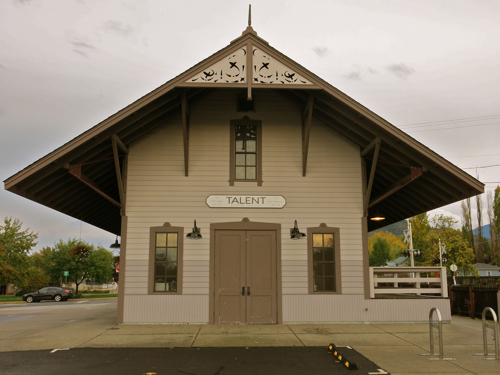
The old railroad depot at Talent, Oregon. The sign reads: “To Portland 336 mi. / TALENT / To San Francisco 436 mi. / Elevation 1,635”
My cousin Sue tells me that up until a few years ago, two trains a day passed through Talent, carrying lumber south to Redding, California. With the collapse of the timber industry in this part of Oregon, there are no more regularly scheduled trains — this, along with the mills closing down, and good working class jobs disappearing, represents the changing economy of southwestern Oregon. The railroad depot has been converted into shops, perhaps a symbol of the growing importance of service industry jobs.
What would you do with a half a winter melon? I’ve gotten friendly with a farmstand that specializes in Asian vegetables at the San Mateo Farmer’s Market. The woman who runs the farmstand knows I love bitter melon, and has told me about its health benefits. She probably figured this white guy needed to expand his Asian melon repertoire, so today she gave me half a winter melon, and said, “Try it in soup.”
There are lots of winter melon soup recipes online, and I’m leaning towards a simple one with dried black mushrooms, chicken broth, a little bit of chopped meat, and some slices of ginger.* But — what would you do if someone gave you half a winter melon?
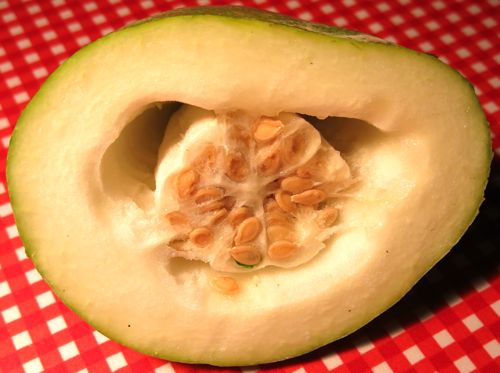
*Two weeks later: And here’s the recipe I have been using for winter melon soup:
Half of a five pound winter melon, cut into 2 inch pieces (about 2 pounds of melon)
1 quart of chicken broth
1 knockwurst, cut into 1/2 inch circles
8-10 dried black Chinese mushrooms, soaked in hot water for 20 minutes
half a dozen slices of ginger root, peeled, and slivered
salt to taste
Bring the winter melon to a boil in water to cover, then simmer covered for 20 minutes.
Drain the water off.
Add chicken broth, mushrooms, ginger, and knockwurst to the cooked winter melon. Simmer for 20 minutes.
Even though the temperature got up to nearly eighty degrees today, it feels like fall. The sun is noticeably lower in the sky, and daylight is noticeably shorter than nighttime. I went for a walk up in the hills overlooking Half Moon Bay, and once you get out from under the redwoods into the chaparral, the plants look tired and dry and worn out, ready for the winter rains. Even the fall asters look faded now, with blossoms that are almost white instead of pale violet.
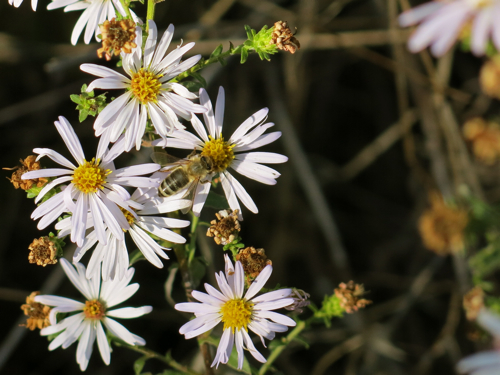
Above: Honeybee pollinating asters at Purissima Creek Redwoods Open Space Preserve; the asters are probably the Common California Aster (Symphyotrichum chilense)
During the long climb back up to the trail head, I kept stopping to admire the way the afternoon sun shone gently on the steep hills and canyons that descended to the ocean; admiring the view was also a good excuse to stop and catch my breath when the trail was steepest. After one particularly steep stretch, I turned and saw a Golden Eagle below me. This was a perfect excuse to stop for a moment. I watched the eagle ride the breeze down the canyon until it disappeared from my view behind a forested ridge.
Thirty-six years ago, my mother called up her best friend Dorothy Lob, and asked Dorothy if she would come help with some sewing. I was about to head off to college, and my mother wanted to sew name tags into my clothing, and on all my sheets and blankets.
I was not allowed to help with the sewing. For all that she was a feminist, my mother never taught me to sew, never let me learn how to use her sewing machine, washing machine or dryer, or her iron or her ironing board. My sisters were allowed, even required, to learn how to use these things, but I was a boy, and boys mostly didn’t work with cloth and fabric. I was, however, allowed to hang out laundry to dry on the clothesline upon occasion, and in this I suspect that my mother was more progressive than her mother.
Although I was not allowed to sew, I did have to sit with Dorothy and my mother while they sewed on the name tags. We sat around the dining room table one bright summer day, and Dorothy was her usual cheerful self, chatting away and making my mother laugh and smile. Dorothy had a musical German accent; she had grown up Jewish in Germany, and had fled to America to escape the Nazis. I never heard her talk about it, but my mother said that was why she wanted nothing to do with organized religion, and that was why she could not believe in any god who could let something like that happen.
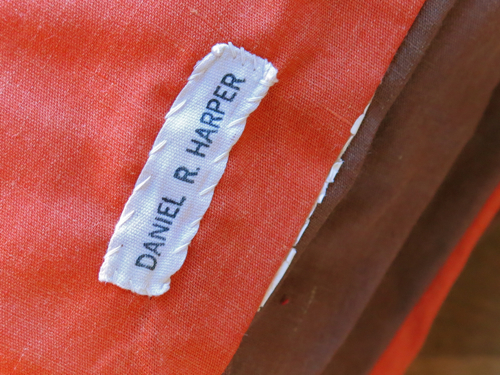
I vaguely remember helping fold clothes, and handing things to my mother and to Dorothy; mostly I probably just got in the way. I definitely remember that Dorothy was faster at sewing on name tags than my mother, and even I could see that she took less care at it. My mother took small careful stitches, securing each end of the name tag, while Dorothy sewed in big, bold stitches that quickly circled the entire name tag.
Although all the clothes I brought with me to college have long since gone to the rag bag, I still have some linens and bed clothes with those old name tags sewn in. I just found a comforter with a name tag sewn on by Dorothy:
And I found an old towel with a name tag sewn on by my mother, so you can compare their stitches:

Their sewing reveals something about each woman’s personality: Dorothy, bold and unafraid and exuberant; my mother, cautious and careful. After they had finished sewing and Dorothy had gone home, my mother looked at Dorothy’s sewing with with some disfavor, and worried aloud that the stitches would come out and the name tags would fall off; thirty-six years later, I can say with some assurance that her worries were unfounded.
With two children in college and another in middle school my mother never had time again to sew name tags on my clothes or linens. Both women are now dead, and the dining room in which we sat is gone because that house was torn down to put up a McMansion. I get a little catch in my throat sometimes when I catch sight of one of those old name tags: you can still see something of those two strong personalities in those stitches.
Carol and I went to Half Moon Bay to watch the sun set tonight.

Above: Heerman’s Gull feeding at water’s edge.
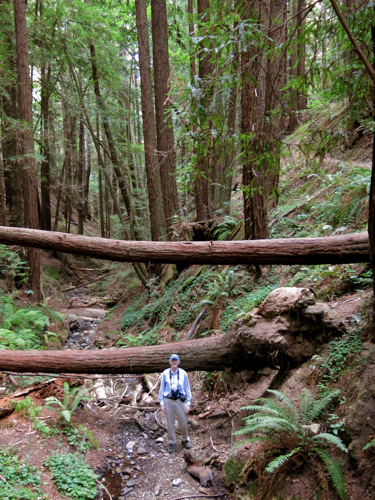
Standing in the creek bed of Purissima Creek, about two miles from Higgins Canyon Road.
Photo credit: Carol Steinfeld
After a week of twelve hour days, getting everything set for the first day of Sunday school, I was ready for a break. When Carol suggested we go for a late-afternoon walk at Purisima Creek Redwoods Open Space Preserve, I was ready to go.
About an hour into our walk, Carol pointed down at the ground. “What’s that?” It was a small animal, dead. A mouse? No, a closer look revealed it was a mole. I turned it over carefully. There was a bit of a flat place where it had been lying; presumably decomposition was beginning. But you could still see the general shape of the animal. I admired it for a while then made a sketch, slightly smaller than the actual size of 110 mm total length, which I refined once we got home:
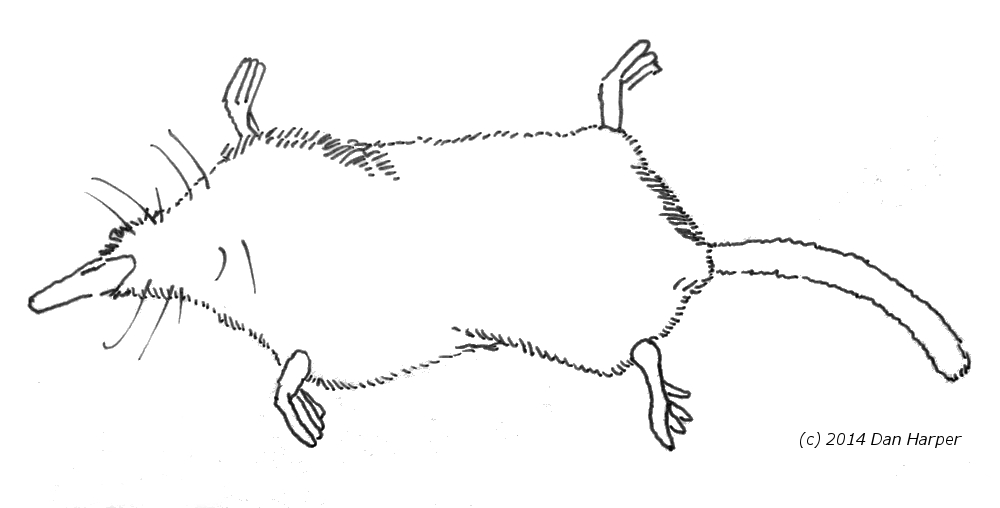
Of the two species of mole which inhabit our area, it was clearly a Shrew-mole (Neurotrichus gibbsii). According to Jameson and Peeters, in Mammals of California, we humans don’t really know what this species eats, or how it reproduces: “The Shrew-mole seems to feed indiscriminately on a board spectrum of soil-dwelling insects, pill-bugs, and centipedes”; it “appears to breed in late winter”; and “little is known of its reproductive habits” (my emphases). Another organism to which we humans live in close proximity, but about which we know little.
This afternoon, we went for a walk at Purissima Creek Redwoods Open Space Preserve in the Santa Cruz Mountains southwest of San Mateo. It was a stunning afternoon, warm but not too hot, with fog beginning to roll in up the canyons from the ocean.
As we hiked down into the preserve, we kept hearing a hawk screaming somewhere in the distance, but we never saw it. And then when we were hiking back up to the parking lot, there it was overhead: an accipter flying over the ridge we were on, then turning and riding the breeze coming up the canyon to our right. And what kind of accipter was it, a Cooper’s Hawk or a Sharp-shinned Hawk? I’d say it was perhaps a little larger, the neck a little longer, the tail a little more rounded, the wingbeats a little more deliberate: probably a Cooper’s Hawk, but I’m not good enough at field identification to be sure. It wheeled around, high above the canyon floor but at eye level for us; a couple of Band-tailed Pigeons came over the ridge, saw the accipter, and quickly ducked into the trees below us. Then the fog rolled up the canyon, and it was gone.
As we continued up the trail, Carol got about a hundred feet in front of me. Suddenly we both froze: walking the trail well up the hill in front of us was a dog-sized canid: a Gray Fox, its long tail behind it, its head turning from side to side, giving us a flash of the rufous fur up the side of the neck. It didn’t seem to notice us; it was busy watching the undergrowth on either side of the trail, and at least once it pounced at something.
We got back to the car a little after seven, and decided to go down to the beach to eat dinner. It was a beautiful foggy evening, and we walked along past Heerman’s and California Gulls, but the real attraction of the beach was the Velella velellas. When I was reading up on this species last night, I found a Web page by Dr. David Cowles that gave a possible reason why so many Velella velellas have washed up on northern California beaches:
“The angled sail makes it sail at 45 degrees from the prevailing wind. Some have a sail angled to the left, others to the right. Off California the right-angled form prevails, and these remain offshore in the prevailing northerly winds. Strong southerly or westerly winds, however, may bring huge aggregations ashore.”
We walked down the beach, making an unscientific survey: of the dozens of individuals we saw — ranging in size from less than two inches long to one that was as long as my notebook or approximately four inches (10 cm) long — all the sails had the same handedness (according to Dr. Cowles’ terminology, right-angled sails). Here’s a sketch from my notebook:
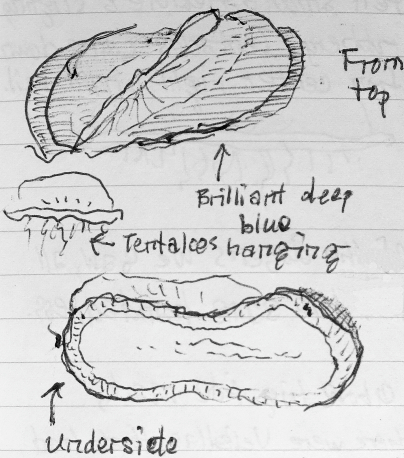
I picked one up by its sail to look at the tentacles hanging down underneath. The velellas, like the fox and accipter, are predators, feeding on smaller organisms with their dangling tentacles. The tentacles seemed to descend from the central oval, and were of varying lengths. The sail itself felt smooth, flexible, and slightly rubbery; I dropped it back into the waves after I had looked at it.
Three very different predators — but each one a fabulously beautiful organism.