Invertebrate pitfall trap

When we humans think about the interdependent web of life, we tend to think about the relationships between ourselves and familiar organisms like mammals and trees. These are organisms that are either larger than us or relatively close to us in size, or they are taxonomically close to us. But if you conduct a survey of biodiversity in a given tract of land, the majority of non-microscopic species you find will be invertebrates, e.g., insects, spiders, crustaceans, etc. For a more realistic theological understanding of the web of life, I think it’s necessary to develop a more realistic understanding of biodiversity. It is easy and fun to feel a connection through the web of life to relatively cute organisms like rabbits, and to relatively majestic organisms like redwoods. Understanding our connections with organisms that are not particularly cute or majestic expands our idea of the interdependent web of life.

A few years ago, I participated in a blogger’s bioblitz; a bioblitz is a study that provides a “snapshot of biodiversity.” One of the tools used in a bioblitz is an insect pitfall trap; this kind of trap provides a sampling of insects and other invertebrates. I decided to place an insect pitfall trap in our front yard, so I could see some of the invertebrates that live in our urban setting.

Some online research revealed that pitfall traps made of glass are most effective (Oecologia 9. VI. 1975, Volume 19, Issue 4, pp 345-357), but the easiest way to make a pitfall trap is with nested plastic drinking cups. You dig a hole deep enough to bury the two nested cups, and pack dirt around them so that the rim of the upper cup is exactly at ground level. Then you can remove the upper cup, dump out all the dirt that fell into it when you were burying it, and then replace it. I used two nested 10-ounce clear plastic drink cups:

BlogFeb1615a

To use pitfall traps ethically, you should check them at least once a day, and either release the captured organisms or collect them responsibly. If you’re expecting rain or hot sun, you should place some sort of cover over the trap, raised up an inch or two. The cover will keep rain and sun out, but still allow invertebrates to crawl into the trap. If you’re no longer going to use the trap, pull it out of the ground.

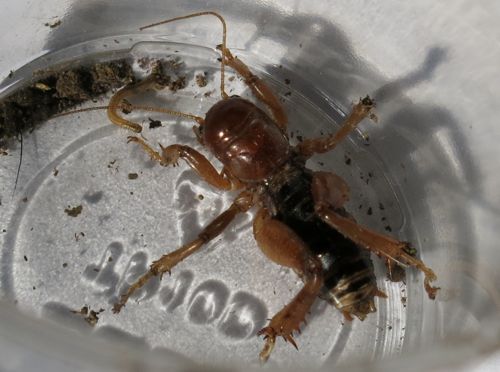
Here’s what I found in my pitfall trap this afternoon:
BlogFeb1615b

The large organism appears to be in the genus Stenopelmatus; from looking at online identification guides, I’d guess this organism is probably a Dark Jerusalem Cricket (Stenopelmatus fuscus [Haldeman, 1852]). Where does it fit into the web of life? According to the Nevada at Reno Department of Extension: “Because it is nocturnal and comes out of the ground at night to roam around, owls, including the endangered spotted owl, feed on it. Probably other nighttime predators such as coyotes, foxes, and badgers eat it as well.” As for their food sources, the Orange County (Calif.) Vector Control District (OCVCD) says the primary food sources of Jerusalem Crickets are “plant roots and tubers; however, “they also feed on other insects, even their own kind.” The OCVCD also states that Jerusalem Crickets do not pose a health threat to humans.

The other organisms in the trap — you can see something like a centipede under the Jerusalem Cricket’s left antenna — were too small for me to have any hope of identifying. Besides, if I’m going to accurately identify insects and similar invertebrates, I’d need to ask an entomologist equipped with powerful binocular microscope.

More about insect pitfall traps.

Mammal signs

Yesterday, Carol noticed some scat and other mammal signs in our garden. First, something has been eating the tree kale Carol has been growing. The bitten-off leaves and stems are some 425 mm / 17 inches from the ground:

BlogJan2315b

This seems a little high off the ground for rabbits. According Jameson and Peeters Mammals of California, the rabbit most likely to be found in our area is Audubon’s Cottontail (Sylvilagus audubonii). The total length, from nose to tail, of Audubon’s Cottontail is 370-400 mm, or about 15 inches; it would be a stretch (but possible) for a rabbit that size to reach up 425 mm to nibble on stems and leaves.

Right next to the tree kale is a deposit of scat: many small pellets, all about 5-7 mm in diameter. This, according to Olas Murie in A Field Guide to Animal Tracks would be absolutely typical of cottontails. But it may be coincidence that there’s a deposit of cottontail scat right next to the bitten-off twigs, and it could be that a deer got into our yard; Carol has seen deer down the cul-de-sac on which we live, and we suspect that they move up and down San Mateo Creek, which is less than a block from our house.

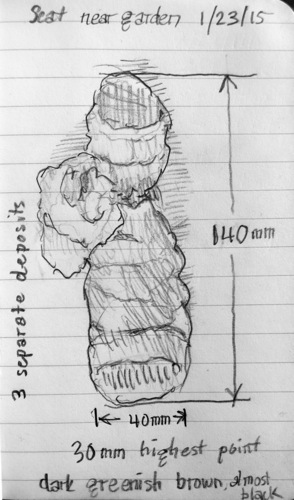
There’s another scat right next to another of our garden beds. Here’s my sketch of it:

BlogJan2315a

The lack of taper on the ends, and the relatively large size, leads me to believe that these are raccoon scat. Murie says that raccoon scat can be difficult to identify, and “may be confused with the larger skunks and opossum.” But given the size — on the large size for raccoons, probably too big for skunks or opossums — and the fact that we regularly see raccoons at night in our garden, I’m going to guess this is from a raccoon.

Sacred Harp Convention

Once every three years, the All-California Sacred Harp Convention comes to the Bay area. It’s going on this weekend.

What is Sacred Harp, you ask? It has nothing to do with harps, but you sing from a book called The Sacred Harp. At a Sacred Harp convention, you sing for three hours in four-part harmony at the top of your lungs along with 150 other singers who range in age from 8 to 80-something. Then you break for this fabulous potluck lunch, where you eat more good food than you can believe. Then you go back sing again for another three hours in the afternoon. Then you go back the next day and do it all over again.

Ants

Recently, I stumbled across the AntWeb site, sponsored by the California Academy of Sciences. Once you create a login (and all you have to provide is a username and password, no other info), you have access to tons of photographs of ant specimens, taken through a powerful microscope. Of particular interest to me is the online field guide to California ants, with photos of nearly all of the 270 resident species. The curator of the California pages writes:

“Prominent California ants include seed-harvesting species in the genera Messor, Pheidole and Pogonomyrmex; honeypot ants in the genus Myrmecocystus; a diverse array of species in the genera Camponotus (“carpenter ants”) and Formica; native fire ants (Solenopsis spp.); velvety tree ants (Liometopum spp.); and the introduced Argentine ant (Linepithema humile). This last named species is particularly common in urban and suburban parts of California, where it establishes dense populations and eliminates most native species of ants.”

I’ve always thoughts ants were interesting creatures. Now having looked through dozens of photos of ants I will go further and say that they are beautiful creatures. Even the Argentine ant appears beautiful, in spite of the destruction it does to native arthropods.

I am also fascinated by the written descriptions; these descriptions have their own kind of beauty, which may be found in their economy and laconic precision. Here, for example, is how to identify the Argentine ant — remembering that you will need a powerful binocular microscope to see all these details:

Diagnosis among workers of introduced and commonly intercepted ants in the United States. Antenna 12-segmented. Antennal scape length less than 1.5x head length. Eyes medium to large (greater than 5 facets); do not break outline of head; placed distinctly below midline of face. Antennal sockets and posterior clypeal margin separated by a distance less than the minimum width of antennal scape. Anterior clypeal margin variously produced, but never with one median and two lateral rounded projections. Mandible lacking distinct basal angle. Profile of mesosomal dorsum with two distinct convexities. Dorsum of mesosoma lacking a deep and broad concavity; lacking erect hairs. Promesonotum separated from propodeum by metanotal groove. Propodeum with dorsal surface not distinctly shorter than posterior face; angular, with flat to weakly convex dorsal and posterior faces. Propodeum and petiolar node both lacking a pair of short teeth. Mesopleura and metapleural bulla covered with dense pubescence. Propodeal spiracle bordering posterior margin of propodeal profile. Waist 1-segmented. Petiole upright and not appearing flattened. Gaster armed with ventral slit. Erect hairs lacking from cephalic dorsum (above eye level), pronotum, and gastral tergites 1 and 2. Dull, not shining, and color uniformly light to dark brown. Measurements: head length (HL) 0.56–0.93 mm, head width (HW) 0.53–0.71 mm.”

Caroling

Jenni suggested the Ferry Building in San Francisco, so that’s where Ray, Tara, and I met her a little after three this afternoon. Both our tenors were ill, but we figured no one would notice that both Ray and I were singing bass. We started out just inside the main entrance, but between the traffic along Embarcadero and the crowds in the building, it was too noisy. So we went down to the south entrance, and set up there. “What should we start with?” “Deck the Hall, page 11.” Jenni counted us in, and we began to sing.

Once we got in the groove of singing, I could relax a little and look at the people who were listening to us. Everyone was smiling. Except two small children, who stood listenly raptly, their mouths slightly open. We decided to take a break, and the woman who was with the two children thanked us. “My kids are just enthralled,” she said. “Oh, then we’ll sing something else for you,” said Jenni. The kids wanted to hear “Frosty the Snowman,” but we didn’t have the music for it, so we settled on “Jingle Bells.”

Later we sang at the north end of the Ferry Building, and people had the same reactions: the adults all smiled, and the children just stood and listened. We all hear a lot of Christmas music in December — the endless Christmas carols played as background music in stores, the songs you hear on the radio — but it’s much better when you hear live music, even when it’s performed by people who are not professional musicians. Live music is not neatly packaged by corporate bean counters; it is not controlled by the touch of your finger on a touch screen; it is not performed in some acoustically perfect recording studio somewhere. Unlike recorded music, it is imperfect and alive and a little bit wild.

We sang until we got tired. We sang several of the carols several times over, but they never got boring, because people were smiling, and one little girl started dancing. Finally we had to stop singing. We were all smiling, too.

Storm

The middle school ecojustice Sunday school class got approval from the Board for installing a rain barrel at church. Last night, Buzz and I rushed to put a downspout from one of the roof drains into the rain barrel, in anticipation of today’s storm. It looks like our rushing was worth it: we’ve had over two and a half inches of rain since then.

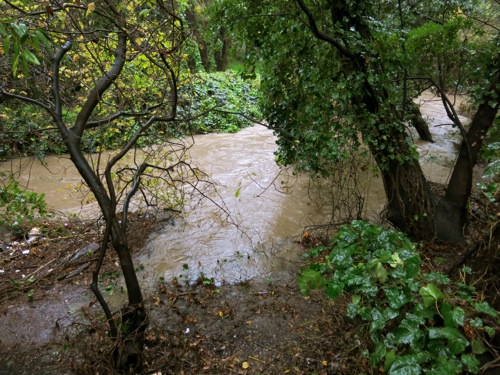
I just took a little walk around our neighborhood. San Mateo Creek was filled with rushing brown water, but the water level is still ten to fifteen feet below the tops of the banks. The ground is pretty well saturated, and I could see puddles everywhere. But the storm drains are still working and the streets aren’t flooded around here. And I can see jetliners flying through the low clouds towards the airport, so it looks like SFO is open.

BlogDec1114

Above: San Mateo Creek at about 3:45 today, from the Delaware St. bridge. Those trees on the right are usually well out of the water.

But according the Twitter, other places around the Bay area are experiencing flooding. For example, Highway 101 south of San Francisco is flooded in places, and traffic is just a mess. I feel lucky that I was scheduled to work at home today.

UNCO 14: last thoughts

The last session I attended at UNCO 14 West was the session on the spiritual and mental health of pastors on Wednesday morning.

The purpose of the Wednesday morning breakout sessions is to figure out what “has legs,” that is, which of the ideas that emerged during UNCO are worth following up on. One of the key ideas that came up during UNCO 14 West was the idea that innovative ministries need to find new funding sources. This is an important step in the evolution of Unco, as Carol Howard Merritt tweeted: “#unco14 discussions at year 5: We have gone from complaining to dreaming to planting. Now we’re looking at funding. It’s really beautiful.”

And I think the idea that we need to support the mental and spiritual health of pastors engaged in innovative ministries is just as important the idea that we need to support the financial health of innovative ministries. Ministry is, in many ways, an essentially conservative profession: we are supposed to conserve the tradition of which we are a part. My own denomination is theologically liberal, but methodologically conservative and risk-averse: a few innovative ideas have been given the imprimatur of the denominational bureaucracy, but most other innovation is ignored. I’d guess my denomination is typical of all mainline denominations.

And what happens if a minister or lay leader tries innovation goes beyond the innovative allowed by the bureaucracy? What happens when a minister or lay leader tries something risky? Well, because of the conservative nature of ministry, and because of the conservative nature of denominations, anyone who goes beyond the allowed limits of innovation had better be well-connected. If you are well-connected, if you have friends in powerful positions, your innovation may be allowed, and if it is allowed, it will likely be funded. But if you are not well-connected, you may well feel like the goat in Leviticus 16 who gets sent into the wilderness: “The goat shall bear on itself all their iniquities to a barren region; and the goat shall be set free in the wilderness.” [Lev. 16.22, NRSV]

Innovative and/or risky ministries are stressful enough in and of themselves. If you are engaged in innovative ministries but are not well-connected within your denomination, you are likely to feel more stress, and have less support. You are also less likely to be held accountable in appropriate ways, and your ministries may well be judged by the wrong standards. This is a recipe for burn-out. I suspect that pastors engaged in innovative ministries are at higher risk for mental illness, something that is already an occupational hazard of professional ministry.

This would suggest that those who are engaged in innovative ministries need additional support. In our breakout session on Wednesday morning, we brainstormed a few ideas: setting up some kind of online chaplaincy for UNCO participants; mutual support and accountability groups meeting via Google Hangouts or Skype; continuing to offer face-to-face support at UNCO; etc. We’ll see which of these ideas “has legs” and will turn into a reality.

But there is a need: innovative ministers need appropriate accountability and sympathetic support.

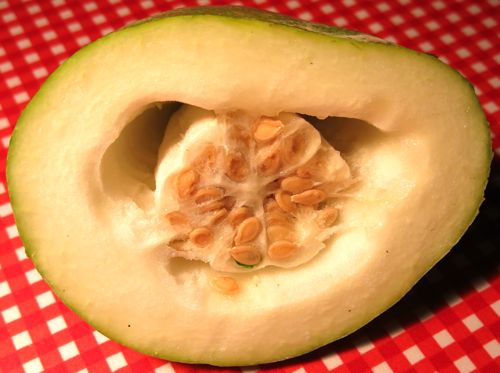
Winter melon

What would you do with a half a winter melon? I’ve gotten friendly with a farmstand that specializes in Asian vegetables at the San Mateo Farmer’s Market. The woman who runs the farmstand knows I love bitter melon, and has told me about its health benefits. She probably figured this white guy needed to expand his Asian melon repertoire, so today she gave me half a winter melon, and said, “Try it in soup.”

There are lots of winter melon soup recipes online, and I’m leaning towards a simple one with dried black mushrooms, chicken broth, a little bit of chopped meat, and some slices of ginger.* But — what would you do if someone gave you half a winter melon?

BlogOct1114b

*Two weeks later: And here’s the recipe I have been using for winter melon soup:

Half of a five pound winter melon, cut into 2 inch pieces (about 2 pounds of melon)
1 quart of chicken broth
1 knockwurst, cut into 1/2 inch circles
8-10 dried black Chinese mushrooms, soaked in hot water for 20 minutes
half a dozen slices of ginger root, peeled, and slivered
salt to taste

Bring the winter melon to a boil in water to cover, then simmer covered for 20 minutes.
Drain the water off.
Add chicken broth, mushrooms, ginger, and knockwurst to the cooked winter melon. Simmer for 20 minutes.

Autumn watch

Even though the temperature got up to nearly eighty degrees today, it feels like fall. The sun is noticeably lower in the sky, and daylight is noticeably shorter than nighttime. I went for a walk up in the hills overlooking Half Moon Bay, and once you get out from under the redwoods into the chaparral, the plants look tired and dry and worn out, ready for the winter rains. Even the fall asters look faded now, with blossoms that are almost white instead of pale violet.

BlogOct1114

Above: Honeybee pollinating asters at Purissima Creek Redwoods Open Space Preserve; the asters are probably the Common California Aster (Symphyotrichum chilense)

During the long climb back up to the trail head, I kept stopping to admire the way the afternoon sun shone gently on the steep hills and canyons that descended to the ocean; admiring the view was also a good excuse to stop and catch my breath when the trail was steepest. After one particularly steep stretch, I turned and saw a Golden Eagle below me. This was a perfect excuse to stop for a moment. I watched the eagle ride the breeze down the canyon until it disappeared from my view behind a forested ridge.