Fishing

Crossing the Border St. bridge, I looked out over Cohasset Harbor. Someone was fishing the whitewater where the tide was running out over the rocks into the harbor. When I got safely across the bridge, I stopped to look, and saw that he was using a fly rod. Mostly I see people using bait and spinning gear. This is the first time I’ve seen someone fly fishing in Cohasset Harbor.

The thought that immediately came into my head was that I’d have to tell Dad about this next time we talked. I gave my head a figurative shake — Dad died nine years ago, I wasn’t going to be talking to him about this. I mean, yes, I could talk with him about it in my imagination, but he wouldn’t be able to tell me whether he had ever gone fly fishing in saltwater (he probably had) and if so, what flies he had used and what he had caught.

Old habits die hard. For the last seven years of Dad’s life, I was living three thousand miles away in California. The last two years, he couldn’t talk any more. Up until then, I’d call him most Sundays, and we’d talk for an hour or so. I wasn’t doing much fishing while I lived in California, and Dad wasn’t doing much fishing those last five years. But we both still thought about fishing and we both still liked to talk about fishing, if either of us had anything new to say. So it’s not surprising that when I saw that guy fly fishing, I’d think about talking it over with Dad.

Here it is, nine years after he died, and there are still a bunch of things I’d like to talk over with Dad. And maybe I’ll go fishing on Father’s Day.

Another anniversary

I was talking with someone I know about the deaths of our respective parents. This person’s parents died four and six years ago, and I got the sense they still feel it fairly strongly. My mother died twenty-five years ago today. I thought I’d feel strongly about the twenty-fifth anniversary my mother’s death, but that hasn’t been the case. Of course I still think about her. But twenty-five years is a long time. She died so long ago now that I don’t really remember what she looked like, I mostly just remember what photographs of her look like. And I don’t really remember what she sounded like, I mostly just remember the one audio recording my younger sister made of her. Then too, she had dementia the last few years of her life, so some of my most vivid memories of her are from that time. So, for example, I remember sitting in my parents’ dining room talking to my mother. She obviously had no idea who I was, but was very polite to me. My father walked by, smiled at her, she smiled back. When he was out of earshot, she turned to me and said, “Who was that man?” That kind of memory is more recent and more vivid than most of my other memories of her. I often feel that my memory is unreliable, and perhaps this is one reason why: the memories I wish were most important, and thus most vivid, often seem to get obscured by other memories.

An anniversary

Thirty years ago this past August, I began working as a director of religious education (DRE) at a Unitarian Universalist congregation. I’ve been working in UU congregations in one capacity or another ever since: as a DRE (twice), an interim religious educator, an interim associate minister, a minister of religious education (twice), and as a parish minister (twice).

Over thirty years and nine congregations, I’ve never seriously considered switching careers. The pay isn’t great (when I moved to Massachusetts, I discovered that I qualified for low and moderate income housing). The job security isn’t all that great (not any more). But I’ve stuck with it, mostly because congregations do a lot of good in the world. For example, research shows that kids who are part of a congregation are less likely to engage in risky behaviors (substance abuse, suicidal ideation, etc.), and are more likely to have good mental health. It’s pretty good having a job where I feel like I’m helping make the world a better place.

But it is kind of odd to think that it’s been thirty years….

Another carnivorous plant

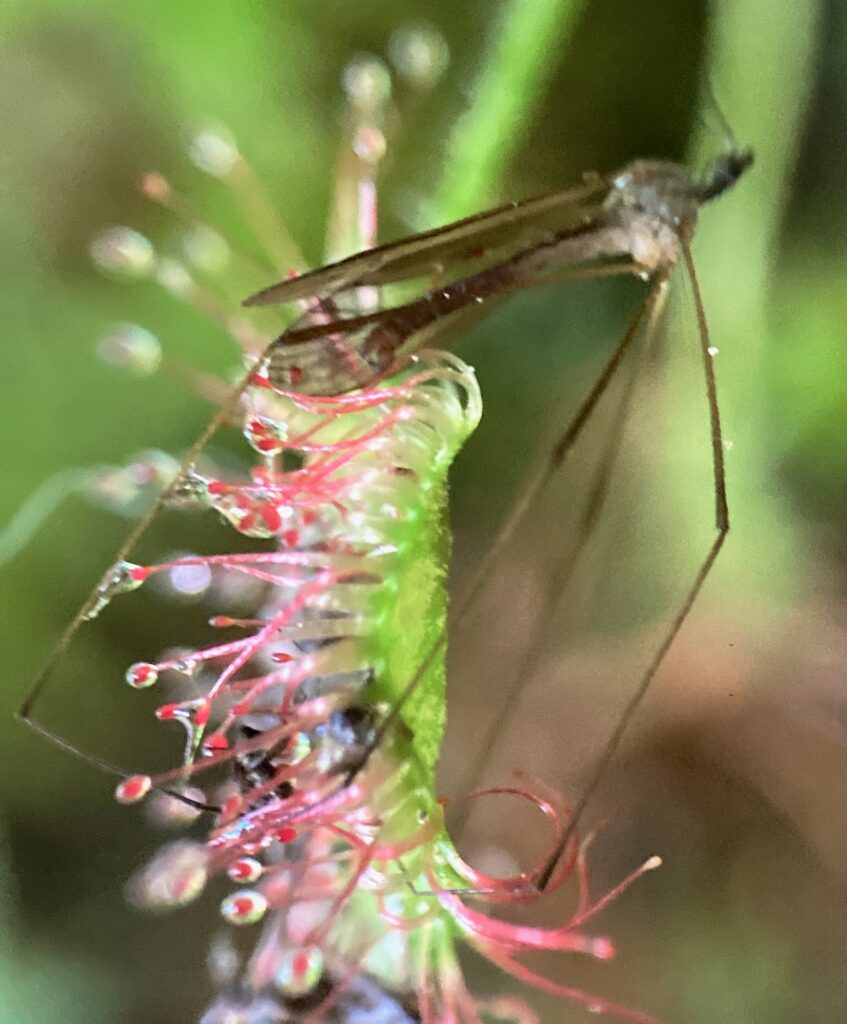
Yesterday, I came across a round-leafed sundew (Drosera rotundifolia). This plant was tiny, not much bigger than the individual sphagnum moss plants amongst which it was growing. I thought I saw some movement on one of the lower leaves.

A tiny plant with leaves that show a sticky substance on them.
Drosera rotundifolia

Sure enough, one of the sticky leaves had ensnared several insects, including a small crane fly that was still struggling feebly.

A small fly with very long legs stuck on a sundew leaf.

The body of the crane fly is far enough away from the leaf that I suspect the plant’s enzymes won’t be able to digest most of the insect. Not that the crane fly’s corpse will go to waste; something else will decompose it, and keep its nutrients cycling through the interdependent web.

A COVID memoir

I wrote this for a science fiction fanzine. But it also works well for this blog.

I

Two years before the pandemic hit, we started living in a graveyard. Not right in the middle of the graves—there was a low stone wall that separated our house, the cemetery office, and the parking area from the graves. But we lived inside the tall iron fence that separated the cemetery from the residential area surrounding it, and each evening an electric motor would start up, slowly driving the big iron gate along its track, shutting us off from the rest of the world.

It might sound a little creepy, but it was actually a very pleasant place to live. We lived in the old caretaker’s house, which was over a hundred years old. Neighbors walked past our house during the day, taking a walk in the cemetery, because it was only open space in the neighborhood. We could chat with the cemetery supervisor, and we got to know some of the members of the cemetery’s board of directors. At night when the gate closed, we had our own private five acre back yard. And, as we liked to say, the neighbors were quiet.

I’m not the first to notice that life during the pandemic felt like living inside a dystopian sf novel. That we lived in a graveyard made it feel even more like a novel. And it felt especially dystopian at the end of the summer, when the sky turned bloody reddish orange.

Continue reading “A COVID memoir”

G. K. Chesterton on romance and religion

In his introduction to the Everyman edition of Charles Dickens’s Nicholas Nickleby, G. K. Chesterton comments on how religion and romance are similar. Mind you, when Chesterton says “religion,” what he really means is “Christianity”; thus his is a narrow perspective indeed. Even so, I’m going to quote some of what he says, interspersed with my own commentary:

“Romance is perhaps the highest point of human expression, except indeed religion, to which it is closely allied. Romance resembles religion especially in this, that it is not only a simplification abut a shortening of existence….”

I agree with the first sentence. I think the second sentence is a gross oversimplification of both romance and religion.

“…religion is always insisting on the shortness of human life. But it does not insist on the shortness of human life as the pessimists insist on the shortness of human life. Pessimism insists on the shortness of human life in order to show that life is valueless. Religion insists on the shortness of human life in order to show that life is frightfully valuable….”

Even though Chesterton is really distinguishing between pessimism and Christianity, I think he’s on to something here. Other religions (or other spiritualities) do in fact say that life is frightfully valuable. This is one of the most important functions of religion and spirituality in human society.

“All this is equally true for romance. Romance is a shortening and sharpening of human difficulty. Where you and I have to vote against a man [sic], or write (rather feebly) against a man, or sign illegible petitions against a man, romance does for him what we should really like to see done; it knocks him down; it shortens the slow process of historical justice….”

And religion does this to some extent, too, although we have a longer timeline that the writers of romances like Nicholas Nickleby. In Nicholas Nickleby, evil uncle Ralph Nickleby is driven to death after a period of two or three years; so it’s only a few years until the evildoer gets what he deserves. According to most religions, it takes longer for justice to prevail. The conservative Christians (like Chesterton) talk about judgement by God after death; we will have to wait until death for evil persons to get their just desserts. Progressive Christians like Theodore Parker and Martin Luther King, Jr., talk about the moral arc of the universe bending towards justice; we will have to wait until long after any of us dies before the evil that is in society is expunged. Some strands of Buddhism tend towards quietism and simply accept suffering while trying to transcend it, but the Engaged Buddhists like Thich Nhat Hanh closely resemble Dr. King and Theodore Parker in their timeline for justice to arrive.

I suspect that what both religions like Christianity and Engaged Buddhism, and romances like Nicholas Nickleby share is a commitment to hope. Pessimists (and even some realists) see hope as ridiculously idealistic. Religions and romances take hope as a given.

Four years

Four years ago today, on Friday, March 13, 2020, the state of California shut down schools across the state. I was then the minister of religious education in Palo Alto, Santa Clara County, California. Since our congregation decided to tie our education programs to whatever the public schools did, that meant we too were going to move all our programs online effective immediately. And on that same day, Santa Clara county banned all gatherings of more than 100 people, so our congregation moved Sunday services online as of the following Sunday.

Complete lockdown happened three days later, as most Bay Area counties issued a stay-at-home order on March 16. A state-wide shelter-in-place order was issued on March 19.

Houses of worship were considered “essential services,” so I could get out of the house and go to work a couple of days a week. But it was definitely creepy commuting to work on Highway 101. The week before, all four lanes in both directions would be packed with cars from 6 a.m. to 9 p.m. In the first weeks after the shut-down, at times I’d see no other cars on the road. It reminded me of this passage from Daniel Defoe’s Journal of a Plague Year: “…the great streets within the city [of London], such as Leadenhall Street, Bishopsgate Street, Cornhill, and even the Exchange itself, had grass growing in them in several places; neither cart or coach were seen in the streets from morning to evening, except some country carts to bring roots and beans, or peas, hay, and straw, to the market, and those but very few compared to what was usual.”

Noted without comment

A letter from Dr. Samuel Johnson, to his friend Dr. Lawrence whose wife had just died:

“The loss, dear Sir, which you have lately suffered, I felt many years ago, and know therefore how much has been taken from you, and how little help can be had from consolation. He that outlives a wife whom he has long loved, sees himself disjoined from the only mind that has the same hopes, and fears, and interest; from the only companion with whom he has shared much good or evil; and with whom he could set his mind at liberty, to retrace the past or anticipate the future. The continuity of being is lacerated; the settled course of sentimant and action is stopped; and life stands suspended suspended and motionless, till it is driven by external causes into a new channel. But the time of suspense is dreadful.”

from Boswell’s Life of Johnson, 20 Jan. 1780

Dream world

I woke up early, decided it was too early, and went back to sleep. I seem to have had a lot of dreams, none of which I remember. But I have vague memories of a dream involving my mother, during the years she had dementia. My mother died twenty-five years ago this month, and for the last few years of her life had gradually increasing dementia associated with supranuclear palsy, Parkinson’s, and the side effect of the drugs she was taking. She didn’t know who I was for the last couple of years of her life, and I didn’t have much in the way of real conversations with her for a couple of years before that. The mother who appeared in my dream last night was the person who had dementia — not always making sense, sometimes hallucinating. It’s funny how vivid my memories of that time still are, vivid enough to reappear in my dreams from time to time.

In an opinion piece on Religion News Service, Tyler Huckabee quotes from an interview with Russell Moore. Moore has become semi-famous for having called out the Southern Baptist Conference on their sex abuse crisis, and getting savaged for it. Anyway, in the interview Moore says:

“…multiple pastors [told] me, essentially, the same story about quoting the Sermon on the Mount, parenthetically, in their preaching — ‘turn the other cheek’ — to have someone come up after to say, ‘Where did you get those liberal talking points?’ And what was alarming to me is that in most of these scenarios, when the pastor would say, ‘I’m literally quoting Jesus Christ,’ the response would not be, ‘I apologize.’ The response would be, ‘Yes, but that doesn’t work anymore. That’s weak.’ And when we get to the point where the teachings of Jesus himself are seen as subversive to us [evangelicals], then we’re in a crisis.”

Mind you, Moore opposes same-sex marriage, opposes abortion rights, and I don’t think I’d have much in common with him. But I admire the way he stood up for his core values. And I find it unfortunate that he paid a heavy price — he was essentially driven out of the Southern Baptist Convention, and is now pastor of a non-denominational church.

We’ve actually seen similar things happen within Unitarian Universalism. To give just one example, we drove out half of our African American members from 1968 to 1970, people who wanted us all to live up a moral standard that the rest of the denomination could not accept.

It’s difficult to live up to high moral standards. It’s even more difficult when someone challenges us, telling us that we’re not living up to the moral standards we claim to hold. Conversely, it’s very easy to convince ourselves that we are right and everyone else is wrong. Especially in today’s hyper-polarized society, where we seem to be unable to listen to any point of view that differs from our own. But if we can’t listen to others, we may find that ourselves saying something that contradicts our core values.