Is napping necessary?

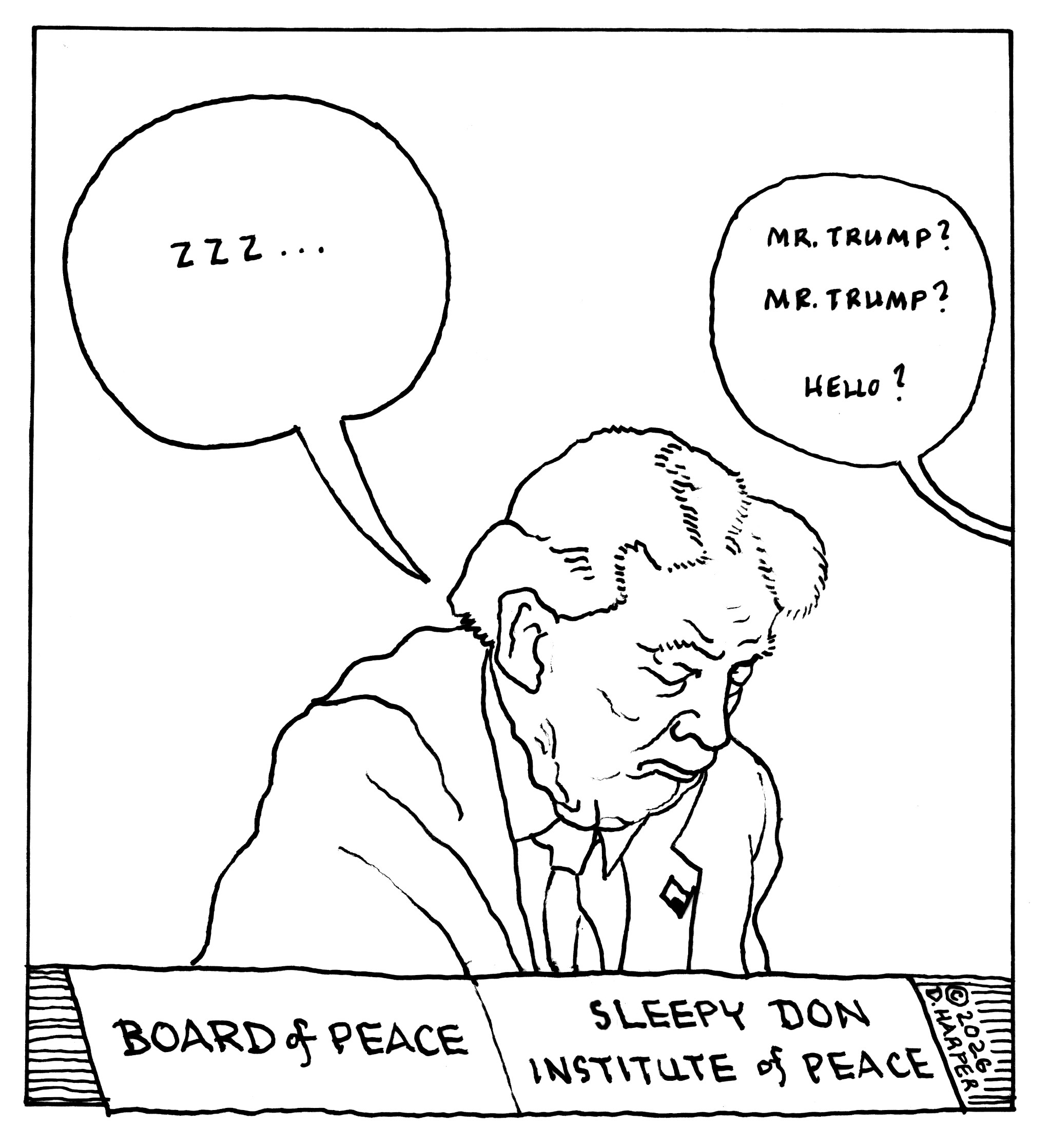
News item: “President Trump has once again dozed off on camera at his own event. Footage shows Trump looking extremely drowsy at his inaugural ‘Board of Peace’ meeting on Thursday at the U.S. Institute of Peace in Washington, D.C.”

As usual, those who oppose Donald Trump will make fun of this, but many health care professionals advise that napping is beneficial. Take, for example, a webpage titled “Is Napping Necessary?” found on the St. Louis Children’s Hospital website (I’ve adapted it slightly):

How the pandemic and the ICE crackdown are similar

“Exploring the Pandemic Impact on Congregations” (EPIC) is a research project that has been — you guessed it — exploring how the COVID pandemic affected congregations. Recently they published a short blog post by Rev. Miluska E. Silencio, a self-described Latina church planter. She finds some interesting parallels between her past experience as a clergyperson during lockdown, and her current experience as a clergyperson during ICE crackdown:

Read the entire piece.

Groan

The OWL grade 7-9 class met this afternoon. OWL is the comprehensive sexuality education course for early adolescents developed by the Unitarian Universalist Association and the United Church of Christ, and beloved by parents; the initials stand for “Our Whole Lives.”

Class ended in time for Superbowl parties. One parent, as he picked up his teen, made a joke that I can’t believe I’ve never heard before. He was taking his child to the Superbowl from superb OWL….

It doesn’t seem so funny when I put it down in cold print, but it was definitely funny at the time.

What the world needs now…

Carol was telling me about an influencer whom she follows. She told me one thing that this influencer said that seemed questionable to me. We argued about it for a bit. “You know influencers lack?” I said.

Carol looked at me skeptically. “What?” she said.

“Editors and fact checkers,” I said.

Two dying professions. I just wish we had more of them.

Quote to start the year

While researching Neo-Dadist sculptor Soroku Toyoshima this afternoon, I ran across a quote by his son that feels like it’s meant for the coming year:

This comes from a 2021 interview titled “Teach-In on Race: Tak Toyoshima on Using Art to Heal the World,” on the Emerson College website. Tak is probably best known as the creator of the “Secret Asian Man” cartoon. And while he’s not exactly a Unitarian Universalist, Tak is UU-adjacent, with a spouse who’s active in a local UU congregation.

Noted without comment

From an interview in Esquire with Scott Galloway, who is clinical professor of marketing at the Stern School of Business, New York University:

(Thank you, Carol, for finding this.)

Noted without comment: “performance of meanness”

From a story by Fiona Murphy titled “How ‘RaptureTok’ amplified an extreme corner of faith” (Religion New Service, 26 Sept. 2025). The story documents how minority religious views are often mocked and belittled on TikTok….

Online resource for practical theology

Practical Theology Hub is a website that says it’s “a space for anyone with an interest in practical theology to share their reflections and explore new ideas.” It’s “not an academic website” but rather publishes short articles from partitioners, academics, students, and “retirees.”

Here are some of the titles of recent articles that caught my eye: “Growing closer to God through stained-glass windows: A dyslexic autistic perspective” (Christianity); “Neoliberalism, Social Inequality, and Christianity of Liberation” (Christian); “Food and interdependence: Responsibility in food donation” (Buddhist); “Avatar Discipleship – Who am I engaging with the avatar or the person?” (Christian); “My Friend, Siddhartha” (Indic religions); “Two Peoples Living in This Land” (Judaism); “Armed Resistance, Islam, and the Limits of Secular Approaches” (Islam).

Resource for faith leaders

Our town social worker pointed out an online course that should be of interest to most faith leaders, including UU clergy — “Mental Health and Aging for Faith Leaders.” This research-based, 4-hour-long course is hosted by the Boston University School of Social Work.

From the course description: “Many older adults and their families turn to their faith communities as they encounter mental health concerns associated with aging. This course is designed to prepare faith leaders and members of faith communities to address these concerns. The course reviews the major mental health conditions that affect older adults, describes barriers to treatment,  and discusses the impact of culture when addressing mental health concerns.”

Get more information here.

Violence, nonviolence

A hundred days ago, Hamas unleashed their attack on Israel. In response, Israel has been carrying out reprisals on the Gaza Strip. And the war is spreading throughout the region, so that the U.S. and other countries have sent warships to protect shipping in the Red Sea. An initial act of violence led to an ongoing violent reaction, which in turn is leading to violence spreading even further….

Many years ago, the science fiction author Isaac Asimov had a character in one of his novels say, “Violence is the last refuge of the incompetent.” This pronouncement by a fictional character is a gross generalization subject to all kinds of exceptions (think about Ukraine). But there is a truth underlying this fictional pronouncement, and that is that violence does tend to beget more violence, so any use of violence can suck you into a vicious circle of more and more violence.

This was part of the genius of Rev. Dr. Martin Luther King, Jr., and his principle of nonviolence. It’s something worth remembering as we celebrate his birthday tomorrow.