Happy Watergate Day

A friend from high school reminded me that yesterday was Watergate Day. On Saturday, June 17, 1972, five burglars paid by CREEP (Committee to Re-Elect the President) broke into the Democratic National Convention headquarters at 2600 Virginia Avenue, Washington, D.C., in the same building as the Watergate Hotel. They placed hidden microphones — bugs — and took photos of sensitive material. It eventually turned out that then-President Richard (“I Am Not A Crook”) Nixon authorized and had direct knowledge of the burglary; he resigned rather than face impeachment proceedings.

The Watergate scandal shaped the political consciousness of my immediate age cohort. People a few years older than my age cohort talk about the assassination of Robert Kennedy and Malcolm X as defining moments in their political awareness, but for us the defining moment was criminal activity by the President of the United States.

A few years after the Watergate scandal, I think in 1977, some friends of mine and I re-enacted the Watergate break-in in our high school: we walked in to the office of one of the principals, dumped dead insects on his desk, and informed him that we were bugging his office. I don’t remember suffering any punishment for this act of street theatre. At least we weren’t selling drugs, one of the things our high school was known for (the school had its own undercover narcotics agents), and at least we showed that we knew something about U.S. history.

I have never commemorated Watergate Day since then. But maybe I should, under the theory that those who forget history are condemned to repeat it. The current presidential election campaign has already descended to mud-slinging and name-calling, and outright criminal acts may be following close behind.

Grumpy old white guys

I feel qualified to speak about grumpy old white men, because (depending on how you define “old”) I qualify as a grumpy old white man myself.

Now, I’m a big fan of being grumpy. There’s plenty to be grumpy about: endless wars, people out of work, terrorists, the list goes on and on. I say: if you’re not grumpy, you’re not paying attention. But as a grumpy old white man, if I want anyone to take my grumpiness seriously, there are some things I should not do.

If I start sounding angry, then even though I may be right my grumpiness loses much of its persuasive force. This is Donald Trump’s problem. When he says we should cut military adventures overseas and do something to protect U.S. jobs, I think he gets it right. But when he goes on one of his angry tirades, all I can think is: “Another grumpy old white guy who bores you to tears telling you everything he’s angry about.”

And if I refuse to acknowledge it when someone gets the best of me, then I lose the high moral ground that grumpiness requires to be effective. (This holds true even when I happen to be right, and others wrongly disagree with me.) This is Bernie Sander’s problem. When he says we need to further reform the health care system and we shouldn’t trust Wall Street, I think he gets it right. But when he refuses to acknowledge that Hillary Clinton has a lock on the Democratic nomination, all I can think is: “Another grumpy old white guy who won’t admit he’s been beaten by a woman.”

Pfeh. All I can say is that these two guys are making the rest of us grumpy old white men look bad; which is too bad, because grumpiness combined with persuasive force, that takes a high moral ground, has the potential to be an enormous force for good.

Obligatory election post

The creators of the Political Compass Web site assert that it is not enough to know whether a political leader is on the left or right; we also need to determine if they are authoritarian or libertarian.

Consider the economic scale first: Those on the far left believe it is best to manage the economy for the greater good of all; the further to the left, the more they believe in managing the economy. By contrast, those on the right believe to a greater or lesser degree in the power of the free market. Now consider the social scale: Those who take an authoritarian position believe that the state is more important than the individual. By contrast, those who take a libertarian view believe in the supreme value of the individual. Both scales are of equal importance.

We can put these two axes together in a Cartesian coordinate system to make the “Political Compass,” where the x axis ranges from leftists (negative numbers) to rightists (positive numbers, and the y axis ranges from libertarians (negative numbers) to authoritarians (positive numbers). In this scheme, Stalin would feel at home in the upper left quadrant, which is where you’ll find those who advocate for state-controlled collectivism. Gandhi would feel at home in the lower left quadrant, with voluntary regional collectivism. Pinochet would be happy in the upper right quadrant, with overwhelming state support for the free market. Ron Paul, with his support of libertarian social ideals and the free market, falls in the lower right quadrant. And the Political Compass Web site has a quiz you can take to determine where you yourself fall along the two axes; I scored -9.6 on the economic scale, and -7.6 on the social scale, placing me in the same quadrant as Gandhi.

As much as I like the Political Compass system, I don’t think four quadrants accurately capture the way I perceive political leaders. Therefore, I like to map the Alignment System from role-playing games onto the Political Compass.

The Alignment System describes a creature or character in a role-playing game along two axes: good vs. evil, and chaotic vs. lawful. The chaotic/lawful axis maps neatly onto the libertarian/authoritarian axis of the political compass. The good/evil axis does not map so neatly. But from my perspective, the current political environment privileges either the free market or individual persons; we are given a choice between making a profit, or protecting individual persons. In the Alignment System, “Good characters and creatures protect innocent life” (link), so I choose to map the good/evil axis of the Alignment System onto the left/right axis of the Political Compass, with good corresponding to leftist.
BlogMay0616

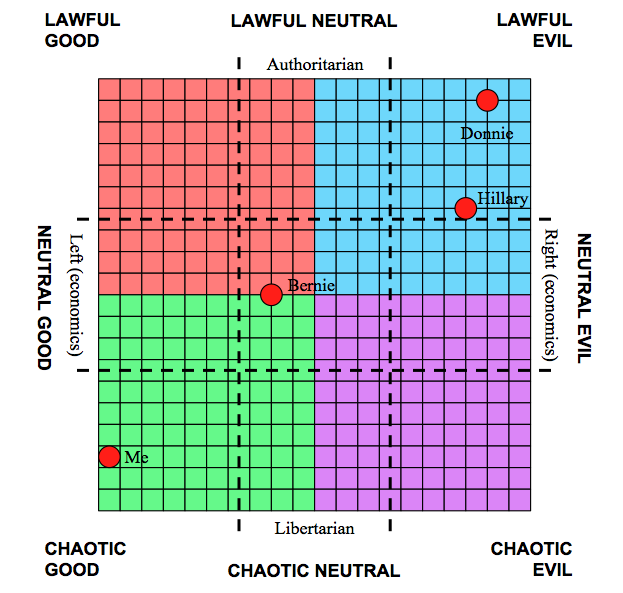
The beauty of the Alignment System is that it offers a nuance that does not appear in the Political Compass: there is a middle ground, named Neutral, in both axes. This gives nine possible orientations, as seen on the chart below: Lawful Good, Lawful Neutral, Lawful Evil, Neutral Good, Neutral, Neutral Evil, Chaotic Good, Chaotic Neutral, and Chaotic Evil. Considered in terms of positive attributes, along the Lawful/Chaotic axis, Lawful equates with honorable; Neutral equates with practical; and Chaotic equates with independent. Along the Good/Evil axis, Good equates with humane; Neutral equates with realistic; and Evil equates with determined (link). All this helps me better understand why I feel left out of the current U.S. presidential race: there are no Chaotic Good (independent and humane) characters running for president.

Considered in terms of the Alignment System, Bernie is probably the best overall choice because he is a Neutral character, both practical and realistic: “…neutral characters … see good, evil, law, and chaos as prejudices and dangerous extremes” (link). Fair enough; but because I am a Chaotic Good character myself, I am turned off by Sanders’ claim that he is Chaotic Good when he is so obviously Neutral. If he would just admit that he is Neutral — a moderate Keynesian who is neither authoritarian nor libertarian — I could see my way to supporting him. Of course Lawful Evil characters dominate U.S. political discourse, and so Sanders will never be allowed to claim his true identity as Neutral; he will always be cast as Chaotic Good because that’s how the Lawful Evil characters perceive him.

Now both Hillary and Donnie are both in the authoritarian right quadrant of the Political Compass; i.e., they are both Lawful Evil, or in terms of positive attributes, they are honorable and determined: “Lawful evil creatures consider their alignment to be the best because it combines honor with a dedicated self-interest” (link). The only real difference between the two is that Donnie is significantly more authoritarian. However, since I am Chaotic Good, I am never going to feel comfortable with either one of them.

If you look back at previous U.S. presidential elections, as charted on the Political Compass Web site (2012, 2008, 2004), you will see that Barack Obama started out as Neutral, but after one term in office became Lawful Evil; and George W. Bush was of course Lawful Evil. The Political Compass Web site did not exist during the Bill Clinton years, but given that Hillary Clinton holds positions similar to his, it seems likely to me that Bill was also Lawful Evil. There is little doubt in my mind that Ronald Reagan was Lawful Evil, and so was George H. W. Bush. Thus we have had Lawful Evil presidents in the U.S. since at least 1980.

You know, that could explain a great deal….

A comment from 1933

“…In large measure the race question involves the saving of black America’s body and white America’s soul.”

— James Weldon Johnson in his autobiography Along This Way, 1933. Although Johnson was discussing his work at the NAACP fighting lynching, in large part this observation still holds true today (and, by the way, provides a self-interested reason for some of us white people to be involved in anti-racism work).

Welders and philosophers

Marco Rubio is an ass. I say this both as a philosophy major, and as someone who has worked with his hands for a living.

In Tuesday’s Republican debate, Rubio stated, “Welders make more money than philosophers. We need more welders and less philosophers.” Let’s take that first pronouncement first. Forbes.com researched the statement, and when the compared teachers of philosophy with welders, they found that philosophers earn more than welders. So Rubio is wrong.

But let’s assume that Rubio is talking about anyone with a philosophy degree. My graduating class in college had about 50 philosophy majors. The majority of them went to to law school; an undergraduate degree in philosophy was then a well-respected pre-law degree because philosophy gave you experience in debate, critical thinking, reading lengthy and mind-numbingly boring texts, and putting up with incredible amounts of bullshit — all valuable skills for lawyers. Note that Rubio is in fact a lawyer, and probably is professionally close to more than one well-to-do philosophy major; he must know the value of philosophy training to lawyers. So it’s hard to know why he puts down philosophy majors, unless perhaps he is jealous of the superior legal skills of those with degrees in philosophy.

Now let’s look at this from the point of view of people who have actually worked with their hands for a living. Which, by the way, Rubio himself has never done. Welding is a great job, and recent jobs posted on the Jobs in Welding Web site include positions ranging from really creative jobs, e.g., welder to work on experimental and production welding — to straightforward production jobs, e.g., working as a boilermaker welder in a railroad maintenance facility. Yes, these are great jobs, but as with any job where you work with your hands, you have to worry about getting hurt, and you have to worry whether your body will physically hold up until retirement. Speaking as someone who spent five years working as a carpenter, I can tell you that these are non-trivial worries, and that because of this many manual labor jobs are far more stressful than white collar jobs. Furthermore, manual labor jobs are constantly in danger of being off-shored, out-sourced, or made obsolete by new technology (e.g., robots now perform many welding tasks; so-called manufactured homes are cheaper than stick-built homes; etc.) — and these dangers just add to the stress.

At this point, we could get into an interesting argument about whether Rubio’s economic priorities are more likely to help or hurt manual laborers, but let’s hold off for a moment. Let’s just say that I’d feel better about Rubio’s pronouncement if he knew what it was like to work with your hands, the constant worry about getting hurt, the seasonal lay-offs. Given that he is a soft-handed law school graduate who has always had cushy, white-collar jobs, his comment about philosophy majors and welders makes him come across as an ass.

I’m using “ass” in a philosophically precise sense, as a shorthand version of the more offensive word “asshole,” a word that has been precisely defined by philosopher Aaron James as someone who “is immunized by his sense of entitlement against the complaints of other people” (Assholes: A Theory, New York : Doubleday, 2013). While James’s book may be problematic in some areas, his definition of “asshole” is a good one. Since Marco Rubio comes across as having a great sense of entitlement, with no awareness of how other people perceive him, he fits James’s definition of an asshole, and it is in this sense that I call Rubio an ass.

So at this point, let’s look at Rubio’s second pronouncement: “We need more welders and less philosophers.” Sad to say, too many of our politicians are persons who, like Rubio, have become immunized to their sense of entitlement. As a philosophy and moral theologian, I would say that what the American political scene needs as much as anything is a healthy dose of humility and moral reflection — something that we philosophers are well-trained to supply. No wonder Rubio wants fewer philosophers: we are the ones who can point out that he’s being an ass, and tell him how to stop.

In summary, although we could use fewer people like Marco Rubio, we actually could use more of both welders and philosophers.

Religion in the public square

In the United States, all too often the phrase “religion in the public square” means someone accosting you and telling you that you should join their religion; so the meaning of the phrase becomes, “our religion is right and yours is wrong.” Or that same phrase can be used pejoratively to imply that all religious practice shouldb e kept out of public view; so the meaning of the phrase becomes, “all religion is wrong.” Either way, someone is imposing their own views on the rest of a democratic society.

But if ours is a truly multicultural democracy, we should allow space in the public square for a variety of worldviews, without letting any one worldview dominance over the others. This becomes a delicate balancing act. Literal or metaphorical shouting matches between religious worldviews don’t promote tolerance; mind you, sometimes you have to get into shouting matches to preserve the openness of the public square, as when we have to fight to limit Christmas displays on public property, but no one imagines that these shouting matches increase tolerance. So given that public religious expression is a delicate balancing act, what does it look like when you have an appropriate expression of a religious worldview in the public square?

Sukkah at the JLISF, Columbus and Lombard, San Francisco

Today I saw such an expression of a religious worldview in the public square, and it looked like a rented flatbed trailer with a sukkah built on top of it. The trailer was parked in front of the Jewish Learning Institute of San Francisco (JLISF), on Lombard Ave. right off busy Columbus Ave in the North Beach neighborhood. Carol and I walked by just as some people from JLISF were cleaning up from lunch. They were polite and friendly, and ready to explain that they were celebrating Sukkot, and what a sukkah was, and so on.

This is a good display of religion in the public square: present, but not intrusive; with friendly people who are ready to explain, but not berate.

Sukkah through a bus window

(Posted the next day, and backdated.)

Test your religious knowledge

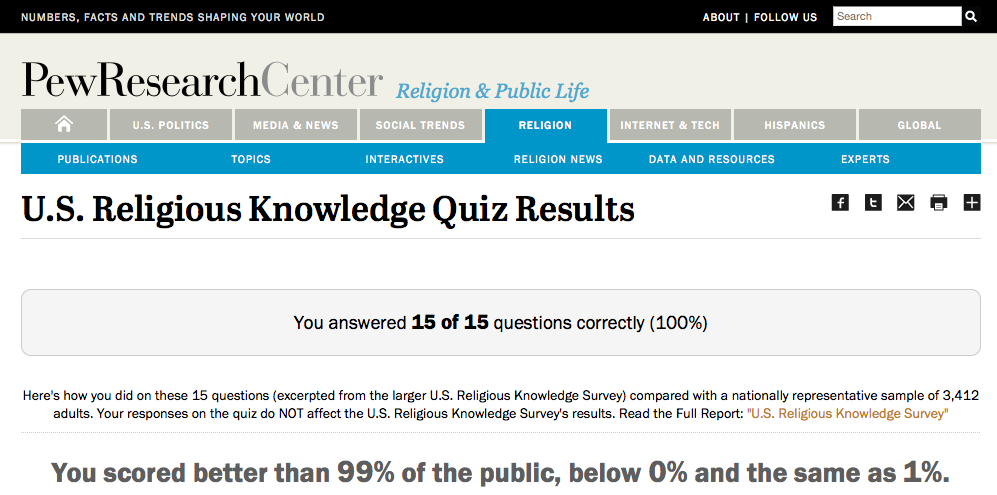
Think you know a lot about religion? Well, the Pew Research Center has developed a “U.S. Religious Knowledge Quiz” where you can find out. The fifteen questions on the quiz test your knowledge of the Bible and of world religions. The online quiz is here.

After you take the online quiz (and find out how much you really do know), you’ll want to go on to read about the survey from which this quiz was extracted, the “U.S. Religious Knowledge Survey.” Pew Research Center did a telephone survey in which they asked 32 religious knowledge questions of a random sample of U.S. residents. The average number of correct responses was 16 out of 32. Jews, atheists/agnostics, and Mormons scored best on this longer quiz. Scoring below average were white mainline Protestants, black Protestants, Hispanic Catholics, and “nothing in particular.”

There were so few Unitarian Universalists included in the sample that they are not included in the statistical analysis. How well would we perform? Sometime I’d like to administer either the shorter quiz, or the longer set of survey questions, to young people who have gone through a UU religious education program. How well have we done at teaching our children basic religious literacy? Since religious literacy is not the goal of most UU religious education programs, my guess is that our kids would only do well if their day school taught them this information. And how about us professional religious educators, how would we do on this quiz? I scored 100% on the quiz, but I’ve been working in UU congregations for two decades, during which time I earned my M.Div. degree — back in 1994, when I started working as a religious educator, my guess is that I would have scored between 50-75%. Finally, how about our ministers?

Do we care? — that is, should religious literacy be a goal of Unitarian Universalist religious education (and should it be a goal for our ministers and religious educators)? I’d argue that in order to be good U.S. and world citizens, we do need a basic level of religious literacy, and that Unitarian Universalists have always aimed to produce good citizens; yet there are very good reasons to disagree with making religious literacy an educational goal.

What do you think?

Today’s lesson plan on Ferguson

Here’s today’s lesson plan, as taught in the summer Sunday school program at the Unitarian Universalist Church of Palo Alto (UUCPA), Calif. We had about a dozen children in gr. K-8. The lesson plan was written to engage the older children (gr. 5-8), in the expectation that the younger kids would do their best to follow the lead of the older kids; this worked quite well, so even though the conversation was over the heads of the kindergarteners, they followed along as best they could, and at least understood that we were talking about something very important.

One unexpected benefit of this lesson plan: While most of the children knew what “Ferguson” was, they were pretty hazy on the details of the events of August 9, 2014. Going over the story three different times helped reinforce details of that day in their memory.

Lesson plan
Credits
Goals and objectives
Theological background
Notes and resources
Thoughts for teachers
Why isn’t —— in this lesson plan?

Continue reading “Today’s lesson plan on Ferguson”

Ancient Greek marriage laws and same-sex marriage

During the Supreme Court argument session on Obergefell v. Hodges, according to the transcription, Justice Alito had the following exchange with Mary Bonauto, Esq., representing the petitioners:

JUSTICE ALITO: But there have been cultures that did not frown on homosexuality. That is not a universal opinion throughout history and across all cultures. Ancient Greece is an example. It was ­­– it was well accepted within certain bounds. But did they have same-­sex marriage in ancient Greece?
MS. BONAUTO: Yeah. They don’t ­­– I don’t believe they had anything comparable to what we have, Your Honor. You know, and we’re talking about —
JUSTICE ALITO: Well, they had marriage, didn’t they?
MS. BONAUTO: Yeah, they had ­­– yes. They had some sort of marriage.

[p. 14 of the official transcript]

I have some interest in ancient Greek thought, and so I’d like to stop right there for a moment. What sort of concept of marriage did the ancient Greeks have, and is it something we would look to as analogous to our present-day concept of marriage? Continue reading “Ancient Greek marriage laws and same-sex marriage”

Old news

I lose consciousness of ugly bestial raid
and repetitive affront as when they tell me
18 cops in order to subdue one man
18 strangled him to death in the ensuing scuffle (don’t
you idolize the diction of the powerful: subdue and
scuffle my oh my) and that the murder
that the killing of Arthur Miller on a Brooklyn
street was just a “justifiable accident” again
(again)

That’s from June Jordan’s “Poem about Police Violence,” from way back in 1980. The poets have been telling about this for at least thirty five years, longer than a lot of you have been alive. And if we forgot (because who reads poetry any more), there was Oscar Grant. And Eric Garner. And now Freddie Gray.

June Jordan said:

People have been having accidents all over the globe
so long like that I reckon that the only
suitable insurance is a gun
I’m saying war is not to understand or rerun
war is to be fought and won

Didn’t Malcolm X say that back around 1960? And — OK, I hear you, violence is not the answer, and I agree with you on that one. But then what is the answer? Because we seem to be hearing the same old news again.