The morals of rich old white guys

The whole disgusting Epstein saga is really a story about how rich old white guys think they can do whatever they want. Jeffrey Epstein, as you recall, was the billionaire pedophile who died by suicide rather than go on trial for sex trafficking girls. And he had lots of rich old white guys as friends. People like Donny Trump, who up until a couple of days ago resisted releasing the Epstein files with all his political might — even though he had promised to release those files during his campaign. People like Larry Summers, who had a nasty email exchange with Epstein in which Larry asserted that women have lower IQ than men. People like No-longer-prince Andrew, who was photographed with his arm around a 17 year old girl that Epstein was trafficking. People like Peter Thiel, who was glad to have Epstein’s investments — an amount that now totals $170 million, none of which will go to Epstein’s victims — and who apparently got tax advice from Epstein.

In their relationships with Epstein, none of these rich old white guys demonstrated what I’d call a strong sense of morality. And now, they are all doing whatever they can to avoid any consequences for making friends with a billionaire pedophile. Donny Trump claims he was mad at Epstein and ended the friendship before anything bad happened. Andy Winsor denies everything, even as his brother the King of England strips him of all his titles. Larry Summers offers a hollow apology that he’s sorry for what he did — while enjoying his $40 million net worth in a very comfortable retirement. Petey Thiel offers no apology whatsoever for accepting Epstein’s money, because (I guess) his business is a realm where morality need not intrude.

As an old white guy myself, I feel it’s incumbent on people like me to call out other old white guys when they behave badly. Not that it will do any good with these guys; their actions show they don’t care about morality. Nevertheless, their lack of accountability makes me want to try (in my ineffectual way) to puncture their aura of smugness. So here goes nothing:
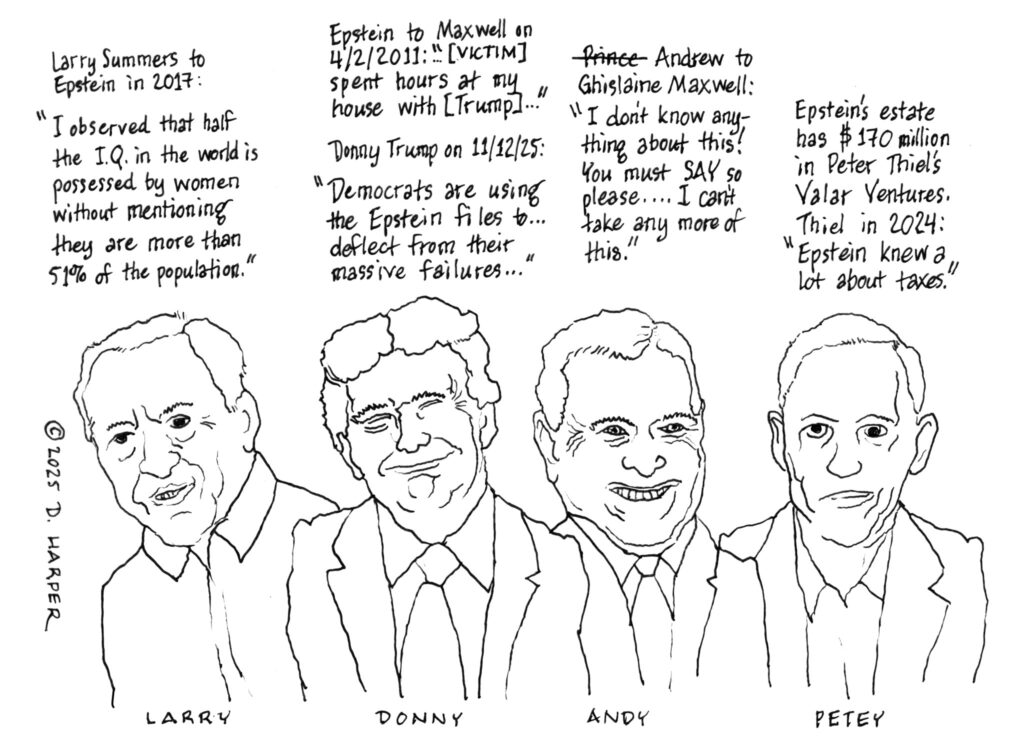
A cartoon mocking Larry Summers, Donny Trump, Andy Winsor, and Petey Thiel.

And please see my earlier post about how the rich old white guys get too much attention.

Noted without comment: White evangelical gun culture

Religion News Service reporter Kathryn Post has an interview with William J. Kole about his new book, “In Guns We Trust,” to report on White evangelical gun culture. In the interview, titled “‘In Guns We Trust’ challenges white evangelicals to rethink their alliance with firearms,” Kole says that he was a part of White evangelical churches, but has been “deconstructing” his Christian faith over his perception that gun culture (and its ally, Christian nationalism) has nothing to do with Christianity:

Kole also says that he’s now “reconstructing” his Christian faith, adding: “I just can’t, in good conscience, continue in the evangelical tradition.”

Recap of NAACP webinar for Labor Action Week

[Note: I wrote up my notes from this meeting, pasted them into WordPress, then forgot to hit “Publish.” Sigh. So this post is dated September 5th, even though it actually went live a couple of weeks later.]

While watching the NAACP webinar on “Labor action Week”, I transcribed a few of the speakers’ comments that especially caught my attention. Here are my rough notes, lightly edited:

Donna Mitchell, who is with Laborers’ International Union of North America (LiUNA, a building trades union), said that their union is asking each local to build alliances in their communities, including of course alliances with local NAACP chapters. LiUNA leadership knows that many of their members voted for Trump, so they are now reaching out to their membership to become “reacquainted.” They are also asking their members to “vote with their paychecks.” As an example of what she means by that, Mitchell pointed out that the Trump administration shut down the Revolution Wind project off Rhode Island, which has thrown hundreds of LiUNA workers out of work. “Overnight, those jobs are gone,” Mitchell said. She added that the demise of Revolution Wind will “drive up energy prices,” thus hitting LiUNA members once again in the pocketbook.

While Mitchell was speaking, I noticed this comment in the chat:

Rev. Dr. Regena Thomas, who is a ministerial associate at Grant Chapel AME church and also Co-Director of Human, Civil, and Women’s Rights for the American Federation of Teachers, said, “If I’m completely honest, I’m mad as hell. But I’m also fearful.” She is especially fearful because of the attacks on Black women by the Trump administration. She sees the labor movement as taking the lead right now, adding:

In response to Thomas, this comment appeared in chat:

Actually, some of the most inspiring material came from the chat. Here is a small sampling of comments from NAACP members from across the U.S.:

You can watch the recording of this webinar on Youtube.
And you can take action by signing the petition to protect Black workers.
And you’ll find more opportunities for action here.

A final note of apology: I was typing as fast as I could, and my transcriptions are probably not entirely accurate; if you spot errors, please leave a comment with a corrected version.

NAACP Labor Action Week

As we work towards getting out the current political situation, most of the so-called progressive left seems to be in disarray, with little more to offer than “We don’t like Trump.” Which, to be honest, is not very helpful.

Fortunately, the NAACP has been promoting a positive vision for what needs to be done. This week, the week after labor Day, is “Labor Action Week,” a week to promote the interests and needs of working people — with the slogan, “Fierce Advocates for Working People.” Tonight, the NAACP offers a webinar on all this. Here’s the description:

“This Labor Action Week, we unite under the banner The Urgency of Now to confront the challenges facing working people — and to act. Join us as we shine a light on the fights, the victories, and the voices that keep our movement strong. Together, we will honor the dignity of work, demand policies that protect and empower workers, and inspire a new generation to carry the torch forward.”

It’s not too late to register for the webinar — I just did. Go to this page, then click through to the registration form. And if you can’t make it, I’ll report on the webinar tomorrow

Happy Flag Day

A company of Revolutionary War re-enactors, one of whom has a sign reading "No Kings."

The photo above shows what the Minutemen were fighting for during the Revolutionary War. They wanted no kings, no dictators, no emperors. They wanted the right to rule themselves, without having some old rich guy, someone who thought he was more important than they were, telling them what to do. That’s what the American flag stands for — no kings, no tyrants, no dictators.

And now, two hundred and fifty years later, King-wanna-be Donny is trying to establish a new monarchy and tyranny. But here in Massachusetts, where the Revolution began, we still don’t want any kings. We still don’t want some old rich guy, someone who thinks he’s better than we are, telling us what to do. Way back in 1776, Thomas Paine described people like King-wanna-be Donny as insolent, poisoned, ignorant, and unfit:

“Men who look upon themselves born to reign, and others to obey, soon grow insolent; selected from the rest of mankind their minds are early poisoned by importance; and the world they act in differs so materially from the world at large, that they have but little opportunity of knowing its true interest, and when they succeed to the government are frequently the most ignorant and unfit of any throughout the dominions.”

On this Flag Day, remember the original meaning of the American flag: no kings, no tyrants, no dictators.

Happy Flag Day!

What’s the biggest problem of this political moment?

Back in 2018, I wrote about some of the challenges the Baby Boomers face — including financial challenges. We hear over and over again how the Boomers are inheriting a ton of money from their parents, so of course all Boomers must be financially secure. Well, not exactly true…

There’s an article in today’s Boston Globe titled “Mass. officials are scrambling to stem the wave of older adults losing their homes.” In the article, reporter Kay Lazar reports on “an ominous wave of older adults who are losing their homes or just scraping by.” Lazar cites some depressing statistics:

“Adults 50 and older are the fastest-growing age group experiencing homelessness, comprising nearly half of the country’s homeless population, according to the US Department of Health and Human Services. Federal data show a 17 percent jump in the number of Massachusetts adults ages 55 and older counted as homeless from 2023 to 2024, the most recent numbers available. Nationally, that increase was 6 percent.”

This reminds me of a book by Elizabeth White titled 55, Underemployed, and Faking Normal: Your Guide to a Better Retirement Life. White’s book, published a decade ago, showed that many 55 year olds simply didn’t have enough money to retire — and that included people like White herself, a highly educated woman who at age 55 found herself working low-paying jobs because that’s all she could get.

White’s book is still in print — because it’s still relevant. White wrote: “This is why the budget battles on Capitol Hill — which until recently only threatened to cut social security and other social-insurance programs like Medicare and Medicaid — are so ludicrous. What we’re really talking about is dooming millions and millions of women to misery and destitution.” And here we are, ten years later, hearing exactly the same claptrap from political leaders, including from our elderly (78 years old) president. Yes indeedy. I’m so glad we live in a Christian nation where our leaders devoutly follow the teachings of Jesus: “If you want to be perfect, go, sell your possessions and give to the poor, and you will have treasure in heaven. Then come, follow me.” (Matt. 19:21, NIV) I’m just so glad we have good Christian leaders who read their Bibles and decide to cut aid to poor elders so they can doom millions and millions of women to poverty and destitution.

OK, that’s enough sarcasm for now.

My real point is that the current culture wars are actually being fought over whether we help poor people move on up out of poverty, or whether we push more people into poverty. Rev. William Barber and the Poor People’s Campaign make the point that there are 140 million Americans who are functionally living in poverty. Nor do I see either major political party facing up to the magnitude of this issue. Actually, I don’t see Unitarian Universalists at the national level facing up to the magnitude of poverty in this country.

Back to the Boston Globe article for some insight into just how bad the problem is:

“‘I am finding more seniors living in their cars,’ said Sheri Miller-Bedau, a city health inspector in Attleboro. ‘We are in Massachusetts. We have great schools. We are supposed to be leading edge. How is this happening?’ She said local shelters were so full this past winter that even older adults living in their cars were not considered an emergency and were told they had at least a six-month wait.”

And to drive the point home, here’s another quote from the Globe article:

“[Julian] Cyr [D, Provincetown], whose district — Cape Cod, Martha’s Vineyard, and Nantucket — is home to the state’s oldest population, said it’s becoming increasingly common to see seniors living in their cars. ‘It’s a housing crisis on steroids,’ he said. ‘When I stop at a park or restroom [on the Cape], I will often see a car, a sedan packed to the gills, and there is an older person, usually an older woman, who is living in the car.'”

And it just might be that the biggest problem of this political moment is not fascism, or racism, or sexism, or homophobia, or immigration, or global climate change — the biggest problem of this political moment just might be poverty.

Which religious groups support Trump?

One hundred days into Donnie Trump’s second reign — er, second term — which religious groups approve of him most?

No surprise — Trump continues to have high approval ratings among White evangelicals. In a recent poll, Pew Research found that 72% of White evangelicals approve of King Donnie — er, President Trump.

Here are the approval ratings for other religious groups in the Pew poll:

  • 72% — White Protestant Christian, evangelical
  • 51% — White Protestant Christian, not evangelical
  • 51% — White Catholic Christian
  • 40% — All US adults
  • 26% — Hispanic Catholic Christian
  • 26% — Religiously unaffiliated
  • 10% — Black Protestant Christian

I was a bit surprised that these approval ratings are very similar to Trump’s first term. In their report, Pew Research says: “Both among the U.S. public as a whole and among major religious groups, Trump’s current approval ratings are on par with what they were around the same time in his first term (April 2017).”

Not surprisingly, White Evangelicals support Trump’s extensive use of executive orders — 53% of them feel that Trump is doing about the right amount by executive order. Only 27% of White evangelicals think Trump is doing too much by executive order, 15% are unsure, and 5% feel he’s doing too little by executive order.

I’d be jumping to conclusions if, based on this one survey, I said that White evangelicals are OK with a president who’s seems to be trying to operate like a king. But I’m keeping that in mind as a possibility.

Read the report here.

Majority of potential deportees are Christian

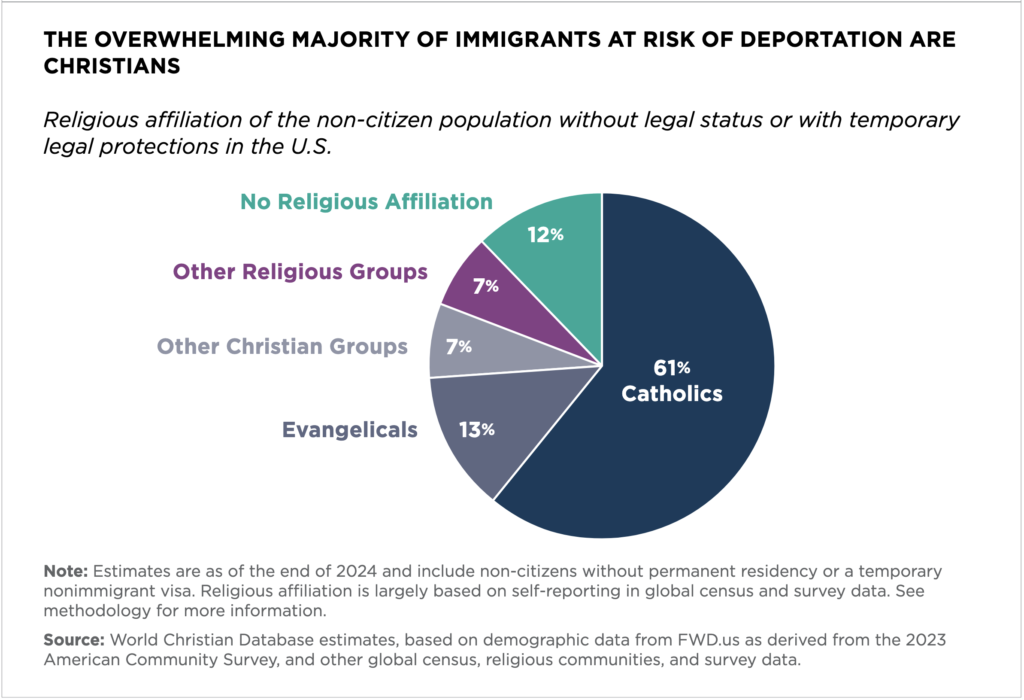
The National Association of Evangelicals (NAE), the U.S. Conference of Catholic Bishops (USCCB), World Relief, and the Center for the Study of Global Christianity have released a report about the impact of the Trump administration’s proposed deportations on American Christian communities. I found the report, titled “One Part of the Body: The Potential Impact of Deportations on American Christian Families” available online on the USCCB website (link to the PDF).

According to their report, the majority of people subject to deportation are Christian. You can go to the actual report to read their methodology, but to give you a quickie summary, here’s a screen shot of a relevant pie chart taken from the report:

Graphic titled "The Overwhelming Majority of Immigrants at Risk of Deportation Are Christians."
Screenshot of part of page 15 from the online report by NAE, USCCB, et al.

An article about this report by Religion News Service (RNS) points out that U.S. vice-president J.D. Vance is Catholic. According to RNS, Vance does not agree with previous statements by Catholic bishops that deportations pose any problems. But the real question is how many American Christians will see this as a problem. RNS interviewed Anthea Butler, a professor of religious studies and an astute commentator on American religion. Butler thinks this report could serve to alert Catholic leaders to a major problem facing them, saying, “For Catholic parishes, for Catholic ministries, this is a disaster.” According to the report, 18% of U.S. Catholics are at risk of deportation, implying that perhaps one in five U.S. Catholics are either at risk of being deported, or at risk of of having a family member being deported.

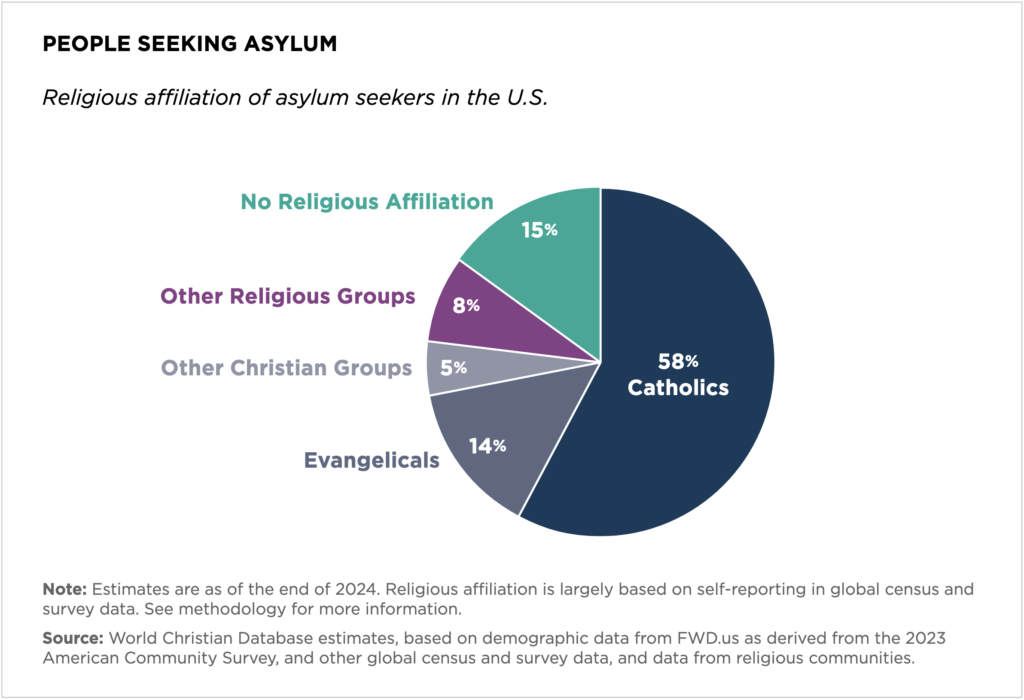
Looking at the religious affiliations of people seeking asylum in the United States, the report concludes that more than three quarters of asylum seekers are are Christians. Of those Christians, 58% are Catholics.

Graphic titled "People Seeking Asylum."
Screenshot of part of page 17 from the online report by NAE, USCCB, et al.

Will reports like this sway the current administration? I doubt it. More importantly, will reports like this sway the majority of the electorate who elected the Trump administration? Well, reports like this are designed by members of the professional-managerial class to affect others in the professional-managerial class — so perhaps this report will influence some Trump voters who are both Christians and who belong to the managerial-professional class.

But honestly — I don’t see reports like this having an effect on voters who don’t belong to the professional-managerial class. Instead, if you really want to influence a broad range of people, you tell stories. So maybe this report will have some impact if it convinces story-tellers to tell about Catholics and Evangelicals, people leading good and moral lives, who got deported.

Making history (up)

The current presidential administration has been making history.

I don’t mean making history the way that phrase is typically used. I mean the Trump administration has been making history up, by erasing facts that don’t meet the administration’s standards for political correctness. The erasures have taken place in several formats, including on federal websites, in federal training materials, etc. The American Historical Assoc. and the Organization of American Historians have issued a “Statement Condemning Federal Censorship of American History”; I’ll include the full statement below.

A few of the changes have been stopped by public protests, such as removing the Tuskegee Airmen from Air Force training videos. The Air Force removed the Tuskegee Airmen from the videos because they intepreted Trump’s executive orders against DEI as applying to any mention of the history of a Black combat unit. Given the wording of the executive order, I feel the Air Force made a reasonable interpretation of the order, i.e., the fault lies not with the Air Force but with the executive order.

Other changes to American history remain in place. For example, as of right now the home page of the Stonewall National Monument doesn’t contain the word “transgender,” and the the acronym “LGBTQ” has been replaced by the acronym “LGB.” (The Internet Archive Wayback Machine shows that the acronym “LGBT” was used prior to the Trump administration executive orders; see e.g. this archived webpage from 2022.) Since trans people were integral to the Stonewall riots, the simple removal of the “T” from “LGBTQ” does in fact represent a major rewriting of history by the federal government. The Trump administration may not like transgender people, but like them or not, they were most definitely a part of the history of the Stonewall riots.

I see several things going on here. First, while the Trump administration and their allies denounce “cancel culture,” this looks like cancel culture to me. Second, while the Trump administration and allies denounce censorship, this looks like censorship to me. And finally, as I said at the beginning of this post, this is political correctness — which the Trump administration and their allies have also denounced.

No surprises here. The Trumpites are not the first politicians to spin stories that have little relationship to facts, but which help to bolster their agendas. But it seems like a good idea to document the amazingly vast extent to which the Trump administration is just — making stuff up.

(Thanks to…)

Continue reading “Making history (up)”

Practical politics

In his History of Western Philosophy, Bertrand Russell provides historical context that helps us understand why philosophers tackled certain problems at different times in history. In much of the Middle Ages, there was no philosophy. So Russell describes the battles between various polities, and the struggles between the Roman Catholic Church and secular authorities, which helped set the stage for the blossoming of scholastic philosophy in the thirteenth century.

In 1154, Hadrian IV became Pope. Hadrian soon became embroiled in a struggle with Frederick Barbarossa, who had become king of Germany in 1152, and wanted the Pope to crown him Holy Roman Emperor. According to Russell, however, Hadrian IV and Barbarossa were able to find common cause when the city of Rome sought to become an independent city. A poulist faction in Rome wanted an elected body of lawmakers, and they wanted the right to choose their own emperor. The Romans brought in one Arnold of Brescia, a man known for his saintliness. Russell doesn’t make it entirely clear what Rome hoped to get from Arnold, but I suppose they wanted moral credibility.

Unfortunately for Rome, Arnold was a heretic. Russell describes his “very grave” heresy thus: “he maintained that ‘clerks who have estates, bishops who hold fiefs, monks who possess property, cannot be saved’” [i.e., cannot be saved from damnation in the Christian scheme of the afterlife]. Arnold maintained that clerics should abjure material things and devote themselves solely to spiritual matters. However, Arnold’s biggest heresy was that he was supported Roman independence. This enraged Barbarossa. Hadrian IV became equally enraged when there was a riot in Rome in which a Roman Catholic cardinal was killed.

This happened during Holy Week, the week leading up to Easter which was the most holy week of the year for the residents of Rome. Hadrian banned the Romans from joining in the Easter rites, unless they got rid of Arnold. The Romans submitted to Hadrian, and expelled Arnold from Rome. Arnold went into hiding, was discovered by Barbarossa’s soldiers, executed, his body burned, and the ashes disposed of in a river. Literally nothing of Arnold remained around which resistance could be organized.

Once Arnold of Brescia was disposed of, Hadrian and Barbarossa could resume their political battle without further distraction. Russell comments:

This is a useful lesson for our own time. Since at least the time of Newt Gingrich, it feels like the honest people have slowly been forced out of politics by the “practical politicians” who seem mostly interested in their personal grabs for power.