The Book of Revelation

“I have stolen more quotes and thoughts and purely elegant little starbursts of writing from the Book of Revelation than anything else in the English language. I love the wild power of the language and the purity of the madness that governs it and makes it music.”

Hunter S. Thompson, author of Fear and Loathing on the Campaign Trail ’72 and other books, in his Generation of Swine (New York: Summit Books, 1988), p. 9; quoted in William McKeen, Outlaw Journalist: The Life and Times of Hunter S. Thompson (New York: Norton, 2008), pp. 311-312.

Politics and Mr. Crankypants

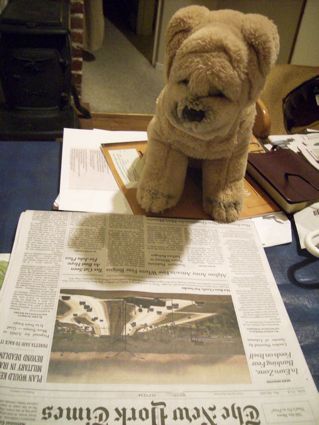
Transciber’s note: This afternoon, Dan conducted an interview with Mr. Crankypants, his evil alter ego, and political commentator for this blog. A complete transcript of the recording of the interview follows.

Dan: Mr. Crankypants, you’ve been wandering around the apartment all day muttering strange predictions about the presidential race. I’m wondering if you could sum up your political predictions for our readers.

Mr. C.: We’re screwed.

Dan: That’s it? That’s all you have to say? Continue reading “Politics and Mr. Crankypants”

Field guide to the airport

When you’re sitting in the airport waiting for a flight, it’s fun to look around you for typical airport fauna. I’m sitting here in San Francisco airport, looking around (keeping quiet so as not to scare the fauna away), and here’s what I see:

— Largemouth Cellphoner: The loud braying call first drew my attention to this male of the species. This typical individual has all the diagnostic field marks: potbelly, self-important air, aggressive strutting walk, expensive but schlubby clothes. However, this individual is exhibiting atypical behavior: he is off in a quiet corner instead of giving his loud call in a densely packed public space.

— Hunchback Gamer: This species is most often found close to a power outlet, and this individual is no exception. She exhibits the typical behavior of the species, hunched over a laptop playing a video game, earphones in place, completely oblivious to the world. Given how shut off from the world the species always appears, one does wonder how they find mates.

— Redfaced Bigmouthed Boobies: A mated couple of this species, a close relative of the Largemouth Cellphoner, are currently shouting across the terminal to each other: “What did you do to this phone?” “Nothing!” “Every time you touch this, it breaks!” Diagnostic field marks include faces red from anger, and aggressive behavior towards others of the same species.

— Common Geek: This individual is a fairly common color morph of khakis and blue button-down shirt. The individual is exhibiting the common behavior of typing madly at a laptop while ignoring his mate. Oh wait: I’m actually staring into a mirror here.

Technology and the classroom (and youth group and…)

We were sitting in youth group today, talking about plans for a trip later in the year. One youth was checking his online calendar on his smart phone; I lent my laptop to another youth so he could set up a Google Plus group for the youth group to use. And a couple of us talked about how we spend way too much time use the Internet.

And this evening I happened upon a blog post by April DeConick, a professor at Rice Unviersity. She writes in part:

I guess what I am saying is that technology is ahead of us. We are enthralled with it. It has become essential to how we live and work. But we have yet to figure out how to control it. We are like that kid in Charlie in the Chocolate Factory who loves chocolate so much he jumps into the chocolate sea and nearly drowns.

Yeah. That would be me.

So I put this out into cyberspace as a kind of call, especially to other teachers. We need to get caught up with the technology and establish technology boundaries in our classrooms. We need to take back the classroom.

Anyway. If you work with young people, you might want to read DeConick’s post.

Star Wars and me

Carol was telling me about her trip to the video rental store. They have a big fancy entertainment center with surround-sound speakers where they show videos, and when Carol went they were showing the fourth Star Wars movie. I admitted that I had never seen that one, and then I had to admit that the only Star Wars movie that I had ever seen in its entirety was the first movie. “But I saw the first Star Wars on opening day,” I said.

“Really,” said Carol, expressing mild interest.

“Haven’t I ever told you that story?” I said. “I went with my friend Mike. We were in the high school science fiction club together. The auditorium was filled with people from the New England Science Fiction Association. When — what’s his name, Harrison Ford’s character —”

“Han Solo,” said Carol.

“Yeah, when he’s talking about how fast his spaceship will go,” I said, “he says something like, ‘Yeah, it’s so fast it’ll go 32 parsecs.’ And all around us you could hear people murmuring, ‘Parsecs? Parsecs per what?’ And then people started booing.”

Carol laughed at the image of a movie theatre full of science fiction geeks booing.

“And when we came out of the movie, they offered us buttons that said, ‘May the Force be with you.’ And I didn’t take one. Mike and I were sure that the only people who would like the movie would be science fiction geeks.”

“That button would probably be valuable now,” Carol said.

“Yeah,” I said. “I figured it would be like George Lucas’s first movie, ‘THX-1138’ or whatever it was called. Good movie, but no one watched it.”

Carol said that when she learned about George Lucas’s connection with Joseph Campbell, she realized how powerful those Star Wars movies could be. I had no such intimation; I didn’t get that Star Wars was myth, religion even, wrapped up in pop culture. And because of that, today I do not own a valuable button reading “May the Force be with you.”

I hate Facebook (again)

Facebook has done it again: they have made their inefficient, poorly designed privacy system even worse. Obviously feeling some heat from Google Plus, they instituted something that looks a great deal like Google Plus’s “circles” feature. Except unlike Google Plus, their “circles” feature is hard to customize, and arbitrarily divides your Facebook “friends” into seemingly random categories.

Since I have an intense distrust of Facebook (their motto: “Have we done our evil quotient today?”), I’m assuming they have really just weakened their privacy yet again. So now instead of merely suspecting that everything you post on Facebook goes out to people you don’t want it to go out to, you can now be sure that everything you post on Facebook may be made completely public at any time without you knowing about it.

Not that Google Plus is any better: it still lacks important features that would make it worth while for me. The only thing social networking sites are good for is the purpose for which they were designed: to sell advertisements.

Another experience of race

In her book Working-Class White: The Making and Unmaking of Race Relations, sociologist Monica McDermott offers an interesting perspective on the intersection of race and class, based on her field work in Atlanta and Boston. She writes:


“The experience of whiteness in the Crescent [her Atlanta field work site] provides an intriguing example of the ways in which racial cues are bound up with class and the local context. ‘White’ is typically conceived in terms of economic and social advantage and residence in predominantly white, affluent areas. What, then, becomes of the white racial identity of those whites who are poor or working class and live in an area with a substantial black, working-class population?

“The results are not the standard ways in which whiteness typically functions in the United States — as invisible privilege, even for economically disadvantaged whites. Whiteness in this context does not simply function like ‘blackness’ when the usual constellation of class and racial cues is reversed. Instead, whiteness becomes a badge of inferiority — one that is contingent upon a global view of whites as more deserving of nice neighborhoods and good jobs than blacks. It is also bound up with expectations about racial segregation and the characteristics of those who live in racially integrated areas.

“Being a white person in this type of neighborhood is distinctly different from being a white person in a predominantly white area. The underlying assumption in the Crescent and Greenfield [the Boston field work site], held by both blacks and whites of various class backgrounds, was that the whites who lived and worked there were somehow defective; that the least capable whites were most likely to live among large numbers of poor and working-class blacks. As one of the working-class men studied by Lamont (1999) asserts, there ‘is no real reason for a white guy to be a failure.'”


While McDermott is quite clear that her study is limited in scope because of her methodology, nevertheless it occurs to me that that class location frequently influences experiences of race.

Singing school, part one

We had a good turnout for the first session of our Sacred Harp singing school at the Palo Alto church: we had set out 54 chairs, and at one point every chair was taken. A dozen or so experienced Sacred Harp singers showed up to help support Marsha Genensky, our singing master for the day. The new singers were about evenly split between people who had sung a few times at a local Sacred Harp singing, and people who had never sung Sacred Harp before but who had some singing experience.

Marsha traced the background of solfege syllables from the Middle Ages up to the development of the “fa, sol, la, mi” syllables used in early American singing schools. She demonstrated how the scale worked with only four solfege syllables: fa, sol, la, fa, sol, la, mi, and back to fa. She showed the class how early American hymnals printed the syllables “F, S, L, M” to indicate pitch. Later, these same syllables were printed beneath standard round-headed notes, and finally notes with different shaped note heads were developed to help make it easy to sight-read a piece of music: fa corresponded to a triangular note head, sol to a round note head, la to a rectangular note head, and mi to a diamond-shaped note head. (Link to a sample scale in shape notes.)

Marsha then organized the class into a scale: some people sang a low fa, a different small group so, the next group la, and so on up the scale. Then she told us to sing our note when she pointed at us — and by “playing us like a marimba,” she had us sing the tune to “Amazing Grace.” (She also told the class that the name of the tune is actually “New Britain,” while the name of the hymn or poem is “Amazing Grace.”)

By this time, the class was ready to sing some songs, and Marsha led us through a couple of easy songs. She had each section — altos, trebles (with men and women singing an octave apart), tenors (the melody line, with men and women singing an octave apart), and basses — sing their part separately and slowly, using the “fa, sol, la, mi” syllables. Then she put us together so that we were singing in four parts. The experienced singers kept us on our parts, and there were plenty of other fine voices in the room, so we sounded great!

After an hour of the singing school, we segued into the regular bimonthly Palo Alto singing. The tempo of the songs picked up, and at times some of the new singers got a little lost, but from where I sat in the back of the bass section, everyone I could see was enjoying themselves, and enjoying the music.

Historical note: The singing school was a regular feature of eighteenth century American life, and persisted well into the nineteenth century in America outside of urban areas. The singing school continued through the twentieth century in the rural South in the tradition of Sacred Harp singing (so named because the tune book used by the tradition is titled “The Sacred Harp”), and today is enjoying a revival outside the South in northern and Western cities, and abroad in Ireland, England, Australia, and even Poland. The singing school remains an excellent way to teach people how to sing, which is why I brought a singing school to our Unitarian Universalist church in Palo Alto.