Another look at sources of sacred song

Music geeks, this post is for you.

Jay Atkinson mentioned to me that he is tracking down errors in the attribution of some of the readings in the 1993 Unitarian Universalist hymnal, Singing the Living Tradition, and I told him that there are also misattributions in the music. He asked me to give him some examples, and with very little effort I came up with the following:


279, “By the Waters of Babylon,” with words taken from Psalm 137, is attributed to William Billings in Singing the Living Tradition. However, this tune does not appear in the definitive four volume Complete Works of William Billings; there is a tune titled “Lamentation over Boston” with the words “By the rivers of Watertown,” a Revolutionary War era parody of Psalm 137, but the tune is utterly different. The second edition (1998) of Between the Lines: Sources for Singing the Living Tradition makes a partial correction, stating “This tune is frequently attributed, erroneously, to William Billings.” On his 1971 album “American Pie,” pop singer Don McLean performs this tune almost precisely as given in Singing the Living Tradition, and attributes it to William Billings; wherever McLean got his misinformation, no doubt this once popular album has spread the misinformation far and wide.

Where, then, does the tune come from? Continue reading “Another look at sources of sacred song”

Election day

A beautiful sunny morning, with damp warm air. I walked the half a dozen blocks to the Congregational Church of San Mateo, noticing little shoots of green poking up everywhere, prompted to grow by the light rains a couple of weeks ago. A big sign outside the church said “VOTE HERE,” and there were smaller signs in Spanish and Chinese, presumably saying the same thing.

At the table for Precinct 2628, two people looked up my name and each of them carefully crossed my name out on their lists of registered voters. The next person at the table had me sign my name in a book, and then she gave me a receipt with an access code on it.

I walked over to the voting booths, and found an open booth between two occupied booths. I cast my votes for U.S. president, U.S. representative, state senator, member of the state assembly, member of the county board of supervisors, member of the county board of education, three members of the board of commissioners of the San Mateo County Harbor District. I also cast my vote for eleven state ballot initiatives and three county ballot initiatives. The only way I got through all those votes without my eyes glazing over was that I brought a sample ballot with me on which I had marked all my preferences. (Years ago, I would do all my research for voting in newspapers, and usually you couldn’t get much information about local candidates; now I can do all my research for local candidates online.) When I finished voting, the same people were still in the voting booths on either side of me, still working their way through all the votes they had to cast. Continue reading “Election day”

Indirect economic attrition

In his short story “The Upside Down Evolution” (c.1985 in Polish, 1986 in English), science fiction writer Stanislaw Lem claims to have read a military history of the world written in the twenty-first century, and used what he learned in his novels:

In 1967, I wrote a science fiction novel entitled His Master’s Voice (published in English in 1983 by Harcourt Brace Jovanovich). On page 125 of that edition, third line from the top, are the words “the ruling doctrine was … ‘indirect economic attrition’,” and then the doctrine is expressed in the aphorism, “The thin starve before the fat lose weight.”

The doctrine expressed publicly in the United States in 1980 — thirteen years after the original [Polish] version of His Master’s Voice — was put a little differently. (In the West German press they used the slogan “den Gegner totrüsten” — “arm the enemy to death.”)

The policy of indirect economic attrition has changed significantly with the fall of the Communist Bloc; nevertheless, it remains an effective foreign policy, one which will, no doubt, be followed by either major presidential candidate.

Zombie jokes

It’s Hallowe’en, and Amy, the parish minister here in Palo Alto, is going to preach on the zombie apocalypse this Sunday. All this means it’s time for more zombie jokes:

What does the dyslexic zombie eat?
BRIANS!

What did the large animal vet zombie eat?
MurRAINS!

What does the zombie of Fantasy Island shout?
Da PLANES! Da PLANES!

What does zombie Mitt Romney say?
I was CEO of BAIN!

A zombie walks into a bar, and the bartender says, “Hey, we have a drink named after you, want to try it?” The zombie says, “Sure, give me a Charles.”

Continue reading “Zombie jokes”

The Cup Game

The Cup Game is a staple of church summer camps, youth conferences, and retreats. There are several variants, and this variant comes from Ferry Beach. I know it’s stupid and pointless; that’s what makes it fun.

(You can find online videos which purport to show you how to play the Cup Game, but these videos are all shot facing someone who is playing it. It is much easier to learn if you can look at it from your own perspective, so that the right hand of the person you’re watching is on the same side as your own right hand; my video shows you how to play from your own perspective.)

Here’s a printable cheat sheet that may also help you learn:

The Cup Game

The author of Mark Tidd

When we were kids, my sister Jean and I discovered the Mark Tidd books, written by Clarence Budington Kelland, while we were staying at our grandmother’s house in Staten Island, New York. I remember one of the books was inscribed “To Bobby” — that was my father’s name when he was a boy — from his mother.

Jean and I loved Mark Tidd. He was smart. Even though he looked funny (he was fat, and he stuttered), he always got the better of potential bullies. He and his three buddies got into all sorts of interesting adventures — in one book they took over a failing newspaper, in another book they ran a store, in another book they rented an entire broken-down deserted resort hotel — and they were always saved from looming disasters by Mark Tidd’s brains.

I tracked down some of the Mark Tidd books a few years ago, to see if I would like them now as much as I liked them when I was a kid. The plots and characters were pretty good, as juvenile series books go — the plots and characters obviously look to Tom Sawyer as a model (Tom Sawyer is explicitly mentioned in the opening pages of the first book; see also “Michigan Authors and Their Books,” Michigan Library Bulletin, vol. 16, no. 4, Sept-Oct. 1925 [Lansing, Michigan], pp. 22-24) — but as an adult I picked up on some undercurrents that made me uncomfortable. In the first book, Mark Tidd and his three friends form a secret society, which they model on the Ku Klux Klan; even though there’s no overt racism in the book (everyone in the story is white), even mentioning the Ku Klux Klan positively made it hard for me to like the book. (The later books don’t mention the KKK.) In the rest of the books, Kelland extols the virtues of hard work , honesty, and financial know-how — these are values I can affirm — but he doesn’t seem to recognize that a key ingredient to Mark Tidd’s success in his various enterprises is the backing of his father’s immense capital.

Recently I tried to find a biography of Kelland. Continue reading “The author of Mark Tidd”

Your Web site on different devices

Carol pointed me to the Screenfly tools on QuirkTools, which allows you to preview any Web site as it appears on various devices, including Android and Apple smartphones and tablets, desktop computers, and televisions. To try this out, try comparing our congregation’s main Web site with our religious education blog; I just updated our congregation’s religious education blog with a “mobile-first” responsive Web design, while the main Web site does not have a responsive design, and there’s a big difference in the way each appears on phones and tablets.

(1) First, open the Screenfly tool in a new window by clicking here.

(2) Next, enter the following URL, and try viewing it as desktop, mobile, tablet, and television:
http://paloaltocre.wordpress.com

(3) Now enter the following URL, and notice how it responds differently to a desktop, mobile, tablet, and television, displaying legibly (and differently) on each):

Home

Isn’t QuirkTools’s Screenfly great fun?

Battleground

The battle isn’t between science and religion, not any more. (Sometimes I wonder how there ever was such a battle; it must have arisen from very narrow definitions of both science and religion.)

The battle is between religion and … soccer, celebrity worship, rock concerts, tarot card readings, what’s left of the human potential movement, yoga classes, art museums and art classes, spoken word performances and hip hop, the cult of personality in politics, the Web (smartphones are the icons before which we worship the Web) … and it’s not a battle, for these are all manifestations of the same human impulse to join with other human beings to celebrate and mourn and have festivals and pretend death doesn’t end everything, and to try to make sense of the world.

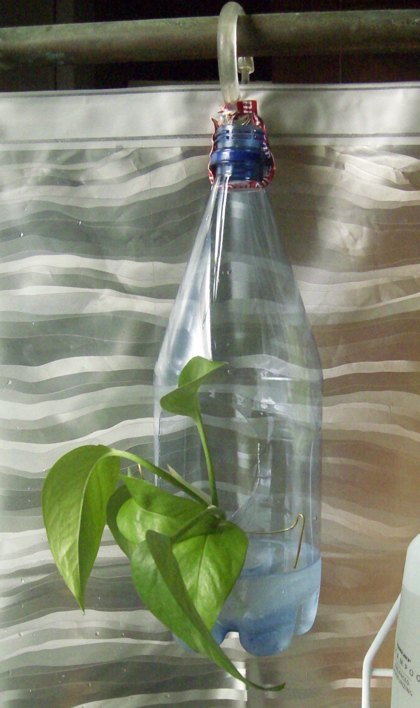
Shower planter

We had to trim our pothos plant. Rather than compost the trimmings, Carol decided to make a home for them in the shower. She got me to cut a big round hole in the side of a plastic soda water bottle using my pocket knife; then she got me to drill two holes at the top of the bottle so we could hang it; I drilled those two holes using the awl in my pocket knife. She attached the bottle to the shower rod using a big twist tie left over from something, added some water, and put the pothos cuttings through the big round hole.

Over the next few days, the pothos cuttings twisted towards the light, and their butt ends pulled out of the water. So I drilled two small holes about an inch back of the big round hole on either side, above the water level, and threaded a piece of straight brass wire through; the wire keeps the pothos cuttings aimed down at the water.

Our shower planter has been up for a month now. Here’s what it looks like:

Easy bubble juice

I’m going to be leading a workshop tomorrow at the “Pot of Gold” religious education conference. For the workshop, I’ll be demonstrating bubble juice that makes medium (9-12 in.) soap bubbles. Below is a recipe, and instructions for making a bubble wand.

Easy bubble juice for 9-12″ bubbles

Ingredients:

4 oz. very hot (not boiling) water

3 oz. Dawn brand Ultra Concentrated dishwashing detergent

3 oz. personal lubricating jelly (K-Y Jelly or any generic brand)

water to make up approx. 1 quart, about 22 oz.

Continue reading “Easy bubble juice”