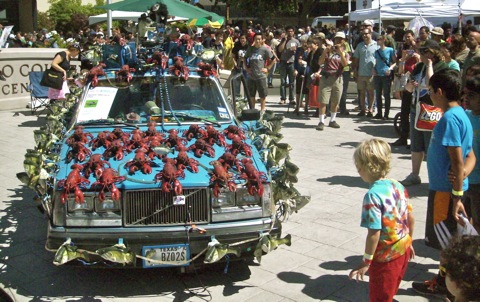
Car

Carol took our 1993 Toyota Camry down to Dave’s Auto Repair. We thought there was something wrong with the hand brake, but it turned out the reason the brake light was on was because there was a leak in the brake line. It was going to cost three thousand dollars to fix. Carol called me up, we talked it over, and I said I thought three thousand was still cheaper than buying a new car. Carol told the mechanic to go ahead and fix the car. There was a moment of silence, and it became obvious he was not expecting her to say that. He told her that the gas tank was also rusted out, and the floor boards were about to rust through. It was time to get another car.

We looked at used cars online. The next day I rented a car, and we drove to the Toyota dealer in Palo Alto to look at some of the used cars we saw online. When you shop for cars, you enter a never-never-land where nothing is quite what it seems. The mileage posted in the online description did not match the mileage on the actual car. One online description said the car had a moon roof, and the sheet posted in the window of the car also said it had a moon roof, but there was no moon roof. The salespeople will tell you whatever you want to hear: does it have a full-sized spare? yes of course it does; but the spare tire turns out to be one of those little dinky ones. We finally settled on a 2008 Camry hybrid. Of course the price wasn’t what we thought it was. Carol haggled with the salesman; he tried to show her his sales awards, but she didn’t want to look; he went off to talk with his manager; he came back with a price that was still too high; Carol haggled some more; another talk with the manager; we accepted the deal; and when the salesman seemed too cheerful, Carol turned to me and muttered, “We could have gotten the price down more.” Then I went and talked with their finance people, and had to sign away all my rights to sue them if the car turns out to be a lemon — California law protects car dealers, not consumers — and wrote a check. And of course, the next day the driver’s side visor fell down and wouldn’t stay up; this in spite of being assured by the salesmen that they check every car over very thoroughly, which leads me to believe that we should never take the car to that dealer for service, if they could miss something so obvious.

We like the car pretty well, in spite of everything. So far we’ve been getting about forty miles per gallon of gas. But I miss the old car. I bought it from Carol’s mom before she died. It drove us across the continent five times (or two and a half round trips). It looked forlorn sitting in our mechanic’s parking lot as we emptied everything out of it — snow brushes and maps and jumper cables and crumpled coffee cups from under the seat. Now it sits there waiting for the junkie to come and pick it up and take it away.

Singing with Coleman Barks

Shelley Phillips and Barry Phillips provided the music to accompany Coleman Barks as he read from his translations of Rumi last night at the First Congregational Church of Santa Cruz. Barks grew up in the south and loves shape note singing, so Shelley asked local Sacred Harp singers if they’d come and sing two tunes.

It’s a long way from San Mateo to Santa Cruz, and Carol and I got to the church about ten minutes before the reading was to begin. All the church’s parking spaces were full, and the school parking lot next door was full, too. We parked on the street.

As soon as I walked into the church, someone spotted the maroon oblong Sacred Harp book in my hand, and sent me to sit in one of the front three rows. I recognized Janet and one or two other singers, but no one else — it’s a long drive, and Santa Cruz singers don’t get up to the Bay Area to sing much.

Coleman Barks began reading. I could hear the cadences of Southern preaching in his voice. Shelley and Barry played — Shaker tunes, Sacred Harp tunes, Bach — as he read. People who study liturgy talk about the continuum from ordinary speech through heightened speech, singing, and finally wordless music. As Southern preachers often do, Barks moved along this continuum from ordinary speech to heightened speech; Shelley and Barry Phillips moved along the other end of the continuum, singing and music.

We Sacred Harp singers sang right after the intermission. Sacred Harp singing moves between heightened speech and singing, so we occupied the middle ground of that continuum from ordinary speech to music. Shelley led us in no. 178 Africa; Barks read one of his poems that mentions Sacred Harp singing, then we sang no. 59 Holy Manna (vv. 1, 3, 5). Barks came to sing with us on Holy Manna, standing in the bass section a couple of people to my left.

I think that was about the deadest place I’ve ever sung Sacred Harp in: I could hear a little of what the tenors were singing, and I could hear the bass I was standing next to, and I could hear Shelley, who was standing facing us; and that’s about all I could hear. So it wasn’t the ecstatic experience Sacred Harp singing can be when you can hear and respond to all the other singers; but it was probably a more musical experience for those who weren’t singing. When you’re singing for an audience, I think Sacred Harp tends to morph from an ecstatic form of heightened speech into musical singing — which, honestly, is a kindness to the audience; ecstasy doesn’t sound so good when you’re not singing along with it. Carol was siting out out in the audience, and she said we sounded fine.

Then Barks continued reading his translations of Rumi: poems of ecstatic and transcendent encounters with the divine; poems about mystic experiences, experiences which cannot be adequately communicated to an audience.

Cross-posted here.

Tragedy in Boston

By now, you’ve probably seen the news online: at least two people were killed by bombs placed near the finish line of the Boston Marathon. Latest reports have another explosion at the JFK library as well. Live coverage at the BBC Web site show people being wheeled away from the site in wheelchairs, some of them with blood or obvious injuries.

Still don’t know who’s behind this — could be a U.S. group, just like the Oklahoma City bombings. I’m sure groundless accusations will abound out there on social media. Which is a good reason to stop looking at social media for a while.

One minor trivia point: today is the day that Patriots Day is celebrated, commemorating the Battle of Concord and Lexington, and the beginning of the American Revolution (the BBC described Patriots Day as commemorating the evacuation of Boston by British troops, but they’re thinking of Evacuation Day, celebrated on March 17). Patriots Day is such an obscure holiday, it’s hard to imagine this bombing is related to it. Rather, the bombing doubtless targeted the second-biggest sports event in the U.S., measured by media coverage, after the Superbowl.

Which one would you attend?

An old friend called me up yesterday, and told me a story. They were traveling, in a strange city over a weekend, and wanted to go to church. The sermon topic at the local Unitarian Universalist church: “Consciousness.” The sermon topic at the hip Christian church in town: “Bad Girls of the Bible.”

If this were you, which church would you attend? — and why?

The next UU app

I’ve been talking with some people I know, and we’ve been brainstorming about the next UU app for Android and/or Apple iOS. Since some of these folks have experience in software and app development, this is not just a pipe dream. At the moment, we’re talking about really basic stuff, like an app for your congregation that lets you know the sermon topic for the week, then on Sunday provides you with an order of service so you don’t have to kill trees by taking a paper order of service. But I’m seeing this as just a first step.

So here’s my question — what UU app do you really want to see on your smartphone and/or tablet?

Why we still need OWL, part II

The school newspaper controversy in nearby Mountain View, which I reported on in this post, got picked up today by the San Jose Mercury News in an article written by Sharon Noguchi: “Mountain View High School newspaper’s sex stories raise parents’ ire”.

The Merc tries to remain objective, but they’re obviously on the side of the student journalists who dared to report on some of the realities of teen life today. In her news article, Noguchi writes: “But the debate also illustrates the gap between adult and teen conversation and mores.” As a columnist, Scott Herhold was able to state his opinion boldly: “A group of parents crawled from their caves to protest that the student journalists had taken things too far — that the stories promoted unprotected sex and imperiled futures. In truth, the articles in the Oracle, the student newspaper, were fairly tame….”

Herhold goes on to point out the heroes of the story, the people who protected the rights of student journalists, and who stood up for what was right instead of caving to intolerant parents and religious views: “The heroes were the administrators and educators who stood up for the paper, led by Superintendent Barry Groves. At the meeting, Groves praised the journalism department and said, ‘There’s nothing I would have taken down.'”

Residents of Los Altos and Mountain View might want to take a moment and write a note of support to Barry Groves. You can find his email address on the school district Web site.

Further reading: You can read the Oracle online here. The Los Altos Town Crier published my letter to the editor on this topic, under the title “Minister supports sex education for teens” (“Look, Mildred, those crazy Unitarians are at it again”), and for the sake of the record I’ll include the full text below the fold.

Continue reading “Why we still need OWL, part II”

Anniversary

Back on February 22, 2005, I wrote the first post on a blog I called “Yet Another Unitarian Universalist Blog.” And here I am, eight years later, still writing.

The online world has changed drastically in those eight years. In 2005, blogging was still cutting edge social media, Facebook was still restricted to users with a .edu email address, and the big social networking site was MySpace. In the first few years of this blog, there were so few UU bloggers that we’d go out of our way to visit one another so we could have face-to-face meetings, and there were even UU blogger picnics.

For a few years, a lot Unitarian Universalists paid a lot of attention to the few Unitarian Universalist blogs. There were only about fifty of us, and we all had a wide audience. I still remember a meeting at General Assembly where members of the Unitarian Universalist Association (UUA) Board of Trustees sat a bunch of us bloggers down and asked how they could get their message out on our blogs.

Twitter came along. Youtube took off. Facebook got big, then huge, then ridiculously ginormous. Many of the conversations that were happening on blogs went over to other social media platforms. These days, the best bloggers are typically paid, or they’re professional writers blogging for exposure on commercial or paid sites. The transformation of Chris Walton, perhaps the best UU blogger ever, can be taken as a representative case: he wound up running UU World, the UUA’s official periodical; moved UUWorld into blogging; dropped his long-running personal blog “Philocrites”; and now he posts his personal thoughts on Facebook.

While the social media field has grown ever larger, ever more dominated by bigger and bigger players, I have kept on with this tiny little blog, with its tiny readership of ten thousand unique visitors a month (the Huffington Post gets more than three times that many unique visitors in one hour), many of which appear to be meaningless visits from questionable IP addresses in Russia and China. While more and more people turn to social media to carry on their online conversations, I stick with the outdated blogging format.

But then, I started my publishing career back in the 1980s, writing a fanzine that had a circulation of less than twenty people. I’m still a zine writer who wound up writing a religion blog by mistake. A zine writer is always looking for readers beyond his or her narrow social circle, which means Facebook will always feel restrictive. A zine writer is, by definition, long-winded, which means that Twitter will never offer enough space. A zine writer feels fondness towards outmoded publishing techniques, like cut-and-paste photocopying and hectographs, and by contrast feels little fondness for the newest and shiniest social media platform.

Finally, a zine writer publishes because he or she is expecting readers to write back. And you, dear readers, do write back — you write comments, you send email, sometimes you send me notes and books and dogtags and old magazines with interesting articles. Blogger and author John Scalzi sneers at tiny blogs like this (he really does; I went to a presentation he gave and heard him do so). Whatever. You, the readers, make this all worth while. Thank you for eight great years.

UU kid on Obama’s Facebook page

One of the middle schoolers from our congregation went to a gun control rally, and a photo with him in it appeared on Barack Obama’s Facebook page. How cool is that?

Obama's Facebook page

Click on the image above to see the caption inserted by Obama’s social media staff: “Harrison Frahn listens to a speech on reducing gun violence at a candlelight vigil in Palo Alto, CA.” I’m sure Obama never even saw this post; I’m sure Obama has forgotten the year or two he spent in a Unitarian Universalist Sunday school; I’m sure that Obama’s social media team merely posted this because it’s a good photo to further their political goals. Nevertheless, it’s really fun to see a UU kid recognized in this way — recognized for taking a public stand on something he cares about.