Old news

I lose consciousness of ugly bestial raid
and repetitive affront as when they tell me
18 cops in order to subdue one man
18 strangled him to death in the ensuing scuffle (don’t
you idolize the diction of the powerful: subdue and
scuffle my oh my) and that the murder
that the killing of Arthur Miller on a Brooklyn
street was just a “justifiable accident” again
(again)

That’s from June Jordan’s “Poem about Police Violence,” from way back in 1980. The poets have been telling about this for at least thirty five years, longer than a lot of you have been alive. And if we forgot (because who reads poetry any more), there was Oscar Grant. And Eric Garner. And now Freddie Gray.

June Jordan said:

People have been having accidents all over the globe
so long like that I reckon that the only
suitable insurance is a gun
I’m saying war is not to understand or rerun
war is to be fought and won

Didn’t Malcolm X say that back around 1960? And — OK, I hear you, violence is not the answer, and I agree with you on that one. But then what is the answer? Because we seem to be hearing the same old news again.

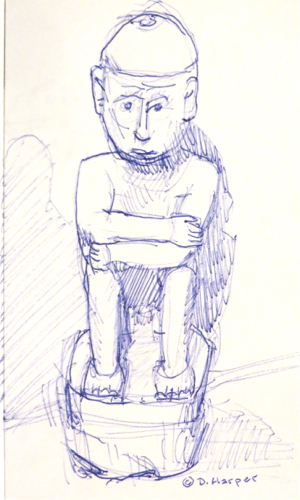
Ceremonial deity, Phillippines

Ceremonial Deity, Philippines

Above: Sketch of a “ceremonial deity,” Philippines, c. 1930. Wood and shell. Asian Museum of Art.

One of delights of going to the Asian Art Museum in San Francisco is seeing the diversity of depictions of deities. Today I particularly noticed the unnamed deities — like this sculpture of an unnamed ceremonial deity, made in the Philippines around 1930. Why do we not know the name of this deity? Is it because it is a minor deity, and thus not widely identifiable (though perhaps readily identifiable by a devotee)? Did it never have a name that could be spoken by humans? Or was this a deity like the Roman Lares familiares, the household gods, who don’t seem to have had names, or whose power was so geographically restricted that their names perhaps were known only to the household they protected?

I think that the end of Christendom is allowing us to see such minor deities more clearly. In the worldview of Christendom, only the major deities — the wildly transcendent deities, Jehovah’s direct competition — were worthy of serious attention. Now maybe we can pay a little more attention to the many minor deities who inhabit the metaphorical space between those distant transcendent deities and mortal creatures.

John Renbourn

Once upon a time, I had a copy of John Renbourn’s recording “A Maid in Bedlam” on cassette tape. I used to play that cassette tape while driving up to the White Mountains to go hiking. I think this was before I had a car with a cassette player — I have a vague memory of Gary, one of my hiking partners, playing this tape on his boom box in my beat-up Chevy Celebrity. The point is that this was a while ago.

This recording captured me with its mix of musical influences. This was a time when early music was still something new; Renbourn’s band performed tunes by Renaissance composers Hans Neusidler and Tielman Susato on recorders, steel-string guitar, and tabla. Was this folk music, or early music, or world music? Or, given the strange harmonic direction they took in the medley of tunes by Neusidler, were they dabbling in new music? And they did strange things to traditional tunes from the British Isles as well: the traditional “A Maid in Bedlam” had that non-traditional the tabla, and the recorders, and the steel-string guitar, and a little bit of rock and roll. “A Maid in Bedlam,” though a traditional song, had a flavor of contemporary folk. The medley “The Battle Of Augrham / Five In A Line” definitely slipped into rock and blues territory. As for “Reynardine,” it was as sexy and crazed in its own understated way as the punk rock that I listened to obsessively.

Much of the music from the late 1970s and 1980s that I used to listen to obsessively has not held up well; a lot of it now sounds heavy-handed, or poorly done, or just plain boring. Much of Renbourn’s music still sounds fresh and interesting, no doubt due in large part to his high level of musical intelligence and his virtuosity on his chosen instrument, the steel-string guitar. But perhaps most important was his ability to mix musics from different cultures and different times, have it make emotional and musical sense, and not leave you feeling as though he had simply been plundering other people’s music. How many musicians can cover five centuries and three continents, avoid pastiche and misappropriation, and still make musical sense? — not many.

Not that Renbourn’s entire career was so brilliant. In fact, most of his career was musically boring. Too often, Renbourn slid down into that musical performance realm inhabited by technical virtuosi who make their living impressing wanna-be guitarists with blistering fingerwork and fretboard hysterics. Renbourn’s topical songwriting was never particularly interesting; he was not a singer-songwriter worth paying attention to. His early forays into Renaissance music were wonderful, but the early music world kept evolving and I don’t feel he managed to keep up with that ongoing musical conversation. And then there was the 1990s reunion of the 1960s band Pentangle — like so many reunion bands, 1990s Pentangle just plowed the same musical ground over and over and over again.

But when he was good, John Renbourn was very, very good:— when his technical brilliance was in the service of his musical intelligence; and when he saw beyond the musical world of British folk and pop to an expanding world of cultural influences; then he was very, very good.

John Renbourn died of a heart attack on Thursday.
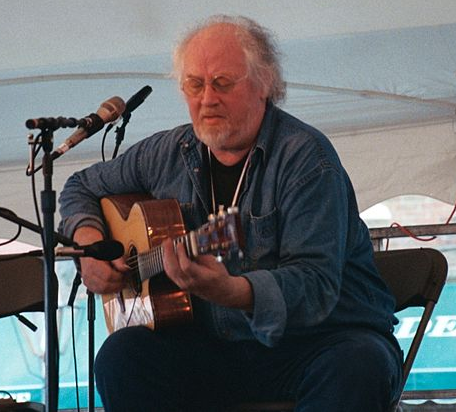
John Renbourn perfomring in New Bedford, Mass.

Above Renbourn at Customhouse Square, New Bedford, Massachusetts, July, 2005. We lived a block away at the time of this performance, but I was out of town at a conference. [Photo from Flickr by Thom C CC BY 2.0]

“Good Morning, Blues”

When the New York Times Book Review asked which literary figure was overdue for a biography, Ayana Mathis argued for Albert Murray. She was persuasive enough that I decided I had better read some Murray, and that led me to the book he co-wrote with Count Basie, Good Morning, Blues: The Autobiography of Count Basie: a book for which Basie supplied the reminiscences, and Murray wrote the text.

Good Morning, Blues reminds me of Anthony Trollope’s Autobiography: both books are, above all, a record of how one artist worked; Trollope was a writer and Basie was a bandleader, which makes for some significant differences, but both are really books about work. Just as Trollope’s autobiography is filled with details of how he came to write his various books, Basie’s autobiography is filled with details of the various bands and combos he put together. The most interesting part of both books comes early on, when the artist serves his apprenticeship; the least interesting part is the ending, but then, autobiographies can never come to a interesting ending because the ending of a life story that we really want to know about is how the person died.

Because Basie’s book is about his work, he avoids dishing dirt, fanning the flames of feuds, or talking much about his personal life. “I don’t want to get into all that,” Murray frequently has him say, and in fact I can just about hear Count Basie saying exactly those words. Basie passes lightly over his first experience of the South’s Jim Crow laws (though he says from his point of view, there wasn’t much in Jim Crow that he hadn’t already experienced in the North). He spends less than two pages on his wife’s death, and perhaps a paragraph on his daughter’s birth. He spends a couple more pages on his own heart attack, but then his heart attack meant he had to take time off from work.Aside from that, he talks about his work — though as Murray has him say: “But truthfully, playing music has never really been work.” Again, you can just about hear Basie saying exactly those words; Murray gets his voice just right, and makes it feel as though it’s Basie’s words you’re reading, even though you know that this book has been carefully writer by a master of American prose style.

I like his music, but I was never a big fan of Basie’s, and sometimes the book devolves into a jazz fanboy’s dream with a little too much minutiae about who played tenor at one specific recording session, and who “cut out” just before which gig at the Famous Door in New York City, and who filled in for them, and so on. But I tolerated all that, and even read it with interest because obviously Basie himself cared a great deal; as a bandleader, who played with him, who was in the band, which personalities were involved in making music at a certain point of time, is of critical importance.

When I finished reading, I had all sorts of unanswered questions about Basie’s life. What about all those hard feelings that are hinted at, then dismissed with, “I don’t want to get into all that”? What about the hints of tough times in his family life? What about the racial discrimination that — to use his phrase — “sepia performers” had to put up with? In the last few pages of the book, Murray has Basie address this last question:

“If I haven’t spent a lot of time complaining about all of these things, it’s not that I don’t want anybody to get the impression that all of that was not also a part of it. It was. So what? Life is a bitch, and if it’s not one damn thing, it’s going to be something else.”

For Basie, what was most important was his work. That’s what he wanted to tell about. And that’s what Albert Murray perfectly captures, making Basie’s words echo the jazz he played, so even the prose style is just what you’d want to hear from a bandleader who cared most about the work. So rather than bothering with trying to read up on Basie’s life, I went online and listened to a whole bunch of his music, from the 1930s right up to the 1980s. Nothing else I could read was going to be as good as Albert Murray’s book, anyway.

Count Basie at the piano in 1964

Above: Still from “Jazz Casual” television program, KQED, 1964 — looking over the shoulder of jazz guitar great Freddie Green, towards Basie at the piano. Clicking on the photo takes you to the half hour show on Youtube, which features Basie’s rhythm section in 1964: Basie on piano, Green on guitar, Sonny Payne on drums, and Norman Keenan on bass.

Tenth anniversary

On February 22, 2005 — ten years ago today — I published the first post on my blog. If you want, you can read the first post here. I’ve posted a summary of how the blog started elsewhere, so no need to rehearse that history now.

Ten years is a long time in the world of social media. When I started this blog in 2005, blogs were about ten years old, and their popularity was still rising as we migrated away from the command-line interface of the old social networks like Usenet to the amazing world of the Web. In 2005, MySpace was arguably the coolest social network, LiveJournal had just been purchased by Six Apart, and Facebook was limited to students in Ivy League colleges. How things have changed.

We are in a vastly different social media landscape today. A great deal of social media now happens away from the Web, in the social universe of texting and phone apps. Web-based social media has become dominated by for-profit companies which are really in the advertising business, not in the social media business. Blogging itself has become dominated by for-profit publishing companies like the Huffington Post. A great many amateur bloggers have discovered that it’s much easier to put your thoughts out on Facebook or Twitter or Pinterest.

Yet in spite of all the changes in the social media landscape in the last ten years, there still appears to be a place for blogs written by amateurs. Blogging continues to be a fairly interesting publishing platform, one that attracts some fairly interesting writers. With that in mind, what better way to celebrate the tenth anniversary of this blog than by pointing you to some blogs that I continue to read:

Charlie’s Diary, written by SF writer Charles Stross, along with guest bloggers and a host of literate commenters, brings back the glory days of blogging — heck, this blog takes me back to the glory days of Usenet, when intelligence, snark, wit, and seriously geeky knowledge ruled social media. Still more fun than Facebook or Twitter.

• I’ve been reading Hoarded Ordinaries off and on for over a decade. Sometimes the subject matter is trivial (this happens to every periodical; even Dr. Samuel Johnson wrote some real crap for The Rambler); sometimes the writing sounds a little too much like the creative nonfiction I used to hear in writing workshops. But Hoarded Ordinaries remains a fine example of the best of amateur blogging, and I keep going back every few months to check in.

• Scott Wells is still writing about religion at Boy in the Bands, and after more than a decade of reading him I still find it worthwhile to listen to what he has to say. This is one of the few religion blogs that I read regularly. I’ll admit my bias: Scott’s one of the few Universalists on the Web, and sometimes I read his blog just to get my fix of Universalism.

• Another religion blog that I read regularly is Roy King’s Mediterranean Wisdom. Roy’s training as a psychiatrist (and former professor of psychiatry at Stanford) and his training as a minister informs his writing about religion, which makes for some interesting reading. Since Roy is also a Universalist, I’m probably biased in his favor, but I can still recommend his blog.

A final note: It’s thanks to readers like you that amateur blogs remain viable. Thank you for supporting these independent voices!

No one sings in church any more

On the Sacred Harp Friends page on Facebook, Katie posted a link to a blog post by Thom Schulz, titled “Why They Don’t Sing on Sunday Anymore.” Schulz’s reasons why people don’t sing in church: too often services are spectator events; church music is dominated by professionals, to the point of squeezing us amateurs out; sometimes the volume gets cranked up so high people just stop singing; the hymns are unfamiliar or hard to sing.

Katie then noted that Sacred Harp singers do sing, and we sing fervently — because there are no spectators, there are no professionals, it’s loud but not deafening, and Sacred harp singers have been singing pretty much the same tunes for a century and a half.

Actually, in my church people do sing. Amy, the senior minister, and I made a pact some years ago that the first hymn would mostly get chosen from a pool of ten or so hymns; that way, the kids can memorize ten or so hymns and know them by heart. And indeed the kids (and the adults) do memorize those hymns, and they do sing with fervor and gusto. In one recent service, I watched as one of our more cynical upper elementary kids stood on a chair, hung on to dad, and sang with utter abandon; cynicism gone, this child was completely lost in the hymn.

Given my experience, I’m with Thom Schulz: congregational singing does not need spectators, over-professionalism, blare, or crappy songs. Congregational singing can aim towards joy, towards ecstatic union with the universe through song. Congregational singing can be — should be — cynical kids belting out a favorite hymn at the tops of their voices, completely lost in the moment.

BlogJan2815

Sacred Harp Convention

Once every three years, the All-California Sacred Harp Convention comes to the Bay area. It’s going on this weekend.

What is Sacred Harp, you ask? It has nothing to do with harps, but you sing from a book called The Sacred Harp. At a Sacred Harp convention, you sing for three hours in four-part harmony at the top of your lungs along with 150 other singers who range in age from 8 to 80-something. Then you break for this fabulous potluck lunch, where you eat more good food than you can believe. Then you go back sing again for another three hours in the afternoon. Then you go back the next day and do it all over again.

Medusa

I’m writing lesson plans and teacher resources for a curriculum for upper elementary grades on Greek myths. The core material in the curriculum was developed with Tessa Swartz, a middle school student who had taken classes with me where I piloted some of the preliminary material. Tessa proved to be a valuable collaborator, especially given her sensitivity to the essentially alien nature of Greek myths, and her willingness to go beyond the common trite interpretations of many of these myths. As we developed the core material of the curriculum, both of us got interested in the figure of Medusa. Here’s an excerpt from this new curriculum, a teacher resource on Medusa:

Medusa as imagined by the artist CarvaggioWhen we chose stories for this course, both of us placed the Medusa story at the top of our lists. What makes Medusa such a fascinating figure? The face of Medusa contains great power: the power to freeze others into stone. On the other hand, we considered Medusa’s killer, Perseus, to be little better than a bully, a strong-arm man who coerces others into doing what he wants through violence or the threat of violence. So the story of Medusa can lead to interesting explorations of power, and the use of power.

Let’s look at Medusa first: Continue reading “Medusa”

Time, like the tide, sweeps over the new year

The following poem appears in A Collection of Hymns on the Most Important Subjects of the Gospel, edited by Thomas Humphrys (Bristol, England: Biggs & Cottle, 1798), pp. 14-15, as a meditation on the new year:

My days, my weeks, my months, my years,
Fly rapid like the whirling spheres
Around the steady pole;
Time, like the tide, its motion keeps,
Till I shall launch those boundless deeps
Where endless ages roll.

The grave is near the cradle seen,
How swift the moments pass between
And whisper as they fly;
“Unthinking man remember this,
“Thou midst thy sublunary bliss
“Most groan, and gasp, and die.”

Eternal bliss, eternal woe,
Hangs on this inch of time below,
On this precarious breath:
The God of nature only knows,
Whether another year shall close,
Ere I expire in death.

Long ere the sun shall run its round,
I may be buried under ground,
And there in silence rot;
Alas! one hour may close the scene,
And ere twelve months shall roll between,
My name be quite forgot….

These late-eighteenth century sentiments probably soundm foreign to most early-twenty-first century American minds. Contemporary American culture insists we be optimistic about the future, so this poem may strike you as morbid. Certainly I do not agree with the theology of the poem, which the poet goes on to wonder whether he or she will go to heaven or hell after death, and in the concluding verse prays: “Help me to choose that better way” that will lead to heaven.

Yet though I do not agree with the theology, it’s not a bad idea to remember that death is just around the corner. We needn’t think obsessively about death and dying, but it can be freeing to realize that many small things that loom large in daily life are not that important. What is important is striving to be the best person possible, which in turn should help us realize that self-reflection and self-knowledge take priority over striving to buy consumer goods or striving to get a promotion at work or striving to get your children into Ivy League schools. In this realization lies freedom.

I don’t know who wrote the poem originally. Humphrys does not attribute this poem to a specific author. Another version of this poem was printed in The Poetical Monitor: consisting of pieces select and original for the improvement of the young in virtue and piety: intended to succeed Dr. Watts’ Divine and moral songs, etc., edited by Elizabeth Hill (London: Shakespear’s-Walk Female Charity School, 1796), pp. 64-65. The poem appears under the tile “On the Eve of the New Year,” and Hill lists the author as “Green.” Perhaps an astute reader can track down the author. Continue reading “Time, like the tide, sweeps over the new year”