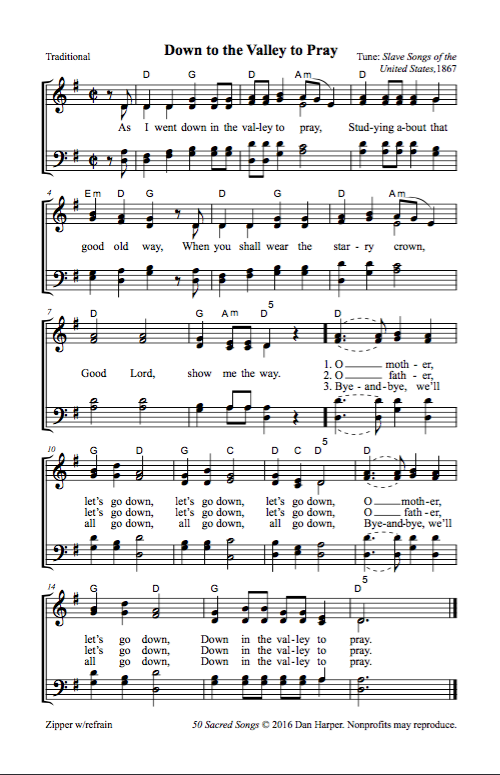
The first known publication of “Down to the Valley To Pray” was in 1867, under the title “The Good Old Way,” in the book Slave Songs of the United States, ed. William F. Allen, Lucy M. White, and Charles P. Ware. In 1872, the Fisk Jubilee Singers included a different version of the melody in their songbook, under the title “The Good Old Way. In the mid-twentieth century, Leadbelly sang it for a Library of Congress recording
The song has also been taken up by white country and bluegrass singers. Flatt and Scruggs played it now and then, and Doc Watson did a lovely recording. In 2000, Alison Kraus popularized the song under the title “Down in the River To Pray,” which was part of the soundtrack to the movie “O Brother, Where Art Thou.”
For this version, I went back to the words and melody recorded in 1867. The melody begins and ends on the dominant, not the tonic, and both white and black musicians have sometimes emphasized that musically ambiguous ending; the final chord for this arrangement is D5 (dominant), not G (tonic).
Performance notes: Because this song is so widely sung, you can safely sing it any way you want: blues, country, gospel, bluegrass, R & B, rock ‘n’ roll. Punk rock version, anyone? Or how about a hip hop version, with samples of Leadbelly’s classic rendition?
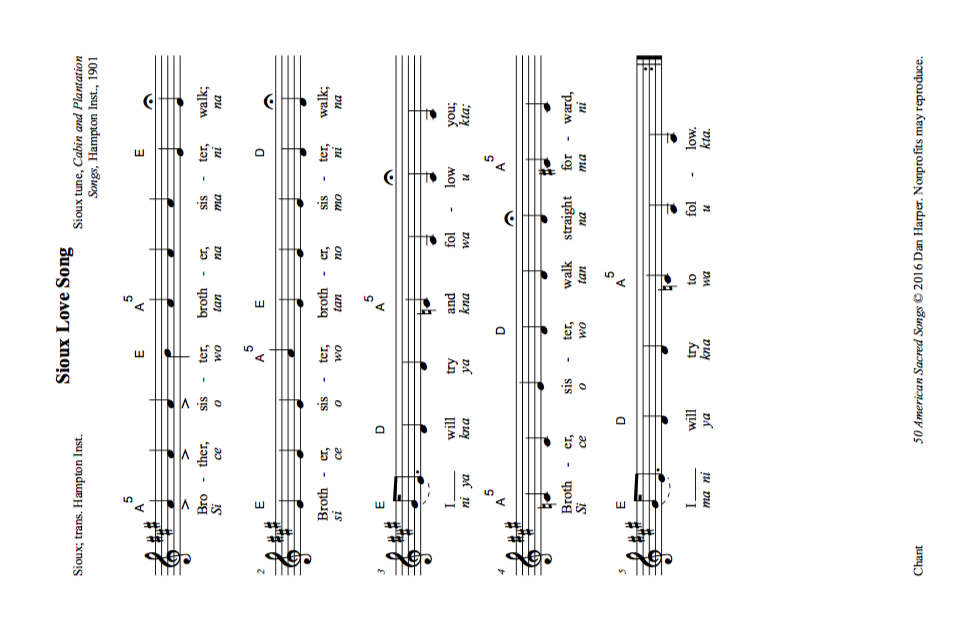
One of the problems you run into when looking for copyright-free sacred songs is that most of the public domain songs out there are Anglo-American or African American, and Christian. That being the case, I’m willing to stretch the definition of “sacred song” quite a bit to include songs on even vaguely spiritual topics. Thus this lovely Sioux chant counts as a sacred song because of the English translation: “Brother-in-law, walk straight forward, I will try to follow you”: I’m willing to consider that a song about moral integrity, and staying in community.
Historical background: Gen. Samuel Armstrong Chapman founded Hampton Institute to educate newly freed African Americans; perhaps the best know Hampton graduate was Booker T. Washington. Armstrong also aimed to “civilize” Native Americans, that is, have them adopt Anglo-American culture. Thus when by Thomas P. Fenner, Bessie Cleaveland, and Frederic G. Rathbun put together Cabin and Plantation Songs, as Sung the the Hampton Students in 1901, the bulk of the music was African American spirituals, but there were also a handful of Native American songs.
Performance notes: About the three Sioux songs in the book, one the editors of Cabin and Plantation Songs wrote: “I have indicated as far as possible the actual tones of the above songs. It is impossible to put into notation the literal manner in which they are sung, as it depends entirely on the singer to change as his fancy dictates.” Thus the songs should be really sung in unison (i.e., with no accompaniment) to allow for this kind of improvisation — but the average congregation will probably find it easier to sing with some kind of accompaniment.
In a more formal worship service, it’s probably enough to sing the song through three times, maybe the second time through trying to sing the transliterated Sioux words. In less formal circle worship, you could sing it till you fall into a trance.
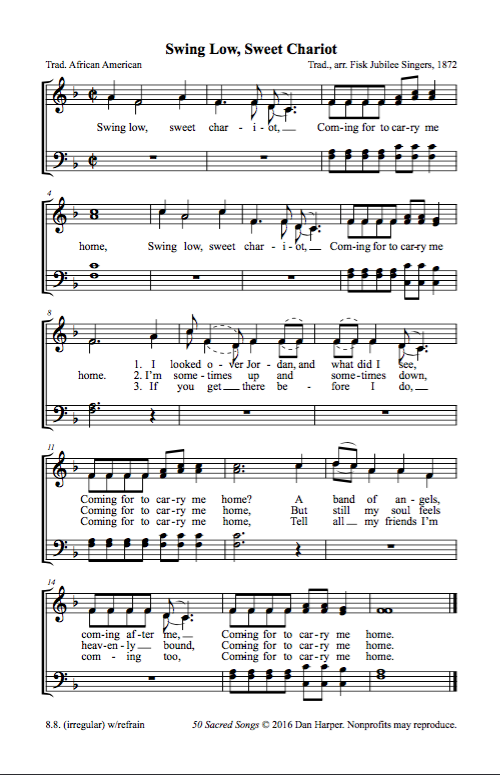
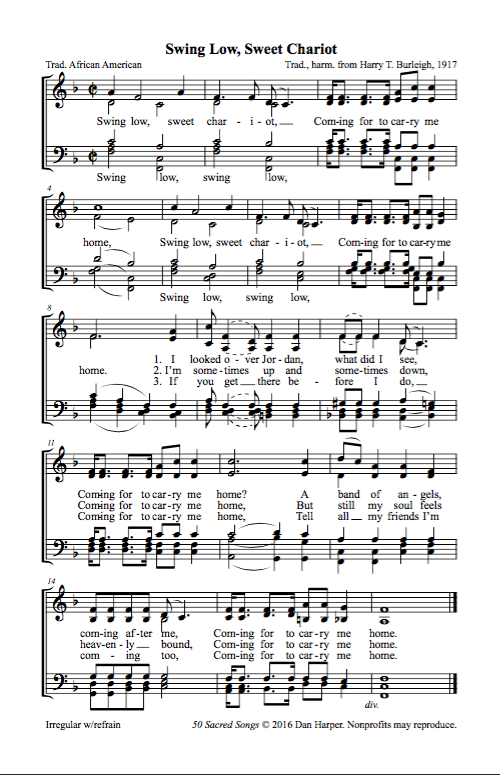
“Swing Low, Sweet Chariot” is a classic spiritual song from the African American tradition. It may have been composed by Minerva and Wallace Willis. Here are two arrangements of this song.
The first arrangement is by the Fisk Jubilee Singers. They published their arrangement in The Story of the Jubilee Singers: With Their Songs (New York: Biglow & Main, 1872). Notice that their arrangement has the first note (“Swing…”) sung on the downbeat; this is different from a common contemporary interpretation of the song where the first note is a pickup measure. The original arrangement of the Fisk Jubilee singers had a fermata over the second note of the opening phrase (“…low…”), and again later where the word “low” is sung; I have omitted the fermata, both because it may confuse congregational singing, and to make this arrangement more consistent with the next arrangement.
The next arrangement is derived from Harry T. Burleigh’s 1918 arrangement of this song for piano and low voice. Burleigh was arguably the first great African American composer of art music; he studied with Dvorak, and helped introduce Dvorak to American folk music. One of the verses and one of the choruses of Burleigh’s piano accompaniment can be easily and logically transcribed for SATB choir, as in the following arrangement.
“Go Down, Moses” is a classic spiritual song from the African American tradition. The earliest known publication was in 1862, in an arrangement derived from a song sung by escaped slaves.
This arrangement comes from the Fisk University Jubilee Singers, perhaps the first African American musical ensemble to tour internationally. They published their arrangement in The Story of the Jubilee Singers: With Their Songs (New York: Biglow & Main, 1872). Their version has 24 verses, telling how Moses led the Israelites to freedom (Exodus 12:29 through Exodus 14 in the Hebrew Bible); other verses mention other matters outside of this basic story. See Historical Background below for how this sacred song has been used as a song of freedom.
Historical background: Harriet Tubman used this as a code song when she was helping enslaved persons escape to the north. Sarah Bradford, in her biography of Tubman, (Auburn, N. Y.: W. J. Moses, 1869), pp. 26-27, wrote: “I give these words exactly as Harriet sang them to me to a sweet and simple Methodist air. ‘De first time I go by singing dis hymn, dey don’t come out to me,’ she said, ’till I listen if de coast is clar; den when I go back and sing it again, dey come out. But if I sing:
‘Moses go down in Egypt,
‘Till ole Pharo’ let me go;
‘Hadn’t been for Adam’s fall,
‘Shouldn’t hab to died at all,’
den dey don’t come out, for dere’s danger in de way.'”
Performance notes: The Fisk Jubilee Singers were first recorded more than three decades after their founding, after many changes of personnel and music directors. In spite of the lapse of time, those early recordings are the best indication we have for the vocal style of the nineteenth century Jubilee Singers. These early recordings reveal a disciplined ensemble with light vibrato, careful enunciation, and precise intonation; a few early recordings are available online at the Cylinder Preservation and Digitization Project, U.C. Santa Barbara. The spare arrangement of “Go Down, Moses” seems to demand discipline, care, and precision in performance. However, the fluid melody is tolerant of the vagaries of congregational singing, and the simplicity of the arrangement means that the average congregation can learn how to sing this song in 4 part harmony.
For an introduction to this sacred song project, including information on copyright, click here.
If your congregation is going to webcast your worship services, you obviously have to be careful of copyright issues. Music, especially, can cause problems: those who hold rights to music can be especially aggressive at enforcing their copyright.
This is further complicated by the fact that more than one person or entity may hold the copyright to a piece of music you wish to webcast, e.g., there may be one copyright on the music and another copyright on the arrangement, and still a third copyright on the lyrics.
Furthermore, you can’t trust the attributions in hymnals. For example, “How Can I Keep from Singing” is widely credited as an old Quaker hymn when it was composed by Robert Lowry in 1869; some of the arrangements published in hymnals are not by Lowry but are copyrighted; and the verse beginning “When tyrants tremble sick, with fear” is attributed to “Traditional” when it is copyright 1950 by Doris Plenn.
And it’s not just webcasts that cause copyright problems. By law, you cannot photocopy any copyrighted tunes, texts, or arrangements (no, not even for an insert in an order of service); nor can you project them onto a screen during a worship service.
So I decided to come up with fifty or so hymns, spiritual songs, chants, etc., that can be safely used without worrying about copyright issues. The tunes, texts, and arrangements either are in the public domain — either that, or they are my arrangements of text or arrangement to which I hold copyright but which I freely permit nonprofit organizations to perform, webcast, record, or project during services.
Update, October, 2016: The project was getting out of hand, so I decided to limit it to American sacred songs, generally with American texts, tunes, and arrangements (though in a few cases I’m including a little bit of English material).
I chose to retain the copyright for two reasons: first, so someone else can’t slap their copyright on my work and profit from it (and yes, Virginia, it has been done); and second, because Creative Commons did not offer exactly the kind of license I wanted. Note that I also retain copyright of the typesetting for all public domain material.
I had another powerful motivation for producing this collection: it should be quite useful for small congregations and house churches that cannot afford to purchase expensive hymnals. A small congregation with a tiny budget can photocopy as many copies as they want; they can project these sacred songs, record them or webcast them, and the congregation can do it for little or no money.
One caveat: I did not research international copyrights. Those who live in the European Union or elsewhere may find that material that is in the public domain in the United States is still protected by copyright in their jurisdiction.
Over the next year or so, I will be posting draft versions of sacred songs from this collection. You are welcome to use them in your congregation — and if you do, I’d love to hear from you if you liked it, or if you ran into any problems.
Every once in a while, I need to type something in ancient Greek. Sure, it’s easy to type Greek letters on most computers, using the Symbol font or equaivalent — but getting the diacriticals right, that’s a real problem. There are rough breathing and smooth breathing marks; and there are oxia (acute), varia (grave), and perispomeni (circumflex) accent marks; and a few other little odds and ends. You can find free ancient Greek fonts (e.g., Brill ancient Greek font), but then you have to change your keyboard settings; not something I want to do when I only need to type in ancient Greek once a year or so.
Then I found this great Web site, TypeGreek. You can learn their simple system for typing accents in about 4 seconds. Then just cut and paste the text into your favorite word processor. And if you can’t get the font to work in your word processor, or if you want to use it on the Web, do a screenshot and insert the image into the document:
The creators of the Political Compass Web site assert that it is not enough to know whether a political leader is on the left or right; we also need to determine if they are authoritarian or libertarian.
Consider the economic scale first: Those on the far left believe it is best to manage the economy for the greater good of all; the further to the left, the more they believe in managing the economy. By contrast, those on the right believe to a greater or lesser degree in the power of the free market. Now consider the social scale: Those who take an authoritarian position believe that the state is more important than the individual. By contrast, those who take a libertarian view believe in the supreme value of the individual. Both scales are of equal importance.
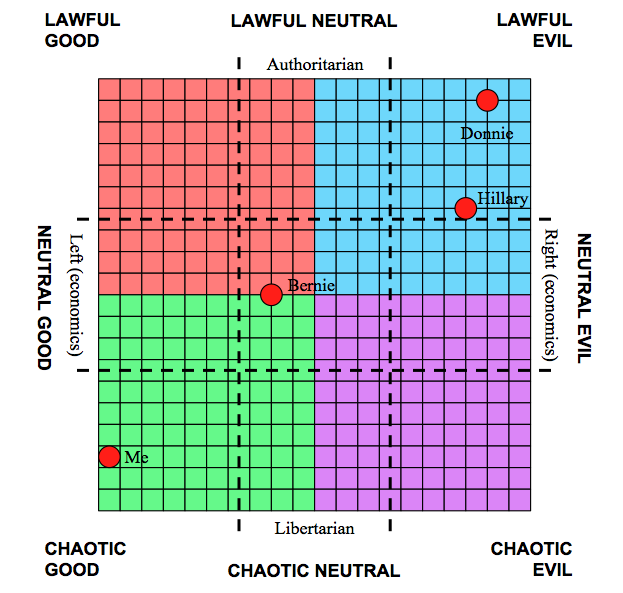
We can put these two axes together in a Cartesian coordinate system to make the “Political Compass,” where the x axis ranges from leftists (negative numbers) to rightists (positive numbers, and the y axis ranges from libertarians (negative numbers) to authoritarians (positive numbers). In this scheme, Stalin would feel at home in the upper left quadrant, which is where you’ll find those who advocate for state-controlled collectivism. Gandhi would feel at home in the lower left quadrant, with voluntary regional collectivism. Pinochet would be happy in the upper right quadrant, with overwhelming state support for the free market. Ron Paul, with his support of libertarian social ideals and the free market, falls in the lower right quadrant. And the Political Compass Web site has a quiz you can take to determine where you yourself fall along the two axes; I scored -9.6 on the economic scale, and -7.6 on the social scale, placing me in the same quadrant as Gandhi.
As much as I like the Political Compass system, I don’t think four quadrants accurately capture the way I perceive political leaders. Therefore, I like to map the Alignment System from role-playing games onto the Political Compass.
The Alignment System describes a creature or character in a role-playing game along two axes: good vs. evil, and chaotic vs. lawful. The chaotic/lawful axis maps neatly onto the libertarian/authoritarian axis of the political compass. The good/evil axis does not map so neatly. But from my perspective, the current political environment privileges either the free market or individual persons; we are given a choice between making a profit, or protecting individual persons. In the Alignment System, “Good characters and creatures protect innocent life” (link), so I choose to map the good/evil axis of the Alignment System onto the left/right axis of the Political Compass, with good corresponding to leftist.
The beauty of the Alignment System is that it offers a nuance that does not appear in the Political Compass: there is a middle ground, named Neutral, in both axes. This gives nine possible orientations, as seen on the chart below: Lawful Good, Lawful Neutral, Lawful Evil, Neutral Good, Neutral, Neutral Evil, Chaotic Good, Chaotic Neutral, and Chaotic Evil. Considered in terms of positive attributes, along the Lawful/Chaotic axis, Lawful equates with honorable; Neutral equates with practical; and Chaotic equates with independent. Along the Good/Evil axis, Good equates with humane; Neutral equates with realistic; and Evil equates with determined (link). All this helps me better understand why I feel left out of the current U.S. presidential race: there are no Chaotic Good (independent and humane) characters running for president.
Considered in terms of the Alignment System, Bernie is probably the best overall choice because he is a Neutral character, both practical and realistic: “…neutral characters … see good, evil, law, and chaos as prejudices and dangerous extremes” (link). Fair enough; but because I am a Chaotic Good character myself, I am turned off by Sanders’ claim that he is Chaotic Good when he is so obviously Neutral. If he would just admit that he is Neutral — a moderate Keynesian who is neither authoritarian nor libertarian — I could see my way to supporting him. Of course Lawful Evil characters dominate U.S. political discourse, and so Sanders will never be allowed to claim his true identity as Neutral; he will always be cast as Chaotic Good because that’s how the Lawful Evil characters perceive him.
Now both Hillary and Donnie are both in the authoritarian right quadrant of the Political Compass; i.e., they are both Lawful Evil, or in terms of positive attributes, they are honorable and determined: “Lawful evil creatures consider their alignment to be the best because it combines honor with a dedicated self-interest” (link). The only real difference between the two is that Donnie is significantly more authoritarian. However, since I am Chaotic Good, I am never going to feel comfortable with either one of them.
If you look back at previous U.S. presidential elections, as charted on the Political Compass Web site (2012, 2008, 2004), you will see that Barack Obama started out as Neutral, but after one term in office became Lawful Evil; and George W. Bush was of course Lawful Evil. The Political Compass Web site did not exist during the Bill Clinton years, but given that Hillary Clinton holds positions similar to his, it seems likely to me that Bill was also Lawful Evil. There is little doubt in my mind that Ronald Reagan was Lawful Evil, and so was George H. W. Bush. Thus we have had Lawful Evil presidents in the U.S. since at least 1980.
If you spend any time with kids, you likely know the song “Down by the Bay”:
Down by the bay, where the watermelons grow,
Back to my home I dare not go,
For if I do, my mother will say:
“Did you ever see a….”
Then you improvise a last line with the name of an animal, and something absurd that rhymes with the animal: “Did you ever see a fly, wearing a tie?”
We’re going to sing this song at camp this summer, so I wanted lots of verses, subject to the following rules:
1. The verses had to be kid-friendly (i.e., no cheetahs drinking margaritas).
2. Only one verse per animal
3. No repeating rhymes (i.e., once you rhyme frog with dog, you cannot rhyme dog with frog)
4. Try to have as many different verbs as possible
I now have 48 verses, from various sources (Web, oral tradition, writing a few new ones). Your mission, should you choose to accept it, is to add even more verses, subject to the above rules. Note that the verses below are listed in alphabetical order by animal.
1. an ant, eat an elephant?
2. a beagle, flying with the seagulls?
3. a bear, combing his hair?
4. a bee, with a sunburnt knee?
5. a beetle, threading a needle?
6. a bunny, eating milk and honey?
7. a cat, swing a baseball bat?
8. a chicken, do some guitar pickin’?
9. a chimp, flying in a blimp?
10. a cockatoo, playing a kazoo?
11. a cow, with a green eyebrow?
12. a crab, drive a taxicab?
13. a deer, throwing a spear?
14. a dog, chopping a log?
15. a duck, in a pickup truck?
16. an eagle, married to a beagle?
17. a fish, do a hula in a dish?
18. a fly, wearing a tie?
19. a fox, hiding in a box?
20. a frog, hopping on a dog?
21. a giraffe, who really made you laugh?
22. a goat, in a ferry boat?
23. a goose, kissing a moose?
24. a hawk, knitting a sock?
25. a hog, going out to jog?
26. a horse, on a golf course?
27. a kangaroo, tying her shoe?
28. a lizard, dressed for a blizzard?
29. a llama, wearing striped pajamas?
30. a lobster, shooting at a mobster?
31. a mink, at the skating rink?
32. a moose, drinking apple juice?
33. a mouse, build a great big house?
34. a mule, swimming in a pool?
35. an octopus, who liked to swear and cuss?
36. an owl, drying on a towel?
37. a pig, dancing a jig?
38. a platypus, in a shuttle bus?
39. a rat, with a great big hat?
40. a seal, on a Ferris wheel?
41. a sheep, driving a jeep?
42. a slug, give a bug a hug?
43. a snail, with a dinner pail?
44. a snake, baking a cake?
45. a spider, drinking apple cider?
46. a turkey, who liked to eat beef jerky?
47. a whale, with a polka-dotted tail?
48. a yak, doing jumping jacks?
(N.B.: If you post an additional verse on Facebook, I’ll assume you give me permission to repost on my blog.)
Is the famous song “This Little Light of Mine” an African American spiritual? Or was it composed by Harry Dixon Loes and Avis B. Christiansen around 1920?
Attributions to the African American tradition
Many hymnals and songbooks attribute “This Little Light of Mine” to “African American Spiritual,” or more generally to “Traditional.”
An influential source: Lift Every Voice and Sing II: An African American Hymnal, ed. Horace Clarence Boyer (New York: Church Publishing, 1993), has the following attribution: “Words: Traditional. Music: Negro spiritual, adapt. William Farley Smith (b. 1941)”. The melody of this version resembles the melody collected in 1939 by Alan Lomax, as sung by Doris McMurray of Huntsville, Texas.; this recording is available online here.
An equally influential source is Sing for Freedom: The Story of the Civil Rights Movement Through Its Songs by Guy and Candie Carawan (Montgomery, Ala.: NewSouth Books, 1963/2007). The Carawans give a somewhat different melody, and attribute this as “Traditional song” (p. 21). They provide documentary evidence that indicates the song was included in the “Highlander Song Book” (p. 25), a songbook that would date from the 1930s. Incidentally, the Carawans provide a bridge that is not included in the hymnals I’ve consulted.
In addition to the audio recording by folklorist Alan Lomax in 1939 (see above), “Let hit shine” was collected by Ruby Pickens Tartt, and published in “Honey in the Rock”: The Ruby Pickens Tartt Collection of Religious Folk Songs from Sumter County, Alabama (Mercer University Press, 1991, p. 5; words only). Note that like the Lomax version, this version was probably collected in the 1930s. The editors do not provide any guidance as to when Tartt collected this particular song, but they provide the following editorial comment, without documentation: “Widely performed by choirs and gospel groups during the 1930s, a favorite on gospel radio shows, ‘Let hit shine’ is now also in white folk tradition.”
The words to “This Little Light” are collected by Steven Gould Axelrod, Camille Roman, and Thomas J. Travisano, in their book The New Anthology of American Poetry: Modernisms, 1900-1950 (Rutgers University Press, 2005), on p. 605. The editors add the following editorial comment: “Harry Dixon Loes (1892-1965) wrote and composed this song with Avis B. Christiansen (b. 1895). The pair also wrote the hymns ‘Blessed Redeemer’ and ‘Love Found a Way’.” This attribution, coming as it does from a well-regarded university press, carries some weight; however, the attribution is not documented.
Typical of the stories told about the song is that told by Ace Collins, in his book Music for Your Heart: Reflections from Your Favorite Songs (Nashville: Abingdon Press, 2013), p. 191: “During his studies [at the Moody Bible Institute], Loes was struck by the significance of three different references to light in the New Testament…. Using light as an inspiration and coupling it to a melody that carried the feel of a spiritual, Loes wrote ‘This Little Light of Mine.’ Yet the song, which is today almost universally known, took a while to take off. Although written in 1920, it would be in the days just before World War II that churches began to adopt ‘This Little Light of Mine’ as a part of Sunday school programs. Within a decade, Loes’s song was translated into scores of languages and sung all over the globe.” Collins provides no documentation whatsoever for any of these assertions.
Although the song was supposedly composed c. 1920, I was unable to find a reference to it in the Catalog for Copyright Entries for the years 1920 and 1921; however, Loes might have copyrighted the song later than 1920.
Hymnary.org shows no publications in hymnals prior to about the late 1930s; see graph here. However, Hymnary.org does not include every single U.S. hymnal from the twentieth century.
Wikipedia attributes the song to Loes, but does not document the source for this attribution. The Wikipedia page was created July 26, 2007, and many online sources (and probably many print sources) unquestioningly accept the Wikipedia attribution in spite of the lack of documentation; therefore, be wary of any source published 2007 and later that attributes the song to Loes.
The Web site Hymntime.com does NOT list “This Little Light” as one of Loes’s compositions. Note that Hymntime.com gives Loes’s dates as October 20, 1892 to February 9, 1965; the birth year is different from the birth year given by Wikipedia.
Conclusion and questions
The fact that folklorists collected the song after Dixon’s purported composition date of circa 1920 indicates that the song could have passed quickly into the folk repertoire soon after composition. However, assuming Loes did indeed write the song (or if Loes co-wrote it with Christiansen), where and when was it first published?
If Loes wrote the melody, what was his original version? Similarly, if the melody is an African American spiritual, what is the earliest recorded version of the melody?
Loes was white, so if he wrote the song, how did it become associated with the African American tradition?
In the absence of firm answers to these and other questions about the origins of this tune, the most careful attribution for this song would be “Unknown.”
NOTE: See the update below for a brief biography of Windom.
I’m trying to track down Aaron Bash Windom, a mid-twentieth century composer of gospel music from St. Louis. One of his better-known songs was “Let Us Sing Till the Pow’r of the Lord Come Down,” often known as “Now Let Us Sing.”
My best guess is that Windom was born in 1910, and died in 1981. The Catalog of Copyright Entries, Third Series, vol. 2, part 5A, number 1, Published Music, January-June 1948 (Washington, D.C.: Copyright Office, Library of Congress, 1948) reveals that his name is Aaron Bash Windom, that he was born in 1910, and that he was the sole owner of A. B. Windom Studio, St. Louis, Mo. The Find-a-Grave Web site has a photo of a grave stone of Aaron Bash Windom who died in March, 1981, at age 70; the grave stone is in Saint Peter’s Cemetery, Normandy, St. Louis County, Missouri.
Windom is mentioned in passing in Horace Clarence Boyer’s The Golden Age of Gospel ([University of Illinois Press, 1995], p. 138): “Two other S. Louis natives who were important figures in gospel between 1945 and 1955 were Martha Bass and A. B. Windom. … Windom, a one-time accompanist for Mother Smith, composed several gospel songs: her ‘I’m Bound for Canaan Land’ and ‘I’ve Got the River of Jordan To Cross” became gospel standards.'” Several other sources indicate that he taught piano; in a couple of places he is referred to as “Professor A. B. Windom,” though I don’t know if he was affiliated with a school or college, or if he, like many other music teachers, was accorded the honorary title lf “Professor” by his students and local community.
The gospel song “Let us sing till the pow’r of the Lord come down” was published in St. Louis, Mo., and is copyright 1948 by A. B. Windom Studio. If you look around online, you can find recordings of it by various musicians. Some online discographies seem to indicate that he made some recordings of his own music, but I can’t confirm that.
But I have no idea if he was white or black; if he played anything besides gospel music; to what extent he made his living as a performer, a teacher, and/or a composer. I cannot find him in the 1930 or the 1940 U.S. Census. Was he married? Did he have children?
If anyone out there knows anything about him, I’d love to hear.
Update, Feb., 2023
Here’s my best effort at a brief biography for Aaron Bash Windom, based on the information listed below, plus information from the comments. Some of this is a little bit speculative, but given how little information we have, this will have to do.
Aaron Bash Windom, known as A. B. Windom, was born on September 11, 1910, in Missouri. Nothing is known about his early years. By 1941, he was publishing his own compositions in St. Louis, often under the imprint “Studio of A. B. Windom.” In addition to being a gospel composer, he also taught music, and his students called him Professor A. B. Windom. He was also a performer, and both sang and played piano.
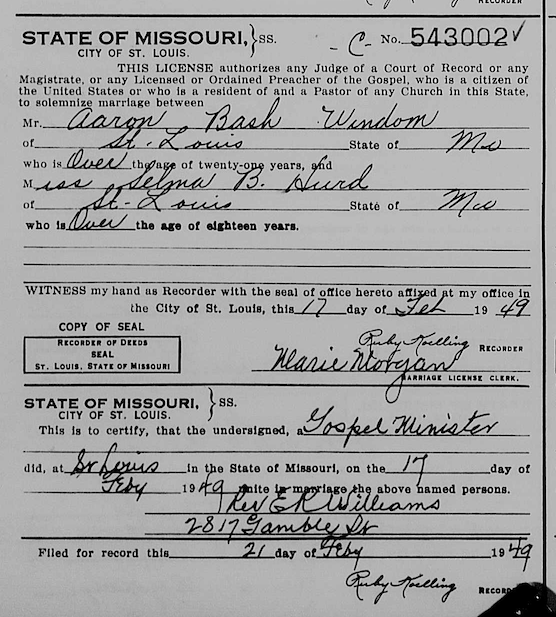
On February 17, 1949, he married Selma B. Hurd. Born c. 1903, Selma was from East St. Louis, Ill., across the river from St. Louis, and was the daughter of Baptist minister Rev. B. M. Hurd.
Although all his published compositions were gospel music, Windom taught classical piano. As one of his students remembers, “He was very well versed in music theory as well. Gospel music is not all he knew. He was a light-skinned Black man, [and] eccentric. I still miss him.” At least one of his students went on to become a professional musician, the gospel composer Rev. Robert Mayes (1942-1992).
Windom served for forty years as the minister of music at Christ Pilgrim Rest Baptist Church in St. Louis, circa 1940 until his death. In 1966, he served on the Devotional Literature Commission of the Progressive National Baptist Convention.
His gospel compositions were recorded most notably by Mahalia Jackson, and also by less well-known performers such as Martha Bass, the Golden Harmoneers, the Clara Ward Singers, etc. His 1948 composition “Let Us Sing Till the Power of the Lord Come Down” (a.k.a. “Now Let Us Sing”) has been recorded a number of times and is widely sung by church choirs. “This song has even entered the folk tradition to the point where”Now Let Us Sing” has entered the oral tradition, passed from singer to singer; unfortunately in the process Windom’s authorship has sometimes been forgotten.
Windom died on February 28, 1981. He had turned over his school at 3905 Evans Street, St. Louis, to Professor Lee Cochran, Jr., who continued to teach music there. Selma, A. B.’s wife, died on February 26, 1994. They are buried together in St. Peter’s Cemetery, Normandy, St. Louis County, Missouri.
Research notes:
(1) Be sure to read the comments. There is some material there from people who knew him.
(2) I’ve found some genealogical information about Aaron Bash Windom. I assumed that the birth year listed in his copyright entries (1910) was correct. Beyond that, “Windom” is an unusual spelling.
(a) I was not able to find him in the 1920, 1920, 1940, or 1950 U.S. Census. That doesn’t mean he’s not there; sometimes names get horribly mangled by the census takers. But I was unable to track him down.
(b) Aaron Bash Windom and Selma B. Hurd were married on February 17, 1949, in St. Louis, by Rev. E. R. Williams. See attached photostat of the marriage record (from Familysearch.org). With such an unusual name, spelled exactly as it appears on his copyright records, this is pretty definitely our A. B. Windom.
(c) Aaron Bash Windom is in the Social Security Death Index, found via Familysearch.org. Date of birth, September 11, 1910; date of death, February, 1981 (no day given). Since he was buried in early March (see below), I’d assume he died in late February.
(d) According to Find-a-Grave, Aaron Bash Windom died in March, 1981 (though actually, this was probably the burial date; see above for a Feb. date), and he was buried in St. Peter’s Cemetery, Normandy, St. Louis County, Missouri. Interment.net summarizes the interment record as follows: “WINDOM, Aaron Bash, age: 70, burial: 03/07/1981, Section: 28, Block: O, Lot: 28.00, Grave: 1.”
This source (which collates public records) has the following information: “WINDOM, AARON was born 11 September 1910, received Social Security number 498-14-7067 (indicating Missouri) and, Death Master File says, died February 1981 [Source: Death Master File (public domain)….] WINDOM, AARON B. died 28 February 1981 in Missouri, U.S.A. Special thanks to Reclaim the Records.” Given the dates of death, I feel pretty confident that both these entries are for our A. B. Windom.
(e) Selma died in 1994, according to Find-a-Grave (this corresponds to the information in the comments below) and she is also buried in St. Peter’s Cemetery. Interment.net lists her as “WINDOM, Selma B., age: 91, burial: 2/26/1994, Section: 28, Block: O, Lot: 28.00, Grave: 2”; in other words, she’s buried next to A.B. (but darn it, I wish they’d given her full middle name). This also gives Selma’s approximate birth year as 1903. That means she was about 46 years old when she married A.B. Windom; thus it’s no surprise that they didn’t have children together. Another source gives her date of death as February 19, 1994 (using information found on reclaimtherecords.org).
Once I knew Selma’s approximate birth year, I could do more research on her life. Our Selma is probably (but not definitely) the Selma B. Hurd born in 1903, and found in the 1910, 1920, and 1930 U.S Census, living with her parents in East St. Louis, Illinois, right across the river from St. Louis, Mo. Her parents were B. M. Hurd (born in Georgia; first name also given as Morgan) and Lusette Hurd (born in Alabama; first name may be Lucetta, Luretta, or Susetta). B. M. was minister of a Baptist church, and is listed in the American Baptist Yearbook for 1910 (p. 151); he is probably the B. M. Hurd who died in 1937. Lusette doesn’t appear in the 1930 Census; she is probably the Lucetta Hurd who died in 1922 and is buried in the same cemetery, in the exact same section, as B. M. Hurd. Note that Selma was Lusette’s second child, for the 1910 census shows she has two living children, though only Selma is living with Lusette in that year (Lusette was about 40 when she had Selma); also note that Lusette married B. M. circa 1901, and this was her second marriage. Also, the 1920 Census lists Selma, Lusette, and B.M. as black.
Given this information on Selma, we might be able to go a little further. A woman named Selma Hurd of East St. Louis, Ill., married Carl L. Jamerson, also of East St. Louis, on September 22, 1930 — there may have been two women named Selma Hurd in East St. Louis in 1930, but I’m betting that it’s the same woman; and if this is the same Selma who married A. B. Windom, then it was her second marriage. However, note that A. B. Windom did not marry Selma Jamerson; which could mean that these are not the same woman, or it could mean that Selma took back her maiden name after her marriage with Jamerson ended.
Be cautious with any of this information about Selma. I found no definite connection between the Selma Hurd of East St. Louis, Ill., and the Selma Hurd of St. Louis, Mo., who married A. B. Windom. They’re probably the same woman (it’s a somewhat unusual name), but they’re not definitely the same woman.
(3) A. B. Windom is mentioned in the minutes of the “First Annual Midwinter Planning Session” of the Progressive National Baptist Convention, Inc., January 19-20, 1966, held at Christ Pilgrim Rest Baptist Church, St. Louis, Missouri: “Professor A. B. Windom of the host church sang a solo, ‘Come unto Jesus'” [for the Thurs. morning, Jan. 20, session]; he was also listed as a member of the “Devotional Literature Commission.” These minutes are bound with the Minutes of the Fourth Annual Session of the Progressive National Baptist Convention, Sept. 7-12, 1965 (p. 165).
(4) I found a number of copyright listings and publication listings for A. B. Windom, but did not have the patience to go through all those listings looking for bits good information (e.g., where the copyright holder resides, etc.). Below is what my quick search turned up for sheet music publications. These are of interest because they place Windom in St. Louis in the 1940s, and show that he published his own music. It also shows that he had connections to Chicago.
1941: “The First Started Burning in My Soul” (27458 Cass, St. Louis: A. B. Windom) 1942: “You’ve Got the River of Jordan To Cross,” with P.D. Johnson and Theodore Frye (Chicago: Theodore Frye) 1945: “There’s Rest for the Weary” (St. Louis: A. B. Windom Studio) 1947: “I Got To Run to the City Four Square (St. Louis: A. B. Windom Studio) 1948: “Let Us Sing Till the Power of the Lord Come Down” (St. Louis: A. B. Windom Studio) 1949:”Oh Lord Remember Me” (St. Louis: A. B. Windom Studio) 1949:”You Got To Stand Your Trial in Judgment” (St. Louis: A. B. Windom Studio) 1954: “Peace, Peace in Jesus” (St. Louis: A. B. Windom Studio) (Sources: Emory Univ.; eBay listings; U.S. Copyright listings)
(5) A. B. Windom is mentioned in a few published reminiscences about the mid-twentieth century gospel music scene — search Google Books — but most of this material either is not available on Google Books, or says little more than “I remember A. B. Windom.”