Making history (up)

The current presidential administration has been making history.

I don’t mean making history the way that phrase is typically used. I mean the Trump administration has been making history up, by erasing facts that don’t meet the administration’s standards for political correctness. The erasures have taken place in several formats, including on federal websites, in federal training materials, etc. The American Historical Assoc. and the Organization of American Historians have issued a “Statement Condemning Federal Censorship of American History”; I’ll include the full statement below.

A few of the changes have been stopped by public protests, such as removing the Tuskegee Airmen from Air Force training videos. The Air Force removed the Tuskegee Airmen from the videos because they intepreted Trump’s executive orders against DEI as applying to any mention of the history of a Black combat unit. Given the wording of the executive order, I feel the Air Force made a reasonable interpretation of the order, i.e., the fault lies not with the Air Force but with the executive order.

Other changes to American history remain in place. For example, as of right now the home page of the Stonewall National Monument doesn’t contain the word “transgender,” and the the acronym “LGBTQ” has been replaced by the acronym “LGB.” (The Internet Archive Wayback Machine shows that the acronym “LGBT” was used prior to the Trump administration executive orders; see e.g. this archived webpage from 2022.) Since trans people were integral to the Stonewall riots, the simple removal of the “T” from “LGBTQ” does in fact represent a major rewriting of history by the federal government. The Trump administration may not like transgender people, but like them or not, they were most definitely a part of the history of the Stonewall riots.

I see several things going on here. First, while the Trump administration and their allies denounce “cancel culture,” this looks like cancel culture to me. Second, while the Trump administration and allies denounce censorship, this looks like censorship to me. And finally, as I said at the beginning of this post, this is political correctness — which the Trump administration and their allies have also denounced.

No surprises here. The Trumpites are not the first politicians to spin stories that have little relationship to facts, but which help to bolster their agendas. But it seems like a good idea to document the amazingly vast extent to which the Trump administration is just — making stuff up.

(Thanks to…)

Continue reading “Making history (up)”

Practical politics

In his History of Western Philosophy, Bertrand Russell provides historical context that helps us understand why philosophers tackled certain problems at different times in history. In much of the Middle Ages, there was no philosophy. So Russell describes the battles between various polities, and the struggles between the Roman Catholic Church and secular authorities, which helped set the stage for the blossoming of scholastic philosophy in the thirteenth century.

In 1154, Hadrian IV became Pope. Hadrian soon became embroiled in a struggle with Frederick Barbarossa, who had become king of Germany in 1152, and wanted the Pope to crown him Holy Roman Emperor. According to Russell, however, Hadrian IV and Barbarossa were able to find common cause when the city of Rome sought to become an independent city. A poulist faction in Rome wanted an elected body of lawmakers, and they wanted the right to choose their own emperor. The Romans brought in one Arnold of Brescia, a man known for his saintliness. Russell doesn’t make it entirely clear what Rome hoped to get from Arnold, but I suppose they wanted moral credibility.

Unfortunately for Rome, Arnold was a heretic. Russell describes his “very grave” heresy thus: “he maintained that ‘clerks who have estates, bishops who hold fiefs, monks who possess property, cannot be saved’” [i.e., cannot be saved from damnation in the Christian scheme of the afterlife]. Arnold maintained that clerics should abjure material things and devote themselves solely to spiritual matters. However, Arnold’s biggest heresy was that he was supported Roman independence. This enraged Barbarossa. Hadrian IV became equally enraged when there was a riot in Rome in which a Roman Catholic cardinal was killed.

This happened during Holy Week, the week leading up to Easter which was the most holy week of the year for the residents of Rome. Hadrian banned the Romans from joining in the Easter rites, unless they got rid of Arnold. The Romans submitted to Hadrian, and expelled Arnold from Rome. Arnold went into hiding, was discovered by Barbarossa’s soldiers, executed, his body burned, and the ashes disposed of in a river. Literally nothing of Arnold remained around which resistance could be organized.

Once Arnold of Brescia was disposed of, Hadrian and Barbarossa could resume their political battle without further distraction. Russell comments:

This is a useful lesson for our own time. Since at least the time of Newt Gingrich, it feels like the honest people have slowly been forced out of politics by the “practical politicians” who seem mostly interested in their personal grabs for power.

Noted with comment

I’ve been rereading Dave Van Ronk’s memoir The Mayor of MacDougal Street (2006). Van Ronk was a musician best remembered for his fingerstyle guitar and his interpretations of blues music, although he thought of himself as more of as a jazz musician manque. He was one of the core musicians of the 1960s Folk Revival, though he never hit it big like his friend Bobby Dylan. Van Ronk was also a serious leftist. He started out as an anarchist, joined the IWW, and wound up as a Troskyite. In his memoir, he reflected on the politics of the 1960s:

Interestingly, I feel the current Republican party actually does have a serious theoretical grounding. I disagree violently with the Republican party’s economic policies, but you have to admit that they are firmly grounded in Milton Friedman’s economic theories. Even if today’s Republicans have drifted away from Friedman in some respects, still a great deal of their agenda — doing away with Social Security, privatizing the National Park System, getting rid of the Post Office, etc. — comes straight out of his work.

Who on the American left offers any theoretical grounding to compete with Friedmanism? If Dave Van Ronk were still alive he’d no doubt advocate for Trotskyism, although to my mind that’s a non-starter in 2025 America. Personally, I’d vote for William J. Barber’s Poor People’s Campaign. However, I suspect Barber’s Christian affiliation is a dealbreaker for many of today’s pissed-off liberals; plus it has proved difficult to get pissed-off liberals to focus on poverty as a central issue.

Reading list: more on Asian history

Brief notices of other histories of East Asian and Southeast Asian countries that I’ve been reading

Tuttle Publishing’s “Brief History of…” series

Tuttle Publishing says that its core mission is “to publish best-in-class books informing the English-speaking world about the countries and peoples of Asia.” Founded in Rutland, Vermont, back in 1832, they now have offices in Vermont, Tokyo, and Singapore. Their “Brief History” series provides popular one-volume histories of various countries in East Asia and Southeast Asia. Current titles in this series cover the following countries: China, Indonesia, Japan, Korea (including North and South Korea), Singapore and Malaysia, Thailand, and Vietnam. An although Bali is part of Indonesia, there’s also a separate book on Bali in this series.

I’ve read all these titles except the ones on Bali and Japan. I can affirm that each book I’ve read gives exactly what they promise: a brief introduction to the history of each country. Each one is competently written and entertaining, and each one generally relies on secondary (and tertiary) sources rather than primary sources. If you want something more than a Wikipedia article, but something less than a dry scholarly history, these are the perfect books to read. While the quality of the books is consistently high, I’ll offer brief comments on the relative strengths of each volume. Then I’ll discuss two other books published by Tuttle that offer more in-depth accounts of two polities.

Nine books on Asian history arranged in a grid.
Continue reading “Reading list: more on Asian history”

Reading list: Southeast Asia

For some reason, I got interested in the history of Southeast Asia a year or so ago. Mostly I was interested in learning more about a part of the world that was completely neglected in my schooling. Below are brief summaries of three of the books I’ve been reading.

Books piled on one another.
Continue reading “Reading list: Southeast Asia”

Reading list

Reviews of three books I’ve read recently.

The Tenant of Wildfell Hall by Anne Bronte

This romance novel from 1848 begins with Gilbert Markham, the male protagonist, telling how he saves a small boy from falling off a high wall. The boy’s mother, the widowed Mrs. Helen Graham, sees him do this; but instead of thanking Gilbert, she treats him coldly and with suspicion. Nevertheless — or perhaps precisely because she treats him so badly — Gilbert falls in love with Mrs. Graham, abandons his previous sweetheart, and pursues this mysterious widow despite her attempts to keep him at arms’ length. So ends the first part of the book. Gilbert manages to portray himself as weak-willed and foolish, and thus not the typical hero of a romance novel.

The second part of the book consists of entries from Helen Graham’s diary, whose real name turns out to be Helen Lawrence Huntington. Helen has given this diary to Gilbert so he can understand her better. In the diary, Helen tells how she fell in love with Arthur Huntingdon, a weak-willed and unscrupulous man. She foolishly marries him. To her astonishment — but not to ours — after their marriage, Arthur reveals himself to be abusive, irrational, domineering, and nasty. Helen puts up with him until she sees that their son is beginning to imitate his father. This she cannot stand, so she flees the marriage with her son, and hides in the country under an assumed name, where she meets Gilbert Markham. So ends the second part. Will her life improve in the third part?

Continue reading “Reading list”

Turning twenty

(I wrote this a few days ago, then forgot to post it. Here it is now….)

On February 22, 2005 —twenty years ago last Saturday — I wrote my first blog post. If you want a summary of this blog’s boring history, try here, here, and here. But I don’t want to look at the past, I want to think about the ongoing role of independent blogs like this one.

Twenty years ago, most blogs were a mix of day-to-day trivia, snarky commentary, and a few more serious long-form posts. All three of these have now migrated to other platforms.

The day-to-day trivia gets posted to social media outlets like Facecrook, TikFok, YouCrude, Instacrap, etc. Much of it consists of images, graphical memes, and videos. There’s no longer much interest in text-based day-to-day trivia.

Snarky commentary has also moved to social media outlets. Again, there’s been a movement away from text-based snark to videos, graphical memes, and images. Snark has also declined in intelligence, creativity, and kindness; I wouldn’t even call it snark any more, I’d call it Rage Porn.

Long-form text-based posts have moved to outlets that cater to that format, such as Substack and Medium. This move is generally a good thing; writers can focus on writing, and they can stop worrying about the technical challenges of publishing online.

In short, most of what appeared on independent blogs twenty years ago has now moved to other platforms. There’s a good reason for these moves: it has become increasingly challenging to stay current with web technology.

Take, for example, WordPress, the blogging platform I use. I started out in 2005 using WordPress 1.5, when it was simple and uncomplicated blogging software. Today, WordPress has morphed into a major CMS capable of running today’s most complex websites. I no longer have the time to stay current with its capabilities. That’s one of the reasons I still use a nine-year-old theme: I don’t have the time to make the move to a new theme. Sure, I could hire a WordPress consultant to do it for me; but that gets away from the DIY ethos that I found so appealing about blogging back in 2005.

Whatever platform you choose, web security has become increasingly difficult, as the evil hackers get bolder and more skilled. I’m lucky I have a good web host who helps me keep current with security issues. But it’s getting harder and harder for me to stay current with web security. I can thoroughly understand why writers would want to move to a platform like Substack or Medium.

Beyond the challenge of staying current with technology, I don’t think there’s much of an audience for independent text-based blogs any more. Most of my early readership long ago migrated to social media platforms. Once you’re hooked in to a social media platform, there’s not much reason to go visit an independent website. Potential new audiences tend to prefer audio or visual podcasts; they don’t want to read text, they want to watch or listen to content.

The only reason to write an independent text-based blog like this one is because you like to write. That describes me. I enjoy the process of writing, and I write all the time. As long as I’m writing something, I might as well publish it. And even though publishing a blog has gotten more difficult in the past twenty years, it’s still far easier than the printed fanzines I used to publish in the 1980s and 1990s.

So what if the audience for independently hosted blogs is tiny? I’m still having fun, which has always been the point of this blog. I hope you’re still having fun, too — and thank you for continuing to read.

Noted without comment

From “The American Taboo on Socialism” by Robert N. Bellah in The Broken Covenant: American Civil Religion in Time of Trial, 2nd Edition (Chicago: Univ. Chicago Press, 1992), chapter 5, pp. 112-138:

World Ukulele Day

February 2 is “World Play Your Ukulele Day.” This holiday was established in 2011 by Mike Lynch (a.k.a. “Ukulele Mike”; see below). In the original announcement, Mike Lynch kept his expectations low. “Take your uke out of its case,” he said, “and play it.”

Simple enough.

Screen shot from a video showing a man holding a ukulele and talking
Screen grab from Mike Lynch’s original Youtube video announcing World Ukulele Day. Click the image to see his video on Youtube.

OK. I did that.

What else can I do?

Mike had a suggestion: “Find someone who needs a smile. You might take it to an elder care, you might take it to a shut-in….” In other words, try to make the world a better place by playing your ukulele. But I went on a field trip with teens from our congregation’s youth group, which didn’t leave time for ukulele excursions.

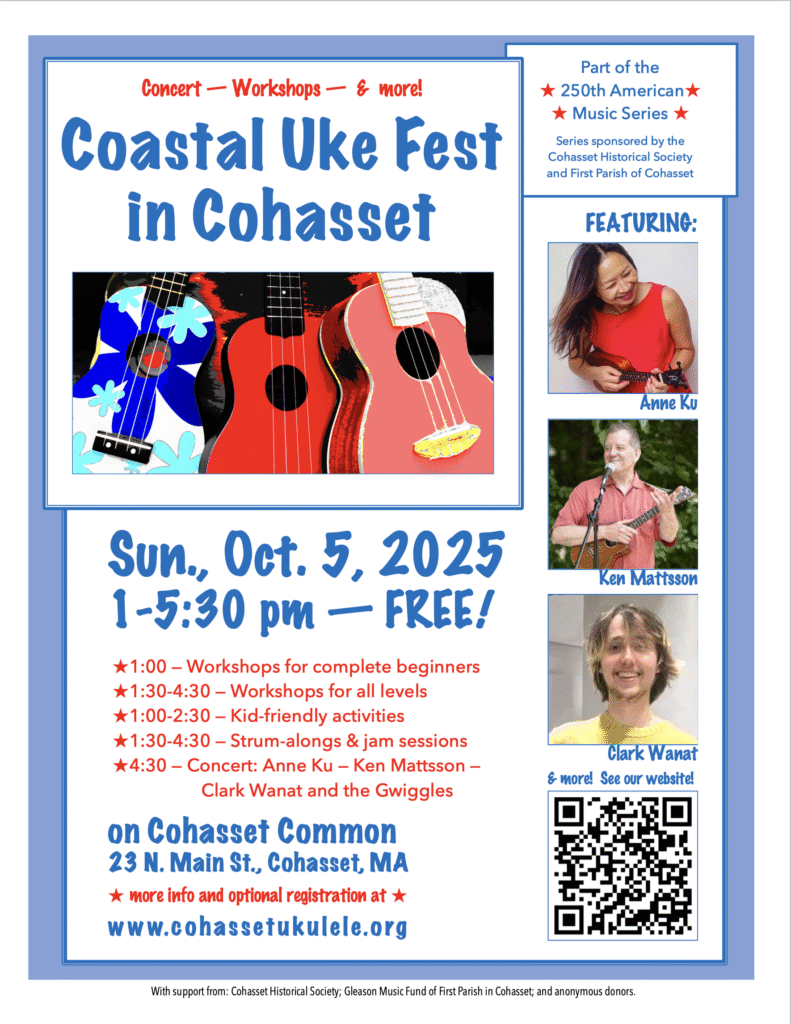
Since I don’t have time to do anything else, I’ll share a ukulele song sheet for “It Was a Lover and His Lass,” Thomas Morley’s 1600 setting of poetry by William Shakespeare. Before you get all critical, yes I know it’s a pretty primitive song sheet. And no, I didn’t attempt to transcribe Morley’s lute accompaniment for ukulele (way above my pay grade), I just put in chord indications based on a simplified form of Morley’s harmony. Yet even in this simplified form, it’s kind of challenging. We tried it at our Cohasset ukulele circle, and people noted the nine different chords you have to know, the fast chord changes, and the tricky rhythm in mm. 22-23. Whatever, it’s a great song — and this is the best I’ve got for World Ukulele Day 2025.

(N.B.: Public domain music, public domain words, and I’m releasing my mediocre typesetting into the public domain. Go ahead and copy it all you want.)

More about Ukulele Mike

Michael B. Lynch (1945-2018) was a career music educator and an accomplished ukulele player. As a youth, he played in a ukulele ensemble led by the legendary ukulele educator Chalmers Doane. Beginning in 2009, he produced a popular series of instructional Youtube videos under the name “Ukulele Mike.” He also published a number of instructional CDs and books, still available through his website that his wife continues to maintain.

Web, c. 2007

I’ve been spending too much time online for the past two decades. But recently I’ve been reducing my screen time, and — surprise, surprise — I feel better. That’s why I’ve reduced my posting schedule to about once a week.

But back in 2007, I lived way too much of my life online. I spent way too many hours writing daily blog posts, commenting on other people’s blogs, hanging out on Twitter, producing a weekly video, watching other people’s videos (back then, blip.tv was the place to really hip creative videos), and on and on.

I also created several random websites, just for fun. Recently, I found the HTML code for a whimsical website I created in 2007. What happened was this: Carol had a website called fishisland.net which she used to publicize ecological projects. Last year, that site got taken over by malicious actors. Our web host shut it down for us. I told Carol I’d restore it but never got around to it (I’m limiting my screen time, remember?).

Well, this week I came down with a nasty head cold. I couldn’t sleep last night because my cough kept waking me up. So I wrapped myself up in a sleeping bag, and tried to resuscitate the hacked web site. And lo and behold, I discovered what I had forgotten — that fishisland.net had originally been my website, that I had hand-coded it in HTML 3.0 with state-of-the-art CSS. The hackers had trashed everything else, but plain old HTML is pretty robust, and I was able to resuscitate the website pretty much as it looked in 2007.

Here’s the resuscitated website. The only real problem I ran into was that the full-size photos had disappeared; I had to take the 200px-wide thumbnails and scale them up in GIMP. Actually, the whole website looks so primitive today, but back then it looked pretty slick. If you’re into HTML, check out the CSS — can you believe how few lines of code it required?

However, don’t try to look at this website on your phone — it will look like crap. And that’s really the big change in the web since 2007. Back then, no one looked at websites on their phones. Now, more than half of all web views are on phones.

Screenshot of website.
A screenshot showing what the resuscitated website looks like.

Update (1/31/25):

A little bit of thought and research revealed that it is in fact possible to have a static HTML website render reasonably well on different sized screens (e.g., laptop, smartphone) without building a responsive site using Javascript. In the case of this website, my CSS originally had an ID selector that styled the second nested div (the first div sets the background color, this div sets size on the screen) as follows:

#wrap {width: 42em; margin: 0 auto;} 

I simply changed that to:

#wrap {width: 95%; max-width: 42em; margin: 0 auto;}

Duh. So obvious. Of course I also had to change padding and margin for various other CSS elements so the site would look OK on a smartphone, which took some time. I also added the following line to the header:

<meta name="viewport" content="width=device-width, initial-scale=1">

Now the site works reasonably well on various sized screens. Is it as good as a responsive website? No. And I’m sure I’ll find more problems. But I had fun, and I like that the CSS is compact and manageable.

And now I’ve spent waaaaay too much time staring at screens today.