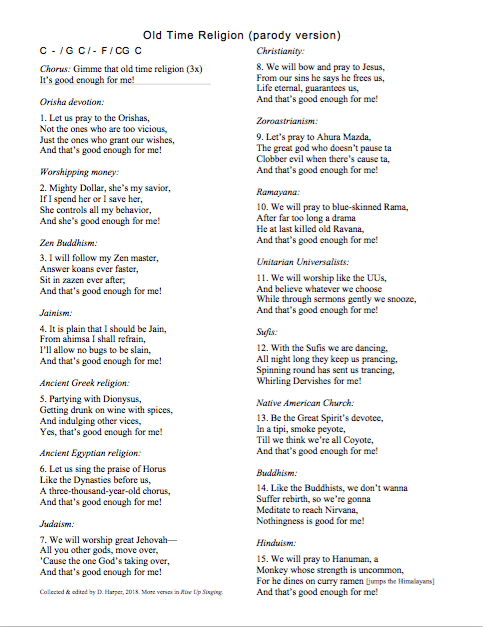
Still more Old Time Religion

I’ve collected a few more parody verses of Old Time Religion, which might be of interest to religious liberals:

Flying spaghetti monster:

If we laugh ourselves unsteady
And keep criticism ready,
Flying monsters of spaghetti
Will be good enough for me!

Atheism:

I am quite sure there are good odds
All who see God are just drunk sods,
So I’d rather worship no gods,
Nothing’s good enough for me!

Science:

There are those who worship science
‘Cause they value our reliance
On electrical appliance-es
It’s good enough for me!

In a subsequent post, I’ll post a PDF including these and 27 other verses I’ve collected….

Even more Old Time Religion

Recently I came across a couple more parody verses for “Old Time Religion”:

We will pray to blue-skinned Rama,
After far too long a drama,
He at last killed old Ravana
And that’s good enough for me!

We will pray to Hanuman, a
Monkey whose strength is uncommon,
Cause he dines on curry ramen,
And that’s good enough for me!

Finally, here’s one I came up with for Unitarian Universalists — and as much as I dislike the abbreviation “UUs” (pronounced “you-youse,” which always sounds to me like someone from New York telling how to form the second person plural possessive), it’s fun to rhyme:

We will worship like the UUs
And believe whatever we choose
As through sermons gently we snooze,
And that’s good enough for me!

(And yes, this is my post for April Fool’s Day.)

Why my blog will leave Facebook

For several years now, I have linked my blog posts to Facebook. I’ve decided to end that arrangement.

I’m not doing this because Facebook helped Cambridge Analytica meddle in the 2016 U.S. presidential election. There is nothing new in that ongoing news story. We have long known that Facebook steals information about us and uses that information to make money. We have long known that as a corporation, Facebook has no moral scruples; if corporations were really persons, as the U.S. Supreme Court asserts, Facebook would be a psychopath. Psychologist Michael Tompkins of the Sacramento County Mental Treatment Center describes psychopaths as “skilled actors whose sole mission is to manipulate people for personal gain”; a phrase that accurately describes Facebook. Facebook lost 14% of its capital value in the last couple of weeks, astonishing that psychopathic corporate entity; and now that entity is trying to figure out how to pretend to be moral, thus allaying our fears so that it can continue to lie and cheat and steal even more from us. But this is a long-standing pattern of behavior; the Cambridge Analytica debacle is nothing new, and there’s nothing in that debacle to make my change my ideas about Facebook.

What has changed for me is I’m beginning to see clearly how Facebook makes its users mean-spirited, unreasonable, and rigid. Facebook reduces public discourse to meme graphics, rage porn, and incestuous conversations among people who already agree, worsening the political and social polarization of the United States. I’m particularly troubled by the effect Facebook has had on the thought processes of Unitarian Universalists.

In particular, I’ve watched Unitarian Universalist ministers re-post meme graphics that play fast and loose with facts; these are ministers who are careful to fact-check their sermons, and it troubles me that they won’t fact-check re-posted meme graphics. I’ve watched Unitarian Universalist ministers re-post rage porn — graphics, videos, or text designed to induce rage, rather than to promote dialogue — these are ministers who would actively resist inciting rage in committee meetings, or in sermons, or in pastoral counseling sessions, and again I am troubled that they feel it is acceptable to induce rage through a social media platform. And I have watched as Unitarian Universalist ministers expel from their Facebook “conversations” anyone who disagrees with whatever narrow conception of “truth” that prevails in that particular conversation; by so doing, they erase nuance, leaving behind only binary, either-or thinking.

It’s not just Unitarian Universalist ministers who do this. Unitarian Universalist lay people are just as bad. I don’t like what Facebook is doing to Unitarian Universalism. To me, one of the strengths of Unitarian Universalism is that it encourages tolerance of other people’s thoughts and feelings, even if I happen to disagree with them. Another strength of Unitarian Universalism is the insistence of the importance of reason, a human faculty that is disengaged by rage porn. Facebook is designed to get you to spend as much time as possible staring at it — that’s how they sell advertising — and to do that, Facebook disengages your reason and erases your sense of tolerance.

There are other horrible aspects of Facebook: it induces feelings of isolation; it is addictive, and interferes with other activities; it is destroying public discourse, and thus directly attacks democracy. These results are not side effects of Facebook; these are direct results of the way Facebook is designed. Obviously, other social media platforms, with socially-manipulative designs similar to Facebook, produce similar results. I abandoned Twitter some time ago. I stay away from Snapchat. And now it’s time to pull back from Facebook.

I’ll still use Facebook to find Sacred Harp singing events. But I no longer want to link my blog directly to what I can only describe as a psychopathic corporate “person” that turns otherwise reasonable people into mean-spirited, unreasonable, intolerant, ill-mannered destroyers of democracy. If you want to read my blog, from now on you’ll have to go directly to my blog.

(Something I should make clear: Amy, the Unitarian Universalist minister I work with, is a responsible user of Facebook.)

Domination vs. understanding

“We may perhaps survive as humanity if we would be able to learn that we may not simply exploit our means of power and effective possibilities, but must learn to stop and respect the other as an other, whether [the other] is nature or the grown cultures of peoples and nations….” So said Hans-Georg Gadamer in 1992, at a time when he was increasingly worried about aspects of the Industrial Revolution — weapons, technologies, ecological disasters — that made it questionable whether our species will survive.

There are at least a couple of philosophical alternatives to learning “to stop and respect the other as other.”

First, you could engage in deconstruction, that philosophical fad of the 1980s and 1990s. Some of those who do deconstruction claim that understanding the other isn’t really possible. (This claim always made me wonder if they could ever make me truly understand what they were saying about deconstruction.) I sometimes feel that the public discourse in the United States is dominated by a half-assed version of deconstructionism, in which everyone has their own truth and they have given up on understanding anyone other than a small circle of allies all of whom think exactly the same thoughts. While deconstruction can be a useful intellectual tool, it can also be an excuse for not listening to anyone else.

Second, you could simply attempt to dominate others. I think there are many people who start out with the best of intentions and wind up trying to dominate everyone else unwittingly. It takes a lot of work to really understand someone else’s viewpoint, and it’s easy to get lazy: why try to listen to someone else when it’s so much easier to yell at them? So that’s one way you can slip away from understanding and slip into domination. But for the college-educated professional class, there is a still more insidious path to domination, and that is being condescending. A great many college-educated professionals think they are much smarter than everyone else; and the more successful they are, the smarter they think they are. When yo have that attitude, it’s easy to slip into the mistake of believing that you know best, and that everyone should just do what you tell them to. It’s pretty ugly when you see it. Bill Gates and Mark Zuckerberg are the most egregious examples, with their foundations giving away money only to those causes which Gates and Zuckerberg, in their supreme condescension, think are worthy. But condescension is equally ugly in the average software engineer or college professor or minister, because condescension is nothing but an effort to dominate other people instead of listening to them.

And maybe these two alternatives aren’t all that different; I suspect that deconstruction has devolved into yet another way that college-educated professionals can condescend to other people. Perhaps both these alternatives are the basic ingredients of the toxic brew that fuels public discourse in the U.S. today — where each person gets to have their own private truth, their own truth that they must defend against all others.

I prefer Gadamer’s alternative: Stop and respect the Other as Other. Listen to the world of non-human organisms. Listen to the “grown cultures of peoples and nations”; and so “we would be able to learn to experience the other and the others, as the other of our self, in order to participate with one another.”

Then we may have a small chance, perhaps, of surviving as humanity.

The Gadamer quotations are from Hans-Georg Gadamer on Education, Poetry, and History: Applied Hermeneutics, trans. L. Schmidt and M. Reuss; ed. Dieter Misgeld and Graeme Nicholson (Albany, N.Y.: SUNY Press, 1992), p. 152; quoted in Hans-Georg Gadamer: A Biography by Jean Grodin (Yale, 2002), p. 329.

Don’t trust video any more

You’ve probably seen the news about “deepfake porn,” in which the face of a porn actor can be replaced by the face of anyone for which you have a photoset. You can now download software to create deepfake porn, and you can run the software at home. As this technology becomes more widespread — very soon, in other words; in a matter of months or weeks — you’re going to see its use spread well beyond porn:

— Faked video is going to make the 2018 election cycle very interesting. You can pretty much visualize what the candidates are going to do to each other, to say nothing of their partisan followers. Next, start thinking about what Russia is going to do with this technology. You thought fake news dominated the 2016 elections? You ain’t seen nothing yet.

— People are going to be framed for crimes using faked videos from surveillance cameras. The cops and the courts will catch on before long, and soon video from surveillance cameras will lose evidentiary value. Someone will try to create secure video technology; someone else will hack it.

— Imagine what the Church of Scientology will try to do to its enemies; imagine what fundamentalist atheists will be tempted to do to denigrate religious figures; and surely faked video will spread throughout religion. It’s enough to make you want to convert to Old Order Amish and renounce technology.

You can spin out your own scenarios….

Yammer yammer

As I walked over to the science fiction section in the library, I could hear a resonant baritone voice in a far corner. Some idiot on their cell phone, I muttered under my breath. Let’s see, McCaffrey, nope further back, LeGuin, getting closer.

Yammer, yammer, yammer, said the resonant baritone voice, distracting me. Yammer yammer yammer.

Laidlaw, Laidlaw, Laidlaw, I repeated to myself, looking through the Ls. What, no Marc Laidlaw? Rats. OK, let’s try S.

yammer yammer give me seed money yammer yammer I’d be CTO yammer

I tried to shut the phone conversation out of my mind, but it was so full of Silicon Valley cliches that it leaked past my defenses. And every other word seems to be “I” or “me,” I said under my breath. I walked around the corner to get to the Ss, and there he was: a young white male, schlubbily dressed. I ignored him as best I could and looked for Stross, but the book I was looking for wasn’t there. Let’s try Matthew Hughes.

yammer what I want yammer I told the VC yammer I said I don’t let people quit my company yammer

The Hs were just around the corner from where the young man was talking. It took some effort to shut the loud self-important voice out of my head. No Hughes on the shelf, but I got distracted by an old Harry Harrison novel. Though I studiously paid no attention, I could sense the young man’s back looking at me with annoyance; I had entered his private space. He walked away, still talking loudly, his self-important voice fading to a distant but resonant whine.

The Harrison novel was not nearly as good as I remembered, so I left it on the shelf and went to look for Pratchett. It occurred to me that the young man with the self-important loud voice was very much like a character from a Terry Pratchett novel: one of those self-involved narrow characters who is certain he is saving the world (from something it doesn’t need saving from) and who is bewildered when he makes a giant mess out of everything.

May the gods preserve us from such people, I muttered to myself as I checked out my books, and then realized I was talking to myself a bit too much. Not a good sign.

Who gets to make a hymnal?

While working on a sabbatical project, I discovered that Louis F. Benson, in his book The English hymn: its development and use in worship (New York: Hodder & Stoughton, George H. Doran Co., 1915), lists nineteen U.S. Unitarian hymnals published in the thirty-four year period from 1830 to 1864. Nor does Benson claim this is an exhaustive list; indeed, he focuses almost exclusively on hymnals published in and near Boston (you can read this list below).

None of these hymnals was published by the American Unitarian Association (AUA). In some cases a large congregation compiled their own hymnal, which other congregations then adopted; more often, an individual editor or group of editors compiled a hymnal as a speculative venture, hoping that congregations would purchase it. In fact, the AUA didn’t publish its first hymnal until 1868.

In the twentieth century, the vast majority of Unitarian (and later Unitarian Universalist) hymnals were published by the AUA, and then from 1937 on by the Unitarians and Universalists together. In the post-World War II era, I’m only aware of two hymnals that were not published under denominational auspices (excluding one-author or one-composer hymn/song collections, such as those by Rick Masten).

So the vast majority of Unitarian Universalist congregations today use a denominationally-produced hymnal. Why is this? Partly I think it’s because copyright law has become much more strict in the past century; anything published after 1922 is probably covered by copyright, and it can be difficult and expensive to track down copyright owners and buy permission to reprint their text or music; it’s going to take a large-ish organization to have enough resources to deal with copyright challenges. But also I believe we have all bought into the notion that the only “real” hymnal is one published by the denomination.

What if one of the large Unitarian Universalist congregations put together a new hymnal? The hymnbook compilers would face significant challenges posed by copyright issues. To balance those challenges, the ease of self-publishing and the rise of print-on-demand would make layout, printing, and distribution extraordinarily easy. Technical and legal issues aside, wouldn’t it be nice if Unitarian Universalist congregations had a choice of hymnals? — at the very least, we could expand the number of our song choices.

———

And for those who are interested, I’ll append a very incomplete list of Unitarian and then Unitarian Universalist hymnals, so you can get a sense of the great variety of hymnals that were once available. (I apologize for not researching Universalist hymnals, but this has been too much of a distraction from my sabbatical project as it is; I can’t justify procrastinating any longer.) Continue reading “Who gets to make a hymnal?”

The singularity as atheist religion

In a talk titled “Dude You Broke the Future,” science fiction author and atheist Charlie Stross takes on Ray Kurzweil and other advocates of the “singularity,” the moment when all our problems will be solved with the emergence of transhuman artificial intelligence:

“I think transhumanism is a warmed-over Christian heresy. While its adherents tend to be vehement atheists, they can’t quite escape from the history that gave rise to our current western civilization. … If it walks like a duck and quacks like a duck, it’s probably a duck. And if it looks like a religion it’s probably a religion. I don’t see much evidence for human-like, self-directed artificial intelligences coming along any time now, and a fair bit of evidence that nobody except some freaks in university cognitive science departments even want it. What we’re getting, instead, is self-optimizing tools that defy human comprehension but are not, in fact, any more like our kind of intelligence than a Boeing 737 is like a seagull. So I’m going to wash my hands of the singularity as an explanatory model without further ado — I’m one of those vehement atheists too — and try and come up with a better model for what’s happening to us. …”

I find it delightful to see a self-proclaimed “vehement atheist” calling out other atheists for doing religion. This is especially admirable, since those other atheists would doubtless insist that they are not doing religion at all; they would claim that they are doing science. Not only that, those other atheists are doing bad religion — transhumanism is as bad as the Prosperity Gospel, insofar as both types of religion are barely believable, have no redeeming social worth, do not engage in worthwhile cultural production, assert that the vast majority of humanity will not be “saved,” spread fear, and are stupid and hard to believe.

This is just a parenthetical remark in a much longer talk — and the rest of the talk is definitely worth reading, particularly for Charlie Stross’ take on corporations as AIs that are making global climate change accelerate.

Snapshots from the Garden of Eden

We went to the Contemporary Jewish Museum today, and I particularly enjoyed Dina Goldstein’s photographs, from a series she calls “Snapshots from the Garden of Eden”: large black and white photographs, maybe three feet by five feet, of staged tableaux showing characters from the Hebrew Bible and Jewish folklore. My favorites:

— King Solomon, looking debauched and slightly bilious, sitting up in a large bed on which are sprawled two partially clad women among disarranged bedclothes (the wicked thought that crept unbidden into my mind: King Solomon as a role model for Judge Roy Moore)

— An unsettling image of a child sitting on a bed completely absorbed in looking at a tablet computer while a strange lights circles around her (the photograph was titled “Ibbur,” but to me it looked more like a dybbuk)

— Rabbi Lowe wearing safety glasses and standing at a bench covered with electronic test equipment, putting the finishing touches on a Golem that maybe he’s going to exhibit at the next Maker Faire

If religion is another mode of cultural production, this is the sort of thing we should be doing: constantly re-imagining religious narratives and metaphors. And by re-imagining, I don’t mean a modernist literalism that, on the one hand erects large granite monuments representing the Ten Commandments in an Alabama courthouse, and on the other hand denies the validity of all religion because religious stories are not literally true; the modernist literalism of both fundamentalist Christians and fundamentalist atheists is unable to cope with the uncertainties of metaphor.

Instead of literalism, I like Dina Goldstein’s way of re-imagining religious narratives: both sincere and ironic, both reverent and irreverent.

Performing a poem

The poet Lew Welch wrote: “I like the idea of giving my readers a text they can perform, themselves. Far too many of our pleasures are spectator sports already…” (introduction to Ring of Bone). The way I like to perform poetry is to write out a fair copy of the poem.

A couple of weeks ago, Carol and I went to the city and stopped in at City Lights Bookstore. I sat in the Poetry Room leafing through books and found the poem “Global Warming Blues” by Mariahadessa Ekere Tallie, in The BreakBeat Poets: New American Poetry in the Age of Hip-Hop (Haymarket Books, 2015). I almost bought the book, but I just got rid of four hundred books so we could fit into our new apartment; no way I could justify buying a new book for just one poem. So I performed the poem by writing out a fair copy on some watercolor paper. I tucked the poem into my coat pocket and forgot about it.

I carried the poem around in my coat pocket. The paper got wrinkled, and the poem got smudged though it was still perfectly legible. Maybe that’s a metaphor for what’s supposed to happen to poetry: poems aren’t supposed to remain captive inside the pristine covers of a book sitting on a bookshelf; poems are supposed to be out in the world: objects of use rather than useless objets d’art. I re-read the last paragraph:

now my town is just a river
bodies floatin, water’s high
my town is just a river
but I’m too damn mad to cry
seem like for Big Men’s living
little folks has got to die