Radio

In high school, I became enamored of broadcast radio. Since I grew up near Boston, along Route 128 — then a high-tech corridor not unlike Silicon Valley — some high-tech company donated a ten watt broadcast station to my public high school. I got my third class radiotelephone license with broadcast endorsement, and became a once-a-week DJ. We lived four miles from the transmitter, and on a good day my parents could sometimes listen to me broadcasting. I don’t remember what music I played on the air, but during my teen years I listened to everything from Renaissance motets to Top 40 rock.

During the 1980-81 academic year, I took a year off from college and went to work in a lumberyard, my first full-time job. There were a few of us who were under 25, and we all listened to WBCN, the freeform rock music station in Boston. Rich, who worked in paint, tried to time his morning coffee break so he could listen to Mattress Mishegas, the strange call-in quiz show kind of thing run by DJ Charles Laquidara, and if he was working up in the paint stockroom, where no one could hear him, he’d listen to ‘BCN. I worked out in the yard so I didn’t get to listen to the radio much. But I heard Laquidara promoting the big protest at Seabrook nuclear power plant over Memorial Day weekend in 1981, and my old youth group buddy John and I drove up and camped out in the woods next to the power plant and watched people we knew committing civil disobedience. Laquidara made no bones about his liberal-left politics.

That was radio at its best: not just playing new music from well-known bands, not just giving airplay to unknown local bands, but connecting listeners with what was going on. And at WBCN, Laquidara and his listeners all talked with Boston accents. You knew you were listening to people like you, people who lived near you; it was local. After the corporatization of broadcast radio in the mid-1990s, radio became less and less local: you could hear Howard Stern anywhere in the country.

The Web does most of what broadcast radio used to do, and does it better. If I want to get involved in social action, I check the Web. I love exploring new music on online sources, and broadcast radio would never have played lots of the music I now listen to online. And there were lots of things that sucked about broadcast radio: stupid commercials, songs that you hated that got played over and over, lots of boring moments. (Although increasingly Youtube.com is overrun with stupid commercials and bad music and too many boring videos.)

I’m not feeling nostalgic about broadcast radio. But what strikes me is the way I think differently now. Broadcast radio was a communal experience; most of the people I knew my age listened to WBCN, we all knew about the local bands they played. The Web is a fragmented, even tribal experience; you can become part of a small tribal music community.

What it looks like when people are really singing

You are unlikely to see people looking like this when they sing hymns at a Unitarian Universalist church:

I took this photo at today’s Sacred Harp singing in Davis, California. Everybody, even the people who are new to this kind of singing, are in full voice, not holding back, letting the song carry them away even if they disagree with the lyrics.

Unitarian Universalists, by contrast, tend to be of three types: Trained Singers, Overly-polite Singers, and Timid Singers. Many of the Trained Signers will be in the choir, and the rest of the congregation defers to them because they have at least some training. The Overly-polite Singers are the inheritors of Lowell Mason’s Better Music Movement, which swept both Unitarians and Universalists in the mid-nineteenth century: this movement expunged American composers and singing styles and replaced them European composers and bel canto singing. The Timid Singers, usually the majority of people at any given Unitarian Unviersalist worship service, having been cowed by the Trained Singers and the Overly-polite Singers, assume they can’t sing.

Sacred Harp singers don’t fit into any of these categories. Sacred Harp singing is an American tradition (there are both black and white versions, but they’re closely related) that does not sound like bel canto singing. Sacred Harp singers may get carried away with the music. Sacred Harp singers know that they should sing as well as they can for every song, even if they don’t like it, so that everyone else sings along on their favorites. Sacred Harp singing is a distinctly egalitarian tradition that says everyone can sing. And Sacred Harp singers let themselves be carried away with the music, as in the photo above.

(There might also be a fourth type of singer in some Unitarian Universalist congregations: the Popular-music Singer. These are the folks who sing along to various types of popular music. They may not read music, but once they hear a song they can generally sing it. They tend to be more egalitarian than the other three types of singer, and they tend to be more passionate singers. However, they are generally outnumbered by the Better Music Movement Singers.)

I wish more Unitarian Universalist congregations sang as if they were being carried away with the music. I wish we were less polite singers. But I suspect that music feels a little too uncontrolled, too irrational: we want to keep it carefully under control.

Below are some videos of faith communities that let their singing get ecstatic. Probably the majority of Unitarian Universalists will find these recordings unpleasant, and disturbingly passionate. Besides, we don’t want to look funny while we sing. That’s who we are; we don’t want to sing like our lives depended on it.

(Just to be clear, on some songs we sing like we mean it out in my own congregation in Palo Alto; we may not have quite the urgency of Sacred Harp singers in full cry, but we’re not too bad!)

Senet, an ancient Egyptian game

Quite a few years ago, when I was visiting the Museum of Fine Arts in Boston (MFA), I saw the ancient Egyptian board game Senet made out of faience (a type of pottery) and wood. Scholars and board-game-lovers have invented modern rules for Senet, based both on ancient Egyptian depictions of people playing Senet and on the several surviving copies of the game. I’ve read through several modern reconstructions of the game, but all the modern rules seem overly complicated. I wanted a set of rules that would be easy for school aged children to learn.

This week I came up with a simple set of rules, rules which remain fairly consistent with what is actually known about the game but are easily learned by school-aged children. The rules are below the fold.

The interesting thing about Senet is that it can be understood to represent the journey of the ba (roughly equivalent to soul) after death through the underworld to some kind of eternal life — it’s not just a game, it’s religion! Some day, I’ll write a lesson plan that ties Senet to ancient Egyptian religion. In the mean time, it’s still a fun game.

Above: The game board I made, printed out and trimmed to size. I used whatever I had around the house for playing pieces — 5 light-colored cubes, and 5 coins (mostly old Boston subway tokens). I made throwing sticks out of some pieces of wood I happened to have (popsicle sticks would work better), and I used a rubber stamp to put an Egyptian scarab beetle on one side so each stick has one clear side and one marked side.

Rules for playing Senet follow…. Continue reading “Senet, an ancient Egyptian game”

“The perilous whiteness of pumpkins”

Overwork and health issues have kept me away from this blog for a couple of weeks, but I now bring you an important scholarly article just in time for Halloween.

Back in 2015, two scholars published a peer-reviewed article in the academic journal GeoHumanities titled “The Perilous Whiteness of Pumpkins.” From the abstract: “Pumpkins in popular culture also reveal contemporary racial and class coding of rural versus urban places.” In other words, according to the authors, rural working class white folks dig pumpkins; urban middle class non-white folks, not so much; furthermore, this difference can lead to riots.

This could have been an interesting article, except I got lost in jargon-filled prose like this: “Spaces where actual pumpkins reside differ from spaces in which metaphorical pumpkins are segregated in the social landscape of modern U.S. cultures.” I’m honestly not sure just what that means, although maybe I just don’t get the jargon of the interdisciplinary study of geography and humanities.

But this next sentence I am quite sure I understand: “Actual pumpkins and the ideas of pumpkins intersect; both stay on the page for the remainder of this article.” I saw no actual pumpkins staying on the page for the remainder of the article. Or I suppose if I had seen the intersection of actual pumpkins, and ideas of pumpkins, it would have looked like this:

By the way, you will notice that this Venn diagram stayed on the page for the remainder of the time you were looking at this article. I have come to expect that sort of behavior from Venn diagrams, although to paraphrase Lord Berkeley’s question: If a Venn diagram is on the page, and no one sees it, does it stay on the page for the remainder of the article? The only reason I can indulge in such stupid sophomoric humor is that the authors of this article needed a remedial course in writing good prose.

Boomer challenges

Most of us who are Baby Boomers are all too aware of the major challenges facing our generation. (Some Boomers are insulated from these challenges, particularly among the socio-economic elites — but that’s always been true for most of the challenges facing humanity, and the elites constitute a small percentage of Boomers anyway, so we can ignore them.)

I’d like to look at three areas where we face major challenges: finances, jobs, and spiritual matters.

Financial challenges first. Back in the 1970s and 1980s, as part of the wave of economic conservatism that swept the United States, employer-managed pensions disappeared and were replaced with 401(k) plans. The Boomer generation, particularly the tail-end Boomers like me, are the ones who are the guinea pigs for this radical experiment in economics. And the experiment, to be quite frank, is going badly.

Younger generations, you will want to pay attention to what happens to the Boomers, because you’re stuck in the same flawed retirement system.

I’ve been reading Fifty-Five, Underemployed, and Faking Normal: Your Guide to a Better Retirement Life, a 2016 book by Elizabeth White that describes in some detail how badly off the Boomer generation is.

Continue reading “Boomer challenges”

Fanzines

From 1995 to 1998, I published a science fiction fanzine. This was before people published their fanzines on the Web, so it was photocopied, stapled, and mailed out. What eventually killed it off was the cost of printing and mailing two or three dozen copies; I didn’t have much money in those days.

It’s hard to explain the whole subculture which surrounded science fiction fanzines in the days before the Web. It’s important to know that there were several different types of fanzines: genzines, with multiple authors writing on topics of general interest to all science fiction fans; personalzines, written by a single person who wrote about whatever interested them; newszines, with news of science fiction fandom. Most fanzines were personalzines; genzines and newszines required a higher level of skill. Fanzines were distributed in several different ways: apazines were distributed through an APA, or Amateur Press Association, where fanzines of APA members were collated and distributed to all the members; a clubzine was distributed to the members of a science fiction club; but most fanzines were made available for the “The Usual,” which meant there were three ways to get a copy: send a letter of comment (LoC), send some modest sum plus a self-addressed stamped envelope; or send your own fanzine in trade. I started a fanzine primarily because I needed something to trade for other fanzines. Other science fiction fans, called “letterhacks,” fed their fanzine habit by writing innumerable letters of comment. And many fanzines carried reviews of fanzines they had received, along with the editor’s address. Fanzine subculture was really a social network organized around the written word; in a very real sense it can be seen as a precursor to today’s online social networks, because a significant proportion of the users of the earliest social networks — BBSs, Usenet, etc. — were science fiction fans, and those early users shaped later social networks. It is not a coincidence that one of the very first web logs, or blogs, was written and hand-coded by Poul Anderson, a science fiction author.

The other part of science fiction fandom’s social network was, and still is, conventions. A science fiction convention was where you met face-to-face the people that you had come to know through reading fanzines and writing letters of comment. Or maybe you didn’t meet those other people: many science fiction fans were (and are) strongly introverted, and a feature of some of the science fiction conventions I attended were sessions in which a whole bunch of people sat in a room together and read books; no one talked. To those of you who are extroverted, this will sound crazy, but for those of us who are strong introverts, this sounds like the perfect way to be social, and even though I never attended one of those sessions it was comforting to know they were an option. Science fiction conventions also attracted a fair percentage of people whom we would now call neuroatypical; it was normal to be neuroatypical at a science fiction fan, just as it was normal to be socially awkward, or to be socially adept, or to be neurotypical. Science fiction fans, in my experience, could be a very tolerant group of people; though at the same time, science fiction fandom has always been subject to intense feuds and violent arguments (to read about a recent science fiction kerfluffle, do a Web search for “rabid puppies hugo”). These conflicts, of course, made wonderful material for several months’ worth of fanzines and letters of comment, and a regular feature of most fanzines was “convention reports,” where someone would tell in excruciating detail all about their experience at some science fiction convention; and the next issue there would be letters commenting on the convention report, and later more letters commenting on the comments, and so it could go on for months. And of course the WordCon — the annual world science fiction convention — was the biggest convention of all, the one which generated more fanzine column inches than any other.

This year’s WorldCon is in San Jose, and it going on right now. I thought about going. I’ve only been to one WorldCon, in 1980, and it would be fun to go one more time. Then I thought of the crowds of science fiction fans mobbing the San Jose Convention Center. I don’t like crowds, even crowds of tolerant people who do things like sit in a room together reading books and not talking. And I remembered years ago, when I was still publishing my science fiction fanzine, I wrote a con report which said, in essence, “I didn’t go.” So this is my con report telling you why I didn’t go to the WorldCon that took place a short drive from where I live.

Boomers and privilege

I’m critical of using the language of privilege in public discourse; what can be a useful tool for analysis among like-minded persons does not always translate well to a wider context. For example, when white people of the professional and upper middle classes gain awareness of how they have personally benefited from structural racism, they may find it helpful when speaking with others who are challenging structural racism to use the phrase “white privilege”; in that context, “white privilege” becomes a useful shorthand way of referring to the specific benefits professional and upper middle class white people get from structural racism. However, when professional and upper middle class white people use the term “white privilege” in public discourse, working class whites can rightfully challenge them on at least two counts: first, the experience of white working class people in accessing the fruits of structural racism is different from that of white people of the professional and upper middle classes; second, white working class people have themselves been the targets of discrimination by white professional and upper middle class people (for one example, see Nancy Isenberg’s analysis of why upper middles class whites embraced eugenics, in her book White Trash: The 400-Year Untold History of Class in America).

A big part of the problem here, I think, is that the nuances of intersectional analysis get lost in public discourse — “white privilege” is a short-hand phrase that sums up a good deal of thoughtful analysis, and short-hand phrases often do not translate well to the public arena. Obviously, the same applies to the phrase “male privilege,” another phrase that is sometimes used in public discourse. Nevertheless, just because I’m critical of using the language of privilege in public discourse, I do find that talking about privilege is helpful when I’m trying to analyze structural inequalities; with the caveat that when you’re dealing with individual people, one individual can experience more than one kind of structural inequality. So it’s important not to reify specific kinds of privilege, e.g., “white privilege” is an abstraction, not an actual thing.

With all that in mind, I’d like to explore the notion that here in the U.S. Baby Boomers have some kind of privilege. “Boomer privilege,” if it exists, arose for a couple of demographic reasons. First, there are large numbers of Boomers, and so it is easy for them to find many others who share a set of life-shaping experiences; because of this, it’s easy for Boomers to assume that their experiences are normative, and then to extend what they perceive as normative to other generations who may have a quite different set of experiences. This perception of what is normative is similar to one of the generating causes of white privilege, dating from when whites comprised the vast majority of the U.S. population: “whiteness” came to be seen by many white people as normative. Continue reading “Boomers and privilege”

Look. Listen. Feel. Visiting other faith communities.

I’m in the process of updating our congregation’s “Neighboring Faith Communities” course for middle schoolers (available online here).

The introductory video for this curriculum might be of interest to readers of this blog, so here it is:

I’ll put the script for the video below the fold, as some group leaders might want access to it. Continue reading “Look. Listen. Feel. Visiting other faith communities.”

Quoted with minimal comment

The historical murder mystery novel The Year of Confusion is set in the final days of Julius Caesar’s reign as emperor of the Roman Empire. At one point, Decius Caecilius Metellus, the narrator, listens to some rich and powerful men complaining about the changes Caesar had made to Rome — and then makes the following comment:

“That was the real reason for the resentment of these men. Caesar was frustrating their own ambitions and humbling their pride. Except for Cicero, they were all men from the great families, men who thought high office to be their natural right, inherited from their ancestors. I had been such a man myself, once. When men prate of things like patriotism, you can be sure that self-interest is at the root of it.”

You can get away with saying things like that in genre fiction, because no one takes it seriously. “When men prate of things like patriotism, you can be sure that self-interest is at the root of it” — yes indeed.

Bay Area Sacred Harp

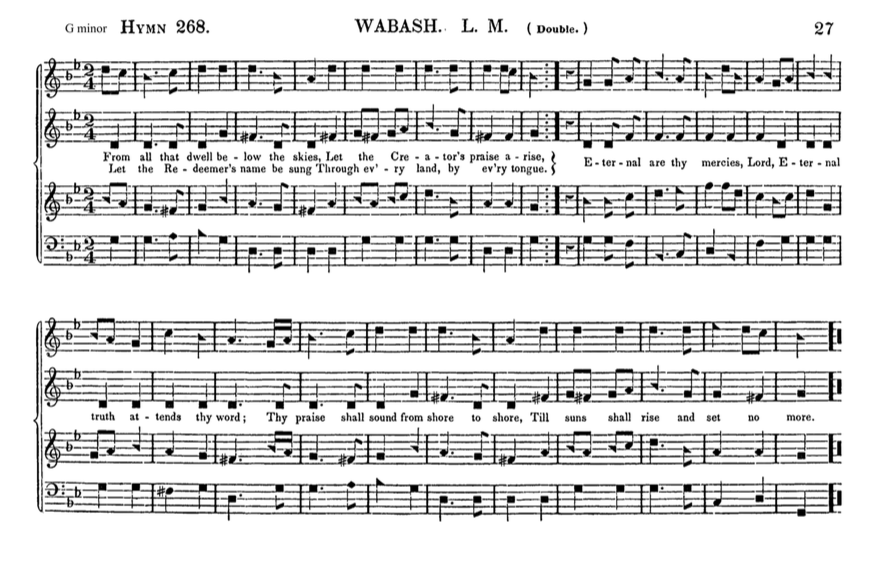
Some Stanford University undergraduates made a brief documentary on the Bay Area Sacred Harp singing community. The students were in an ethnomusicology class, and their goal was to document a local musical community. Given their time constraints, I think they give a pretty good sense of how music and community are woven together in Sacred Harp.

Notes: No one is identified in the video, but this is who you’ll hear from, in order of appearance: Pat Coghlan, Gridley, Calif.; Lena Strayhorn, San Francisco; Jeannette Ralston, Half Moon Bay; Terry Moore, Palo Alto. (Jeannette is the senior singer who was interviewed; she has been singing Sacred Harp in the Bay Area since the 1970s.) The local singings shown are Berkeley (in the church with pews); Palo Alto (in the children’s art room); and San Francisco (in the living room). You’ll hear the Palo Alto singers on Nehemiah Shumway’s Ballstown (begins 0:05; cont. 0:27 and William Billings’s Easter Anthem (begins 1:58).