On the brighter side…

This summer, a couple of people whom I knew and liked and respected have died; one of them was quite a bit younger than I. The news of their deaths really brought me down. On top of that, there’s the national and international news, which has also been bringing me down. Plus today I started feeling under the weather — I hate being sick in the summertime.

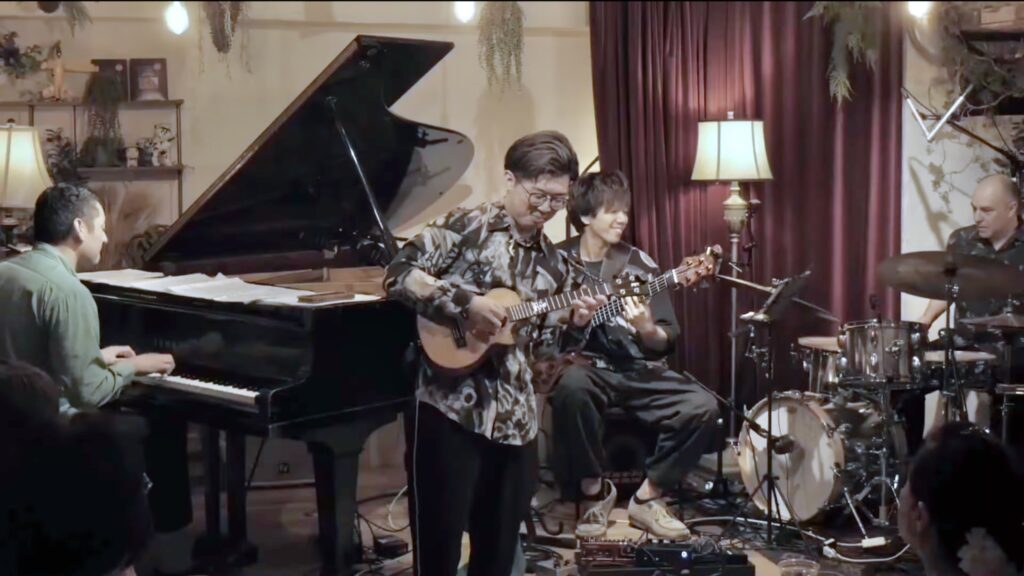
I needed something to pick me up. So I looked for music by Rio Saito, a young ukulele virtuoso who has been playing some hot jazz. And I found a Youtube video of the Rio and Dani Brazilian Jazz Trio, recorded last November, playing “Aquelas Coisas Todas” by Brazilian jazz great Toninho Horta. I recognize Rio Saito as the ukulele player and band leader, but since I don’t read Japanese I can’t tell you the names of the pianist, bassist, and drummer. All I can tell you is that they are all fabulous musicians who put across eleven minutes of bright, uptempo, very accomplished jazz that made me smile.

One of the reasons I love jazz is because of the international connections. This performance is a perfect example — a Japanese ukulelist playing a Brazilian composition that comes from the American tradition of jazz. In a world filled with hot wars and trade wars and cultural wars, it’s good to remember that we can build connections across our differences.

Rio Saito playing ukulele, with a pianist, bassist, and drummer behind him on a small stage.
Screenshot from the video. Click on the image above to view the video on Youtube.

And if you want more, here’s Abe Lagrimas Jr. and Rio playing Antonio Carlos Jobim together.

Quaker Checkers revisited

Back in 2012, I posted a game board and rules for playing “Quaker Checkers.” Photocopies of that game had been passed around for years between Unitarian Universalist Sunday schools. I decided to create a clean copy, and put it online where maybe more people could access it. And if you read the comments on that 2012 post, you’ll see that Quaker Checkers has been played with great success in Unitarian Universalists Sunday schools (and maybe in one or two Quaker First Day Schools as well).

This week, I received email from Sally Q Campbell, who invented the game. Sally said she’s currently talking with a friend of hers about developing an online version of Quaker Checkers. Actually, I would have loved to have an online version during the pandemic when Sunday school had to meet online.

It appears that Sally is one of those endlessly creative people. She is also a songwriter, with a number of songs about peace and spirituality to her credit. On her her Youtube channel, she writes: “I’m a Quaker Singer/songwriter. Many of my songs are given to me in the silence if I will S l o w D o w n.” In fact, I especially like her song “Go Down Low,” which is all about slowing down and centering down. She hadn’t come up with chords for it, so I did. Here’s the standard warning for online chord/lyrics sheets: this is my interpretation of someone else’s song, posted here for educational purposes only; the songwriter Sally Campbell retains the copyright.

Graphic with lyrics and chords

(N.B.: she sings “Go Down Low” in B flat.)

All the above is by way of digression. My real point in writing this blog post is to correct something Sally pointed out in her email. She said: “You did make one error when you tidied it up. My board does not have dark and light squares, it’s just a grid. Makes it more of a challenge.”

She’s absolutely right. To make amends, here’s a corrected version of the game board:

Graphic of the game board for Quaker Checkers.
Click on the image above for a printable PDF of the game.

Hammer dyeing with sumac leaves

I was reading the chapter on mordants in the book Craft of the Dyer: Colour from Plants and Lichens (by Karen leigh Casselman, 2nd ed., Dover Publications, 1993), when I came across this: “Some dye plants are used in the pot as mordants. This is true with alder and with sumac leaves.” (p. 40). (In case you’re not familiar with the term, a mordant is a substance used to help fix dyes in the cloth; a mordant helps make the dye color more light-fast, and helps the color stand up to washing better.)

This summer, I got interested in hammer dyeing (also known as “plant pounding”). This process transfers plant colors to cloth by hammering the plant against the cloth (details on the process are in this blog post). One problem with hammer dyeing is that the colors are not always lightfast, and may not stand up well to washing. But if sumac leaves can act as both mordant and dye-stuff, I wondered if they might produce a more permanent color if used for hammer-dyeing.

So I hammer-dyed a t-shirt using sumac leaves. And yes, they did indeed stand up to washing. As for lightfastness, only time will tell.

To see photos and a description of the whole process, scroll down.

Continue reading “Hammer dyeing with sumac leaves”

AI and UU sermons

Should Unitarian Universalists use so-called AI (Large Language Models, or LLM) to write sermons?

Since Unitarian Universalists don’t have a dogma to which we must adhere, there will be many answers to this question. Here are my answers:

I/ Adverse environmental impact of LLMs

Answer: No. The environmental cost of LLMs is too great.

First, we all know about the huge carbon footprint of LLMs. And the more complex the answer required from the LLM, the more carbon that is emitted. Deborah Prichner, in a June 19, 2025, Science News article on the Frontiers website, sums up the impact by quoting someone who researched energy use of LLMs:

“‘The environmental impact of questioning trained LLMs is strongly determined by their reasoning approach, with explicit reasoning processes significantly driving up energy consumption and carbon emissions,’ said … Maximilian Dauner, a researcher at Hochschule München University of Applied Sciences…. ‘We found that reasoning-enabled models produced up to 50 times more CO2 emissions than concise response models.’”

Thus, not only do LLMs have a big carbon footprint, but handling something as complex as a sermon could result in a carbon impact 50 times greater than the lowest LLM carbon footprint.

Second, the data centers running LLMs use a tremendous amount of fresh water. In their paper “Making AI Less ‘Thirsty’: Uncovering and Addressing the Secret Water Footprint of AI Models,” Pengfei Li (UC Riverside), Dr. Jianyi Yang (U Houston), Dr. Mohammad Atiqul Islam (U Texas Arlington), and Dr. Shaolei Ren (UC Riverside) state:

“The growing carbon footprint of artificial intelligence (AI) has been undergoing public scrutiny. Nonetheless, the equally important water (withdrawal and consumption) footprint of AI has largely remained under the radar. For example, training the GPT-3 language model in Microsoft’s state-of-the-art U.S. data centers can directly evaporate 700,000 liters of clean freshwater, but such information has been kept a secret. More critically, the global AI demand is projected to account for 4.2 – 6.6 billion cubic meters of water withdrawal in 2027, which is more than the total annual water withdrawal of … half of the United Kingdom.”

Third, on 1 May 2025, IEEE Spectrum reported that “AI data centers” cause serious air pollution. The article, titled “We Need to Talk About AI’s Impact on Public Health: Data-center pollution is linked to asthma, heart attacks, and more,” raises several concerns. The authors write:

“The power plants and backup generators needed to keep data centers working generate harmful air pollutants, such as fine particulate matter and nitrogen oxides (NOx). These pollutants take an immediate toll on human health, triggering asthma symptoms, heart attacks, and even cognitive decline.”

In sum: Because my religious commitments call on me to aim for a lower ecological impact, the environmental impact of LLMs alone is enough to stop me from using them to write sermons.

II/ Sermons as human conversations

Answer: No. I feel that sermons should be the result of human interaction.

You see, for me, a sermon should arise from the spiritual and religious conversations that people are having in a specific congregation or community. As a minister, I try to listen hard to what people in the congregation are saying. Some of what I do in a sermon is to reflect back to the congregation what I’m hearing people talk about. At present, a LLM cannot access the conversations that are going on in my congregation — a LLM can’t know that P— made this profound observation about their experience of aging, that A— asked this deep question about the reality of the death of a family member, that C— made a breakthrough in finding a life direction, that J— took this remarkable photograph of a coastal wetland. Some or all of those things affect the direction of a sermon.

Mind you, this is not true for all religions. Deena Prichep, in a 21 July 2025 article on Religion News Service titled “Are AI sermons ethical? Clergy consider where to draw the line,” states that “The goal of a sermon is to tell a story that can break open the hearts of people to a holy message.” In other words, according to Prichep, for some religions the role of the preacher is to cause other people to accept their holy message. Prichep quotes Christian pastor Naomi Sease Carriker as saying: “Why not, why can’t, and why wouldn’t the Holy Spirit work through AI?” I can see how this would be consistent with certain strains of Christianity — and with certain strains of Unitarian Universalism, for that matter, where the important thing is some abstract message that somehow transcends human affairs.

But that’s not my religion. My religion centers on the community I’m a part of. Yes, there is a transcendent truth that we can access — but as a clergyperson, I don’t have some special access to that transcendent truth. Instead, truth is something that we, as a community of inquirers, gradually approach together. Any single individual is fallible, and won’t be able to see the whole truth — that’s why it’s important to understand this as a community conversation.

As a clergyperson, one thing I can do is to add other voices to the conversation, voices that we don’t have in our little local community. So in a sermon that’s trying to help us move towards truth, I might bring in William R. Jones, Imaoka Shinichiro, or Margaret Fuller (to name just a few Unitarian Universalist voices). Or I might quote from one of the sacred scriptures — i.e., from one of the sources of wisdom traditions — from around the world. Now it is true that maybe a LLM could save me a little time in coming up with some other voices; but given the huge environmental costs, it seems silly to save a small amount of time by using a LLM.

III/ Biases built into LLMs

Answer: No, because of hidden biases.

LLMs are algorithms trained on digitized data which has been input into them. For a LLM, the digitized data is mostly in the form of text. But we know that certain kinds of authors are going to be under-represented in that digitized data: women, non-Whites, working class people, LGBTQ people, etc. The resulting biases can be subtle, but are nonetheless real.

As a Universalist, I am convinced that all persons are equally worthy. I have plenty of biases of my own, biases that can keep me from seeing that all persons are equally worthy of love — but at least if my sermons are affected by my own biases, my community can successfully challenge me about my biases. If I use a LLM model to write a sermon, a model that’s riddled with biases that I’m not really aware of, that makes it harder for my community to help me rid my sermons of my biases.


IV/ Final answer: No

Would I use a LLM to write a sermon?

No. It goes against too many things I stand for.

Should you use a LLM to write your sermons?

I ‘m not going to answer that question for you. Nor should you ask a LLM model to answer that question for you. We all have to learn how to be ourselves, and to live our own lives. Once we start asking others — whether we’re asking LLMs or other authority figures — to answer big questions for us, then we’re well on the road to authoritarianism.

Come to think of it, that’s where we are right now — on the road to authoritarianism. And that’s a road I choose not to follow, thank you very much.

Adventures in cyanotype

(Written on July 3, finally getting around to posting on July 12.)

I’m running an ecology workshop at a small conference at Ferry Beach Park Association in Saco, Maine. One of the activities I did to get participants to see the world in new ways was making cyanotype prints of plants. I was inspired in part by Anna Atkins, who created the first-ever book of photographs with cyanotypes of seaweed.

Thea and Mandy were leading an art workshop at the same time, and they got interested in cyanotypes. So after our morning workshops were over, we did some experimenting. In the evenings, after it got dark, we coated several different kinds of paper with cyanotype emulsion. During the day, we experimented with different compositions using natural object to make photograms. We even took a field trip to the Portland Museum of Art, where there’s a special exhibit of Jo Sandman’s large photograms on platinum-palladium paper.

We didn’t wind up with much in the way of finished art works. But we learned a great deal. As Thea kept reminding us, often the process is more important than the product.

Bhairava

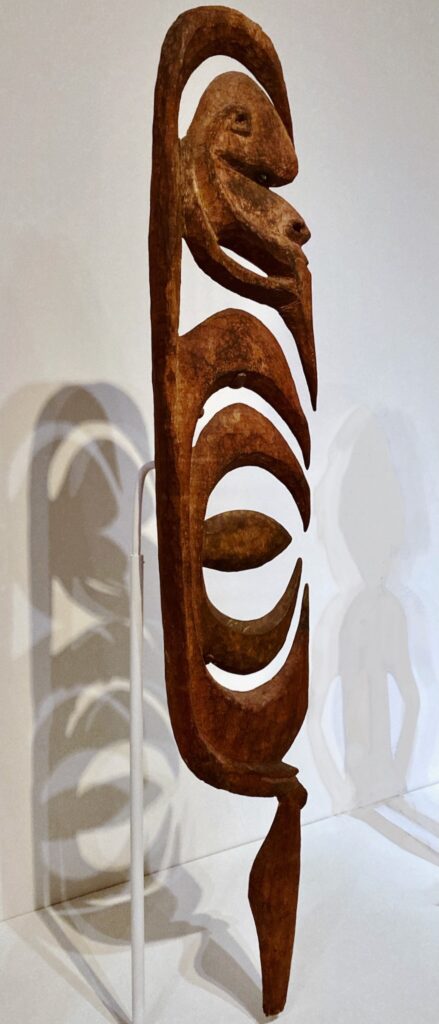
This representation of the deity Bhairava, now in the Walters Art Museum in Baltimore, was once part of a building in Nepal’s Kathmandu Valley. The deity was an integral part of a wooden support that supported an overhanging eave.

A deity carved in wood, with four arms and three heads.
The museum label reads: “Strut with Bhairava, Nepal (Kathmandu Valley), ca. 1700, Wood with traces of pigment…. Gift of John and Berthe Ford, 2021, acc. no. 25.271”

Bhairava is actually one of the forms that the Hindu deity Shiva takes on. H. Krishna Sastri, who was Asst. Archeological Superintendent for Epigraphy (Southern Circle) in the early twentieth century, describes Bhairava in his book South-Indian Images of Gods and Goddesses (Madras Government Press, 1916), p. 151:

I don’t know to what extent Bhairava takes on another form in Nepal, but the Bhairava in the Walters Art Museum does in fact have round eyes, protruding teeth, and wide nostrils. He wears a garland of either skulls or heads, and something that could be a snake is draped around his neck. At one time, his six hands held various items, but those are all lost now — perhaps they included a trident, a sword, and/or other destructive weapons. He is either naked or close to it, and he is riding on the back of an animal that could be a dog. In short, this Bhairava from the Kathmandu Valley seems to be very similar to the South-Indian Bhairava described by H. K. Sastri in 1916.

The Daya Foundation, a Nepalese nonprofit organization, published a blog post last August titled “Bhairav in Nepal.” In that post, they offered this interpretation of Bhairava’s origins:

In this blog post, the Daya Foundation describe some of the ongoing worship of Bhairava. Among other things, Bhairava is connected with the Nepalese monarchy, “as a guardian of both the spiritual and the civic welfare of Kathmandu.”

Don’t forget Pee on Earth Day tomorrow

One of my favorite holidays of the year is Pee on Earth Day. This delightful holiday is celebrated on the longest day of the year — June 21 in the northern hemisphere, and December 21 in the southern hemisphere.

Why should you pee on earth? If you live in a part of the world where there are no diseases spread through urine (which means most of my readers), peeing on earth is a way to get rid of your urine in a sanitary and ecological manner. Your urine contains valuable nutrients that plants can use, and as long as you don’t eat too much salt, your urine (diluted, or in small amounts) is good for plants. Peeing on earth is a way to remind yourself that you are a part of the great cycle of nature. As Carol puts it, “Don’t throw it away, grow it away!”

Why on the longest day? Because it’s unlikely there will be snow on the ground, and it’s likely the weather will be more conducive to peeing outdoors.

We’ll be on the train from Baltimore back home to Cohasset for much of Pee on Earth Day. I’ll wait to pee on earth until we get home.

Pee-on-earth bumper sticker. Image (c) Carol Steinfeld, used by permission.

Why Are You You?

I’ve got convention brain. What did I do after yesterday’s business meeting? What programming did I attend? With whom did I talk? It’s a bit of a blur.

But I do know that last night I went to a screening of the documentary “Why Are You You?” a new documentary about the now-defunct youth program Young Religious Unitarian Universalists, or YRUU. I was fairly heavily involved in YRUU as an adult advisor from 1995 through about 2003, serving as an advisor in local youth groups, as well as at district and continental “cons” or conventions. As a result, I got to meet youth leaders and youth advisors across the continent, from Alaska to Maine.

The filmmakers interviewed a number of former YRUU youth leaders, and I recognized several of them. I enjoyed hearing their memories of YRUU conferences and programs; I especially enjoyed hearing about how YRUU changed their lives. Given all those hours I spent supporting youth leaders and UU youth institutions, it’s nice to know that those hours weren’t wasted. But the ending of the movie is a little depressing. The Unitarian Universalist Association (UUA) ended funding for YRUU in (I think) 2007. There was no replacement for YRUU — YRUU was a semi-independent organization with youth leadership, not just another department of the UUA.

Not that YRUU was perfect. The documentary touches on some of its problems. What’s missing are the voices of all those teens for whom district and national YRUU programs held no interest, or those for whom YRUU did not feel safe — I knew quite a few of those teens, some of whom were devoted members of a local youth group. What’s also missing is mention of the adult advisors with poor boundaries — I saw a few too many of those; part of the reason I pulled away from district and national youth events was that I felt YRUU didn’t train adults adequately, nor hold them fully accountable.

Yet these were all solvable problems. The solution was not to get rid of the national youth organization; the solution was to reform that organization. For the past twenty years, I’ve had the sense that Unitarian Universalism broadly construed, especially at the national level, just really doesn’t like children and teens. Children and teens are messy, they take up a lot of time and energy, and if you don’t like them that much, it’s easier to shut them out rather than support them and their families. I feel that the death of YRUU is part of this larger trend.


P.S.: If the issues raised by this film are of interest, you might also be interested in childist theology, a new approach to Biblical interpretation that places children at the center of Biblical interpretation. So… What would it mean to place children and teens at the center of a Unitarian Universalist theology?

South Arabian goddess

The Walters Museum in Baltimore has a small selection of South Arabian art. I’m completely unfamiliar with South Arabian art, and before I went to the Walters Museum yesterday I knew nothing about its long history. According to the Smithsonian National Museum of Asian Art:

“For over a thousand years, from around 800 B.C.E. to 600 C.E., the kingdoms of Qataban, Saba (biblical Sheba), and Himyar grew fabulously wealthy from their control over the caravan routes of the southern Arabian peninsula and, in particular, from the international trade in frankincense and myrrh. Excavations at the capitals of these ancient kingdoms have yielded spectacular examples of architecture, distinctive stone funerary sculpture, elaborate inscriptions on stone, bronze, and wood, and sophisticated metalwork.”

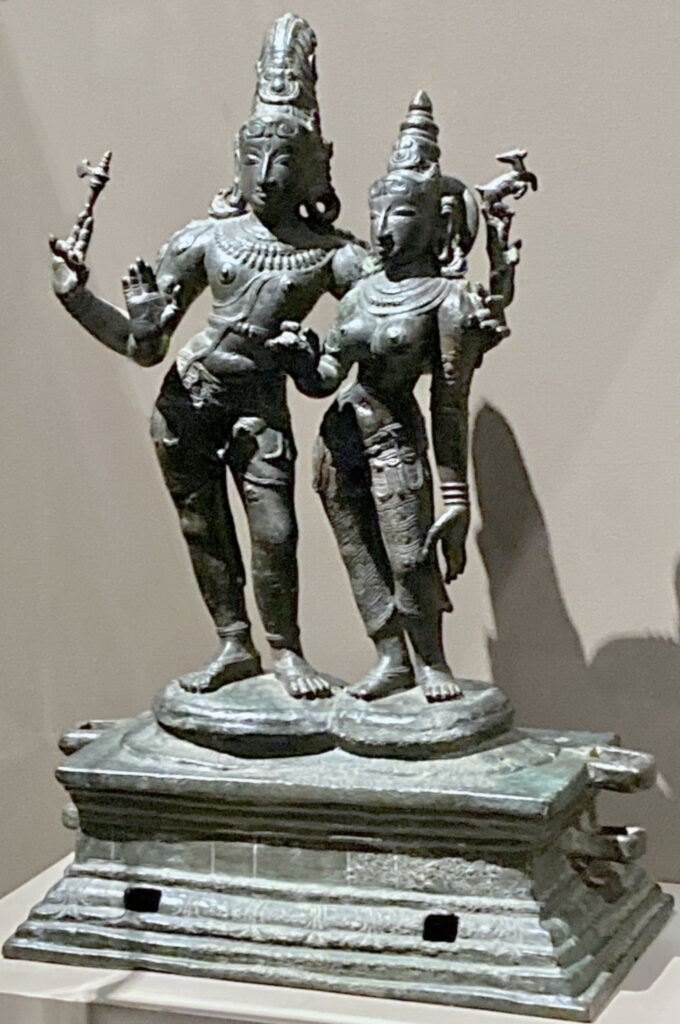
One of my favorite pieces of South Arabian art on the view at the Walters Museum is an unnamed goddess, who appears in a fragment of a pediment. She sits next to a child deity. Due to the lighting, I found it difficult to take a photograph due to the reflections on the glass case which houses this goddess; I had to do a fair amount of digital manipulation to make her look more or less the way she looks in the museum.

Sculpture carved in stone.

Here’s what the museum label says about this sculpture:

I wonder if she was really a fertility goddess, or a goddess of wine. I don’t think we’ll ever know.

Happy Flag Day

A company of Revolutionary War re-enactors, one of whom has a sign reading "No Kings."

The photo above shows what the Minutemen were fighting for during the Revolutionary War. They wanted no kings, no dictators, no emperors. They wanted the right to rule themselves, without having some old rich guy, someone who thought he was more important than they were, telling them what to do. That’s what the American flag stands for — no kings, no tyrants, no dictators.

And now, two hundred and fifty years later, King-wanna-be Donny is trying to establish a new monarchy and tyranny. But here in Massachusetts, where the Revolution began, we still don’t want any kings. We still don’t want some old rich guy, someone who thinks he’s better than we are, telling us what to do. Way back in 1776, Thomas Paine described people like King-wanna-be Donny as insolent, poisoned, ignorant, and unfit:

“Men who look upon themselves born to reign, and others to obey, soon grow insolent; selected from the rest of mankind their minds are early poisoned by importance; and the world they act in differs so materially from the world at large, that they have but little opportunity of knowing its true interest, and when they succeed to the government are frequently the most ignorant and unfit of any throughout the dominions.”

On this Flag Day, remember the original meaning of the American flag: no kings, no tyrants, no dictators.

Happy Flag Day!