Changes in a New England Meetinghouse

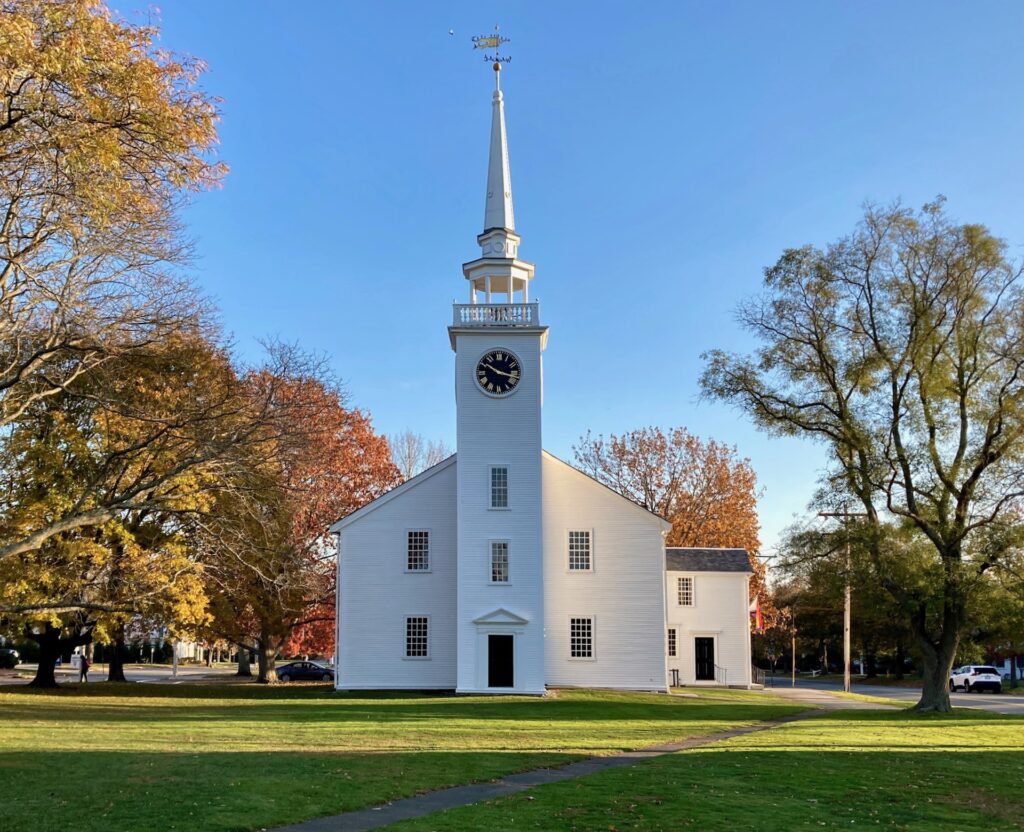
First Parish in Cohasset, where I work, has a meetinghouse built in 1747. When you come at it from the north and see it across Cohasset Common, it looks like the classic white New England church with a simple steeple:

White clapboard New England church set amid lawn and autumnal trees
Cohasset Meeting House from the north

But the tower and the steeple weren’t added until 1799, over half a century after the meetinghouse was first erected. Let’s go back to 1773, the year of the Boston Tea Party. There were three young men from Cohasset who participated in the Boston Tea Party (after being encouraged by their Patriot minister), and they might have seen something like this when they came at the meetinghouse from the north:

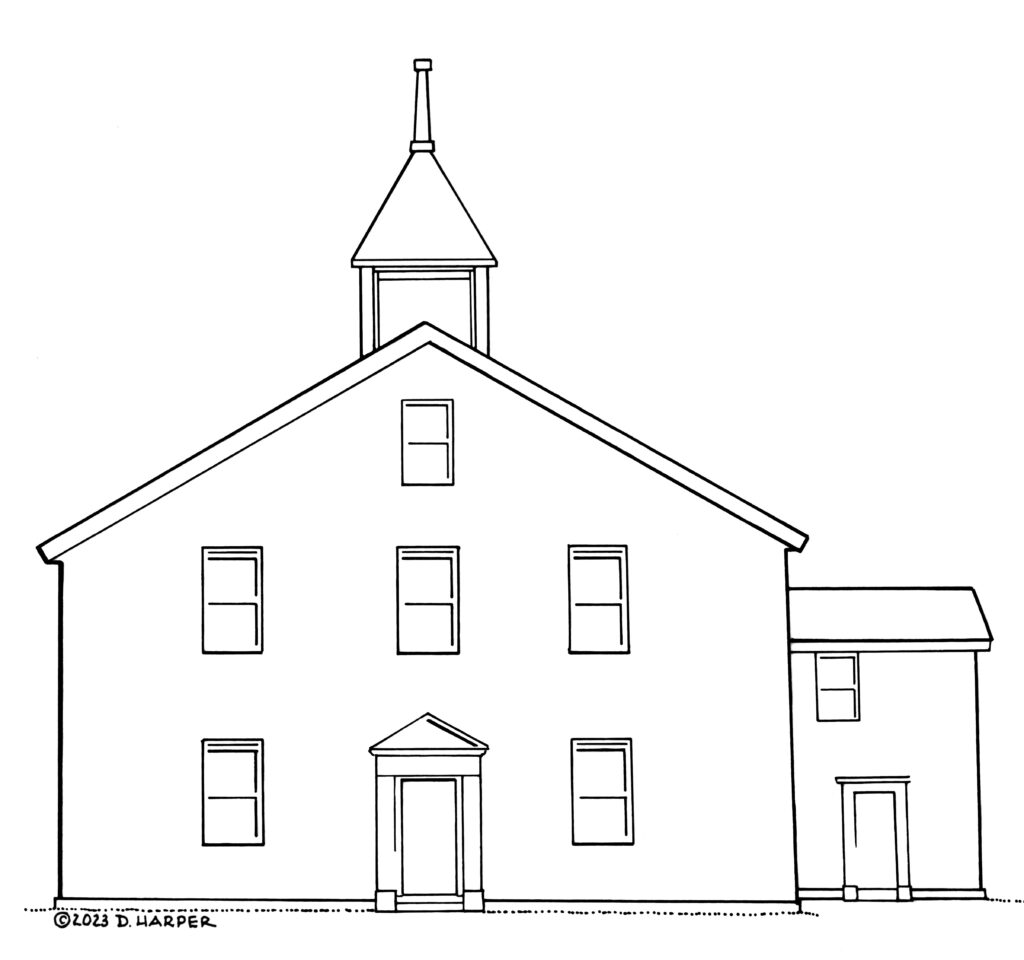
Line drawing of Cohasset meetinghouse before the tower and steeple were added
My visualization of the appearance of the Cohasset Meetinghouse c. 1775

Instead of the tower and steeple, there would have been small belfry on the north end of the building. (When you go up into the attic today, you can see timbers in the north end that now serve no special purpose, and it’s possible they served to support the belfry.) I haven’t found any record of what Cohasset’s belfry looked like, but there are drawings of other eighteenth century meetinghouses with belfries. The sketch above shows the north facade with a representative eighteenth century belfry.

This still isn’t the original appearance of the Cohasset Meetinghouse. Originally, there was no porch on the west side. That porch was built in 1761. In order to create more floor spaces for pews, the original stairs to the gallery in the northwest and southwest corners inside the main building were removed. The porch was added to house a new set of stairs to the gallery. Prior to the addition of the porch, the Cohasset Meetinghouse looked something like this:

Line drawing of meetinghouse
My visualization of the appearance of the Cohasset Meetinghouse c. 1760

As you can see, prior to the addition of the porch the meetinghouse was just a simple rectangular building with a small belfry on the north end. Mind you, we don’t really know the exact appearance of the building. In my visualizations, I’ve added triangular pediments above the doors, but who knows if there was even that level of ornamentation.

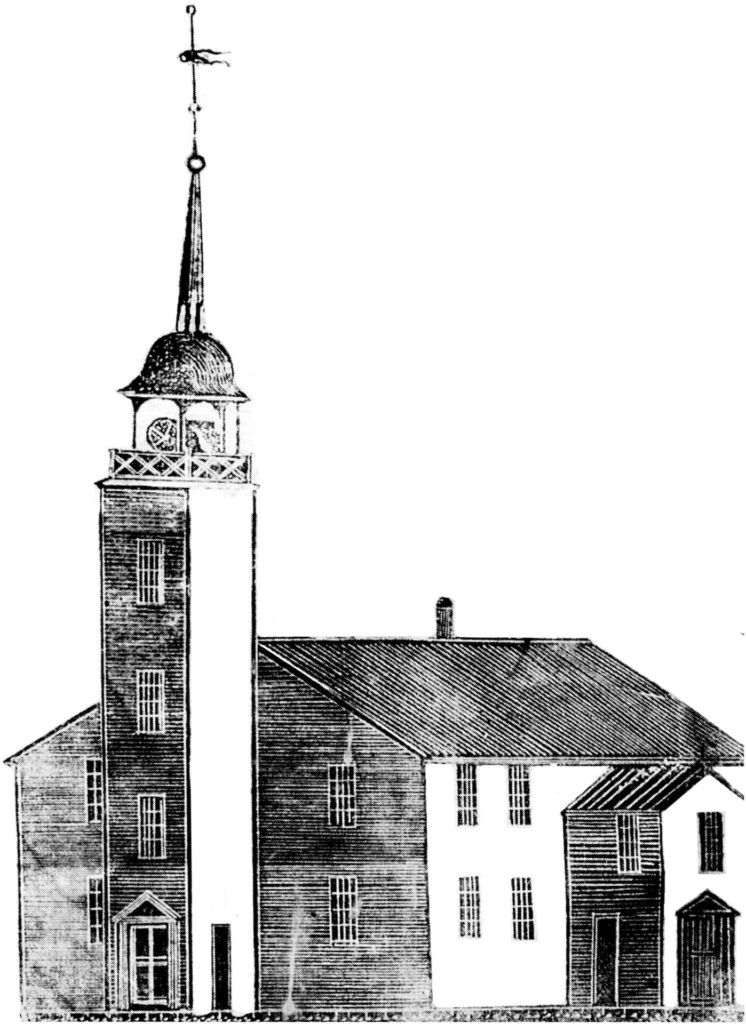
The earliest drawings we have of the Cohasset Meetinghouse date from the mid-nineteenth century. They are fairly consistent in showing the tower with crossed balusters at the bell level, and a steeple with a rounded section before the actual spire — quite different from the present steeple. The meetinghouse was not painted white; it was pea green. In fact, most New England meetinghouses were not painted white prior to the Colonial Revival in the late nineteenth century; documented colors include various shades of yellow, red, and green; there were even a few meetinghouses painted orange. Here’s my digitally edited version of an 1850s woodcut showing the Cohasset Meetinghouse:

Reproduction of a woddcut

There have been several other changes over the years. The clock was added in 1764. Shutters (or more accurately, exterior louvered blinds) were added around 1765. The steeple was completely rebuilt after 1869; it got shattered by a lightning strike in that year. The shutters were removed again around 1986.

In short, like most historic buildings the Cohasset Meetinghouse has changed considerably over the years.

The unlamented decline of the platform formerly known as Twitter

According to the BBC, Elon Musk recently shared “an antisemitic conspiracy theory, calling it ‘actual truth’.” Of course, Musk has denied that he’s antisemitic. And no doubt he’ll insist that he’s just a free speech advocate. But his remarks are yet more evidence that platform decay has progressed quite far on X, the platform formerly known as Twitter. It’s no longer a social media space, it’s a cesspool.

I actually spent some time on Twitter, during the second year of its existence. I liked it at first because it allowed me to post to my blog using my phone (I couldn’t afford one of those fancy new smartphones). I soon discovered that Twitter’s biggest strength was in polemic and diatribe, with a subsidiary strength of news-without-nuance. Not my jam. But that mix attracted a lot of people, especially (from what I could see) people who were a generation younger than I: tail-end Gen Xers and older Millennials.

I get the impression that most of the people lamenting the ongoing demise of X, the platform formerly known as Twitter, are still from that age group. Without realizing it, they’ve gotten to the age where it’s hard to let go of the familiar, hard to adopt something new. It’s hard for them to watch X turn into a cesspool of hatred which is now led by an antisemitic conspiracy theorist. They lament the loss of what they once had.

Here’s some advice from someone who’s ten or twenty years older: Don’t go around lamenting the loss of something that no one else cares much about. If you do, you’ll sound like the Boomers lamenting the Sixties — which weren’t all that great to begin with, so that lamenting them just makes Boomers look faded and sad.

There are many problems in the world worthy of lamentation: antisemitism, racism, conspiracy theorists. The demise of Twitter is not one of them. It’s time to move on.

What to do

The war in Israel and Gaza is horrific. Here in this country, there is disagreement about what to do. People are staking out positions; to even name the positions is to take a position, because of the way you describe the different positions. I’m not particularly adept at politics, and I feel the proverbial deer in the proverbial headlights: no matter which way I go, it looks bad. Thus I was relieved to read this on The Velveteen Rabbi’s blog:

“One recent day on social media, comments from two people I respect crossed my transom within about an hour. One said (I’m paraphrasing both) that any rabbi who doesn’t call for an immediate ceasefire in Gaza is morally bankrupt. The other said that any rabbi who would call for a ceasefire, given Hamas’ stated goals of destroying Israel, is betraying the Jewish people. I’ve been sitting with that tension, and it feels like a black hole inside my heart. How am I supposed to know which path is most likely to lead to a future of peace and justice and coexistence in that beloved land? How would I know whether more military response or a ceasefire is likelier to bring about the just peace both peoples need? I can’t possibly know….”

Like the Velveteen Rabbi, I never studied political science, international relations, or military strategy. Yet she knows more than I — at least she’s been to Israel, and clearly has a better sense of the issues than I do. I’m glad that someone else is willing to say, “I can’t possibly know.”

All I know for sure is that the war in Israel and Gaza is really deadly (on the order of 10,000 fatalities so far, depending on which source you’re willing to trust). And this war is happening at the same time as the really deadly war in Ukraine (around 32,000 fatalities in the last 12 months). Then there are the really deadly wars that don’t get talked about much in the U.S. — Sudan, Myanmar, the Mahgreb insurgency — each of which has seen about 12,000 fatalities so far this year.

I don’t know what the path to peace is for any of these major ongoing wars. I’m not one of those religious leaders who will tell you with great self-assurance what we should do. I can’t possibly know….

Guts

Today was my day off for the Veterans Day holiday, and I managed to come down with bronchitis. What a waste of a holiday. I’m ill enough that I can’t do anything fun, but not so ill that I can sleep all day. By mid-afternoon, I got so bored that I was reduced to watching sports.

Fortunately, the World Flying Disc Federation recently posted the final game of the 2023 Asia-Oceanic Guts Championships, held on September 6-10 in Manila, Philippines. Guts is that crazed game where five players line up 14 meters apart, and try to throw a flying disc (a.k.a. “frisbee”) so hard the other team can’t catch it. The flying disc can travel as fast as 80 m.p.h., requiring fast reactions and a high tolerance for pain.

I’m generally not much of a sports fan. But I watched the entire hour-long Asia-Oceanic guts final. And you know what? — It took my mind off my hacking cough, it took my mind off all the wars in the world, it took my mind off the growing effects of climate change. It was like meditation, only better (for me, anyway). Maybe that’s one reason why sports is now bigger than religion in the U.S. (or, more precisely, sports is now the biggest religion in the U.S.).

Screenshot of a guts frisbee game.
Screenshot of the 2023 Asia-Oceanic guts final match — Japan has just thrown, and you can see the blurred bright orange flying disc about three quarters of the way to Chinese Taipei — click the image to watch the game

Guts rules at World Flying Disc FederationGuts Players AssociationUSA Guts team (with game videos)

Subscribed

I get most of my online news from BBC.com. I’m also a regular online reader of Religion News Service, which covers the news beat I’m most interested in, the role of religion in culture.

But I’ve put off subscribing to other online news outlets. If I want local news, I’ll go out and buy a print copy of the Boston Globe and the Quincy Patriot Ledger. But an online subscription? No thanks. The Globe and Patriot-Ledger websites are ugly, riddled with ads that hold no interest for me, and the stories I actually want to read are too hard to find.

Then today, just by chance, I stumbled across the Christian Science Monitor website. The old days when the Monitor was a daily are long gone — it’s at best a weekly now — but I quickly discovered some great journalism on their website. The story that grabbed my attention, and made me want to subscribe, was titled “Americans have a right to guns. How about to public peace?” Rather than framing the story as a partisan issue of Democratic gun control advocates vs. Republican gun rights advocates, the Monitor frames this as a story about peace: how do we achieve peace in our neighborhoods? As a pacifist, I found this refreshing.

So I subscribed. And almost immediately found a long feature article from last June titled “When $1 billion isn’t enough. Why the Sioux won’t put a price on their land”, part of a series of articles, “Reparations debate: Mending the past, forging the future.” Here again, the Monitor combines a refreshingly different perspective with good solid journalism.

The Monitor isn’t going to appeal to everyone, but for someone like me, a subscription is definitely worth the money.

Finding the sacred for Gen Z

Springtide Research Institute recently published a study of Gen Z titled “The State of Religion and Young People 2023: Exploring the Sacred.” They charge twenty-two bucks for the full report, so you might want to check out Religion News Service’s excellent summary.

A key finding, in my opinion: Gen Z are quite willing to find and define sacred moments outside of traditional religion. Tricia Bruce, executive director of Springtide Research, told Religion New Service:

“‘Certainly, we might expect young people to tell us, “Yes, I’ve experienced the sacred when I attended a religious service or in prayer,” and they do, but they also told us “I experienced the sacred in nature,” “I experienced the sacred when I got into college,” “I experienced the sacred in a virtual connection,”‘ Bruce told Religion News Service in an interview. ‘Creative spaces that we may not think of as sacred themselves, or as religious, or we may not materially construct as such, young people are telling us that, in fact, that’s where the sacred lives for them.'”

Actually, some of us do in fact view “creative spaces” as sacred. (1) I’m one of those people, and I’m not even in Gen Z. I’ve had some of my most intense sacred experiences through the arts — in my case, through things like the visual arts, making music with others, poetry, and so on. (2)

Apparently, the survey also found that 69% of people in Gen Z have experienced a sacred moment in nature. Here again, although I’m not in Gen Z, I’m one of those people who experiences the sacred in nature.

Honestly, I don’t often experience the sacred in a worship service. (When I do, it mostly comes through music or group singing.) For me, the point of a worship service is not to experience transcendent experiences, but to provide a community where I can make sense of the transcendent experiences I have in the rest of my life. And then, once I make sense of those experiences, I want to figure out a way to use them to make the world a better place.In my opinion, transcendent experiences can be justified only if they bend the moral arc of the universe towards justice (otherwise they’re just self-indulgent), and if you want to make justice happen you’re going want to be part of a community.

Note

(1) I actually don’t like the term “sacred experiences.” It sounds too Christian-centric to me, and not in a good way. I prefer to talk about mystical experiences, or better yet transcendent experiences.

(2) I’ve always taken this for granted, but I guess it’s not obvious to others. Maybe I need to write more about how I have transcendent experiences through the arts.

Ardoksho

Ardoksho (also spelled Ardochsho) was a deity who is best known for her appearances on gold coins of the Kushan (also spelled Kusana) Empire roughly two thousand years ago. The Kushan Empire included parts of today’s nations of Pakistan, Afghanistan, Uzbekistan, and the northern part of India. Contemporary empires included the Han Empire in what is now China, the Roman Empire, and the Parthian Empire between the Kushans and the Romans.

Gold coin with a crude image of a goddess.
The Iranian deity Ardoksho, reverse side of a coin issues by the Kushan king Huvishka, c. 126-163; Asian Museum of Art, San Francisco, F1999.38.2.

It may be that Ardoksho had never been represented visually prior to her appearance on Kushan gold coins:

“…Taken collectively, the coins of the Kusana include twenty-three (and possibly as many as thirty) confirmed different-named deities, most of whom seem to have been drawn from Iranian, indian, and Greek pantheons. Zeymal has argued that the vast majority of these have no known anthropomorphic form before their appearance on Kusana coins. He asserts that only three of the religious figures depicted on Kusana coins draw from preexistent figural forms, and one of these is the Buddha. However, the rest of the deities, such as Miiro, Mao, Ardochsho, Athsho, and Pharro, are unkonw in figural art before the intervention of the Kusana die cutters. While the exact motivation for this explosion in iconographic innovation is unknown, it is conceivably a by-product of Kusana cultural borrowing. In other words, after the tradition of minting coins with images of deities on the reverse was adopted, such practice was expected, and the coin makers were compelled to create forms for those gods that had no prior iconography….” (1)

Ardoksho was a fixture on Kushan coins for something like five hundred years. As a goddess of prosperity, she would have been a likely candidate for inclusion on a coin. Her origins are not entirely clear: she may be related to the ancient Greek goddess Demeter, or perhaps the ancient Greek goddess Tyche or the Roman goddess Fortuna; or she may have been her origins in a local goddess of eastern Iran known as Ardvi Sura Anahita, a goddess of water and moisture; and she is said by some sources to be the daughter of Ahuramazda. But Ardoksho’s iconography is fairly stable, always relating to prosperity and plenty: she was typically depicted holding a cornucopia or horn of plenty; a cornucopia and a wreath; a flower in her right hand and a wheat-stem in her left hand (not unlike Demeter); or a cornucopia in her right hand and a fillet in her left hand. (2)

Empires tend to bring different cultures together, which can lead to cross-cultural fertilization. Over the centuries she appeared on Kushan Empire coins, Ardoksho is one of the deities who engaged in cross-fertilization:

“…If Greeks were converted to Vaishnavism or came to accept the presence of Bhagavata and Shaiva deities, Indians began to worship deities from across the borders, some of which entered the Indian pantheon, such as the goddess Ardochso in the form of Shri….” (3)

Indeed, the Kushan Empire was quite tolerant of local deities and religious practices:

“Although the Kushans had a favored style of military architecture, it is clear they did not attempt to impose a single religious tradition on their empire but rather patronized key regional cults. Vima Kadphises’ son, Kanishka (127-147), thus dedicated a major ceremonial complex at Surkh Kotal in Afghanistan which combined dynastic statues with a [Zoroastrian] fire-temple but also established a major Buddhist stupa at Shahji-Dheri, in Peshawar to the south. His coinage demonstrates similar plurality, and he was equally happy to be portrayed with the Hellenistic deity Helios, the Iranian deity Adsho, and the Buddha, whose identities were confirmed in Greek script.” (4)

On the coin shown above, Ardoksho appears in the center, with her name written at left. I don’t think she’s holding a cornucopia; I believe on this coin she’s holding a flower in her right hand and what might be a wheat stem in her left hand.

Notes

(1) Robert Daniel DeCaroli, Image Problems: The Origin and Development of the Buddha’s Image in Early South Asia (University of Washington Press, 2015).

(2) Prashant Srivastava, A Dictionary of Divinities and Their Symbols on Ancient Indians Coins (WebGuruCool, 2022), pp. 10-11; excerpts from the earlier publication by Srivastava, Encyclopaedia of Indian Coins: Ancient Coins of Northern India up to c 650 AD, 2 vols. (Delhi: Agam Kala Prakashan, 2012). See also: British Museum website, “Ardochsho,” https://www.britishmuseum.org/collection/term/BIOG132101 accessed 3 Nov. 2023; this web page references J. Rosenfield, Dynastic Art of the Kushans (Berkeley, 1967), pp. 74-75.

(3) Romila Thapar, The Penguin History of Early India: From the Origins to AD 1300, p. 223.

(4) Robin Coningham and Mark Manuel, “The Early Empires of South Asia,” in The Great Empires of the Ancient World (London and New York: Thames & Hudson, 2009/2021), pp. 187-188.

Updated to add more info about Kushan religious plurality.

Banned books pamphlet

Beacon Press has published a pamphlet about banned books. You can download a PDF here. I picked up a hard copy at Harvard Book Store in Cambridge, Mass. — presumably when bookstores buy books from Beacon, they receive some hard copies of the pamphlet.

The best thing about this pamphlet is not the infographics or text — it’s the QR code that links to some Beacon Press ebooks. These ebooks are free for people who have any difficulty obtaining them, which presumably means schoolkids.

If you’re not familiar with Beacon Press, it started as a Unitarian Universalist (UU) publishing house, got spun off as an independent publisher, but still retains its UU connections.

Doumu in depth

A follow up to an earlier brief post on the deity Doumu.

Porcelain statue of a goddess with eighteen arms.
Asian Art Museum, San Francisco: The Taoist deity Doumu, approx. 1700-1800. China; Fujian province, Qing dynasty (1644-1911). Dehua ware, mold-impressed porcelain with sculpted decoration. The Avery Brundage Collection, B60P1362.

Doumu, a Daoist deity, is sometimes called “Dipper Mother” in English because she’s the goddess of the of the Big Dipper, Ursa Major. Her name is variously rendered Doumu, Tou Mu, Dou Mu Yuan Jun, etc. The illustration above shows a Qing dynasty sculpture of her in the collection of the Asian Art Museum, San Francisco.

Doumu has nine pairs of arms. She also has three eyes. In the sculpture on the cover, the third eye is hard to see, but it’s there — between her other two eyes, in a vertical orientation in the middle of her forehead.

Close-up of the previous photo showing her third eye.
Doumu’s third eye.

Back in 1912, E. T. C. Werner gave a summary of Doumu’s attributes and powers in his book Myths and Legends of China:

“Tou Mu, the Bushel Mother, or Goddess of the North Star, worshipped by both Buddhists and Taoists, is the Indian Maritchi, and was made a stellar divinity by the Taoists. She is said to have been the mother of the nine Jen Huang or Hu-man Sovereigns of fabulous antiquity, who succeeded the lines of Celestial and Terrestrial Sovereigns.

“She occupies in the Taoist religion the same relative posi-tion as Kuan Yin, who may be said to be the heart of Buddhism. Having attained to a profound knowledge of celestial mysteries, she shone with heavenly light, could cross the seas, and pass from the sun to the moon. She also had a kind heart for the sufferings of humanity. The King of Chou Yu, in the north, married her on hearing of her many virtues. They had nine sons. Yuan-shih T’ien-tsun came to earth to invite her, her husband, and nine sons to enjoy the delights of Heaven. He placed her in the palace Tou Shu, the Pivot of the Pole, because all the other stars revolve round it, and gave her the title of Queen of the Doctrine of Primitive Heaven. Her nine sons have their palaces in the neighbouring stars.

“Tou Mu wears the Buddhist crown, is seated on a lotus throne, has three eyes, eighteen arms, and holds various precious objects in her numerous hands, such as a bow, spear, sword, flag, dragon’s head, pagoda, five chariots, sun’s disk, moon’s disk, etc. She has control of the books of life and death, and all who wish to prolong their days worship at her shrine. Her devotees abstain from animal food on the third and twenty-seventh day of every month.

“Of her sons, two are the Northern and Southern Bushels; the latter, dressed in red, rules birth; the former, in white, rules death.”

Drawing of a many-armed goddess sitting on clouds.
Doumu, as illustrated in Myths and Legends of China. Note that in this illustration she has only 8 arms, while the text of the book describes her as having 18 arms. This illustration is attributed to a “Chinese artist.”

Unfortunately, Werner doesn’t tell us his sources. I’d love to know the date of his sources, because all deities have a tendency to change over time. Furthermore, Chinese culture is not monolithic, and I’d love to know the regional origins of Werner’s information. Nor does Werner tell us much about how Doumu’s devotees venerated her — all he says is that they abstain from eating meat two days a month, but what were her festivals, and how did devotees show their devotion on a daily or weekly basis?

Werner also neglects to tell us anything about the temples dedicated to, or named after, Doumu. For that information, we have to turn to other sources. An English language guidebook from 1912 briefly mentions one of Doumu’s temples on Tai Shan mountain:

“After a quarter hour’s climb (6 hrs. 50 min. [from the town of T’ai Fu]), the Toumu-kung ‘Temple of the Goddess of the Great Bear’ on the E. of the road. This temple, within whose walls are to be found a singular mixture of Taoist and Buddhist divinities, was inhabited up to 1906 by Taoist nuns.”

Tai Shan was one of the most sacred sites in China, and served as the home for other temples and sacred sites, as shown in the map below, from this 1912 guidebook. Doumu’s temple, labeled “Tou-Mu Kung,” appears almost in the exact center of the map.

Map of Tai Shan Mountain.
Map of T’ai Shan from Myths and Legends of China.

It would be interesting to know if there were any relationships between the various temples. It would also be interesting to know something about the lives of the nuns who lived in the temple up to 1906. Doubtless there are Chinese language sources that could provide some or all of this information, but I was unable to find anything written in English.

Doumu’s temple on Tai Shan is still in existence. Wikimedia Commons has several photographs of the temple, taken by “Zhanzhugang” on 12 August 2015. Here’s Zhanzhuguang’s photograph of one of the entrances:

A modest building in the mountains, with tourists in front of it.
Along the Tai Shan mountain road —— Doumu Temple

Other temples dedicated to Doumu exist today. For example, Doumu has a temple named for her at 779A Upper Serangoon Road, Singapore. A Singapore government website gives some more information about this temple:

“The Hokkien community refer to Tou Mu Kung as Kiu Ong Yah or Kau Ong Yah Temple (‘Temple of the Ninth Emperor’), which accurately reflects the main Taoist deity worshipped in the temple. While the temple is dedicated to Jiu Huang Ye, it is officially named in honour of another deity, Dou Mu Yuan Jun (‘Mother of the Big Dipper’), who is the mother of Jiu Huang Ye. Believed to be holding the Register of Life and Death, she is venerated by devotees in hope of prolonging one’s life and avoiding calamities. One version of the legend tells of Jiu Huang Ye as comprising nine stars: seven stars constituting the Big Dipper and two assistant stars that are invisible to the naked eye.

“Another legend describes Jiu Huang Ye as a single entity, often represented by an incense burner instead of a statue. This form of Jiu Huang Ye is adopted by Tou Mu Kung which enshrines the sacred incense burner on the upper floor of the two-storey pagoda behind the temple. Access to the pagoda is restricted to males.”

Although Jiu Huang Ye is still venerated by annual rites at the Singapore temple, there is no mention of any rites performed for Doumu.

But there is an annual festival in Singapore for her children, the Nine Emperor Gods. A Youtube video from 23 October 2023 shows scenes from this festival, including people lighting incense, leaving offerings, watching performances, etc. Electronic keyboards play side by side with traditional instruments for the Hokkien opera; flashing lights outline the ceremonial palanquins; devotees dressed all in white line engage in various activities. At one point someone drives a bright orange Lamborghini sports car into the festival. While this festival doesn’t directly involve Doumu, it takes place in her temple. It looks like a fun mixture of contemporary pop culture and folk religion.

A large indoor area with crowds of people.
Screenshot from the video of the Nine Emperor Gods Festival, Tou Mu Kung (Doumu Temple), 779A Upper Serangoon Road, Singapore

Doumu entered the Daoist pantheon in the Ming and Qing dynasties, as an adaptation of the the Hindu goddess Marici (Despeux, 2000). Having similarities to Guanyin, she sometimes became associated with that deity. She then traveled beyond China to Southeast Asia, where she became associated with the Nine Emperor Gods.

According to Hock-Tong Cheu (2021), for ethnic Chinese people living in Malaysia, Singapore, Thailand, and Indonesia, veneration of the Nine Emperor Gods takes the form of veneration of Doumu. In Southeast Asia, she may be represented as either a Daoist or a Buddhist deity. Contemporary sculptures in these countries most often depict Doumu with nine pairs of hands. There are nine pairs to represent the Nine Emperor Gods. In sculptures, these eighteen hands hold precious objects “such as the sun’s disk, the moon’s disk, bow, arrow, spear, sword, flag, rosary, book, ruler, scissors, dragon’s head, gourd, fan, pagoda, chariots, precious gem” and other objects. Each of these objects provides insight into Doumu’s abilities:

“Informants reveal that each of these precious objects signifies Doumu’s power. The sun and moon disks, for example, portray her power in controlling the universe, through the manifestation of day and night, brightness and darkness, heat and cold, health and disease, life and death, etc.; the bow and arrow demonstrate Doumu’s power in protecting humankind against war and pestilence, and in maintaining peace and harmony; the flag is used as an emblem to signify her power in preserving human integrity and territorial sovereignty; the rosary acts as a medium through which Doumu inculcates devotion, piety, and asceticism as channels through which salvation [sic] may be attained; and so forth.”

But more than anything else, contemporary devotees of Doumu understand her as the deity of “Lovingkindness and Mercy.” Devotees perform rituals during the Nine Emperor Gods Festival, which is held each year for the first nine days and nights of the ninth lunar month, so that these offspring of Doumu will give them blessings of “fu lu shou,” or fortune, prosperity, and longevity.

Doumu hasn’t made much of an impact on Western society; a few practitioners of Westernized Daoism might know who she is, but New Age practitioners don’t seem to pay much attention to her, and she hasn’t made the ultimate leap forward in status by being included in a video game. But she is still widely venerated in east Asia.

Sources

Hock-Tong Cheu, entry on Doumu in Chinese Beliefs and Practices in Southeast Asia (Singapore: Partridge Publishing, 2021).

Catherine Despeux, “Women in Daoism,” in Daoism Handbook, ed. Livia Kohn (Leiden/Boston: Brill, 2000), pp. 393 ff.

David B. Gray and Ryan Richard Overbey, Tantric Traditions in Transmission and Translation (Oxford University Press, 2016).

Claudius Madrolle, Northern China: The Valley of the Blue River, A Handbook for Travellers in Northern China and Korea, in the Madrolle’s Guide Books series (London: Hachette & Co., 1912), p. 163.

A Simple Video Youtube channel, “Tou Mu Kung Temple Nine Emperor Gods Festival 2023,” video from 23 October 2023, accessed 30 October 2023, https://www.youtube. com/watch?v=tZ7U67il2qY

Singapore National Heritage Board, “Tou Mu Kung,” webpage accessed 30 October 2023, https://www.roots.gov.sg/places/places-landing/Places/national-monuments/tou-mu-kung

E. T. C. Werner, entry on Doumu in Myths and Legends of China (London: George G. Harrap & Co., 1922), pp. 144-145.